Fantasy

Blitz spirits: Nonesuch, by Francis Spufford, reviewed

If you read books for a living, the calling probably started with a moment of utter entrancement: a novel you couldn’t bear to set down; a few unforgettable days, as Bleak House, Earthly Powers, The Woman in White or Titus Groan worked its unsuspected magic on its millionth reader. Such books are rarer these days, but they do still happen, and Francis Spufford’s Nonesuch is an absolute corker. Randall Jarrell once wistfully imagined a novel that would ‘bear up under the weight of hundreds of thousands of readers a plot that higher critics could call crude and that bewitched families could pad over in house slippers’. Nonesuch does the trick, and I won’t be the only reader whom it keeps up until 3 a.m. It’s a novel of immense confidence.
romantasy

Romantasy, the hot new literary genre du jour

From our US edition

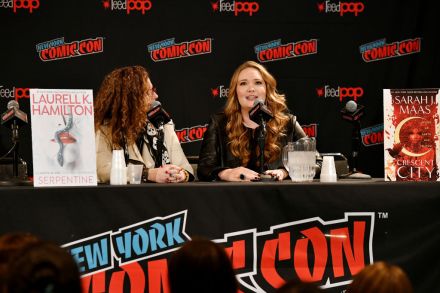
A friend recently found himself trapped on a plane next to a young woman reading a Kindle bedecked with stickers of dragons and pointy-eared, hunky men. The font size was so large it was impossible not to see the sexually explicit text. He observed, “I was reading The Lord of the Rings; her book was more along the lines of I’m the Lord of Your Ring. I’ve never felt so uncomfortable.” Welcome to the cultural phenomenon of romantasy — a newly mainstreamed trend fueled by TikTok, or rather BookTok. It’s a shame there isn’t room in the portmanteau name for “sex,” which is a crucial ingredient in the genre, made clearer in the alternative informal term “fairy porn.

George ‘R&R’ Martin takes it easy

From our US edition

Now that the Stranger Things disappointment has died down – slightly – George R.R. Martin and his merry band of Game of Thrones cohorts have recaptured attention in what we must call the Thrones universe. After the warily positive but underwhelming reception that the major spin-off House of the Dragon received, A Knight of the Seven Kingdoms’s six-episode offering is in a lower key than either of its forbears. No dragons, no enormous battles, no big stars, just a small-scale relationship drama focusing on the hapless “hedge knight” Ser Duncan the Tall, aka “Dunk” and his child squire, Egg, whose origins are rather less lowly.

george r.r. martin knight seven kingdoms

Amid the alien corn: Beautyland, by Marie-Helene Bertino

‘I am an Adina,’ the four-year-old protagonist of Marie-Helene Bertino’s Beautyland writes to her extraterrestrial superiors on Planet Cricket Rice, which is light years away from Earth. ‘Yesterday I saw bunnies on the grass,’ she adds, using the fax machine her mother retrieved from their neighbour’s trash. ‘DESCRIBE BUNNIES,’ they respond, sparking a dialogue that continues well into her adulthood. Adina’s premature birth in September 1977 coincided with the departure of the Voyager 1 probe, which was launched with a phonograph record of sounds intended to explain human life to intelligent extra-terrestrials. The timing is significant because Adina was sent to Earth from Planet Cricket Rice to report on human life.

Who’s the muse? In a Deep Blue Hour, by Peter Stamm, reviewed

The Swiss writer Peter Stamm’s fiction is often enigmatic – unreliable narrators, contradictory behaviour and characters who can’t admit to their emotions. In his latest novel, fortysomething Andrea is in Paris with her cameraman boyfriend Tom, attempting to make a documentary about a celebrated author 20 years older than herself. The subject, Richard Wechsler, appears to like Andrea, but isn’t enthusiastic about the film. His novels generally feature a muse to whom the male character frequently returns, and Andrea becomes obsessed with discovering if this relates to Wechsler’s life. At the same time, she is annoyed if Tom asks Wechsler similar personal questions. (Andrea is easily irritated, ending several relationships when none of them lives up to her exacting standards.

More about my mother: Elaine, by Will Self, reviewed

Inspired by his late mother’s diaries, Will Self’s fictionalised Elaine covers just over a year in the life of its titular character. Elaine Hancock is a trailing wife living in upstate New York, where her husband, John, teaches English at Cornell. It is not for the faint-hearted to write about one’s mother’s sex life. But Will Self is no stranger to outrageousness Zigzagging chronologically, the novel takes place in the mid-1950s – more than a decade before Self lived in Ithaca with his parents, who then separated. He portrays it as a loose time at the faculty: the Hancocks display a ‘masochistic intimacy’ by swapping notes about the people they’ve drunkenly ‘necked’ during evenings out.

Doomed to immortality: The Book of Elsewhere, by Keanu Reeves and China Miéville, reviewed

One of the first things I was taught in literary theory was to look for supposed rhetorical rather than logical opposites and unravel them. It works well with ‘the opposite of cat’. Cartoons show this can be either mouse or dog. The Book of Elsewhere, based on the comic BRZRKR, poses something similar with metaphysics. The protagonist, B., or Unute, has a narrative arc quickly summarised as ‘I kill, I die. I come back’. What is the opposite of B.? He is not alive in a way we understand, but he is not dead, or a zombie; he is not undying, and time alone will tell if he is immortal. He feels pain, suffers, ‘dies’ and respawns like a computer game character, bursting out of an egg-like chrysalis, sometime – hence the title – elsewhere B.

Arresting visual spectacle and superb fight scenes: Netflix’s One Piece reviewed

What would you say is the most successful comic-book series in history? If you’re thinking Tintin you’re not even close. (Curiously enough, even the now largely forgotten Lucky Luke scores higher.) If you’re thinking Peanuts, you’re getting warmer. And if you named Asterix, good try but that’s only number two. No, the hands-down winner, with total sales exceeding 516 million, is a Japanese manga called One Piece. One Piece? Me neither. It’s quite unusual these days to chance upon a massive cultural phenomenon – the series has been going since 1997, with 1,093 chapters so far – of which one has never once even heard. But this, I suspect, will be the experience of most viewers approaching the Netflix adaptation.

The magnetism of His Dark Materials

From our US edition

When I was in middle school back in the 1990s, there were two sets of books every boy seemed to have in his backpack. One was the Redwall series, Brian Jacques’s swashbuckling tales of heroic mice and tyrannical wildcats. The other was the His Dark Materials trilogy by Philip Pullman. It’s no coincidence, I think, that both Jacques and Pullman are British. What made these books intriguing, beyond their carefully wound plots, was that they were marketed to children yet addressed subject matter that was very much adult. In Redwall, it was the brutal violence. His Dark Materials had some of that too (in the first chapter of the first book, we witness an attempted killing; in the first chapter of the second book, we witness an accidental fatality).

his dark materials

The heart of The Rings of Power

From our US edition

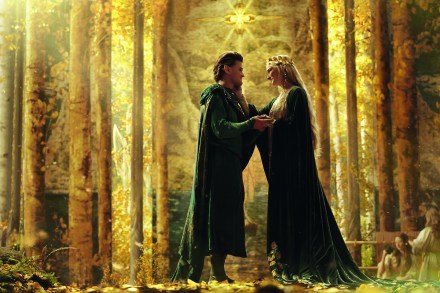
“Ours was no chance meeting. Not fate, nor destiny,” Galadriel says. “Nor any other words Men use to speak of the forces they lack the conviction to name.” The line is a bit pompous, but then so is the hotheaded elven warrior (Morfydd Clark) who speaks it in Amazon’s Lord of the Rings: The Rings of Power. Pomposity aside, Galadriel’s words reveal why the work of J.R.R. Tolkien is unique in a crowd of fantasy competitors. Anyone can give us elves and dragons and wizards. But few can match the anguished, longing note of hidden Providence in Tolkien’s Middle-earth. The Rings of Power has not yet achieved such depths of feeling — perhaps it will not be capable of doing so — but it has shown prudence in its stewardship of the story’s heart, which is encouraging.

lord of the rings of power

A visit to the Renaissance Faire

From our US edition

There exists a magical place where not only are you free to identify as who or whatever you wish, but you’re also encouraged to adopt a persona that defies reality. You aren’t restricted to the narrow LGBQTIA+ choices our unimaginative liberal elites have imposed, either. Nay, in this ultra-diverse, inclusive land, you’re expected to dream beyond this century — this planet even — and transition uninhibited into whatever strikes your fantasy. No, not the “metaverse”; I’m referring to the time-honored American tradition of the Renaissance Faire, where history buffs, fantasy nerds, down-and-out actors, and normal suburban families converge to create a giant freakshow that is innocent fun at its best.

renaissance

Identity politics is in retreat in Hollywood

‘Diversity is woven into the very soul of the story.’ If those words of praise from a rave review in a left-leaning journal sound to you about as inviting as a cup of cold sick, then my advice would be to stay well clear of The Sandman. Neil Gaiman’s epic graphic novel series (launched in 1989), set in the world of dreams, was relentlessly inclusive long before it became the norm. ‘I wanted to change hearts and minds,’ Gaiman has said in an interview. ‘I had trans friends and still do, and it seemed to me that no one was putting trans characters into comics. And I had a comic.’ If this TV version had been made five years ago, it would probably have been considered very cutting edge.

Faeries and queens

From our US edition

Flint and Mirror, John Crowley’s engrossing and elegant latest book, is set in a sixteenth century where angels and demons watch over human quarrels and sometimes even intervene. History and magic entwine, and yet are opposed. There is the ongoing conflict between Catholicism and Protestantism, as the Catholic Spaniards eye up invading England. The novel is also about the beginnings of modernity. As the reign of Queen Elizabeth I of England comes to an end, we progress gradually toward exploration of the globe and the Enlightenment. Farewell rewards and fairies, indeed. Elizabeth, serpentlike, broods in her English fastness, sending spies both physical and metaphysical throughout the land. Her personal magician, Dr.

crowley

Time to slay J.K. Rowling’s ‘Fantastic Beasts’

From our US edition

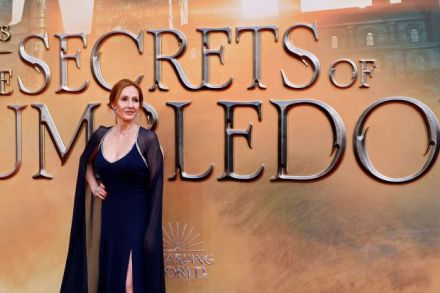
Next week marks the release of the third J.K. Rowling-scripted Fantastic Beasts film, a series that has overstayed its welcome. This latest iteration is subtitled The Secrets of Dumbledore. As if to wrong-foot those who would smirkingly speculate that one of Dumbledore’s secrets is his sexuality, the film opens with the old wizard and his former lover-turned-nemesis Grindelwald (now played by Mads Mikkelsen, replacing a disgraced Johnny Depp) mourning the end of their love affair, which at least makes the homosexual subtext hinted at in previous films explicit. But that, alas, is about it for any kind of coherence, or interest, or originality.

War between Heaven and Hell: The Absolute Book, by Elizabeth Knox, reviewed

Ursula Le Guin once described speculative fiction as ‘a great heavy sack of stuff, a carrier bag full of wimps and klutzes’. By this definition, Elizabeth Knox’s genre-hopping fantasy The Absolute Book must count as oversized baggage; but it trundles along winningly, even if it’s a trifle stout at 640 pages. Taryn Cornick is our girl. She is a scholar whose debut book, a study of libraries, is the toast of the literary circuit. But she is also the recipient of an unlucky inheritance: an elusive manuscript, nicknamed the Firestarter, last spotted in the library of her grandfather’s ancestral pile. From these Borgesian beginnings, the story orbits into wider and wilder expanses.

Dungeons and Dragons goes woke

From our US edition

East Lansing, Michigan, August 15, 1979 — James Dallas Egbert III, 16, disappears. The child prodigy went missing at Michigan State University, where he studied computer science and played the fantasy roleplay game Dungeons & Dragons. Egbert was shy and especially small for his age. The young boy faced intense academic pressure, battled drug addiction and was a latent homosexual. He entered the steam tunnels underneath his college, intending to commit suicide by consuming methaqualone but failed. Egbert woke up the next day and fled. His parents hired private investigator William Dear to track him down. Dear discovered Egbert’s fascination with D&D after scoping through his dormitory, where he found evidence suggesting Egbert hosted games in the tunnels with other students.

dungeons and dragons

A dazzling fable about loneliness: Piranesi, by Susanna Clarke, reviewed

Susanna Clarke is a member of the elite group of authors who don’t write enough. In 2004, the bestselling debut from a cookery book editor seemed to promise an unfailing fountain of the creative imagination: Jonathan Strange and Mr Norrell, a three-volume reworking of Britain’s military tussle with Napoleon, but with added fairies, felt like Jane Austen brewed up with spells and a dash of the Brontës’ Angria sagas. A short story collection, The Ladies of Grace Adieu, set in the same eerie territory, followed, and since then — silence. Piranesi is a publishing event, therefore. Austere and classical, it has no fairies but plenty of magic. The title character lives secluded in a mansion of dizzying perspectival queasiness.

A time for Ice and Fire

From our US edition

No one likes to watch television with me, because I am that sick pedant who delights in pointing out anomalies and plot-line errors, never more so than when the show in question is connected in some way to a cherished book. That’s when my pedantry enters an almost superhuman phase, as I educate the room about literally every single deviation from the original literary source. HBO’s Game of Thrones series was an absolute gold mine in this respect, because it came out just after I’d finished devouring the books in George R.R. Martin’s epic series. If you haven’t read those books, you should do so now — as you may never again have this much spare time on your hands.

a song of ice and fire