Fame

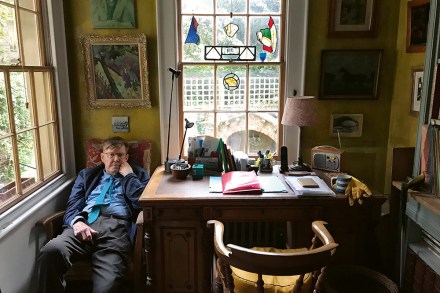
A revival of Alan Bennett’s early work is long overdue

It is a curious literary form, the published diary. A surprising number of the classic diarists did write for eventual, usually posthumous, publication – Chips Channon under a 60-year embargo, A.C. Benson, Samuel Butler, in his wonderful notebooks, and surely the possibility was in the minds of Samuel Pepys and the Duc de Saint-Simon. More recently, great diaries have been published within the author’s lifetime. James Lees-Milne’s first instalment came out 30 years after the period it described. Alan Clark’s initial offering, covering 1983-92, appeared in 1993. Tony Benn’s hilariously tedious volumes emerged on a rolling programme which slowly caught up with the events they described.

Things still seem oddly disorientating without Seamus Heaney

Whether you went with the two big rugby goalposts, those opposing H’s of Heaney and Hughes, or with Blake Morrison’s quondam super league of world English (or sometimes airport) poets, Brodsky, Walcott, Murray and Heaney, Heaney loomed amiably in the poetry landscape of the late 20th century. I knew him a little and liked him a lot. Enough now to appreciate that there was something endlessly consoling about being alive at the same time as an incontestably – or only rarely, foolishly contested – great, canonical poet, someone you might occasionally meet or, more regularly, see new poems or new books by; and something correspondingly harrowing and disorientating about this same poet no longer being alive. A geographical feature has been taken away, a hill, a forest, a river.

My obsession with ageing rock stars – by Kate Mossman

‘The older male rock star isn’t just my specialist subject, it’s my obsession,’ admits Kate Mossman in the opening pages of Men of a Certain Age. Over the 15 years she’s spent interviewing ageing rockers such as Sting, Tom Jones, Ray Davies, Glen Campbell and Nick Cave for the Word and the New Statesman, she describes feeling ‘something inside of me ignite... so excited, yet so at ease’. ‘How is it,’ she asks, ‘that in the presence of a wrinkly rock star twice my age, I sometimes feel like I’m meeting... me?’ Having encountered my share of these guys myself, I know precisely what she means. Rock journalism is a field in which all the writers are fans, but, as Mossman notes, ‘part of the art is pretending not to be’.

The thrill of being recognized

From our US edition

I had just left Tate Britain and was heading toward the Pimlico underground station when I noticed an attractive woman coming toward me. I smiled at her and she smiled at me. And then she stopped and said, “Are you Cosmo Landesman?” There are writers and journalists who get public recognition like this all the time. Alas, I’m not one. But I was married to one of them, and it’s a real drag having a famous partner. You have to stand there at the supermarket checkout line with a big fake smile on your face as your loved one laps up all the love from some adoring fan. Imagine how poor John Gregory Dunne must have felt being married to the very recognizable Joan Didion. Having a famous writer friend is also a bummer. Socially, you will always be in their shadow.

writers

Portrait of an artistic provocateur: Blue Ruin, by Hari Kunzru, reviewed

Whatever happened to the likely lads and lasses of the East London art scene at the high noon of Cool Britannia? Hari Kunzru’s seventh novel, Blue Ruin, loads much else on to its ideas-rich plate – not least a pandemic yarn set in the panic-stricken spring of 2020. At its core, however, his plot traces contrasting afterlives from the Sensation generation. It reconnects three survivors – two male artists and the woman both loved – from a time when making conceptual art could feel like ‘a kind of social repair’, even a ‘utopian laboratory’. In his earlier career, Kunzru himself seemed to belong in a gilded group of younger British authors.

The great deception: The Book of Goose, by Yiyun Li, reviewed

As introductions go, ‘My name is Agnès, but that is not important’ does not have quite the same confidence as ‘Call me Ishmael’. But there’s a reason for this. Agnès Moreau, the narrator of Yiyun Li’s disconcerting, mesmerising fifth novel The Book of Goose, only became a storyteller by accident. Writing from Pennsylvania, where the ‘French bride’ Agnès raises geese, she remembers post-war rural France and her childhood in Saint Rémy. She and her friend Fabienne, avoiding other girls their age, spent their days lying among gravestones and minding cows – until Fabienne decides that they should write a book together.

Getting in touch with my inner groupie

From our US edition

I like to think that I’m too intelligent, too sophisticated and too cultured to get excited by the presence of a famous person. Let the manipulated masses enjoy the bread and circus of celebrity; we enlightened members of the metropolitan elite are far above that sort of thing! Or so we like to think. Whenever I encounter the famous, something very strange happens to me: I go all groupie. I get excited. I giggle. I inwardly drool. I long to please. I want to be their new best friend. I want to tell all my friends about meeting my famous new friend — who isn’t actually my friend, but never mind. I was reminded of my groupie tendencies the other day when I went to the Idler Festival, Britain’s best arts and literary festival. I usually hate those sorts of events.

famous

Solving the mystery of mass almost ruined Peter Higgs’s life

In 1993 William Waldegrave, the science minister, was looking into a project being planned on the continent. Cern, the European research body, was upgrading its particle collider to create what it called the Large Hadron Collider. This underground apparatus ran beneath the French-Swiss border and it was so vast that its diameter equalled that of the Circle Line. Two beams of subatomic particles called protons would be fired around this subterranean loop in opposing directions and smashed together at 99.99 per cent of the speed of light. The scientists’ aim was to prove the existence of a fundamental particle called the Higgs Boson, which they hoped would appear momentarily from the sub-atomic luminescence. Waldegrave grasped the significance of the project.

American celebrity culture has become exhausting

From our US edition

How was your Super Bowl party? I spent mine investing all my money in crypto and then blowing it on Peacock subscriptions. For once it was the commercials that were the most memorable part of the game — not Matthew Stafford's lightning arm, not even 50 Cent entering the halftime show upside-down like a bat. And that was because every ad was a broadside of celebrities. Not a fan of Bud Light Seltzer? Wait until it's pitched to you by Guy Fieri and a race of Eloi-like doppelgangers (spoiler: you still won't be a fan of Bud Light Seltzer). And how can I not order Uber Eats after watching Gwyneth Paltrow smell her own vagina candle while Trevor Noah eats deodorant? I'm old enough to remember when movie stars starred in movies; now they're hawking Doritos and cheap flights to Istanbul.

celebrity

Introducing Wokeyleaks

From our US edition

A regular column by an anonymous whistleblower operating deep within heart of the Social Justice Movement that is the entertainment industry. To protect their identity, they will go under the code-name ‘They/Them’. Wokeyleaks will also function as a confidential news leak organization for any other sources who wish to divulge classified information (and hilarious anecdotes) about woke culture without fear of getting canceled. My disillusionment with the Social Justice ‘left’ was less a road to Damascus moment and more death by a thousand cucks. It was when a friend told me that ‘people are concerned about your use of POC hand emojis on Instagram’. Apparently, it’s ‘the equivalent of blackface’ (it’s really not).

wokeyleaks