Fake news

The power of disinformation is that it’s so readily believed

On 27 November 1960 African and Indian diplomats visiting the UN in New York opened their mail to find a leaflet from the Ku Klux Clan: A foul stench spreads out from the East River and hangs over New York like a pall — the greasy sweat of the Black Races and the Yellow Races of Asia which have invaded the United Nations. It is enough to make every White Protestant American vomit. It ended with a threat: the delegates better stay close to the UN buildings and the ‘brothels of Harlem, and not defile the hotels and restaurants of the White City’. FBI officers investigating the correspondence noted a couple of oddities. First, some of the language was off: it called for delegates to be ‘tanned and feathered’ rather than ‘tarred and feathered’.


The war for your mind

From our US edition

The romantic plans of a Kazakh bodybuilder named Yuri Tolochko have become one more casualty of the coronavirus pandemic. He was going to marry his ‘fiancée’, Margo, a silicone sex doll, in March, but they both agreed on the need to delay. ‘My baby supported me on this. We are determined and our mood is good.’ His Instagram feed depicts their domestic idyll: a bald, muscle-bound man gazes adoringly at a pneumatic blonde who, it must be said, stares back somewhat blankly. You might already know this if you get your news from Russian outlets like RT — Russia Today — or Sputnik. Their websites have an unerring eye for the human-interest stories that make for irresistible clickbait.

russians

The allure of child trafficking conspiracy theories

From our US edition

It was a frustrating weekend for the workers at the National Human Trafficking Hotline. For days, they ‘received hundreds of reports’ referring to’ a series of viral posts’, though ‘none’ were made by someone who had ‘a specific connection to any alleged missing children’. This made it ‘more difficult’ for them to ‘provide support and attention to others who are in need of help’. The subject of those reports? Wayfair.According to the Wayfair child trafficking theory, which has stewed on Reddit, Instagram and elsewhere, children are being sold across the internet through the e-commerce website Wayfair.

child trafficking conspiracy theories

If a video is viral, who cares if it’s fake?

From our US edition

After two months, the 'mostly peaceful' label for the riots gripping American cities is wearing a touch thin. That’s not just because it fails to satisfy conservatives and moderates, who puzzle over how 'mostly peaceful' demonstrations leave so many downtowns torched. It also fails to satisfy the actual rioters. They insist their demonstrations are very violent, courtesy of brutal tactics from the police officers they want abolished.'Proof' of such violence went viral on Wednesday. The video was first shared by Twitter user @Andy_Resist, but was swiftly magnified by a different Andy. This one bore Twitter’s hallowed blue checkmark and enough followers to populate a small city, or a few dozen 'mostly peaceful' protests. https://twitter.

fake news

Fact-checking the New Yorker fact-checkers

From our US edition

The most recent issue of the New Yorker includes a 5,000-word feature on the police (summary: they are racist). In it, staff writer Jill Lepore drops this frightful fact to illustrate the barbarism of America’s uniformed enforcers:'One study suggests that two-thirds of Americans between the ages of 15 and 34 who were treated in emergency rooms suffered from injuries inflicted by police and security guards, about as many people as the number of pedestrians injured by motor vehicles.'Cockburn started writing precisely to avoid ever doing math again, but even to him, this claim sounded like a howler. Two-thirds of all emergency room visits by American young adults were for police injuries?

new yorker

Yes, it’s time to defund NPR

From our US edition

When the Public Broadcasting Act was signed into law in 1967, the stated goal was to provide public financial assistance to producers and broadcasters of educational programming. And so PBS and NPR came into existence. They enjoy public funding from taxpayers today. But should taxpayers continue to fund these enterprises, when they clearly focus less on educating the public, and more on pushing commentary and opinion, and now, even libel?Public media has long been defended. Frequently it’s pointed out that public funding for NPR is only about two percent of their federal operating budget, the same excuse we hear when Planned Parenthood pushes back against calls to defund it. Just as frequently, right-leaning outlets seek to point out a clear bias in publicly-funded coverage.

npr

Five more conspiracy theories Trump can use to distract the media

From our US edition

Donald Trump’s go-to tactic for hijacking the news cycle is simple: bash enemies, mercilessly, and insinuate that they are part of a terrible conspiracy.The President has spent the last few days again tweeting conspiracy theories about the mysterious 2001 death of an aide to then-Rep. Joe Scarborough, who now hosts Morning Joe on MSNBC. Cue outrage and the news cycle shifts in the President’s direction. He does it every time. https://twitter.com/realDonaldTrump/status/1265624335898869760 But Cockburn has noticed that the President is straining for something shocking or strange enough to flip the world’s attention. As November approaches, he will become ever more desperate for electoral outrage-fodder.

conspiray theories

How can Twitter decide whether COVID news is ‘untrue’?

From our US edition

Do masks help contain COVID-19? Right now the answer is yes, definitely yes. Sort of. Maybe. The Centers for Disease Control and Prevention are sure masks help. Now.But in January, Dr Nancy Messonnier, director of the National Center for Immunization and Respiratory Diseases at the CDC, said during a briefing, ‘the virus is not spreading in the general community. We don’t routinely recommend the use of face masks by the public to prevent respiratory illness. And we certainly are not recommending that at this time for this new virus.’And on March 1, 2020, the Surgeon General repeated that masks are ‘not effective’ and warned people to stop buying them lest they be in short supply for medical staff.

fatwa twitter

NABJ cancels Huawei-sponsored misinformation panel

From our US edition

The National Association of Black Journalists (NABJ) was planning to run a panel tomorrow called ‘The Rise of Misinformation’ sponsored by Huawei — a Chinese consumer electronics firm with suspiciously close ties to the Chinese Communist party. Sadly, just over 24 hours before the start time, the NABJ suddenly canceled the event. What happened?A statement released by the NABJ said that the panel had ‘become a distraction from other priorities’, as it ‘had come under attack because controversial technology giant Huawei was planning to sponsor the webinar though it had no editorial control’.

van jones nabj huawei

Richard Jewell was a victim of ‘fake news’

From our US edition

Few things enrage journalists more than when President Trump accuses the media of creating ‘fake news’ or calls them the ‘enemy of the people’.Reporters and pundits understandably take it as a threat — not only to themselves but also to the First Amendment and the bedrock notion that a free press is necessary for a free society. Some have interpreted Trump’s remarks as emerging fascism or even wondered if they could end up in jail for criticizing this administration (though the media curiously didn’t make as much of a stink when President Obama was trampling reporters’ constitutional rights).Yet to date, no journalists have been locked up. No fascist measures have been taken against the press.

richard jewell

Tacitus knew how to handle stories from ‘insiders’ and ‘sources’

We read much about ‘fake news’ these days and of efforts to rid the internet of it. But what of media that report dodgy stories derived from ‘insiders’ and ‘government sources’ and ‘contacts’? The great Roman historian Tacitus knew what to make of such sources. The first Roman emperor Augustus died in ad 14. It was a critical moment: who would succeed — Augustus’s grandson Postumus Agrippa, banished (by his wife Livia) or Tiberius, Livia’s son by her first marriage? Tacitus reported that Augustus and a companion, Fabius, arranged a reconciliation with Agrippa; that Fabius leaked and paid the price; and Livia at once recalled Tiberius from abroad, and then ‘saw to’ Augustus.

Why 80 per cent of young people in this Macedonian town have turned to posting ‘fake news’

It’s such a relief to turn on the radio and hear the voice of Neil MacGregor. That reasoned authority, his deep knowledge of history and how things have come to be as they are, his measured common sense and ability to see round an argument or story. He’s like the voice of how things used to be, when the world was not so topsy-turvy and the news reports made sense. His series, As Others See Us, returns to Radio 4 this week (produced by Tom Alban), taking him this time to Singapore, the USA, Australia, Poland and Spain to talk to people there about Britain’s past connections, present woes and future prospects. It’s fascinating, salutary, and more than a little disturbing. Take Singapore, for instance.

Deepfakes could be good news

From our US edition

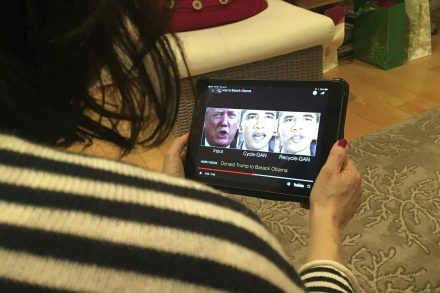
Are you scared of deepfakes? Perhaps you should be. A few years old and continually growing more sophisticated, deepfakes are digital simulacra generated through machine learning that are barely distinguishable from the real thing. They’ve been used to fake celebrity porn videos, make Barack Obama seem to call Donald Trump a ‘dipshit,’ and most recently, superimpose Steve Buscemi’s face on to Jennifer Lawrence’s body in a video that was at once mesmerizing and scary (Buscemi/Lawrence bore a strange resemblance to Tilda Swinton).

deepfakes jennifer buscemi

BuzzFeed, ‘BOOM!’ and the Russiagate bombshell

From our US edition

Robert Mueller’s office possesses evidence showing that Donald Trump instructed Michael Cohen to lie to Congress! My goodness, what a bombshell. When the BuzzFeed story alleging this was first published Thursday night, the reaction was as painful as it was predictable. Journalists and fellow-traveler Twitter personalities lit up social media with grand, gleeful pronunciations about the imminent downfall of the Trump presidency. You could almost hear the champagne corks being popped. Within what seemed like mere seconds, the report was blared across all the major TV networks, and the reporters who broke the news were touted as once-in-a-generation heroes. Plaques and monuments in their honor entered the early stages of construction.

buzzfeed news ben smith

The Der Spiegel journalist who messed with the wrong small town

From our US edition

This week, the star reporter of the German magazine Der Spiegel was fired after it was revealed that he had been fabricating stories for several years. Here, Michele Anderson and Jake Krohn expose the many inaccuracies in his article about their town, Fergus Falls, Minn. In February 2017, my husband and I attended a concert at our local theater, and were sipping some wine in the lobby before the show started. Several people came up to us at separate times excitedly, and asked, ‘did you meet the German guy yet?!’ I hadn’t, but my spider senses perked up when I heard that he worked for Der Spiegel, a magazine based in Hamburg, and that he was writing about the state of rural America in the wake of Trump’s presidency.

der spiegel

Trump may have a point about fake news

In recent years, much scrutiny has been paid to the workings of social media algorithms. Driven by escalating competition for human attention, social media sites became filled with negative or controversial posts, because these attract more protracted engagement than anything else. Since reader attention attracts revenues, any profit-seeking algorithm will learn to highlight divisive content at the expense of more important topics. So a story about Hawaiian pizza might be more lucrative than one about human trafficking, since the idea of pineapple on pizzas polarises opinion more than a story about something universally agreed to be bad. But this problem is not confined to digital media.

Words of the year

In Amsterdam the courts have given leave to ban the bierfiets. Fiets is the Dutch for ‘bike’. (The plural is fietsen.) A bierfiets is a float on which a dozen people sit on high seats facing each other across a narrow bar running fore and aft, enjoying their beer and pedalling away to power the vehicle. Someone sits at the front to steer and brake. Some suggest that bierfiets has entered the English language as the name of this newish thing. I’m not sure it really has, any more than many another name in a foreign language for foreign things (churros or currywürste). If the bierfiets itself survives it is as likey to be called a beer-bike in English.

Moment of truth | 18 May 2017

Two extremes of the listening experience were available on Monday on Radio 4. The day began conventionally enough with Start the Week, chaired by the deceptively genial Amol Rajan (now in charge of The Media Show), whose warm, inviting voice fronts a keen, intense intelligence. He guided his guests through a conversation about our post-truth world which, apart from the subject-matter, could have graced the airwaves in the 1950s. This was a masterclass in elevated discussion, so graceful were the exchanges, so theoretical the ideas, yet so clear the meaning.

High life | 23 March 2017

A cloudless sky, crunchy spring snow, longer, warmer days. I’ve finally got in some good skiing, twisting around moguls like an arthritic champ. It’s all in the mind, as my old wrestling coach used to tell me. If you think the other guy’s better, you’re bound to lose to him. The same goes for the slope. If it scares you, stay in the club and have another drink. Otherwise, attack it with gusto and feel like a champ again. The same applies to the fairer sex. If you’re too nervous to speak to her, keep moving. We have four of the prettiest young women at The Spectator, all taken alas, and I’ve managed not to make a fool of myself with any of them (well, a tiny bit with one of them, but what the hell, no one’s perfect).

High life | 9 February 2017

When I was young my recurring nightmare was that I would die and be reincarnated as a polo pony. I squeezed in lots of polo during the years I played, at least three matches per week, mostly in Paris, and I felt that polo ponies had the kind of deal the mass media are now handing Trump. I wasn’t mad about the people I played with either. Back then, in the Sixties and Seventies, fat businessmen who cantered hired good Argentines to carry the can, but picked up the cup after strolling around the field and yelling quite a lot. Well, now I’m over it, but have an even worse nightmare: that I might return as Trump’s White House press secretary, Sean Spicer, and have to face the outraged and hysterical so-called press corps every day.