Evelyn waugh

Polymath or psychopath?

From our UK edition

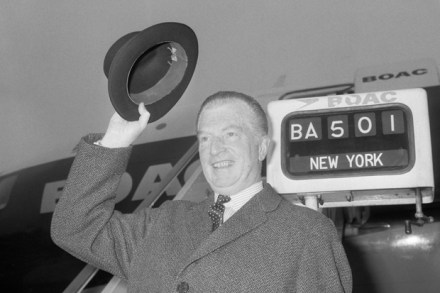
They don’t make Englishmen like the aptly named John Freeman any more. When he died last Christmas just shy of his centenary, the obituaries — once they had expressed astonishment that this titan from the age of Attlee and empire had still been around —paid tribute to a polymath whose achievements could fill nine more ordinary lives. Freeman was a pioneer of television, virtually inventing the TV celebrity interview. He was a leading politician — the last surviving member of the 1945 Labour government; a diplomat — at one time our man in Washington and High Commissioner in India; a much decorated war hero; and — not least — a renowned swordsman between the sheets, boasting four wives and innumerable girlfriends.

A noble undertaking

From our UK edition

I adore undertakers. Unlike dentists or buses or boyfriends, they’re always there when you need them: even if you call in the middle of the night you will be answered by a human, not an answer-phone message. Funeral directors (as they prefer to be called) are surely the only businesses in Britain never to greet a customer with the words: ‘Sorry love, we’re just closing.’ They are unfailingly courteous and full of good sense. They listen reverently while you recite your woes; like a therapist, but without the side effect of making you hate your family. In an age when even consultant surgeons dress in trainers, there is a pleasing dignity in the formality of their dress.

Low life | 4 June 2015

From our UK edition

The entries are crawling in on their hands and knees for the ‘drunkest I’ve ever been’ competition to win a place at the launch party for the Low life column collection. Gawd. Reading your accounts makes me feel as sober and upright by comparison as a sidesman in the Dutch Reformed Church, and that I have the Low life position on this magazine under false pretences. What we do have in common however, I think, is that we are terrible lightweights who can’t take drink like others can. For me, a single pint of strongish lager is a shape changer. Pass me a second and I couldn’t give two figs about the future. Three and I’m Gussie Fink-Nottle giving out the prizes or Augustus Carp after several glasses of Portugalade.

Hope against hope

From our UK edition

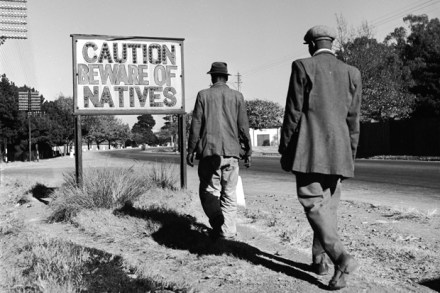
At the eye of apartheid South Africa’s storm of insanities was a mania for categorisation. Everything belonged in its place, among its own kind, as if compartments for scientific specimens had been laid out across the land. Or, as Christopher Hope puts it in his caustic new satire, people were ‘corralled in separate ethnic enclosures, colour-coded for ease of identification’. Reminding us that ‘Jim Fish’ was a derogatory term for a black man in South Africa, Hope thrusts his eponymous hero, who fits no racial category, into this mad system of classification. To some, Jimfish appears ‘as white as newly bleached canvas’, to others ‘faintly pink or tan or honey-coloured’. Nonetheless, racist whites treat him as ‘not the right sort of white’.

Max Hastings’s diary: The joys of middle age, and Prince Charles’s strange letters

From our UK edition

I am living in rustic seclusion while writing a book. Our only cultural outing of the week was to Newbury cinema to see, transmitted from the National Theatre, Arthur Miller’s A View From the Bridge, object of rave reviews. We respected the piece but did not enjoy it. Granted, appreciation of all major works of art requires an effort by the viewer, listener, reader. But a pleasure of getting older is to be unafraid of waving the white flag. We resist modern-dress Shakespeare or worse, opera. We will cross continents to avoid the music of Harrison Birtwistle or the art of Damien Hirst. We are ardent Trollopeians, incorrigibly middlebrow.

You realise how little you know of anybody when they die

From our UK edition

Whether or not you believe in the afterlife, death remains an impenetrable mystery. One moment a person is making jokes and comments and observations about life; the next he is gone. What has happened to that store of wit and wisdom acquired over a lifetime, to that particular way of understanding and looking at things, to that unique muddle of thoughts and feelings that every individual has? Even if someone has gone to heaven, it is difficult to imagine that he has taken these things with him. If he did, they would hardly be compatible with eternal rest.

Bidding a fond, and drunken, farewell to the awe-inspiring Mark Amory

From our UK edition

Rubbing shoulders with political suits on the pavement outside the Westminster Arms, I drank two pints of Spitfire. Pump primed, I strolled the 50 quaint yards along Old Queen Street and entered the Spectator offices through the open door of number 22.  An elderly chap on his way out said, ‘You’ve missed the speeches.’ I said, ‘Is all of literary London in there?’ ‘I wouldn’t know about that,’ he said huffily. I went downstairs to the party and grabbed a ready-poured gin and tonic from the drinks table of one’s dreams.

Deborah Devonshire: JFK’s friend, Hitler’s antagonist, The Spectator’s columnist

From our UK edition

The lives of the Mitford Sisters have riveted, and repelled, anglophiles since the thirties. Diana Mitford once wrote, 'I must admit "the Mitfords" would madden ME if I didn’t chance to be one'. Their hold on the public imagination can be attributed to a mixture of aristocratic eccentricity, romance, rebellion, devotion, betrayal, estrangement, tragedy, and loss; and through it all, a uniquely irrepressible wit. And although much of it will survive in the memoirs, biographies, novels, and collected letters they and others have written, the last living link has been lost with the death of Deborah, the youngest of that astonishing sextet.

Why it’s time for a Cad of the Year Award

From our UK edition

[audioplayer src="http://traffic.libsyn.com/spectator/TheViewFrom22_22_May_2014_v4.mp3" title="Harry Cole and Camilla Swift debate the return of the cad" startat=1527] Listen [/audioplayer]Plans are afoot to introduce the Flashman novels, those politically incorrect celebrations of cowardice, bad form and caddish behaviour, to a new generation of readers. But according to Sarah Montague on the Today programme, ‘Flashman is not typical of our times.’ Is she correct? I can think of quite a few latterday Flashmans off the top of my head, such as Fred ‘The Shred’ Goodwin, whose knighthood had to be prised from his cold Scottish fingers. Not only did Fred keep his pension millions when all about him were losing theirs, he also had an extramarital affair.

Our own folly may yet lead us to a second dishonourable Yalta

From our UK edition

'He was back after less than two years’ pilgrimage in a Holy Land of illusion in the old ambiguous world, where priests were spies and gallant friends proved traitors and his country was led blundering into dishonour.' Those words are taken from Officers and Gentlemen, the second volume in Evelyn Waugh’s Sword of Honour, his trilogy about the second world war. The words describe the disillusion of the protagonist, Guy Crouchback, as Britain sides with Soviet Russia to defeat Hitler: an alliance with an atheist tyranny to defeat an atheist tyranny, an alliance that led to the betrayal – perhaps necessary – of Eastern Europe at Yalta.

Spectator letters: On the Pope, Jesus and Mandy Rice-Davies

From our UK edition

Papal blessing Sir: In his excellent article on Pope Francis (‘Pope idol’, 11 January), Luke Coppen mentions the satirical rumour that the new pontiff had abolished sin. It could never be said, however, even in a spoof, that he has abolished the Devil, whom he has named and shamed on a number of occasions. What Coppen calls ‘the cockeyed lionisation of Francis’ is surely itself a trick of the Devil: so too the ‘older son problem’ — the disgruntlement of obedient Catholics at Francis’s embrace of sinful prodigal sons and daughters. Virtue is surely its own reward, and no one who has experienced grace hankers after the fleshpots of Egypt.

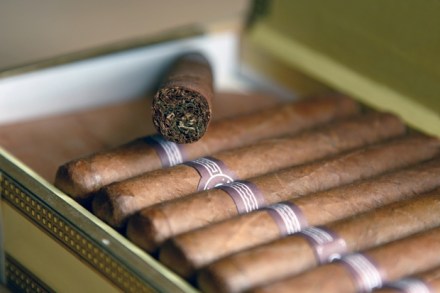
Alexander Chancellor: The Chinese must save the cigar from extinction

From our UK edition

In Dorchester during the Christmas holiday I bought a two-slice electric toaster at Currys. It was a nice little toaster that worked very well when I got it home. And it cost only £4.50, which turned out to be little more than half the price of a packet of Marlboro cigarettes. It’s some years since I gave up smoking; but at my peak I smoked three packets of Marlboros a day, which now would cost the same as more than five two-slice electric toasters. Or, put another way, with the money I have saved from giving up smoking I could buy nearly 2,000 electric toasters a year. I could by now be running a successful electric toaster shop.

Tom Sharpe nearly killed me

From our UK edition

I was on a train when it happened. I was bent double with my head between my knees, gasping for air and unable to speak. The Surrey matriarch sitting opposite leant forward to ask me if she could help. I imagine she thought that I was choking, or perhaps suffering cardiac arrest. In fact, I was laughing. Laughing so hard I couldn’t stop. And the more I wanted to stop, the worse it got. It was painful. My lungs rasped and the muscles in my sides contracted of their own free will. I was no longer master of myself, so you might say that I was in ecstasy. It was certainly exhilarating. I regained composure and explained myself to this kind woman. She looked stern; her immaculate curls bristling slightly at my wildness.

‘Turboparalysis’ Revisited

From our UK edition

The word ‘turboparalysis’, coined by Michael Lind (who has a brilliant piece on the subject in the Spectator Christmas double issue), is paradoxical, even illogical. And yet it is clear, perfect for our times. Lind defines his term as: ‘a prolonged condition of furious motion without movement in any particular direction, a situation in which the engine roars and the wheels spin but the vehicle refuses to move.’ Turboparalysis is a new word; but its sense is familiar. We are often warned that we ‘risk repeating the mistakes of the 1930s’. Comparison between eras is always awkward.

When the going got tough

From our UK edition

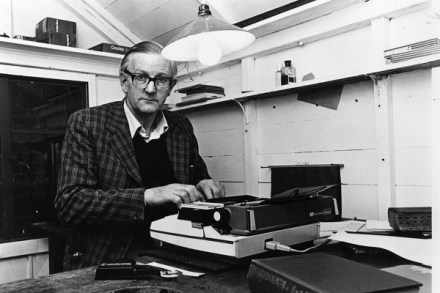
The acute emotional pain caused by his first wife’s infidelity was of priceless service to Evelyn Waugh as a novelist, says Paul Johnson Evelyn Waugh died, aged 62, in 1966, and his reputation has risen steadily ever since. His status as the finest English prose-writer of the 20th century is now being marked by an annotated complete edition of his works, sumptuously published by the Oxford University Press. As a prolegomenon, Penguin is issuing another complete edition in hardback, the first eight volumes of which are now available, priced £20 each. They include his life of Rossetti, three travel books, Labels, Remote People and Ninety-two Days, and his first four novels, Decline and Fall, Vile Bodies, Black Mischief and A Handful of Dust.

Let me not be Mad

From our UK edition

I am not I: thou art not he or she: they are not they.’ Few epigraphs to fiction have been so widely disregarded as the disclaimer with which Evelyn Waugh presaged Brideshead Revisited. Immediately it was published, as Waugh’s great friend Nancy Mitford wrote to him, the general view was simply: ‘It is the Lygon family. Too much Catholic stuff.’ And it is easy to see why people were tempted to see Madresfield Court, seat of the Earl of Beauchamp, as the original of Brideshead. Just as in Brideshead, here is a stiff older son and a younger son losing the golden beauty of his youth to alcoholism. Here were clever sisters, a starchy and religious materfamilias, and a father in exile following a scandal.