Eu

Why condemn the US diplomat caught on tape denouncing the EU? She has a point

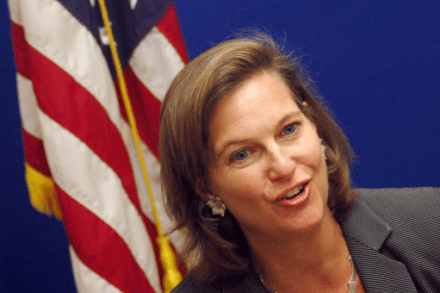
I have my criticisms of the Obama administration, but it does seem to have the right idea about the European Union’s diplomatic efficacy. His top diplomat for European and Eurasian affairs, Victoria Nuland, has been taking a lot of stick after she was caught on tape (or hacked, as we Brits would call it)  discussing the Ukraine problem with the US ambassador in Kiev, Geoffrey Pyatt. She was rude about the EU, but the condemnation of her language seems to have overlooked her central point. The EU has been trying to muscle in on talks about Ukraine’s pro-democracy moves. It could have helped by offering membership to Ukraine, but it prevaricated

What the US really thinks about Europe (and why it might help push reform)

Whether it wants to or not, Washington has a role to play in the UK’s EU debate. Eurosceptics and Europhiles constantly wrangle over what the US position is on Brexit, splitting hairs interpreting State Department officials’ carefully worded remarks in order to claim victory for their side. The latest episode in this running saga sees the sceptics feeling vindicated by Washington’s exasperation with the EU. Assistant Secretary of State (for European Affairs no less) Victoria Nuland appears to have landed herself in some rather hot water – both diplomatic and political. In a reportedly leaked phone call to the US ambassador to Ukraine, Nuland is heard unceremoniously blasting the EU

How the first world war inspired the EU

Among the millions of words which will be expended over the next four years on the first world war, very few will be devoted to explaining one of its greatest legacies of all, the effects of which continue to dominate our politics to this day. One of the best-kept secrets of the European Union is that the core idea which gave rise to it owed its genesis not to the second world war, as is generally supposed, but to the Great War a quarter of a century earlier. It was around that time that the man who can be described as ‘the Father of Europe’ was first inspired to the

Spectator letters: Bernard Jenkin and the cabbies fight back, rising school fees, Nigel Lawson on aid

Private pain Sir: A line in Alec Marsh’s article (‘Britain’s one-child policy’, 1 February) caught my eye; that school fees have ‘almost doubled in the past decade’. I recently found an 1823 bill for an ancestor’s attendance at dame school (broadly equivalent to a prep school) that was approximately £3 a term for full boarding. In the 1970s, seven generations later, my own prep school fees were just over £300 a term. Whilst this represents, in nominal terms, a little more than a doubling every generation; in real terms the growth in school fees over the 150 years averages less than 10 per cent a generation. However, one generation on

Any other business: The £1 bet that built a 1,000-strong company

At a charity lunch in Manchester, I meet a cheerful ‘engagement manager’ from AO.com, formerly Appliances Online, a fast-growing internet seller of fridges and washing machines headquartered at Horwich near Bolton. The job title is new to me: it turns out to mean engaging the company’s workforce in ways that help them enjoy their jobs and feel valued. Their employment package features a £4-a-month ‘healthcare cash plan’ including dentistry, days off for charity work, gym memberships and a 50 per cent subsidy for ‘any social activity our staff fancy, so long as it develops their skills and is done by more than four people’. The emphasis on well-being and fun

The media’s not giving us the full picture of Ukraine

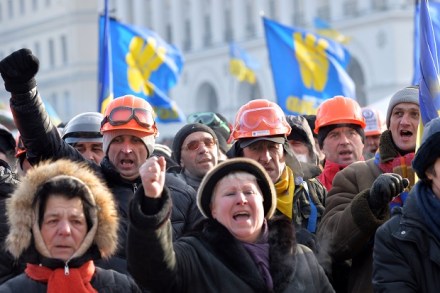
Much as was the case with Syria, and to a lesser degree Egypt, I wonder if we are getting a true picture of the mood within Ukraine on our excitable daily news programmes. Reporters speak of a ‘revolution’, and certainly there is fury in the capital, Kiev and some other cities in the west of the country, such as Lviv. But what’s happening in the east of Ukraine, and the south? The country’s four largest cities, after Kiev, have been very quiet. A handful of protestors – about 50 – in Donetsk, and vague sounding ‘reports of unrest’ and ‘crowds of hundreds’ in Odessa or Dnepropetrovsk. Meanwhile,  one hundred thousand people marched

Goodbye, Claudio Abbado. You helped us glimpse eternity

Fellini’s credo ‘the visionary is the only true realist’ could also be applied to the life of Claudio Abbado, who died earlier this week in Bologna at the age of 80. It would be wrong to think of Abbado as a dreamer, for conducting at the angelic heights to which he ascended is a matter of serious thought, but he had the gift, rarer than is commonly supposed, of liberating musicians. Being liberated, they gave performances of such beauty and emotional power that those who heard them will consider their lives enriched; in many cases transformed. Milan-born, Abbado grew up musically in Vienna, where he studied with Hans Swarowsky, and

What is Europe good for? Rather a lot, actually…

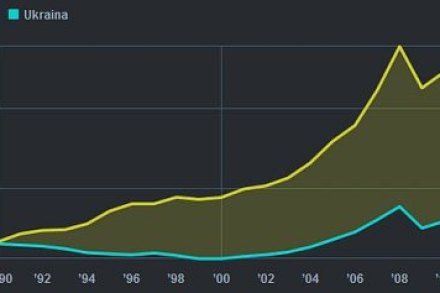
Europe, eh? Good for nothing, innit? That’s the prevailing narrative you hear these days. But, as so often, this is a matter of perspective. The chart above, plundered courtesy of Anne Applebaum’s twitter feed, shows the respective growths of GDP per capita in Poland and the Ukraine since the fall of the Iron Curtain and the disintegration of the Warsaw Pact. One of these countries, as you can see, has done rather better than the other. It’s the country that has made a better fist of democracy. And it’s the country that is a member of the European Union. Which is one reason why Britain should still be in favour

Any other business: Oh dear… perhaps Standard Chartered isn’t as dull as it looks

The cautionary tale of the Co-operative Bank, its black hole and its naughty chairman has recently taught us that if a financial institution has the reputation of being dull, earnest and set in its ways, it probably isn’t. The collapse last year of Switzerland’s oldest private bank, Wegelin & Co — whose boss once claimed that being small and provincial made it ‘easy to avoid the deadly emotions of greed and fear’ — was another example. Attention now turns to Standard Chartered, an overseas commercial bank that has long had the reputation of sticking cautiously to the mode of business in which it has historic roots, notably in Asia, and

George Osborne: Britain is better off in a reformed EU

George Osborne’s speech to the Open Europe conference this morning was billed as the Chancellor taking a tough guy stance with European leaders, demanding that they reform or see their project crumble. It sounded, from the overnight briefings, as though Osborne was trying to cheer up his backbenchers during their current round of banging on about Europe as much as he was trying to make the case for European reform. But when he delivered the full address, it had as much pro-European thinking in it as it did threats. Osborne was focusing on making the case for the whole of Europe to reform, for Europe to create better conditions for

There are no shortcuts to reforming the EU

What does a Tory eurosceptic look like? Loud chalk-stripe, a flash of red braces and the faintest whiff of a lunch-time gander at the Members’ wine list. Right? Wrong. The economic trauma of the crash of 2008 is demanding that just as Conservative modernisation needs to be rebooted to suit the new Age of Austerity – with a focus on bold economic reformism to tackle welfare traps, worklessness and failing schools instead of the cultural gesturism of early modernisation – so too the crisis demands a rebooted euroscepticism.  The Tory Party in Parliament has been transformed by the arrival of the Cameron generation: more entrepreneurial, impatient, ambitious and global in

The EU had 30 years to create a single market, and failed – we need change

It is perhaps the most striking failure of the EU that nearly 30 years since Margaret Thatcher signed the Single European Act with the vision of a single trading market by 1992, that in 2014 we do not yet have a genuine single market in the services sector. This profound failure has cost the EU billions in economic growth and disproportionately affects the UK, which has a huge service industry base. The EU official website, with a delicious piece of understatement, comments: ‘Despite its achievements so far, the single market is not yet complete. Important gaps remain in some areas. Pieces of legislation are missing. And administrative obstacles and lacking

The British option – a business proposal for EU renegotiation

Announcing the Balance of Competences review in July 2012, in which the Government launched a consultation of Britain’s membership of the EU, William Hague told MPs that ‘we must take the opportunities for Britain to shape its relationship with Europe in ways that advance our national interest in free trade, open markets and co-operation…that should involve less cost, less bureaucracy and less meddling in the issues that belong to nation states.’ Today, Business for Britain has published the first of several position papers that we are proposing as a means of re-balancing our relationship with Brussels under the Foreign Secretary’s terms. ‘Setting out the British Option: Liberating 95 per cent

Viviane Reding, secret UKIP supporter?

Viviane Reding’s criticism of David Cameron’s concerns about immigration show how completely out of touch she is with voters. Reding, the Vice-President of the European Commission, is reported to have said ‘free movement and the supposed invasion of people who want to take advantage of social security and of the health system is an invention of politicians who like to have populist movements in order to win elections’. Can it be that Reding is a secret supporter of Nigel Farage? Her comments, hot on the heels of her decision to press ahead with proposals for a European Public Prosecutor’s Office despite the opposition of 14 national parliaments to the scheme,

Why should Nigel Farage have to fight the ghost of Enoch Powell?

One of the genuine seasonal pleasures to be enjoyed as 2013 slipped around the U-bend was Enoch Powell making his familiar comeback as the Evil Ghost of Christmases Past. Enoch was disinterred by the producers of the hitherto un-noticed Murnaghan Show — presumably in order to frighten the viewers and put a spanner in the wheel of the programme’s principal guest interviewee, the Ukip leader Nigel Farage. Dermot Murnaghan tripped up Mr Farage by the devilishly clever tactic of reading him some anodyne quotes from Powell’s exciting and controversial ‘Rivers of Blood’ speech and asking Farage if he agreed with them. But only later did he reveal that they were the

Ed Miliband’s immigration nightmare

[audioplayer src=”http://traffic.libsyn.com/spectator/TheViewFrom22_9_January_2014_v4.mp3″ title=”David Goodhart and Tim Finch on Labour’s immigration woes”] Listen [/audioplayer]Victor Spirescu came to Britain last week looking for work washing cars, but seems to have landed himself with a career in broadcasting. The Romanian, who arrived on the first flight into London after restrictions on workers from Bulgaria and Romania ended on 1 January, has now spent the days since touring studios and newspaper offices, obliging those who wish to talk to him about his new life. Those who bump into him as he weaves his way across television studios have the impression that he wishes he’d caught a slightly later flight. But someone had to meet

Have your say on the EU

The EU commission office in London was kind enough to send me this, a warmup for a ‘town-hall style meeting’ on the part of the Vice-President of the Commission, Viviane Reding, though I’m not entirely sure that the Royal Institution is quite your normal town hall. Anyway, something of the spirit of the open primary has entered the EU so I think Coffee Housers should enthusiastically take up the invitation to get involved in the online discussion. Quite what will happen to the contributions afterwards is anyone’s guess; but let’s not be churlish – it’s the blight of every consultation exercise. Anyway, let us hope that the discussion does actually represent

Stand up for the real meaning of freedom

When pressed for a statement of their beliefs, conservatives give ironical or evasive answers: beliefs are what the others have, the ones who have confounded politics with religion, as socialists and anarchists do. This is unfortunate, because conservatism is a genuine, if unsystematic, philosophy, and it deserves to be stated, especially at a time like the present, when the future of our nation is in doubt. Conservatives believe that our identities and values are formed through our relations with other people, and not through our relation with the state. The state is not an end but a means. Civil society is the end, and the state is the means to

The great recycling myth

My frail elderly mother has recently moved in with us in Epsom and in so doing has joined the 15 million people worldwide who spend their days sorting through rubbish. Mum, however, does not get paid $1 a day. She does it for nothing. This is because we now have five separate bins and every morning she and the other 10,000-plus members of Surrey’s army of housewives sort through their rubbish to make sure it all goes into the right one. I am of course describing the phenomenon known as kerbside recycling, and Epsom Council would like you to think that it is good for the environment. But my day

Economists – the scourge of mankind

Are there any disciplines on earth as hyped-up and overrated as economics? Every subject depends to some extent on others; you can’t, for example, understand history without a bit of geography or human biology, and you can’t master either of those without a bit of chemistry, for different reasons. The same goes for all disciplines – except, for some reason, economics, where the opinion of the experts seems to count for a great deal in discussions where their field is only one aspect. The great example of this was the euro, which was promoted by the great and the good of the dismal science as a brilliant idea because, of