Eu

The Polish Invasion Was A Good Thing

It seems typical of Labour’s reaction to being removed from office after 13 frustrating years in power that it should have decided to disown one of its braver, better, bolder decisions: the decision to permit unfettered movement from Poland and other EU-accession countries to the United Kingdom. It takes a special kind of malignancy to disown your most benign moment in power. But this is where Labour are; trapped in equal measure by their search for populism and their weakness for authoritarianism. First it was Ed Balls, then it was Yvette Cooper and then Ed Miliband himself. Each apologised for decisions that did their party – and their country –

New blow to European integration

A spectacular row has broken out in Europe. Bulgaria and Romania have been denied access to the Schengen area after Finland and the Netherlands vetoed their inclusion. The Romanians pre-empted the decision over the weekend by banning Dutch flower imports on the grounds that they harboured dangerous bacteria. This decision won’t disrupt the continuity of European life because Bulgaria and Romania already have access to the single market; so, in this case, the Schengen rules would mainly pertain to customs checks rather than freedom of movement. But this is of enormous symbolic importance because it rejects Jean Monnet’s mission of ever closer union. The Dutch and Finnish governments are under

Time to leave the EU?

Today’s Lib Dem attack on their coalition partners comes from Chris Huhne, who rails against a “Tea Party tendency” in Conservatives sceptical of the European Union. His premise is that those who are hostile to the EU are a minority. It’s worth digging a little deeper here, because the opposite is true. If you believe that Britain has benefited from EU membership, you’re in a smallish minority – 35 per cent to be precise. Huhne seems genuinely unaware of the depth of feeling out there. CoffeeHousers may be familiar with opinion polls commissioned by eurosceptic groups. But – as we say in the leading article of this week’s Spectator – the

Bumper turnout for Tory Euro-sceptic meeting

I hear that 124 Tory MPs attended the inaugural meeting of the Tory ginger group pushing for renegotiation of Britain’s relationship with Europe. Those present included at least one minister — Theresa Villiers, several PPS and a few whips who were keeping a beady eye on proceeding. George Eustice, the convener of the group, told the room that he wanted the group to work with the government rather than against it and that he wanted front-benchers to feel comfortable attending the meetings. The group intends to put out a series of proposals as to which powers should be repatriated before issuing a white paper on how the government should renegotiate

Hague says he’s been held back on Europe by the Lib Dems

William Hague’s comments in an interview with The Times that the Liberal Democrats are restraining the Tories on Europe will increase the grumbling among Tory backbenchers about the power of the junior coalition partner. Hague tells the paper that ‘A point of difference in our manifesto was the aim to repatriate some powers. Clearly that’s something I’m in favour of, but that’s the area we had to compromise on in return for other compromises.’ (In many ways this is a statement of the obvious. But in the current uncertain European environment, his remarks are news). In an attempt to reassure euro-sceptics, Foreign Secretary stresses that the Conservative party ‘would like

Merkel’s domestic difficulties threaten the Eurozone

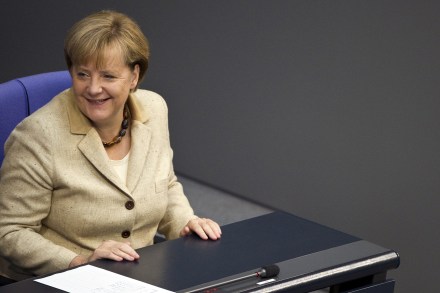
As August draws to a close, Europe is bracing itself for a series of September sovereign debt crises. Events in Germany at the moment have the potential to make these crises into events that could break the back of the Eurozone. As Ambrose Evans-Pritchard reports, Chancellor Merkel might not have the votes to push the European Financial Stability Facility through the German parliament. Merkel is currently under attack from all angles in Germany. Helmut Kohl has criticised her foreign policy, while the German president has implied that she should not have let the European Central Bank buy up so many poor quality bonds. It is now possible to see her coalition

This autumn, Europe could become the most important issue in British politics again

Europe will be one of the political issues of the autumn. The government expects another round of sovereign debt crises in the autumn and these will add urgency to the Merkel Sarkozy plan for ever closer fiscal union between the eurozone members. Nearly every Tory MP and minister I have spoken to is instinctively sceptical of the Franco-German strategy. But Cameron, Osborne and Hague believe that because the Eurozone members won’t accept the break-up of the currency union, Britain has to back further fiscal integration in the hope that it will make the euro work. (Cynically, one might add that their position also makes life easier within the coalition given

Osborne warns Eurozone that decisive action must be taken now

The UK government is becoming increasingly concerned about the situation in the eurozone and the fact that there does not appear to be the political will to address it. One government source complained to me earlier today that “unless they get their act together the eurozone are in danger of fiddling while Rome burns.” Tonight, in a major departure from Britain’s previous softly-softly approach to the issue, George Osborne is issuing a statement calling on the eurozone countries to take “decisive action” to “prevent market uncertainty doing real damage to the world economy.” The Chancellor calls on eurozone countries to: “…now set out in detail how they plan to expand

Europe, the times they are a-changin’

Before writing my column for The Spectator this week I asked one of the most clued-up Eurosceptics on the centre right what opt-outs Britain should push for in any negotiation over an EU treaty change. His answer, to my surprise, was “forget that, we should just leave”. This answer took me aback because this person had been the embodiment of the view that the European Union could be reformed from within. But people are dropping this view at a rapid rate for reasons that Matthew Parris explained with his typical eloquence in The Times (£) yesterday. I wrote in The Spectator this week that two Cabinet ministers now favour leaving

Will Britain leave the EU in 2025?

Britain is going to stay in the EU for the next ten years at least. Of that I’m sure. But after that, when David Cameron’s retired, William Hague has taken to writing books, George Osborne’s had his chance and the 2010 intake run the party, the Tories are going to be more openly hostile to the EU. Labour will too; it has a larger reservoir of pro-EU sentiment among its ranks, but one that is shallower than it was. Focusing on the Tories, it is worth noting that nearly all of the names being bandied about as future Tory leaders have a visceral dislike of the EU. By and large

The gulf between public opinion and Westminster opinion on Europe

It’s Europe Day today, where the flag of the EU will be flown by 26 of its 27 member states. David Cameron is refusing to join in* — and rightly. Why celebrate an institution to which the British public is hostile? I’ve always found it strange that Euroscepticism is caricatured as a fringe, minority position when the polling evidence is so overwhelming. The European Commission anxiously monitors this, conducting identical polling in all member states — the largest poll in the world. The results are never publicised in Britain because they make clear the depth of public hostility. We have dug a few out, from the Eurobarometer data archives, and

Much ado about Brussels, bailouts and budgets

The news that the European Union has decreed that its Budget be increased by 4.9 percent in 2012 ties a knot in the stomach, as I ponder an Easter weekend spent in Margate rather than Majorca due to austerity. As Tim Montgomerie notes, the government is taking this opportunity to assert its euroscepticism. Stern communiqués are being worded; stark warnings are being issued. Behind the scenes, the government has joined with the Dutch, its closest ally on the Continent, to confront the avaricious Commission. Patrick Wintour reports that the French will also oppose the proposed Budget, and the Austrians, Danes, Swedes, Finns and Belgians are expected to lend their weight

Allied military intervention in Libya has commenced

Reports are coming in that French jets have fired the first shots in the UN-supported intervention in Libya. The coming conflict will determine, in the short term, whether the Gaddafi regime is toppled and, in the longer term, whether the international community rediscovers its appetite for intervention which had been so diminished by the controversies over Iraq and the difficulties of the Afghan mission. That there is intervention at all in Libya is down in no small part to David Cameron and William Hague. Hague played a key role in ensuring that Arab countries were prepared to commit to putting planes in the air in this operation, something that was

Cameron’s persistent leadership on Libya was key to tonight’s resolution

David Cameron deserves huge credit for tonight’s Security Council vote. He has kept plugging away for a no fly zone and has succeeded in moving the Obama administration’s position. Cameron’s decision to have Britain table with the French and the Lebanese a Security Council resolution without the support of the Americans or even having talked to the president was a bold move that has turned out to be a game changer. The Prime Minister has proved himself an effective and courageous actor on the world stage. The question now is how quickly and effectively military force can be deployed and how Gaddafi is to be ousted. It, obviously, would have

Downing Street’s bureaucratic burden

Do head over to ConservativeHome, where Tim Montgomerie has put together a comprehensive guide to the revamped Downing Street operation. I won’t spoil its considerable insights here, except to highlight this: “An analysis of papers sent to Downing Street and the Cabinet Office has revealed that just 40% are directly related to the Coalition’s programme. Roughly 30% come from the Whitehall bureaucracy and another 30% from the EU.” James makes the point in his latest politics column that Tory ministers are becoming more and more Eurosceptic as they face the EU in government. That pile of European directives in the in-tray must just be getting too much.

The EU should impose sanctions on Gaddafi’s Libya

The EU spends €460 million a year in operational costs alone on its new foreign policy department, the External Action Service, headed up by Catherine Ashton. This body – created by the Lisbon Treaty – was Europe’s ‘great white hope’ for the global stage, finally allowing it to speak with one voice and therefore giving it leverage where it previously had none.   It hasn’t quite worked out that way. Caught between Cairo and Tripoli, the EU has received yet another reminder that its bureaucracies and institutions cannot magically replace 27 individual foreign policies, as EU leaders continue their bickering over what to do.   The EU’s response to the

China eclipses the Japanese economic miracle

Official figures suggest that China has replaced Japan as the world’s second largest economy, after an estimated 10 percent growth rate left China with an economy worth close to $5.8trillion at the end of quarter four 2010. Japanese growth hovered around the 3 percent mark in 2010 with a total GDP value of $5.47 trillion. Analysts have told the BBC that it is ‘realistic’ that China will overhaul the US’ economy in about a decade, which, as Pete has demonstrated, does not look too outrageous a suggestion.  All of this puts me in mind of the European Union. The CIA World Factbook records that the EU leads the globe in

Irish to block EU integration

In continental lore, it is Britain that is often seen as the greatest impediment to EU integration. The government’s EU Bill initially caused horror in the rest of Europe. Would Britain have to vote for each treaty change, even those needed to enlarge the Union? Before the text of the bill became clear, every self-respecting eurocrat spat the name ‘Britain’ over their lait russe. Even now, they are not best pleased. But in future it may not be Britain, but Ireland that will block any further EU integration. For Ireland is turning a lot more eurosceptic. The role of the euro in Ireland’s decline remains a subject of debate. In

What to do about Belarus, Europe’s last dictatorship?

For a while it looked like the West had the upper hand. Belarus’ Aleksandr Lukashenko, Europe’s last dictator, seemed to be moving away from Russia and closer to the West. A succession of European ministers went to see him and returned to develop packages of support and assistance with his country. In that new “Great Game” played out on Europe’s periphery it looked like Vladimir Putin’s winning streak was finally coming to en end, after partial success in Georgia and outright victory in Ukraine. Or so European leaders hoped. But any hope of changing Belarus’ position has now been dashed with the violent crackdown in Minsk against pro-democracy activists following

A preview of the rebellions to come

Today’s papers are full of the Tory right asserting itself. In the Mail On Sunday, Mark Pritchard—secretary of the 1922 committee—demands that the Prime Minister and his allies come clean about any plans to create a long-term political alliance between the Tories and the Lib Dems. In The Sunday Telegraph, there’s a report that Tory rebels will vote with Labour to try and defeat the coalition’s European Union Bill. I suspect that these stories presage one of the major themes of the year, an increasingly assertive right of the Tory parliamentary party. For too long, Cameron has neglected his own MPs both politically and personally. The result is a willingness