Eu

Papandreou wins no confidence vote, but appears set to stand down

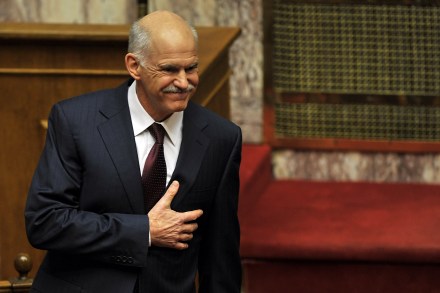
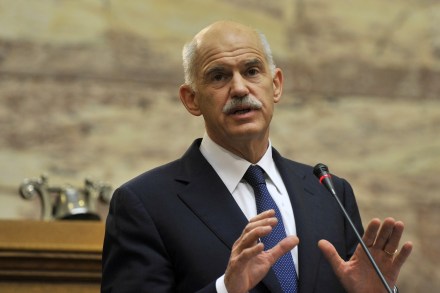
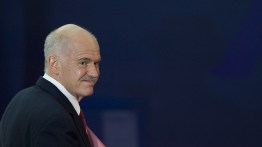
The political situation in Greece remains unclear this morning. George Papandreou’s government survived last night’s confidence vote. But the main opposition party has rejected the idea of a national government and Papandreou’s finance minister appears to be maneuvering to replace him. Papandreou’s victory in the no confidence vote means that there probably won’t be elections in Greece this year. But the huge difficulties involved in implementing the austerity plan remain. The measures continue to command little public support and the opposition will continue to criticise them. The debt deal proposals will also have to win parliamentary approval at some point soon and the French and the Germans are, The Independent

Envoy for repatriation

A few days ago Douglas Carswell laid out a way for the Prime Minister to regain the eurosceptics’ trust. One of his ideas was to replace the UK’s new chief diplomat in Brussels with someone directly accountable to Parliament. This idea has a snowball’s chance in hell of succeeding. First, the PM has resisted all sorts of political appointments – he’s even limited the number of Special Advisers – and I don’t think he’s about to start. Second, doing so would upend a constitutional principle: that officials report to the government, not the legislature. For this reason even generals are not approved by Parliament, as they are in the United

Reuters: Papandreou to resign on Friday

Reuters is reporting tonight that the Greek Prime Minister has agreed to resign on Friday. The news agency says that at a meeting Cabinet colleagues told George Papandreou that he had to resign for the good of the Socialist party and he agreed. It quotes one source saying, “He agreed to step down. It was very civilised, with no acrimony.” Now, after Thursday’s experience, I suspect we’re all taking reports about what will, or will not, happen in Greece with a pinch of salt. But it does seem that the referendum is off, stymied in part by Merkel and Sarkozy, who have ridden roughshod over the idea of non-interference in

Papandreou stays… for now

Confusion has reigned today in Athens, clouding the first day of the G20 summit in Cannes. Reports at midday that the Greek Prime Minister was to resign turned out to be false. Papandreou’s staying put, for now at least. Instead, it seems there will be no referendum on Greece’s bailout package. In a sharp reversal, Papandreou reportedly told his Cabinet: “The referendum was never an end in itself. We had a dilemma – either true assent or a referendum. I said yesterday, if the assent were there, we would not need a referendum.” It seems he may have gained that assent, in that the opposition New Democracy party will support

The euro sparks a Cabinet row

Word reaches me of a vigorous exchange of views in Cabinet this week between Chris Huhne and Michael Gove over the European question. Huhne, who has form when it comes to Cabinet scraps, launched into a polemic against Tory Eurosceptics and insisted that the coalition not be “wagged by the Eurospecptic tail”. It has, obviously, escaped Huhne’s notice that there are more Tory Euro-rebels than there are Lib Dem MPs. There then followed an even more incredible moment where Huhne implied that if he had been in power, the single currency would have worked and so it was unfair to suggest that he had been proved wrong. This was all

BREAKING: Greek PM Papandreou offers his resignation

The BBC reports that Papandreou will resign today and ask the Greek president to approve a new coalition government, with former ECB vice president Lucas Papademos likely to take over as Prime Minister. Opposition leader Antonis Samaras has said: “I’m asking for the formation of a temporary, transitional government with an exclusive mandate to immediately hold elections. And the ratification of the bailout deal from the current parliament.” This is now the main question: will Papandreou’s replacement approve the bailout before new elections are held? UPDATE: It now seems Papandreou might not be resigning after all. This from AFP: “Greek Prime Minister George Papandreou, who is facing a growing party

The euro is destroying Europe

This week’s issue of The Spectator hits the newsstands today. Here, for CoffeeHousers, is James Forsyth’s Politics column from it: Last week’s rebellion by David Cameron’s backbenchers in support of an EU referendum ended eight years of peace in the Tory party on the European question. Now, the offer by the Greek Prime Minister of a referendum on the bailout package — designed to appease nervous Greek Socialist party backbenchers — means that the uncertainty surrounding the eurozone will drag on into the New Year. George Osborne regards the confusion surrounding the future of the single currency as the single biggest obstacle to a British economic recovery. The Chancellor and

Merkel and Sarkozy try to hold the euro together

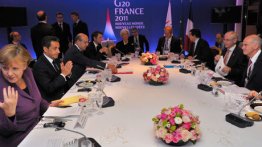
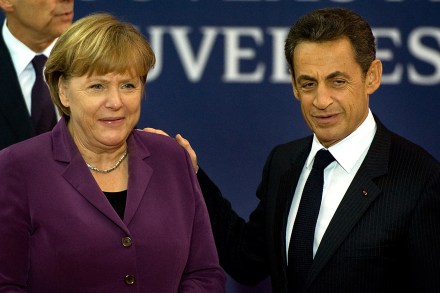
Right about now, Nicolas Sarkozy and Angela Merkel are having George Papandreou for dinner. There have been all sorts of rumours today about what Sarkozy and Merkel will demand from him. Thankfully, they seem to have abandoned plans to tell him to cancel the referendum. But they still seem keen to dictate the question and the timing to him. How that will go down with the Greek demos remains to be seen. One thing is clear, though: the euro is now destroying the whole European project. The European Union’s claim to be a force for peace, stability and democracy in Europe is rapidly disappearing into the Athens smog. The wholesale

A declaration of independence?

The British electorate, in a referendum held on Thursday 19th June 2014, votes to leave the EU. On Monday, 23 June 2014, the Prime Minister and the Leader of the Opposition send the following joint letter to the President of the EU Council, the President of the Commission and the heads of state and government of the other twenty-six EU member states. Dear Herman, José-Manuel, Angela, Nicolas, Silvio etc. etc. …, UK Resumption of Sovereignty On 19 June 2014, in a referendum, the British electorate voted decisively to leave the European Union. Her Majesty the Queen, in her capacity as Head of State of the United Kingdom, consented to her

The wisdom of Eurosceptic crowds

How much does public opinion on Europe matter? A poll for today’s Sunday Times found that 41 per cent want out of the EU and on the BBC1 Politics Show today, Jon Sopel confronted Douglas Alexander with this statistic. Wee Dougie replied that, on Monday’s vote, he was in the “no” lobby with the leaders of all British political parties – so of course he was in the mainstream. This raises a crucial issue: the vast disconnect over Europe between the political elite and the masses. To declare my hand: I’m in favour of our EU membership and regard the free movement of people, goods and services as a noble

The Great Repatriation Question

And the word of the weekend is ‘repatriate’. Not only do we have yet another poll showing that the British public, when asked, would prefer to tug powers back from Brussels, but there’s also this eyecatching story in the Daily Telegraph. No.10, we’re told, is pushing Whitehall departments to determine just exactly where Europe’s influence could be counteracted. There is also a backbench group of Tory MPs providing covering ideas.  So why hasn’t this been happening before now, particularly given how frustrated those around David Cameron have become with the constant torrent of EU directives? Part of the answer is that the events of the past week have made all

From the archives: Cut off in Brussels

Let’s end the working week how it began: with talk of a European referendum. The talk, in this case, is provided by Daniel Hannan, who wrote an article for us in 2008 about his efforts to promote a referendum on the Lisbon Treaty from within the European Parliament. Here it is, our latest excavation from the Spectator archives: For MEPs, public opinion is merely an inconvenience, Daniel Hannan, The Spectator, 22 November 2008 I’ve just done the most pointless thing an MEP can do: I’ve delivered a speech to the European Parliament. Actually, ‘speech’ is rather a grand word for my little soliloquy which, under the rules, had to be

Europe’s new battlefield

The long flight from Australia should give David Cameron plenty time to think about Europe, and how it just won’t go away. He didn’t want this battle — not now, not ever. But in the Daily Telegraph today, the first in what will be a weekly column, I lay out the battlefield that awaits him on his return. First, this bailout is not the end. A trillion Euros needs to come from somewhere, and today the Chinese are being tapped up — God knows what we’ll agree to in return. But that doesn’t address what is, as Mervyn King has said, a solvency issue rather than a liquidity issue. And

Cameron’s Euro-migraine

The picture of Nicolas Sarkozy not even turning around to shake David Cameron’s hand rather neatly sums up the Prime Minister’s problems right now. The danger for him is that the 17 Eurozone countries start writing a new set of rules and riding roughshod over the interests of those countries that are outside. This would be bad enough at anytime but with the Conservative party on the warpath over Europe it is a clear and present danger to the Prime Minister. As one ally of the Prime Minister said to me today the PM’s predicament is made even harder by the fact that many of the 10 countries outside the

The government’s European tribulations continue

It has been a fraught and ill-tempered week in Westminster. And — whether it is the rumour that Tory backbencher Andrea Leadsom told George Osborne to “f**k off”, or David Cameron’s dismissal of Ed Miliband as a “complete mug” — most of it has had Europe at its root.  So it is, too, with the latest news of government strife. Iain Duncan Smith, it’s reported, had a ferocious row with the Tory chief whip, Patrick McLoughlin, over the EU referendum . Apparently, he warned that, “If you ever put me in this position again, that’s it”. As it happens, there is more on IDS’s disgruntlement in Charles Moore’s column for

Summit for nothing?

The punchline to yesterday’s eurosummit comes in the very first paragraph of the official statement, released in the darkness of morning: “The euro continues to rest on solid fundamentals.” Now that you’ve brushed away the tears from that one, what was it that was actually agreed upon in the end? The main measure is effectively a fiscal target for Greece: its national debt, expected to peak at around 180 per cent of GDP in 2013, will come down to 120 per cent by 2020. And this will be achieved by cutting the value of bonds held by private investors in half, alongside further waves of privitisation and Greek frugality. Brussels

The Euro masquerade

So much rot has been said about the Eurozone crisis that you do wonder whether Merkel, Sarkozy et al have come to believe their own spiel. This is an economic problem and it can’t be solved by political will. Greece is bust and several French, German and Dutch banks were stupid enough to lend €130 billion to the Greek government that they’re not going to get back. All the summits in the world cannot change this simple fact. These crisis talks are about bailouts for banks, not bail outs for Greeks. BNP Paribas is in for €37bn. Commerzbank of Germany is owed €15bn. And if Greece defaults, then insurance claims

Why this is not the time for an EU referendum

Having spent five hours in the debate last night, one thing was absolutely clear: we are all Eurosceptics now. So why did I choose to vote against the motion? It is because I believe that anger and frustration alone will not resolve our justifiable grievances towards the EU; we need a clear-eyed strategy to move forward.    We can all agree that Europe in its current form is not working for us. We have passed powers to Brussels at the cost of undermining the sovereignty of Parliament. Regulations that hinder our growth have not only been adopted but gold-plated, and with the Lisbon Treaty we are saddled with a constitution

The coalition bares its tensions over Europe

Here’s an irony: last night’s EU fandango was the fifth largest vote in favour of the government this year. And yet there is little about the situation that is favourable to the government this morning, as the story moves on from Tory splits to coalition ones.  It started with Michael Gove’s appearance on the Today Programme earlier. The Secretary of State for Education put in a much more conciliatory performance than William Hague managed yesterday; praising the “cordiality” of the Tory rebels, and reassuring them that the Tory leadership would like to see specific powers returned from Europe “in this Parliament”. As he put it: “We need to win more

43 percent of Tory backbenchers vote for an EU referendum in defiance of David Cameron

The scale of tonight’s rebellion is quite remarkable, 43 percent of Tory backbenchers have defied a three line whip—and we are only 18 months into the parliament. Indeed, if you factor in the abstentions more than half of Tory backbenchers rebelled. This should be a wake-up call to David Cameron. He needs to develop a proper policy for repatriating powers from Brussels, change his style of party management, and reform the Whips office.  This rebellion will encourage the hard-line Euro-sceptics to try again and again. They will reckon, rightly, that as the parliament goes on the number of potential rebels will grow. If they can get this number of rebels