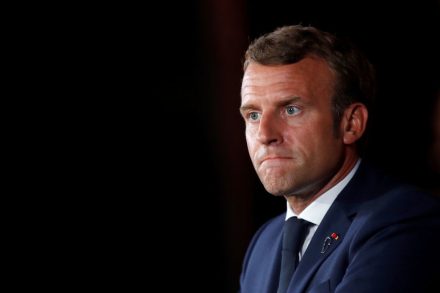
Emmanuel macron

What Macron’s spat with Italy is really about

Who needs the Comédie-Française when there is Emmanuel Macron in the Élysée? France's recall last week of its ambassador from Italy for consultation was pure theatre on the part of the president. And it was a decision more for the benefit of his domestic audience than for the coalition government in Rome. In a statement explaining why Christian Masset had been ordered home, the foreign office said that for several months France has been subjected to outrageous statements that have created a 'serious situation which is raising questions about the Italian government’s intentions towards France.' France blamed the recall on Luigi Di Maio, the Italian deputy prime minster, who flew to Paris last week to meet members of the Yellow Vest protest movement.

Why doesn’t Emmanuel Macron like Britain?

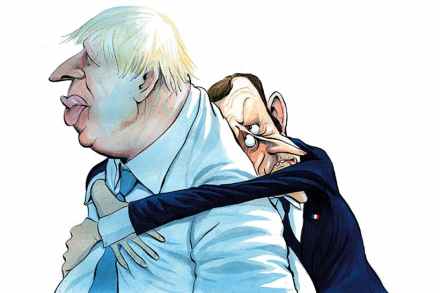
Why is Emmanuel Macron raging against Britain? The French president has returned to the subject of the British once again in the course of his Great National Debate. To be honest, thus far this has been something of a great Macron soliloquy, as he finds it difficult to stop talking. It was inevitable that during one of his lengthy televised discourses (there have now been three) he would turn once again to his new favourite subject, and so he did.

Brogues gallery

I spend most of my time drawing politicians, trying to work out what makes them distinctive. The eyes, the expression, their mood: it’s all about finding people’s peculiarities and accentuating them. When I started, I’d focus on the face. Everything else was an afterthought. It wasn’t until I came across a drawing by the Norwegian cartoonist Finn Graff – a cartoon of Helmut Kohl, I think – that I realised what I had been missing. How much you can tell from someone’s shoes. I didn’t discover this, so much as rediscover it. When I was a teenager, I worked in a shoe shop in my home town of Arendal, Norway. I used to challenge myself to identify the right shoe for a customer the moment they walked in.

How the Gilets jaunes movement could spread across Europe

The eminent historian Emmanuel Todd was on the radio in France last week. He had much to say, none of which would have made for easy listening at the Élysée Palace, particularly his warning that Emmanuel Macron is facing a coup d'etat that has been fomenting for years. Todd believes that fundamental to the rise of the Yellow Vest movement is what happened in 2005. That was the year France, in the words of the Guardian at the time, "decisively rejected the new European constitution". The 'non' votes were 54 per cent (out of an overall turnout of almost 70 per cent) and jubilant campaigners demanded the resignation of Jacques Chirac as they celebrated in the Place de la Bastille.

Emmanuel Macron’s next fight could be his toughest yet

In normal circumstances, Emmanuel Macron would welcome a trip to Marrakech in December as an opportunity to escape cold Paris and enjoy some North African hospitality. But his date in the Moroccan city next week could not have come at a worse time. France is burning and Macron's presence on Monday at the United Nations intergovernmental conference in order to sign France up to the global compact for safe, orderly and regular migration could add to the conflagration. The United Nations states that the global compact "comprises 23 objectives for better managing migration at local, national, regional and global levels". The document has been more than two years in the making and its aim is to help the 258 million migrants around the world living outside their country of birth.

Emmanuel Macron has united France against him

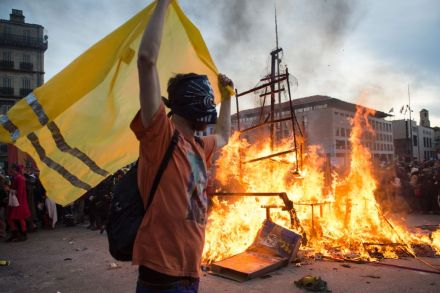
I would say we’ll always have Paris. But maybe not. It was only a few weeks ago that French president Emmanuel Macron promised a red carpet for bankers fleeing Brexit Britain. As matters have unfolded, the carpet has become one of broken glass. On the Avenue Kléber, one of the toniest streets in Paris and heart of the district where Macron will have been expecting to resettle his beloved bankers, fleeing London like the sans culottes, every bank has been attacked, every shop window broken, upscale apartments have been attacked and every Porsche and Mercedes within blocks set on fire. Invest in France? Emmanuel Macron is undoubtedly brilliant. He won all the glittering academic prizes. He had a supersonic ascent into the stratosphere of the French civil service.

Yellow fever

I met a friend for lunch in Paris last Sunday. He and his wife had come up from the countryside for a weekend’s shopping. As we sat down, their nerves were still frayed from the previous day. It was, they told me, the most terrifying few hours of their lives. Trapped between the rioters and the police, they retreated to their hotel, where staff instructed them to stay in their room. The mob soon arrived and against a background noise of helicopters, police sirens, breaking glass and detonations, they tried unsuccessfully to force their way inside the hotel while singing an ode to the Révolution. It has been said that the gilets jaunes movement is to Emmanuel Macron what the miners’ strike was to Margaret Thatcher in the mid-1980s. Not in the slightest.

Let them buy Teslas! How Macron provoked an uprising

Emmanuel Macron is supposed to be the cleverest man in France but he has painted himself so completely into a corner that there’s no way out. Whether the gilets jaunes insurrection achieves its objectives or not, it has become his nemesis. As the yellow wave roils France, Macron is a diminished figure after a crunching fall to earth. Bastion of anti-populism, he has united 70 per cent of France against him. He did self-identify as Jupiter. Now, perhaps, he is looking like a sickly lame duck, albeit one for whom the word hauteur might have been invented. Instead of the confident leader, lecturing and preening on the global stage, he is barricaded in his palace, a sort of latter-day Marie Antoinette. French people can’t afford diesel? Let them buy Teslas.

In praise of the Gilets jaunes

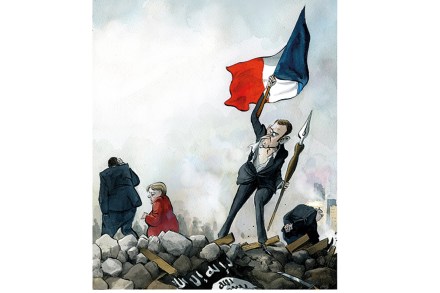
At last, a people’s revolt against the tyranny of environmentalism. Paris is burning. Not since 1968 has there been such heat and fury in the streetsThousands of ‘gilets jaunes’ stormed the capital at the weekend to rage against Emmanuel Macron and his treatment of them with aloof, technocratic disdain. And yet leftists in Britain and the US have been largely silent, or at least antsy, about this people’s revolt. The same people who got so excited about the staid, static Occupy movement a few years ago — which couldn’t even been arsed to march, never mind riot — seem struck dumb by the sight of tens of thousands of French people taking to the barricades against Macronism. It isn’t hard to see why.

Emmanuel Macron is leading France towards disaster

I would say we’ll always have Paris. But maybe not. It was only a few weeks ago that French president Emmanuel Macron promised a red carpet for bankers fleeing Brexit Britain. As matters have unfolded, the carpet has become one of broken glass. On the Avenue Kléber, one of the toniest streets in Paris and heart of the district where Macron will have been expecting to resettle his beloved bankers, fleeing London like the sans culottes, every bank has been attacked, every shop window broken, upscale apartments have been attacked and every Porsche and Mercedes within blocks set on fire. Invest in France? Emmanuel Macron is undoubtedly brilliant. He won all the glittering academic prizes. He had a supersonic ascent into the stratosphere of the French civil service.

Emmanuel Macron is Donald Trump in reverse

Is Emmanuel Macron the oddest leader in the EU? When he became President of France last year, he made a speech at Versailles to both houses of parliament calling for a renewal of ‘the spirit of conquest’. This year, commemorating the centenary of the Armistice, he seemed more inclined to invent a project for perpetual peace, like some 18th-century rationalist. In recent days, he has demanded our fish, decided that the gilets jaunes, who are rioting about his astonishing diesel price rises to save the planet, are really a ‘brown plague’, and welcomed a report which wishes to empty France’s museums of any treasures which originated in Africa, Oceania and anywhere else that can claim victim status, and return them thither. M.

In place of strife

France has been in a state of organised uprising this week, with 300,000 motorists taking to the streets and autoroutes to protest against rising fuel taxes. One protester has died, more than 400 have been injured and even more disruption is on the way. Watching Emmanuel Macron, you wouldn’t know it. He travelled to Berlin to commemorate Germany’s war dead, launching for the second time in a fortnight into his proposal for a single European army, and saying it was Europe’s duty to prevent the world ‘slipping into global chaos’ — apparently unable to recognise the chaotic scenes he had left behind.

The rivalry between Macron and Salvini is a battle for Europe’s soul

When Emmanuel Macron won a resounding victory over far-right nationalist Marine Le Pen in the 2017 French presidential elections – claiming 66 per cent of the vote – Matteo Salvini was a little known Italian politician largely scoffed at as a clown by the status-quo parties. While Salvini was posting selfies on Facebook and making outlandish comments about North African migrants, the eurozone, the European Union, and the Italian political establishment, Macron was in Paris measuring drapes in the Élysée Palace. Stories in the Washington Post, the New York Times, and the Guardian gushing about Macron being Europe’s saviour from the dark forces of populism were as prevalent as stories deriding Salvini as a buffoon.

Low life | 15 November 2018

The monument to this French village’s war dead is a plain white stone block with the head of a grizzled old French infantryman chiselled on top. His big capable hands are gripping the block’s edge, as though he is peering intently over the parapet of a trench. On Sunday we assembled around him to honour the 53 local men, from a population of 1,800, who lost their lives in the first world war. Schoolchildren queued at a microphone to sing out their names. A ladies choir sang a plangent song about Verdun. The state bell tolled for 11 minutes. The major made an interminable speech in the rain. Everybody sang the Marseillaise. Around 300 people turned out (beneath about 100 umbrellas) from a winter population the same size as it was 100 years ago.

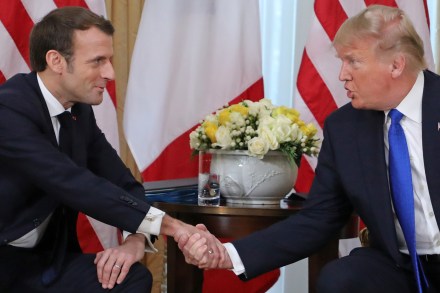
Macron and Trump’s doomed bromance is good news for Le Pen

Emmanuel Macron's hosting of sixty world leaders in Paris last weekend to commemorate the centenary of the Armistice has turned into a public relations disaster. The president of the Republic not only infuriated Donald Trump, but he also put the Serbian president's nose out of joint. According to reports, Aleksandar Vucic was not amused with the seating arrangements at Sunday's service of remembrance. While Kosovo's president Hashim Thaçi was behind the leaders of France, Germany, Russia, and the United States, Vucic was shunted off to the side. "You can imagine how I felt," Thaci is quoted as telling the Serbian media. "I couldn't believe what I was seeing before me, knowing the sacrifice that the Serbian people made in World War One.

Eclipse of the Sun King

Emmanuel Macron was elated when France won the World Cup in July. The photograph of him leaping out of his seat at the Moscow stadium showed a leader at the peak of his power. Or so he thought. Ever since then, he has been bumping back to earth. Last week, the French President took the unusual step of retiring to Honfleur for four days’ rest and recuperation. ‘His face has changed, he is marked by the weight of power,’ confided one of his team; another expressed concern about the President’s weight loss. Part of his deterioration is self-inflicted. Macron likes to boast that he gets by on four hours of sleep, and his texts to ministers in the early hours are legendary.

France is fracturing but Macron remains in denial | 17 October 2018

As chalices go, few are as poisoned as the one Emmanuel Macron has just handed Christophe Castaner. Minister of the interior is one of the most challenging posts in government. The former Socialist MP has cultivated an image over the years of a political tough guy, in contrast to his predecessor, the diminutive Gérard Collomb. But what passes for tough in the National Assembly won't intimidate the tough guys in France's inner cities. During his eighteen months in the post, Collomb was a diligent minister, but in the end the 71-year-old was worn down by the enormity of his task. He parted with a message that should cause his successor a few sleepless nights.

The euro is the source of Macron’s troubles

A new interior minister. A new agriculture and culture minister. There wasn’t, despite some speculation, a new prime minister, but there will be lots of new fresh faces around the cabinet table. France’s dynamic young president Emmanuel Macron has finally re-launched his government after a wave of resignations in a bid to kick-start phase two of his term of office, restore some order to an increasingly chaotic administration, and, probably not co-incidentally, to rescue his tumbling poll ratings. The trouble is, his real problem is not the team around him. Nor is it his style, or resistance to his reforms, although both might cause controversy. In fact, it is becoming painfully obvious that France’s real problem is the euro.

Macron is quick to take on nationalism. What about Islamism?

On Sunday, I reached the summit of the col de Riou in the Pyrénées to find a shepherd tending his flock. He asked if I'd seen a bear on my way up through the forest. One of his sheep was missing and he suspected a bear was responsible. I'd seen no sign of one but that got us talking, and I asked what he thought about the government repopulating the Pyrénées with bears. He shrugged and said the time for protesting was past. The bears are here to stay and that was that. One could say the same about Salafists, I reflected that evening, as I read Le Journal du Dimanche. Spread across two pages of the newspaper was an interview with Hakim El Karoui, the author of a report published last week by the Institut Montaigne entitled 'The Fabric of Islamism".

Conservatism and the radical centre

Every so often, usually on Twitter, you hear calls for a new centrist party. The Tories have gone Brexit bonkers, runs the argument, and Labour hard-left – surely most people are in the middle? And look at Emmanuel Macron: by sheer self-belief he won the presidency and leads a majority parliamentary party that did not exist three years ago. So don’t we need a new centrist force in Britain? I’m not sure that we do, and I explain why in my Daily Telegraph column today. Let’s look at Macron, and what he’s trying to do. Reject high taxes for the rich, on the pragmatic grounds that they don’t raise revenue.