Emmanuel macron

Is Eric Zemmour France’s answer to Trump?

Eric Zemmour, a right-wing French essayist, has had a stellar rise in the media and public opinion. He has now reached 17 per cent in the latest Harris Interactive poll for the first round if he were to run as a candidate. After Macron’s ascent to power from nowhere only five years ago, will Zemmour become the Donald Trump of French politics? It looks unlikely. Zemmour certainly hit a raw nerve with his anti-immigrant theme, but whether he can dominate the campaign will depend on events outside of his control. If the voters' concern turns towards the energy crisis and purchasing power, Zemmour would be without an offer.

Macron’s selective defence of free speech

In the early years of his presidency, Emmanuel Macron became known as Monsieur 'En Meme Temps'. The president of France was in the habit of setting out one vision but, 'at the same time', presenting an alternative point of view. He acquired the reputation of a man who was ideologically elusive. What does he stand for? Neither left, neither right, was his campaign slogan in 2017, and four years on he continues to flummox the French. Nowhere is this equivocation more apparent that in Macron's attitude to free speech. Twelve months ago, the French teacher Samuel Paty was brutally slain outside his school because he had shown a caricature of the prophet during a class discussion about freedom of expression.

Eric Zemmour is eating Marine Le Pen alive

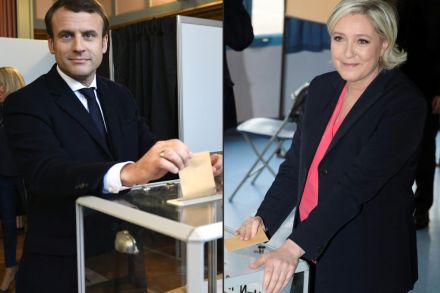
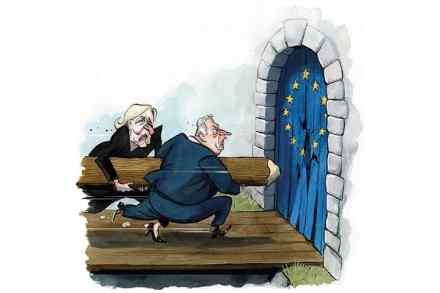
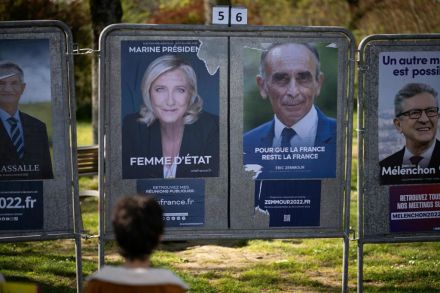
French opinion polls are best taken with a generous bucket of sel de Guérande but this evening’s drop of a Harris Interactive survey of intentions to vote in the 2022 presidential election might genuinely be described as explosive. This poll contains the crucial assumption that Xavier Bertrand will emerge as the candidate of the centre-right Les Républicains, but it nevertheless suggests that trends are moving in unpredicted directions. Bertrand is currently only marginally ahead of Eric Zemmour, whose insurgent campaign from the right is starting to profoundly unsettle the conventional wisdom. If Zemmour, who still hasn’t officially announced his candidacy, continues to climb and Marine Le Pen to decline, something extraordinary might happen.

Von der Leyen is the real winner of the German elections

The bald guy who leads the Social Democrats. The earnest looking Green lady. Or perhaps the guy in the charcoal-grey suit who leads the oddly named Free Democrats — free from what exactly? — who may end up picking the next chancellor. Lots of commentators will argue for a long time about who is the real winner of the German elections. But in fact there can be no real dispute about who has come out in a far stronger position. The President of the European Commission Ursula von der Leyen. A power vacuum in Berlin will be filled by a hyper-active, ambitious Commission There are two reasons for this. First, she is now by far the most powerful German politician.

The German elections are good news for Macron

The German election result means that a three party coalition will almost certainly be needed to form a government. Olaf Scholz, the SPD leader, has made clear just now that he is going to try and form a coalition with the Greens and the Free Democrats. Whoever succeeds her will take time to build up the authority that Merkel had in these meetings Scholz has a strong claim on the chancellery. The SPD came first in the election and polls consistently showed that he was Germans’ preferred choice for candidate. Despite being from a different party, Scholz successfully positioned himself as the Merkel continuity candidate. The results might suggest a shift to the left among the German electorate. But German voters clearly want more Merkelism.

Is this the real reason Macron dislikes Brexit?

As I read The Wet Flanders Plain by Henry Williamson, a veteran of the first world war who encountered hostility from locals when he returned to the western front in 1927, a thought struck me: have I stumbled upon the source of Emmanuel Macron's Anglophobia? Let's not beat around the bush; the president of France does not like us. Politicians and diplomats may gainsay, and claim that Macron has the greatest respect for the United Kingdom. But his behaviour during the last four and a half years indicates that the current resident of the Elysée is the most Anglophobic president since Charles de Gaulle. Throughout the Brexit negotiations Macron was the most intransigent of the EU leaders, and following Britain's departure he has been the most embittered.

Macron’s ambitions have been torpedoed by Aukus

Today France is outraged. First, explicitly because Australia has broken a large contract to have a French company design their submarines and for that contract to be switched to a US-UK substitute. Secondly, sotto voce, because Emmanuel Macron’s Indo-Pacific strategy has been shaken by an Australian, American and British strategic agreement entitled Aukus, to which France has not been invited. What are the facts of the matter? In 2016 Australia signed a contract with France to buy 12 conventional French-designed diesel-electric submarines for the Australian navy. The contract worth €35 billion was badged by the French as ‘the contract of the century’. In reality, only €8 billion was to go to the 60 per cent state-owned French company Naval Group.

Macron is playing Eric Zemmour’s tune

In a big speech yesterday, Macron presented himself in almost Nixonian terms as guardian of law and order. He said he would rewrite the penal code and double the number of police on the streets. But only if he’s re-elected. He further promised at least ten specific security measures and €500 million in additional spending. Ever the triangulator, he mixed hard with soft — promising also a parliamentary oversight body to clamp down on police brutality. Nobody can accuse Macron of lacking policies, though they’re mostly more show than go. His attempt to co-opt the security agenda is thus far merely rhetorical.

Hidalgo has trashed Paris. Can she do the same for France?

Anne Hidalgo, the socialist mayor of Paris, whose reign has submerged the city in debt and rubbish, is the latest no-hoper to declare her candidacy for the 2022 presidential election. She’s in fifth place in the polls, although these are rarely credible at this stage and currently ignore several candidates for reasons that seem obscure. Hidalgo, the daughter of Spanish immigrants, is to run on a platform of social justice. She says she is doing so with humility, although this is not a characteristic that has so far been evident in her personality. Ruthless ambition comes closer.  It is rather obvious that Hidalgo has zero chance of finishing in the top two of the first round of voting next April.

Afghanistan could fatally undermine Macron’s election strategy

To nobody’s great surprise, France’s Minister of Health, Olivier Véran, announced last week that the Covid Passport may have to be extended beyond 15 November – the initial expiry date of the government’s controversial measure, first introduced in July. I’ll hazard a guess that come April 2022 the French will still have to show their passport to enter cafes, shopping centres, sports clubs and cinemas. April, of course, is the date of the presidential election and Emmanuel Macron is banking on his response to Covid helping him to secure a second term. His belief is that the electorate, particularly the over-50s, will be reluctant to change presidents in the midst of a pandemic. Better the devil, and all that.

Michel Barnier’s doomed presidential bid

The French President Emmanuel Macron has, it is revealed, forbidden all talk at the Elysée of the forthcoming presidential election and has refused to discuss even whether he will be a candidate. His entire attention is focused on France and the French, he claims. Of course this is entirely the opposite of the truth as his entire attention is focused on being re-elected. Nevertheless, he was likely to have been opening a bottle of something sparkling in which to dip his croissant this morning with the announcement that Michel Barnier, yet another no-hoper, has thrown his beret into the ring to oppose him. Divide and conquer seems to be Macron’s strategy.

Boris Johnson’s Macron-esque pettiness

How we all hollered with outrage in May when Emmanuel Macron closed France’s borders to people arriving from Britain on the dubious basis that Britons, and Britons alone, were in danger of infecting France with the Indian variant. I believed, and I still believe, that Macron and his government were in part motivated by Brexit — it was part of our ongoing punishment for daring to vote to leave the EU. It certainly wasn’t justified on scientific grounds: if Briton had more recorded Indian variant (or Delta) cases than other European countries at the time it was largely thanks to more samples of Covid being sequenced here. Some countries, France included, were not analysing more than a tiny fraction of cases.

Liberté, égalité, vacciné: France’s Covid passport revolt is just beginning

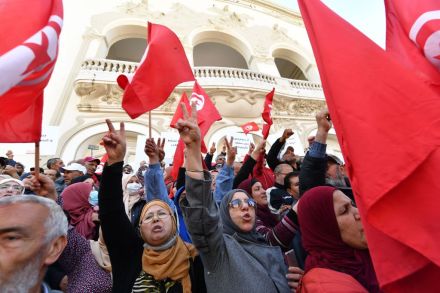
Montpellier Three weeks ago, 100,000 demonstrators turned out on the streets of France to protest President Emmanuel Macron’s hastily passed law to require vaccination passports to get on a train, eat at a restaurant or visit a shopping centre. A week later, the number had more than doubled. Last Saturday, it doubled again. One police union estimated that close to 500,000 had turned out, although as usual the Interior Ministry claimed a much lower number. Enormous demonstrations were staged not just in Paris but in more than 150 cities and towns across France, as well as in the overseas territories of Guadeloupe and Réunion. All this in the middle of the sacred summer holiday season. On the current trajectory, one million could be on the streets by September.

Macron’s Covid passports are causing intergenerational warfare

The protest movement against Emmanuel Macron’s Covid passport, which comes into full effect today, continues to grow in France. On Saturday over 200,000 men, women and children took to the streets, more than twice the number that demonstrated when the protests began on July 17. As a veteran of the Paris protests, I’ve found one of the most interesting aspects to be the reactions of passers-by as the cortège files through the streets of the capital. Some clap, some look on in contempt, others shout words of encouragement and a few hurl terms of abuse.

The French are rebelling against Macron’s Covid Passports

A manager of an attraction park in France was reportedly assaulted on Sunday after he denied entry to a customer. It's alleged the man lost his rag when he was turned back because he didn't have a valid Covid passport. It is unlikely to be the last such incident. In the space of a fortnight, the atmosphere in France has turned toxic. A hospital in Saint-Étienne was invaded on Monday by 60 demonstrators, mainly medical professionals, opposed to the measure that will force them to vaccinate or be suspended without pay. That is also a strike at a Lyon hospital that will start tomorrow. Elsewhere cinemas, theme parks and fitness centres have been labelled 'collaborators' for their participation in the government's Covid Passport scheme.

Emmanuel Macron’s dangerous infantilisation of the French

From St Tropez to La Rochelle to Deauville, there is a familiar sight this summer in many of France’s most popular coastal resorts. A year after the wearing of masks outside was made mandatory they are back, and French and foreign sunseekers are forced to muzzle under a broiling sun. It was only a month ago that the government relaxed the rule on the wearing of masks outdoors, but that was before a rise in cases caused by the Delta variant. Most of the infected are the young and unvaccinated, hospitalisations are stable and deaths remain minimal: there were 11 in the last 24 hours, compared to ten last Saturday.

Macron’s vaccine passports are a betrayal of French values

What a celebration of diversity I witnessed in Paris on Saturday as tens of thousands of demonstrators marched through the capital. Organisers put the figure at 50,000, the government at 18,000; I'd say the former is the more accurate estimation. It took two hours to walk the one and three-quarter miles between the start of the march, in the Place du Palais Royal, to its terminus at the Place Pierre Laroque outside the Ministry of Health. In total, and again depending on your source, between 114,000 and 150,000 people demonstrated across France on Saturday to protest against the planned introduction of the 'Pass Sanitaire', France’s vaccine passport. All ages, sexes, classes and colours were represented.

Macron’s Covid crackdown is a risky bet

Will the French accept compulsory vaccination against Covid? Health passports to get on a plane or train? Children of 12 jabbed, whether their parents wish it or not? As fears are stoked of yet another wave of infection, we may be about to find out. In recent days, France has seemed rather normal with restaurants open, summer holidays in full swing, tourists returning, shops open. But we’re told that none of this will last. ‘We must vaccinate all of France,’ president Macron announced last night in his fifth Covid television address so far. It was a striking elocution. Macron ditched his habitual black undertaker outfit for a smart blue suit, and his office in the Elysée for the dome of the Grand Palais, framing the Eiffel Tower.

Le Pen is just another establishment politician

One Saturday in March, I attended an anti-lockdown rally in central Paris. I was there partly out of journalistic curiosity but also out of solidarity with those Frenchmen and women who believed it was high time life returned to normal. What struck me was the similarity between the protestors and those I had walked with in 2018 in the early weeks of the yellow vest movement in Paris — overwhelmingly middle-aged blue-collar workers. The yellow vests famously had no leader because it was a protest movement that arose not out of any strong political conviction but from what the French call ras-le-bol: despair at what was perceived as an arrogant and out-of-touch political class who seemed intent on punishing the poorest in society.

Is Marine Le Pen’s presidential bid doomed?

Nothing went as predicted in France's regional elections. Marine Le Pen's Rassemblement National did not win a single region and Emmanuel Macron's La République en Marche failed to grow roots in local government, or even act as a kingmaker. All incumbent regional candidates were re-elected, sometimes with quite a comfortable margin. Does this mean we are back to the good old left-right divide in French politics? Regional elections are not national elections, of course. Abstention reached a record high in this election and voters from RN and LREM have shunned the regional vote more than left-wing and conservative voters.