Education

Gove goes on the attack

This afternoon's education question felt like a pressure valve being released. For a week now, the story has been all about the heat building-up under Michael Gove. But, today, the Education Secretary looked far more comfortable, and managed to swing the blowtorch back in Ed Balls' direction. The message that the coalition had been struggling to make previously came out clear and loud: the Building Schools for the Future cuts are a result of waste and bureaucratic mismanagement by the previous government. And Gove even came armed with examples, such as the £1.3 million paid to an individual consultant from the BSF fund. His point: this would be better directed at pupils and teachers.
Cameron’s refreshing honesty on schools

David Cameron has today told the News of the World that he is "terrified" about the prospect of sending his children to an inner-London state school. This is quite some statement, given how many tens of thousands of parents are in the same predicament. Isn't it the classic politician's error? To betray how his aloofness from voters by showing how he fears what ordinary parents have to put up with? That's what Tony Blair thought – so he'd pretend to be happy with state schools while sending his kids to the ultra-selective Oratory School. That is hypocrisy. What David Cameron has said represents honesty. After all, why shouldn't he be terrified? As I say in my News of the World column today, the record is appalling.

The Gove fight-back begins

His apology earlier this week was a reminder of how Cabinet Ministers used to behave. Today’s cock-ups and crises have increased the pressure on the Education Secretary – two schools face cuts despite meeting the government’s criteria. Now Gove has penned a defensive article for the Sunday Express. He writes: ‘Reform is never easy, and certainly not when cash is tight... but school building will not stop under this government.’ Gove is, of course, right. Money is tight. But he must explain why reform is necessary in and of itself, and why his ideas should be adopted. There was an aloofness and arrogance about his performance on Newsnight on Monday, suggesting that Gove believes he has won the argument.

Cable’s aspirations

"Aspiration" tends to be a convenient word for politicians, in the sense that any policy that they can't implement now can be glossed over as something they want to do in future. But, if Vince Cable's interview with the Times is anything to go by, it could become a troublesome word for the coalition. Speaking about the Lib Dem's election promise to scrap university tuition fees, Cable says that: “It is an aspiration, but we’re highly constrained financially and we have got to try to work out ways of doing it. I’m not Father Christmas.” But nowhere does the coalition agreement say that scrapping tuition fees is an "aspiration".

The coalition must do more than blame Labour

John Redwood has written a typically thoughtful piece, questioning the government’s arch cuts rhetoric. He writes: ‘Ministers would be wise to tone down the rhetoric of massive cuts. They need to mobilise, energise and reform the public services. Labour made clear in their marathon moan in the Commons yesterday into the early hours of this morning that they are out to talk the economy down, highlight alleged huge cuts in jobs and services and campaign with the Unions against sensible change. The government needs to be smart and careful in its choice of words to bring about the improvements in quality and performance needed.’ Ministers sound terse and defensive at present.

That’ll learn ‘em

At last, some will cry, teachers are to be given increased disciplinary powers to moderate unruly children’s behaviour. Rather than tear up the statute book, the measures aim to change perceptions and practices and redress the balance of rights in favour of the teacher. Force can be used to restrain pupils at present, but teachers rarely resort to force for fear of prosecution. The government will lessen what it terms ‘vilification’ by protecting teachers’ anonymity against complaints unless a criminal prosecution is brought. Search and confiscation powers will be extended and summary penalties imposed on transgressors. Currently, schools have to write to parents and give 24 hours notice to detain a pupil.

Gove puts democracy ahead of bureaucracy

Michael Gove's welcome freeze on Building Schools for the Future will invite tomorrow's press to claim only that this means 715 various building projects are not being carried out. In fact, what it means is that the fund will be open for the Swedish-style new schools. The budget will be transferred from bureaucratic priorities to those of communities, as expressed by those who wish there to be a new school. One of the great tragedies of the politicians' stranglehold over education is that they just love huge, shiny buildings to point at, complete with new whiteboards and all the latest gadgets. The Swedish experiment has shown the parents care not one jot about how grand the building is: their value is placed on the importance of teaching.

Back into the black

George Osborne has an historic opportunity to begin to turn the UK's public finances back into the black. As Reform noted in an alternative budget released last week, while this will require making the toughest spending choices for a generation, history will smile on him if he does this in the right way. What the right way is will largely reflect three key things. First, George Osborne's Budget needs to be ambitious in its timeframe for reducing the deficit. Setting out to, say, simply "eliminate the bulk of the structural deficit in the term of this Parliament" will not be enough. Delay will make fiscal consolidation harder as interest payments on debt and the costs of unreformed programmes and entitlements will continue to rise.

A bizarre approach

Thank God for Iain Martin, who has called Labour’s response to the Gove ‘Free schools’ idea what is: ‘moronic’. He writes: 'Labour warned that the resulting experiment risks creating a “two-tier” education system. Good grief. And Britain doesn’t have a two-tier schools system now? Actually it’s more like 10 tiers. In this troubling context, claiming that Britain somehow has a splendid one-tier education system that must be preserved is moronic.’ If enacted and delivered, the Gove school reforms will transform education: either they will inaugurate extraordinary improvements, or they’ll be catastrophic.

The schools revolution is under way

There's an historic tinge to proceedings this morning, as Michael Gove prepares to release an application form by which parents, charities and other groups can establish free schools.  In effect, this is zero hour for the policy that The Spectator described as "reason enough to vote Conservative” a couple of months ago. The coalition is hoping that the first of the new breed of schools will appear in September next year. Much of it will come down to take-up: how many schools are set up, and when. So it's encouraging that people and organisations are already expressing heavy interest in the government's plans.

Spending cuts must start with welfare

The new and independent Office for Budget Responsibility estimated that interest payments on public debt are set to rise to £67 billion a year by 2014-15. The hole in the public finances is so deep that every cut in spending that can be made should be made. Few commentators have grasped that tinkering around the edges, such as with “efficiency gains,” will not be enough. The only way to eliminate the deficit and to begin the task of repaying public debt is through making deep cuts in spending and for people to take more responsibility for themselves.   Cuts must start with welfare. The UK government spends more on welfare than on anything else.

Cable, the free radical, dreams of a grand future

What is Vince Cable up to? He is on manoeuvres, keeps making attempted power grabs from George Osborne. Barely a week passes without him rattling the cage to which Cameron and Clegg have confined him  - that is, the unwieldy and yet fairly powerless Department for Business, Innovation & Skills. For all its bulk, the department doesn’t really do anything. It has the universities brief, which is important, but it is certainly not an economics department as Cable was pretending last week. “It is a bit like the German economics ministry and the finance ministry,” he claimed. “Two departments, working in parallel.” As if.

School days

There it is: Winder, one of the most imposing peaks across all the Howgill Fells. Whenever I visit my brother, a teacher at Sedbergh School, we make a habit of climbing it. Up you march, through grass kept short by wild horses and paths kept alive by other walkers, until you round back on yourself and see the entire town of Sedbergh contained within in the valley below. The school. The houses. The shops. The lives and cluttered history that make a community what it is.    Now two current Sedbergh pupils, Ben King and George Head, have done the literary equivalent of climbing up and looking down. In a collection of interviews with Old Sedbergians, they map the peaks and troughs of life at this hardy school.

The IDS agenda could help to end the benefits trap

Yesterday, it was Michael Gove's schools agenda. Today, it's the other main reason to get behind the coalition: IDS's plans for fixing the welfare system. The Secretary of State for Work and Pensions has given a speech outlining them this morning. You can read it here, and I'd certainly encourage you to do so. There are plenty of welcome ideas in there, but none more so than IDS's emphasis on removing disincentives to work from the tax and benefit system. We at Coffee House have banged on about his "dynamic" approach, developed at the Centre for Social Justice, for some time now - and with due cause.

Gove must guard against the vested interests

Polly Toynbee was on ‘mute’ on Sky News in my office, the remote wasn’t working, which is frustrating because I’d love to hear how someone mounts a passionate defence of why local government should have monopoly control of state schools. Very few things in politics are indefensible, but a system which doles out sink schools to sink estates is one of them. When Michael Gove was a journalist, he described comprehensive education as the greatest betrayal of the working class. And now, as Education Secretary, he is outlining a system that will give the poor the same choice of schools that the rich have. Who on earth could be against that?

Gove’s school reforms get off the ground

The arduous process of reforming our country's education system begins today.  After two school reform bills were announced in yesterday's Queen's Speech, Michael Gove is writing to all English primary and secondary schools inviting them to cut loose from local authority control and become academies.  This is but stage one of the reform process: changing the system that's already in place.  The really radical part will come after the summer recess, with the government's plans for pupil premiums and the like.

The Tories still need to do more to sell their school reforms

It is quite telling that David Cameron's first newspaper article since becoming Prime Minister is for the Daily Mail, and even more telling that its central message is, "you still have a Conservative Prime Minister".  There then follows a series of reassurances about Dave's political motivations ("I believe the state is your servant, never your master. I believe in the common sense and decency of the British people") and about the policies contained in the coalition agreement. One line that jumped out at me, though, is this rather inspid description of the Tories' radical school reform agenda: "We're also giving parents, charities and other organisations the opportunity to set up their own new schools." Hardly inspiring, is it?

My understanding is that Cameron will not sacrifice schools reform

During coalition talks, wild rumours can fly - and some of them can be true. That's why Michael Gove would have stopped many a Tory heart this morning by telling Andrew Marr that he was by no means wedded to a Cabinet job and then heaped praise on David Laws. The Gove schools policy is ranked by The Spectator as reason in itself to vote Tory and by The Economist as the best single policy of the election campaign. Might it be sacrificed? The 10am radio headlines were suggesting so.  I bumped into Gove just afterwards and asked him: panic over. He had simply sought to make clear that he was not insisting on a Cabinet job, and nor was he drawing some kind of red line around is own position. He sought to state the obvious: that he serves at the pleasure of the party leader.

A deal that would kill Gove’s agenda at birth

While both the Conservatives and LibDems support the idea of Swedish schools, a Lib-Con deal could kill the agenda stone dead. David Laws is proposing to allow local authorities to have the power to veto new schools – which would, in effect, mean no rollout. As we all know, this could strangle the Gove school agenda at birth. Local authorities, whether Labour or Tory, will hate the idea of competition in the provision of education. The local authorities and teachers’ unions are incredibly powerful, and defeated Thatcher, Adonis and Blair. They have also nobbled the LibDems to the extent that, I understand, David Laws believes that he could not get rid of the local authority veto. His party, and the special interests it represents, would not let him.

A deeply emotive issue

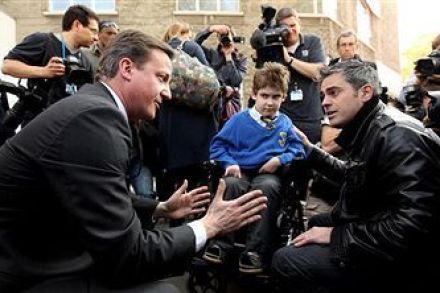
Jonathan Bartley, the man who ambushed Cameron yesterday, has written a piece for the Guardian. In it, the education establishment’s counter-productive monopoly is exposed. Bartley writes: ‘Either we are for inclusion or we aren't. To include children with special needs in mainstream schools takes commitment and a lot of work. Indeed, it requires "bias" – which has actually been lacking in the education system, despite all the talk of inclusion from Labour. There are few parents of children with special educational needs who would not want their children to attend their local school with brothers and sisters and friends, provided that the school is properly resourced, equipped and able to successfully include their children.