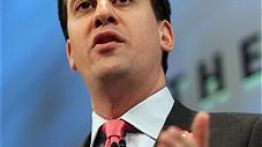
Ed miliband

The pros and cons of tweaking the housing benefit cuts

It says a lot about the Lib Dems that a meeting between their party leader and deputy leader can throw up so many policy differences. When Nick Clegg and Simon Hughes chatted behind closed doors yesterday, the latter sought concessions over the coalition's housing benefit cuts – the cuts that Clegg then had to defend in the House. This morning, it was reported that he might just get some of them, even though Downing St are denying the story. Regardless of the outcome, the situation is reminiscent of the child benefit cut for higher-rate taxpayers. A policy was announced, only for the coalition to start pulling back from it in the face of both internal and external opposition.

PMQs live blog | 27 October 2010

VERDICT: The housing benefit cuts inspired Ed Miliband's chosen attack – and he deployed it quite effectively, with none of the unclarity that we saw last week. For the most part, though, Cameron stood firm – leaning on his favourite rhetorical stick, What Would Labour Do? – and his final flurry against Ed Miliband was enough, I think, to win him this encounter on points. But don't expect this housing benefit issue to dissipate quickly. Bob Russell's question was evidence enough of how tricky this could be for the coalition. 1232: And that's it. My quick verdict shortly. 1231: Bob Russell, a Lib Dem, says that housing benefit cuts are "not a laughing matter," and urges the PM to reconsider the coalition's position.

Miliband’s stage directions

Labour have sprung a leak, and it's furnishing the Times with some high-grade copy. Yesterday, the paper got their hands on an internal party memo about economic policy. Today, it's one on how Ed Miliband should deal with PMQs (£). With this week's bout only an hour-and-a-half away, here are some of the key snippets: 1. The Big Prize. "The big prize is usually to provoke the PM into appearing evasive by repeatedly failing to answer a simple question, often one that requires a simple Yes or No." 2. Cheer lines. "It's important to have a cheer line that goes down well in the chamber and can be clipped easily by the broadcasters. Mocking humour us especially useful here, especially if it strikes a chord with Tory backbenchers to silence them." 3.

Stronger than expected growth

The growth figures for the third quarter of the year have just been released, and it's better than we thought: 0.8 percent, twice the 0.4 percent figure that was expected, but down on the 1.2 percent achieved in the spring. In any case, it should play well for Osborne & Co. We've just witnessed the fastest third-quarter expansion of the economy for a decade. Double speed, rather than double dip. Really, though, these figures throw up more questions than conclusions. By far the most important is: where next? The coalition would have been untroubled by an even larger reduction in growth now (caused by weak consumer spending, among other variables), so long as we get stronger growth in future.

Cameron’s certainty contrasts with Miliband’s equivocation

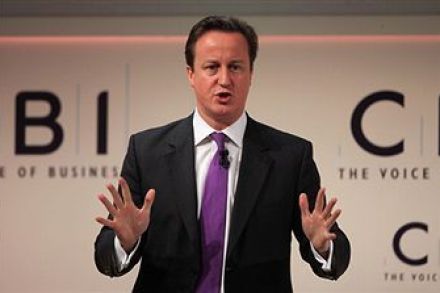
An opportunity to compare-and-contrast David Cameron and Ed Miliband outside the sweaty heat of PMQs, with both party leaders delivering speeches to the CBI this morning. Given the audience, both majored on business, enterprise, and all that – and it meant there was plenty of overlap on areas such as green technology and broadband. There were some differences, though, that are worth noting down. Cameron was first up, setting out a three-step plan for boosting British business. Broadly speaking, it revolved around what the government is trying to achieve in the Spending Review – and so the PM boasted that, "last week, we took Britain out of the danger zone.

Simpson and Bayliss are reading the Miliband creed

Derek Simpson has had a Damascene conversion. The gnarled bruiser, famous for telling Alistair Darling to ‘tax the bankers out of existence’, has backed Les Bayliss, the moderate candidate in the race to lead Unite. According to Sophy Ridge at the News of the World, Simpson added: 'Ranting and raving from the side lines will only keep Labour in opposition for a generation. The cuts announced this week are the tip of a very nasty iceberg but the task of opposing them will be complex. Only one candidate standing in the Unite general secretary election has in my mind the skills for this difficult job.

Cameron’s morals

By his own admission, to today’s Mail, David Cameron is not afraid of unpopularity. On hearing this, a few quizzical grins may break across his critics’ faces, but, undeniably, the government’s fate was cast this week: either its fiscal plan will work or it won’t. Cameron is unperturbed because he is sure that he is right - not only in his political and economic judgement, but also in terms of morality.

The Islamic Republic of Tower Hamlets

Andrew Gilligan explains why Lutfur Rahman’s victory in Tower Hamlets is a potentially alarming development. Obviously, this is a humiliation for Ed Miliband. The victory of a de-selected Labour councillor is bad enough, but what does he say about Ken Livingstone’s involvement in Rahman’s campaign? Widening those imploring eyes, offering an apologetic shrug and saying "Ken will be Ken" probably won’t cut the mustard this time. Perversely, Livingstone might benefit from Rahman’s victory, as it has allowed him to resuscitate his ‘Red Ken the insurgent’ pose – and you can’t get much more cynically subversive than this latest stunt.

Labour’s Kill Clegg strategy

One question swirling through the sea of British politics is this: how will Ed Miliband act towards the Lib Dems? The Labour leader certainly didn't flinch from attacking the yellow brigade during the leadership contest, at one point calling them a "disgrace to the traditions of liberalism." But surely he'll have to soften that rhetoric in case the next election delivers another bout of frenzied coalition negotiations. Which is why Andy Burnham's article in the Guardian today is worth noting down. In making his point – that the Lib Dems haven't won the pupil premium they sought – he does all he can to force a wedge between Nick Clegg and his party. It's "Clegg's failure". It's "Clegg's ideological journey". It's a "problem for Clegg," and so on.

Cameron’s warm-up act for Boy George

Cameron was a mere warm-up man at PMQs today. With Osborne’s statement due at 12.30 the session felt like a friendly knock-up rather than the main fixture. Ed Miliband rose to thunderous cheers from his backbenches and he tried to capitalise on their support by opening up an ancient Tory wound – heartless attitudes to unemployment. Spotting Cameron chinwagging with Osborne instead of listening, Miliband chided the PM for not paying attention. ‘Well, it’s a novel concept,’ said Dave smoothly ‘but in this government the prime minister and the chancellor speak to each other.’   Ed’s problem was that the OBR has predicted rising employment for the next three years. Bad news for the opposition leader.

PMQs live blog | 20 October 2010

QUICK VERDICT: More heat than light today, but Cameron easily got the better of Ed Miliband. Now to the Spending Review live blog. 1230: Cameron says that as cuts are made, the government will have to reform the way it does criminal justice. This is a prelude for the deep cuts that the Home Office and Justice department are expected to face in the spending review. 1228: The Lib Dem MP asks whether Cameron believes that better-off graduates should bear more for their university costs. Cameron says that he agrees on principle, and claims that "everyone in the House" wants the "same thing": a fair and well-funded university system. 1226: Cameron says that the spending review will contain answers on social housing - but hints that the results may be better than expected.

Cameron reveals the scale of defence cuts

David Cameron delivered his statement on the Strategic Defence and Security Review with few rhetorical flourishes. He had two main messages: i) the mission in Afghanistan would be spared from the 8 percent cuts in this Parliament’s defence budget, and ii) the problems the review is trying to deal with stem from the fact that “the last government got it badly wrong.”   The appalling legacy that Labour has left the coalition on defence rather hamstrung Ed Miliband in his response. The most memorable line in it was a gag about how he had advance sight of the statement in ‘today’s papers, Monday’s papers, Sunday’s papers.

Labour to propose raising the top rate of income tax?

Peter Hain is wizened counsellor to young king Ed, or gives that impression at least. The two are close, which makes Hain’s recent comments on tax noteworthy. Hain describes universal benefit as ‘non-negotiable’, adding: "If you start driving a coach and horses through universality you're effectively saying to middle Britain, 'you've got no stake in the welfare state.' I think the Tories and Liberals are making a very big mistake on child benefit. There's an answer to people on higher incomes and that's they pay higher taxes. And that is the answer to squaring that circle.

Ed Miliband has had a good week – only 200 to go

No one would begrudge Ed Miliband the plaudits for his fine first performance at PMQs. He has made a good start and seemed to take David Cameron by surprise. The Labour leader has a small, under-resourced team, which has been devoted much of the last week to preparing him for the task of his first confrontation with the Prime MInister. This is simply not sustainable. The weekly duel, terrifying though it may be, cannot come to dominate his thinking - however good he comes to be at it, He should always bear in mind the figure of William Hague, whose Labour mirror-image he risks becoming.  It has become a tiresome platitude, reinforced by New Labour rhetoric, that political parties must occupy the political centre ground in order to win elections in the UK.

Cameron’s cruise uninterrupted by Miliband’s confident start

You could write a book about that. The first ever Dave vs Ed Miliband fixture at PMQs was a fascinating joust between two smart, skilful and ruthlessly ambitious public men who have been groomed for power, in their different ways, from the cradle. Four decades of arduous preparation led to this tumultuous match. Ed Miliband opened in funereal tones and offered ritual homages to the dead of Afghanistan. Then in his modest bank-manager’s manner he pledged to support government reform to sickness benefits. But not, he added ominously, to child benefit cuts. How many families with one stay-home parent would suffer from the forthcoming cuts, he asked. Cameron couldn’t answer with an integer. He gave a percentage. Those who pay the higher tax-rate would be affected.

Miliband starts with a bang

Score the first round to Ed Miliband. In his debut PMQs performance, Miliband comfortably got the better of David Cameron, forcing him onto the defensive for most of the session. Miliband’s first question was a long and worthy one about the death of Linda Norgrove, the UK aid worker, in Afghanistan last week. Then, he moved to the proposed child benefit changes, asking Cameron to justify the anomaly where a single earner family on £45,000 a year would lose it while a two earner household on £80,000 would keep it. Cameron’s problem was that nine days after the policy was announced, he still has no answer to his point. (Although, I suspect that the number of households that fall into this category is fairly small).

PMQs live blog | 13 October 2010

VERDICT: Well, who would have thought it? In his first PMQs performance, Ed Miliband not only put in a solid showing – but he got the better of David Cameron. I certainly don't agree with the Labour leader's central argument: that it is unfair to restrict child benefit. But he put his point across in measured, reasonable tones – and Cameron seemed flustered by comparison, as he wagged on about the size of the deficit. Make no mistake, the argument and the public's sympathies will unwind themselves over the course of the entire Parliament. They will not be resolved in one session of PMQs. But in presentational terms, MiliE will have the more flattering clips on the news later – which is more than he could have expected going into today.

Miliband versus Dave – round one

Well, here it is. Ed Miliband will meet David Cameron for the first time at PMQs today. For all his determination and tactical sense, Miliband has his work cut out. Neither gave vintage speeches at the recent party conferences, but, in terms of presentation, Cameron’s easy wit trumps Miliband’s adenoidal drone. This will be Westminster's final act of posturing before next Wednesday’s spending review, a vanity soon to be forgotten. However, Labour has to fertilise its barren economic policy, and quickly. PMQs is the best opportunity to start.  Labour's strategy is clear: the government has made no plans for growth; in fact, their cuts are inimical to growth and squeeze hard-pressed middle earners.

Ed Miliband calls for humility – now let’s see some

So Ed Miliband told the Parliamentary Labour Party that he and they need to show humility. He is right, but this is easy to say and much, much harder to do. We shall see whether he has managed it at the despatch box tomorrow when the tackles David Cameron at his first PMQs. The feeling power gives politicians seeps into their bones and they get used to the trappings of deference. Ed Miliband has been close to significant power for most of his adult life, as have many of the people around him.  They need to realise that for a while - about 18 months probably - no one will be seriously interested in what Ed Miliband's vast new team of shadow ministers has to say. The lobbyists have long gone and soon the hacks, once so sycophantic, will start postponing lunches.

The Postie’s twinkle

The Postman's eyes twinkled as he met George Osborne across the dispatch box for the first time this afternoon. With the air of an apologist who isn't remotely contrite, Alan Johnson told the House of his 'vast experience in this job' and gave the impression he was having a blast. This jolly masque hid an insubstantial performance. Johnson latched on to Chris Huhne's vow that he would not be 'lashed to the mast' of needless spending cuts - Johnson wondered if the deficit might not be eradicated within one parliament. Osborne said that it would. Then Johnson repeated the substance of his attacks of the weekend.