Ed miliband

The Tories’ secret weapon

Too much time at the barbers. That’s the opposition’s problem. Ed Miliband showed up at PMQS today after a long morning lounging in the chair having his hair coiffed and burnished. His darkly gleaming scalp now looks like the kind of thing toffs scrape their boots on after a morning’s shooting. And that’s precisely what the Prime Minister proceeded to do with him today. With no time for a strategy meeting beforehand Ed had just grabbed a list questions from the last PMQs-but-three.   He began by having a go at Cameron on youth unemployment. But we know how Cameron deals with that one. Been a problem for decades, old

Cameron breaks from the norm at PMQs

PMQs today contained a rare moment: the Prime Minister admitting that he wasn’t happy with government policy. Ed Miliband, who split his questions up this week, asked Cameron if he was happy with his position on forestry and Cameron replied, ‘the short answer to that is no.’ The answer rather drew the sting from the rest of Miliband’s questions on the topic. But it was a rather embarrassing admission for the PM to have to make.    Cameron made quite a lot of news at the despatch box this week. He accused Manchester City Council of making “politically driven” cuts, said that more regulations needed to be scrapped and announced

Unemployment rises

It was the snow wot done it. The new unemployment figures have been published and the headline figures are that unemployment increased by 44,000 to 2.49 million between December 2010 and January 2011; the claimant count also went up by 2,400 to reach 1.46 million. It’s disappointing news, especially as figures from Germany are markedly different. Miliband may exploit the news at PMQs. But there are reasons to be positive. The government’s mouthpiece on these issues, Chris Grayling, who is less attack dog more beast of burden these days, argued that Q4’s negative growth figures will have had some effect on employment (and it’s likely to continue to do so

The Sun shines on Miliband

When Ed Miliband won the Labour leadership, there was much speculation that he’d be ‘Kinnocked’ by The Sun. His brother David had been the favoured News International candidate and ‘Red Ed’, as The Sun dubbed him, offered a fair few targets. But the paper has been giving the Labour leader a hearing in recent weeks. Ed Miliband has been to The Sun for dinner and today’s he written for the paper, attacking Cameron for breaking his promises on crime — classic Sun territory. Partly this rapprochement is a product of the fact that Labour are ahead in the polls. No paper can take the risk of writing Miliband off as

My Adventures in the Big Society

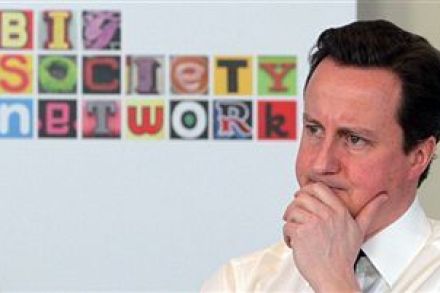
I was invited to Somerset House on the Strand yesterday as part of the Big Society Network to watch David Cameron take questions for the best part of an hour on his pet subject. My organisation, New Deal of the Mind, has been helping deliver two welfare-to-work contracts since last year and, along with most people in what I have learned to call “the third sector” I am prepared to give this idea the benefit of the doubt. There doesn’t seem to be anything particularly ideological about the Big Society, although Ed Miliband showed in his Independent on Sunday article at the weekend just how convenient a whipping boy this

A well fought fight

Plenty of personality at today’s PMQs. Not much policy. Miliband opened with one of his stiletto questions. Short sharp and deadly. ‘How’s his Big Society going?’ he asked the prime minister. Potentially this is tricky ground for Cameron and he rose to a barrage of Labour jeers. At least he’s had time to rehearse his defence. ‘Devolving power to local authorities was in the opposition manifesto and in ours and in the LibDems’ …Every member of the House of Commons backs what we’re talking about,’ he said cheerily. A robust counter-attack. Pose as an optimistic philosopher-king and leave Ed Miliband looking like a whining defeatist. Miliband duly obliged and unfurled

PMQS live blog

VERDICT: A rowdy session, but constructive. Miliband went for the Big Society, which is in severe difficulty at present. He was very effective, but his attacks lacked absolute coherence. He failed to establish a link between his examples and his wider political point that the agenda is mere packaging for latent libertarianism. So, Cameron had enough wriggle room to repulse Miliband and was able to launch his own attacks on the Labour leader’s irresponsible opportunism, and he also savaged Liverpool Council’s reactionary politicking. Both leaders had good lines and were deft on their feet, as point was met by counter-point. Their supporters were in full voice too, sufficient to allow

Today’s battlefield

Today’s PMQs threatens to be overshadowed by the statement on Project Merlin, the government’s deal with the banks, expected at one o’clock. I suspect that Cameron will try and push away any questions on banks with the line that Miliband should wait for the Chancellor’s statement. But PMQs will still be a far livelier affair than last week’s one. Watch to see whether Miliband tries to attack Cameron for hurting the Big Society. Miliband has moved Labour away from ridiculing the idea to embracing it and saying that ‘Tory cuts’ are the threat to it. This is all part of Labour’s strategy to try and ‘recontaminate’ the Tory brand. But

Cambridge’s £9,000 a year fees will cause political headaches

Cambridge University’s decision, leaked to The Guardian’s Nick Watt, to start charging fees of £9,000 a year from 2012 is an irritation for the Liberal Democrats who did not want any university to move to charging the highest fee possible straight away. It also threatens to overshadow Nick Clegg’s efforts to increase the social mix at Britain’s best universities. But the news has also reminded me of how tricky the question of university fees will be for Labour in 2015. If Labour says it is going to reduce the fees universities can charge, it will have to accompany this with a promise to increase state funding to make up the

What’s Labour’s alternative to the Big Society?

After a difficult few weeks for the Big Society, culminating in Liverpool’s nakedly political ‘withdrawal’ from the vanguard projects, Peter Oborne has already drafted an obituary for the Conservative’s policy agenda.   As Oborne says, the Big Society goes to the heart of this government’s reason for existence, and its (real or perceived) failure would damage the Conservatives. But it’s notable Labour has yet to come up with an alternative to the Big Society, or even a substantive critique of the idea. The problem for Miliband is that the Big Society agenda captures the centre ground of social policy – neither pro nor anti-state – and risks sidelining his party.

Clegg stands up for deficit reduction

Cleggologists will mark down the Deputy PM’s speech today as a typical effort. There was basically nothing in it that was new – but Clegg still put it across with more punch, and more persuasively, than most of his colleagues could manage. All of the slogans and pre-announced policies added up to something that sounded, fleetingly, like a plan for growth. Although we’ll still have to wait for Vince Cable’s review to see the outlines of that plan shaded in. Clegg’s main point was straightforward enough: that the government has to, and will, go beyond deficit reduction to stoke the embers of the British economy. He then ranged across everything

Miliband angles for the youth vote

For those who don’t have the inclination to delve behind the paywall, Ed Miliband’s interview with the Times can be summarised in four words: think of the children. Yep, the Labour leader is out a-courting the youth vote – and who, really, can blame him? The recent student protests have made Westminster’s strategists realise that these people aren’t apolitical after all. It was inevitable that someone would try to reach out to them. The problem for Miliband is that he doesn’t really have a prospectus to offer. He rattles off three familiar policies – a graduate tax (of uncertain design, and even more uncertain worth), votes at 16, more apprenticeships

Coffee House interview: Julian Astle

Open any mass-circulation newspaper and you will find plenty of insider’s information about the Tory party. But precious little is known about their coalition partners, the Liberal Democrats. After decades in the political wilderness, most editors reasoned that it wasn’t really worth their while finding out what the party thought. After all, what difference did it make?   Well, times have changed. What the party thinks, what it does, and, crucially, what it won’t do, really does matter. So to help us here at Coffee House, Julian Astle, a friend of the Lib Dem leadership and director of CentreForum, the liberal think tank, has agreed to answer a few questions.

As the oldest parliament yawned, the oldest civilisation erupted

One yawn every minute. That’s how PMQs felt today. Foreign affairs dominated the session as Ed Miliband and the Prime Minister exchanged lofty words about the Cairo demonstrations and the spread of democracy around the world. Doubtless they felt they struck a suitably elevated tone but to the viewers they came across as a pair of prep school smart-alecs trying to sound like great statesmen disposing of liberated peoples after the fall of empires. Egypt and Afghanistan were both treated to a torrent of high-minded vacuities. David Cameron found the demonstrations ‘incredibly moving.’ Ed Miliband was impressed by the sight of ‘hundreds of thousands of people facing overwhelming odds to

Consensus reigns over PMQs

A very different PMQs this week: six questions on foreign affairs and almost total consensus between Cameron and Miliband. Miliband’s office had given No 10 advance warning of the topics they wanted to raise and the two agreed on pretty much everything. Miliband argued that ‘the best route to stability is through democracy.’ Cameron agreed but stressed that democracy means more than just elections. You get the picture. At the risk of disagreeing with Pete, I must say that the exchanges were a reminder of just how dull PMQs would be if it was not confrontational. For Miliband, the advantage in taking this more considered approach today was that it

PMQs live blog | 2 February 2011

VERDICT: What a refreshing change that was. After several weeks of Punch ‘n’ Judy rivalry, the two party leaders finally put down their batons and stumbled upon a new way to do it. Much of the credit must go to Ed Miliband, for asking pacific questions about Egypt and Afghanistan in the first place. But credit, also, to Cameron, for answering them in a straightforward and statesmanlike manner. The rest of the House, for its part, was stunned into silence by this peculiar scene. Some of the blood rushed back into proceedings with the backbench questions, and as Cameron directed attacks at Ed Balls, but this must still go down

Ten points about the Ed Balls interview

Ed Balls gets personal in his interview with the Times (£) today, but not in the way you might expect. For most of the piece he dwells on what the paper calls his “hidden vulnerability” – the effort to contain his stammer. And from there on, the politics seems a touch softer than usual. There are surprisingly few overt attacks on his opponents, and those that make the cut are considerably less violent that we’re used too. Which isn’t to say that the interview lacks politics. No sirree. Here’s a ten-point selection of some of the political highlights (so to speak), with my added comments:      1) Doubling back

The Limits of Hefferism. (And of Ed Miliband)

Anthony Wells sifts through IPSOS Mori’s latest poll: For David Cameron, 30% of people like both him and his party, 39% like neither. 17% like Cameron but not his party, 7% like the Conservatives but not Cameron. Hence, in total Cameron is liked by 47% of people (down 6 since before the election) and the Conservatives by 37% (down 1) – while Cameron’s likeability has dropped somewhat since the election, he is still viewed considerable more positively than the party he leads. Emphasis added. Like everyone else, I’m an admirer of Simon Heffer’s style (and he is sound on cricket too) but it might be worth remembering that his pro-Conservative,

The Lib Dems reject Ed Miliband’s overtures (again)

What a joy it is to watch Ed Miliband contort and twist so that he can offer a hand of friendship to the Lib Dems. It has been a three-act show, so far. First, during the Labour leadership contest, he described the Lib Dems as a “disgrace to the traditions of liberalism,” adding that, “I can see the death of the Liberal party to be honest”. Then, he said that he would actually work with those dying Liberals, but only if they ditched Nick Clegg first. And then today, in an interview with the Independent, he suggests that Clegg might be able to stay on, after all. As turnarounds go,

This Ed’s no Goliath

Ed Milliband took up his position at PMQs today flanked by Caroline Flint and Ed Balls. Between a rock and a hard face. His proximity to so many colleagues who wish him ill can hardly have helped his performance. He was like a stale doughnut. Layers of stodge surrounding a hole in the air.   His battle-plan wasn’t entirely useless. He wanted to tempt the prime minister into foolish speculation about the causes of last quarter’s poor growth figures. Cameron stood up and admitted that the numbers were pretty lousy whether the weather were blamed or not. And that whether-the-weather left Miliband completely stuffed. He’d expected Cameron to shift at