Ed miliband

Labour divided on electoral reform

John Healey has become the most senior shadow cabinet minister to declare that he will be voting no to AV. In a pugnacious article for the Independent, the Shadow Health Secretary describes the proposed system as a ‘perverse’ leg-up to extremists and one that will make Nick Clegg a permanent kingmaker. He added that he had not been ‘persuaded that AV is an upgrade to the voting system’. This is a small but important intervention. Until now, Labour’s contribution to the no campaign had been a procession of ghosts from former regimes: messrs Reid, Blunkett and Prescott being the most prominent of these heavyweight has-beens.

Miliband: I won’t share a stage with Clegg

Ed Miliband has been on Sky, talking about the alternative vote and Nick Clegg. The normally consensual Miliband was in strident mood. He said: ‘I want to win the AV referendum because I think it is important to reform our politics and I think it will make for a more accountable democracy and one where more votes count. The problem is Nick Clegg is the last thing we need to win this referendum.’ Earlier this morning, Miliband also urged Clegg to ‘lie low for a bit', after the latter's office allegedly derailed a joint event on AV between Miliband and Charlie Kennedy. Miliband may be dabbling in the Leader of the Opposition’s stock-in-trade of curt throwaway lines, but this could signify a policy shift.

Are two Eds better than one?

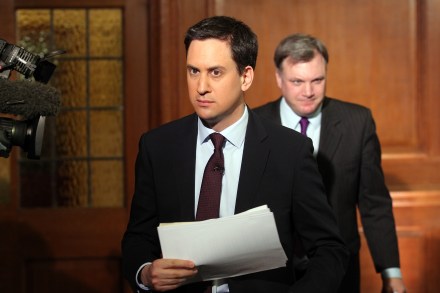
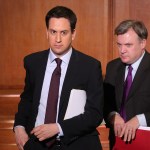
This was the question raised by today’s joint Balls Miliband press conference. The two Eds are very different in both body language and temperament. Balls is the far more pugilistic politician, always looking to dispute the premises of a question and happy to use aggressive language. While Miliband is far more of a conciliator, looking to find consensus and using only gentle humour. They even stand at the lectern in different ways: Balls hunched over his, leaning into the fight. Miliband hanging back from his, and taking a gentle step towards it when answering a question. The danger for Miliband is that Balls appears to be the alpha male, the one taking the fight to Labour’s enemies.

Balls and Miliband fail the credibility test

Eds Miliband and Balls gathered the press corps together this morning to broadcast a straightforward message: oh yes, we do have an alternative. And the shape of that alternative? A repeat of the one-off tax on bankers' bonuses that, Balls claimed, raised £3.5 billion last year. The money would be used for an entire buffet of economic delights, from the creation of new houses to the funding of job schemes for the young. The upshot, apparently, would be 110,000 new jobs. Nice work, as they say — if you can get it. But there are a couple of problems with all that, the first of which Labour has pre-empted. It is that last year's bonus tax may not have raised as much as £3.5 billion, after all.

Balls sets Labour against Clegg (again)

It's not just the protestors who are rallying against Nick Clegg today. Here's what Ed Balls has to say about the Lib Dem leader, in interview with the Guardian: "'Clegg looks an increasingly desperate, shrill and discredited politician, losing both public and party support. People think that if Clegg says something, it cannot be the truth. The Liberal Democrats need to have some real hard thinking about what they stand for' He says it would be impossible for Labour to govern with Clegg after the election, arguing: 'I don't see how Nick Clegg could change direction again with any shred of credibility, or how he could work with Labour now, but that is not true of Liberal Democrats more widely.

Labour’s inflation pitch

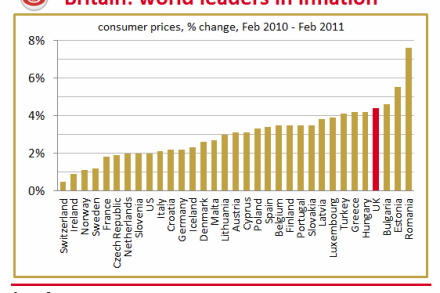
Curiouser and curiouser. We in Coffee House have been saying for some time now that – whatever Mervyn King thinks – Britain has the worst inflation in the Western World apart from Greece. An OECD report out today shows we’ve got it worse than most eastern countries too. Korea, Turkey and Estonia are the only eastern nations with higher inflation: But what strikes me most about today is that food prices are soaring here, to an extent far worse than the rest of the world. This is what voters notice most: putting food on the table is very expensive. As Micawber might put it: annual food price inflation 6.3 per cent, annual wage inflation 2.5 per cent, result: misery. And plenty of it.

Abel fights back

One of the hardest tasks of any opposition is to gain the trust and credibility to run the economy. After what happened over the last few years, Labour have an enormous credibility gap. Ed Balls’ decision to oppose any measure to deal with the deficit has reduced Labour’s economic credibility still further. So too has the two Eds’ decision to make attacks based on mis-truths, like denying there was a structural deficit before the election; or attacking the coalition for cutting bank taxes, when it is actually putting them up; and like backing another bonus tax, despite opposing it at the election, and despite Alistair Darling’s careful explanation of why it won’t work.

A tasty contest

Today’s PMQs was full of verve and bite. A welcome change after last week’s washout. It’s all getting a bit tasty between Ed and Dave. The Labour leader opened with Libya and after making ritual noises about wanting to support the government’s foreign policy he admitted he found it hard not to voice his ‘concern about incompetence’. Nice tactics there. Pose as a statesman and stick the blade in under the table. But Cameron wasn’t standing for it. ‘I don’t want to take a lecture from Labour about dealing with Libya and Gadaffi,’ he said furiously. And the cheers from the Tory benches redoubled when he called for Labour to apologise for its part in the release of the still-not-dead Al Megrahi.

PMQs live blog | 9 March 2011

VERDICT: A turgid sort of PMQs, where most of the quips were clumsy rather than cutting. Cameron probably won it by virtue of one of the few direct hits – his line about Ed Miliband knifing a foreign secretary, aka MiliD – and because Miliband failed, really, to prod and aggravate the coalition's wounds over Libya. The Labour leader's main attack – over the competence of the coalition – was clear enough, though, and could have some purchase depending on, erm, how competent the coalition is. As it is, Cameron's hint that he still has the occasional cigarette will probably capture the spotlight. 1231: And that's it. My quick verdict shortly.

David Miliband hurtles back into orbit

Ah, there it is, in the final sentence of the fourth paragraph: a flattering reference to Ed Miliband. Phew. Good job David Miliband squeezed his brother's name into his article on Labour's future (£) for the Times today, otherwise it might have been July 2008 all over again. As it is, MiliD's third newspaper article in as many days is enough to suggest that he's keen to remain a prominent figure, if not yet an actual rival for his brother's crown. In some respects, though, the recommendations made by MiliD are a challenge to his brother's Way of Doing Things. His suggestion that the left be "an ally of wealth creation," for instance, reads something like: "enough with the banker bashing, already.

Pickles on the offensive against ‘propaganda sheets’

Eric Pickles is no longer a genial giant. His speech to the Conservative Spring Forum was the rallying cry that many Conservatives in local government, some of whom will be scrapping for survival in May’s elections, have waited to hear.   ‘Ed Miliband,’ Pickles said, ‘is weaker than Neil Kinnock.’ The Labour leader could not take on his unions and militant councils, the Communities Secretaries said before turning an example: ‘Take Labour-run Camden. Ed Miliband’s local council. His councillors are cutting the Surma Community Centre, coincidentally visited by Samantha Cameron. Yet the council has spent twice as much on its town hall newspaper.

Khan comes to Ken Clarke’s support (kinda)

When it comes to the overall sway of British politics, Sadiq Khan's article for the Guardian is probably the most important of the day. We've heard Ed Miliband say before that, "when Ken Clarke says we need to look at short sentences in prison because of high re-offending rates, I'm not going to say he's soft on crime." But Khan's article, a summary of a speech he is giving later today, actually puts that sentiment into practice – and then some. His central argument is straight from the Hush Puppied One's playbook, particularly in its emphasis on the limitations of New Labour's policy: "Some claim crime fell because of the rise in the numbers imprisoned. But the relationship between crime rates and prison population is more complex than that.

Why Ed Miliband’s getting it right on the cost of living

George Osborne's budget, due in two weeks' time, will be billed as an agenda for growth. This is welcome, but a year late. The burning agenda now is the cost of living. It was our cover story for The Spectator last October: why fret about mild 1 percent-a-year cuts, we asked, when the real killer will be prices? Petrol at 130p a litre is only the most visible sign of this. Other horrors confront shoppers in the supermarket - salmon fillets up by a third, potatoes and butter by a quarter. When Alan Duncan speculated that petrol could hit 200p, he was on the right scent. While the BBC is talking about cuts and Osborne is talking about jobs, Ed Miliband is now talking about the cost of living - even helping to launch a Commission on the Cost of Living.

Osborne’s political economy

George Osborne’s speech to the Tory spring conference today showed the classic left-right way in which he wants to frame the political debate about the economy ahead of the Budget on the 23rd of March.  In a move straight out of the election-winning centre-right playbook of the 80s, he attacked Balls and Miliband as “Two left-wing politicians who don't understand anyone who wants to get up and get on, anyone who want a better life for their family, anyone who want to create wealth, and start a business, and create jobs, and leave something to their children.

Dave ‘n’ Ed’s Flying Circus

It was Monty Python without the jokes. The focus of PMQs today veered surreally between crisis in north Africa and early swimming pool closures in Leeds. The session opened in Security Council mode with Ed Miliband politely asking the PM to brief us on the humanitarian disaster evolving in Libya’s border-zone. Cameron went into his statesman-of-the-year routine and announced that HMS York had docked in Benghazi with medical supplies.   At such moments the imperial ghosts of the Commons seem momentarily reawakened. Ed Miliband sounds like some Victorian stooge asking the Foreign Secretary to reassure the nation that an uprising in a far-flung oriental possession is being energetically suppressed. Having dealt with Libya, Ed Miliband moved to Bromley.

Osborne goes on the offensive

Attack, attack, attack. That's the temper of George Osborne's article for the Guardian this morning, which sets about Labour's economic credibility with a ferocious sort of glee. Perhaps the best passage is where he asks how many times Labour can spend their ubiquitous "bank tax," but this is more pertinent to the recent debate: "Where does all this leave Ed Miliband's newfound enthusiasm for the "squeezed middle"? Let's pass over his failure in every interview to define it – his last effort included around 90% of taxpayers. Where we can all agree is that these are difficult times for family incomes. There are two root causes. One is global: rises in food and commodity prices.

Miliband’s latest break with the past

As an independent creature, the Resolution Foundation's new Commission on Living Standards isn't doing Ed Miliband's work for him. But, boy, must the Labour leader be glad that they exist. At their launch event this morning, the "squeezed middle" – aka low-to-middle earners – suddenly took shape. There were graphs, such as those in James Plunkett's post for us earlier, setting out the very real problems facing a segment of British society. And there were even definitions explaining what that segment is: 11 million adults, by the Resolution Foundation's count, too rich to benefit from measures for the least well-off, and too poor to be entirely comfortable. This was a decent platform for Miliband's speech, and he used it to make a fairly important leap forward.

Labour sets about warning of a “cost of living crisis”

Ed Balls has been warming up to this one for a while, and now it has finally come: an all-out attack over rising prices. In an interview with the Sunday Times (£), the shadow chancellor warns of Britain's "cost of living crisis," and demands that George Osborne reverse the VAT increase. Much of his pleading is made on behalf of motorists, who – as I pointed out a couple of days ago – face punishment at the petrol pumps. He doesn't even mention spending cuts once, especially not where his own party's are concerned. Rising costs, clearly, are the new weapon of choice. And it's not just Balls.

Mandelson casts doubt on Miliband’s vision

The Kindly Pussycat has returned to the fray with a revised version of his memoirs. The FT's Jim Pickard has highlighted an arresting passage about Ed Miliband’s decision to execute New Labour. 'When Ed pronounced New Labour ‘dead’, he was not only being more categorical than was wise, but quite possibly more than he really intended. (xxi) …Even allowing for the tactical choices he had made in his bid to become leader, however, I was struck by the fact that he had given no strong clue during the campaign as to what alternative to New Labour he envisaged. He was quick to say what he was against: essentially, Tory policies and Tony’s policies.

A fraternal fix

"Now he and his leader know what it’s like to be people’s second choice," trilled George Osborne during his recent encounter with Ed Balls over the dispatch box. But might Balls actually have been Miliband's third choice for the shadow chancellorship? That's the implication of a delicious little story in today's Sun, which claims that Miliband first "tapped up" his brother, aka MiliD, when trying to replace Alan Johnson: "A Labour insider revealed: 'Ed's people were desperate not to give the job to Balls.' However, Ed stopped short of offering his brother the job when David made it clear he wanted to stay on the backbenches." If true, then it's revealing on two counts.