Ed miliband

The spotlight shifts to Labour

Politics abhors a news vacuum. So with the government on holiday, attention shifts to the opposition. This is why oppositions normally have a whole series of summer stories ready to fill this vacuum. But, oddly, we have heard little from the Labour front bench in the last ten days or so. One consequence of this is that criticisms of Ed Miliband’s leadership by the Labour backbencher George Mudie are going to get more play than they normally would in tomorrow’s papers. There’ve been none of the attacks on a government that you would expect from the opposition in the penultimate summer before a general election. It is hard not to

George Mudie’s gloomy tunes suggests that Ed Miliband is under increasing pressure

George Mudie is the Labour Party’s answer to Marvin the Paranoid Android. He gave an interview to The World At One earlier today which was so morose in tone that I think he must, as a matter of urgency, have a meal at the Restaurant At the End of Universe. Yet, through the fog of his despair, Mudie (a seasoned agitator of the Blair and Brown era) shot some cruel barbs at Ed Miliband. Words like ‘confused’ and ‘hesitant’ dotted his spiel, together with rambling rhetorical questions like: ‘Do you know, ‘cos I don’t, our position on welfare, do you know our position on education, do you know our genuine position on how we’d run the health service?’  The Tories

Shapps’s trinity of Labour weaknesses

Grant Shapps’ latest broadside against Labour shows how keen the Tories are to frame the next election not as a referendum on their performance in government but as a choice between them and Labour. Shapps wants voters to think about the fact that the alternative to David Cameron as Prime Minister is ‘Miliband and Balls’ driving up Downing Street before they cast their ballots. The Tory Chairman’s speech, due to be delivered at Policy Exchange this morning, also shows where the Tories think Labour are vulnerable. Tellingly, he talks about ‘Miliband and Balls’ rather than just Miliband; the Tories believe that Balls’ presence is a reminder to voters of the

The three places where the Tories want to hit Labour hardest

In the last few months, the Tories have–quite deliberately—behaved like an aggressive opposition. They’ve sought to constantly attack Labour, trying to force them onto the back foot. Even with David Cameron and George Osborne away on holiday, the Tories are determined to keep doing this. On Wednesday, Grant Shapps will launch the Tories’ summer offensive against Labour. He, in the kind of language more commonly used to promote summer horror films than a political agenda, will invite voters ‘to imagine a world where Ed Balls and Ed Miliband end up back in Downing Street.’ This is all part of the Tories’ efforts to link Miliband to Gordon Brown and memories

Ashcroft poll shows potential cost of union reforms for Labour – and the opportunity for the Tories

Ed Miliband was clear yesterday when he announced that he will run a special party conference next spring to vote through his reforms to Labour’s relationship with the unions that there would be a ‘cost’ to the party. Now we have the first indications of how great that cost might be. Lord Ashcroft has released one of his inimitable polls, this time of Unite union members. It finds that only 30 per cent of members would choose to opt in to Unite’s political fund, while 53 per cent said they would not and 17 per cent had not decided. There wasn’t much support for the current opt-out system, either, with

PMQs sketch: Cigarettes and alcohol and Lynton Crosby

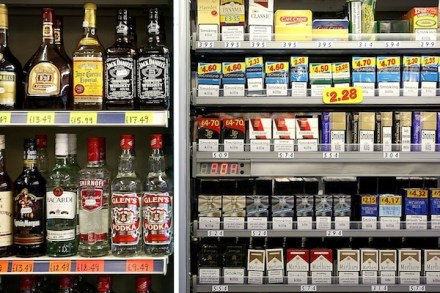
Cigs and booze. These issues dominated PMQs today. Ed Miliband tried to portray the PM as a puppet of ‘Big Tobacco’ whose decision not to introduce plain packaging for cigarettes was influenced by his electoral guru, Lynton Crosby. Had the PM ever ‘had a conversation’ with Crosby about fag packets? Shifty Cameron dodged sideways and declared that Crosby never ‘lobbied me about anything’. ‘Weasel words,’ said Miliband, looking triumphant. He quoted a Tory GP, Sarah Wollaston, who labelled the decision ‘a day of shame’ for the government. Up popped the lady herself from the backbenches. Dr Wollaston begged the PM to re-think his decision against ‘minimum unit pricing’, which she

PMQs: Cameron cheers MPs with ‘every day this country is getting stronger and he is getting weaker’ attack

PMQs today was not as noisy an affair as last week. But the opening exchanges between David Cameron and Ed Miliband still had plenty of needle in them: things are becoming increasingly personal between these two. The Cameron/Miliband exchanges were initially relatively even. I noticed a fair few Tory backbenchers having to stifle a laugh at Miliband’s line that Cameron was the Prime Minister for ‘Benson and Hedge funds’. His attack on Cameron’s ‘weasel words’ about whether or not Lynton Crosby had spoken to him about plain packaging, combined with Labour’s call for an inquiry by the Cabinet Secretary, will keep this story going. But Cameron’s last line that ‘every

Why partisan columnists (like me) are doomed

An email exchange with a Conservative-leaning friend this week left me feeling sheepish. But if shameful my behaviour be, I’m not alone in the shame. I thought it worth sharing the conversation. We were corresponding about Ed Miliband’s stand-off with the Unite trade union. In a message to my friend, I remarked: ‘It’s reaching the point where (paradoxically) EM’s tendency to take the line of least resistance may actually push him into confronting Unite.’ And that’s true: worms turn and it’s not always good politics to corner people. But it is the next part of the message that I’m hard-put to defend. If Miliband wimps out, I said, then ‘I

The Spectator’s notes | 11 July 2013

Andrew Mitchell was forced to resign as the Tory Chief Whip last autumn because he called policemen at the Downing Street gates ‘plebs’. Then it turned out, as this column suggested at the time, that he had not done so. It emerged that there was a conspiracy — quite how deep has not yet been made public — by police and accomplices to attribute to Mr Mitchell words which he did not speak. People pretending to be by-standing members of the public said how shocked they were by Mr Mitchell’s remarks, and then it turned out that no bystanders had been within earshot of whatever it was that Mr Mitchell had

Dame Gail Rebuck – tax cutter

The Queen of Publishing, Dame Gail Rebuck, abdicated earlier this week when she stood down as chairman and chief executive of Random House. Dame Gail will take up the somewhat more emeritus position of chairman of the UK arm of Penguin Random House — the literary world’s new super-group. Her Majesty will use some of her spare time to chair the Cheltenham Literary Festival. She has been making remarks about these changes over the last couple of days and Mr Steerpike was interested to learn that this firm Labour supporter, the widow of Philip Gould, is a tax cutter. She said that bookshops (which she believes to be ‘cultural showcases’) should be given tax

PMQs sketch: Wimbledon and trade union scandals

Andy Murray’s joy is now complete. Yes, he won Wimbledon and all that, but his crowning glory came today when he was mentioned at the start of PMQs. Cameron apparently has no idea how goofy and devious he looked last Sunday when he half-opened the door of Downing Street and stepped out to greet Murray with a shifty smirk plastered across his face. In the House, he declared that the first British victory at Wimbledon in 77 years was a historic event. Ed Miliband agreed but appended the triumph of Virginia Wade in 1977 to Cameron’s tribute. This was greeted by a Labour cheer so loud that it registered at

Miliband shores up his leadership at noisy PMQs

That was as loud as the Prime Minister’s Questions that immediately preceded the last election. The Labour benches were clearly determined to ensure that there was no repeat of last week’s mauling of Ed Miliband. They barracked David Cameron from the off, even chanting ‘weak, weak, weak’ during his answers and almost every Labour question was on the propriety of the Tories’ relations with their donors. This, combined with a far stronger performance from Ed Miliband, ensured that the session ended with Cameron, not Miliband, on the back foot. Cameron’s problem is that Miliband is turning this from a debate about union influence on Labour selections into one about money

Miliband’s challenge is an opportunity for the Tories to reach out to union members

The warm reception to Ed Miliband’s speech yesterday was so eerily positive that it could never have lasted. Today we get the first taste of the real battle to come, with the GMB warning that they’d be ‘lucky if 10% of our current affiliation levels say yes, they want to be members of the Labour party’ and that as a result the union could disaffiliate from the party. This is a challenge for Ed Miliband to show that he is determined to force these changes, even if it means calling a party-wide ballot to overrule the union bosses But this is also an opportunity for the Conservatives. If the unions

Let’s have iMembers in our parties and really change politics

Ed Miliband got it right. Faced with a fiasco in Falkirk, where the trade union, Unite, attempted to fix the Parliamentary selection process, the Labour leader has come out on the right side of the argument about political reform. In our eagerness to attack him, we Conservatives are in danger of putting itself on the wrong side of the debate. Falkirk-type fixes have been going on for years. Safe Labour seats have been run as trade union fiefdoms for as long as anyone can remember. What Falkirk demonstrates is not that tiny cliques have been manipulating party selections, but that that old school way of doing politics is no longer acceptable.

Ed Miliband’s Surprisingly Bold Plan for A New Model Labour Party

Tony Blair has welcomed Ed Miliband’s “big speech” on reforming Labour’s relationship with its Trade Union backers. And so has Len McCluskey, chief potentate at Unite, the Union whose allegedly nefarious activities in Falkirk have prodded Miliband towards reform. Blair expects Miliband’s proposals to change everything; McCluskey, presumably, is confident any changes will prove largely cosmetic. They can’t both be right. But, actually, it is a little unfair to put “big speech” in inverted commas. This was, or at least has the potential to be, a transforming moment for the Labour party. Granted, no-one is quite sure how this will happen  – and the detail matters – but everyone agrees

If Labour is to be democratised, Ed Miliband must reform how his party chooses its leader

By insisting that trade unionists must opt-in to party membership, Ed Miliband has taken a bold and brave first step in reforming Labour’s troublesome relationship with its affiliated trade unions. At a stroke, he has gone far beyond the achievements of his modernising predecessors, John Smith and Tony Blair. Considerable fanfare accompanied the introduction of one member one vote for party elections in 1993 but John Smith’s initiative proved to be flawed – an outcome demonstrated by the role that trade union leaderships were able to play in the 2010 Labour leadership contest. The abolition of Clause IV in 1995 was little more than a symbolic reform.For all the furore

Ed Miliband is back on the front foot, for now at least

There was a point in Ed Miliband’s speech on a ‘better politics’ where it became clear that for the rest of our lives we’re all going to be trapped in an endless cycle of opposition politicians announcing that they are going to forge a ‘new politics’, as though some other chap hadn’t said the same thing only a few years before. There really is nothing new under the sun. But it would be unfair to dismiss the Labour leader’s speech as meaningless simply for saying what others have said before him: perhaps he was hoping that the goldfish bowl of the Westminster Village would turn out to contain a bunch

Ed Miliband’s speech on reforming Labour’s relationship with trade unions: full text

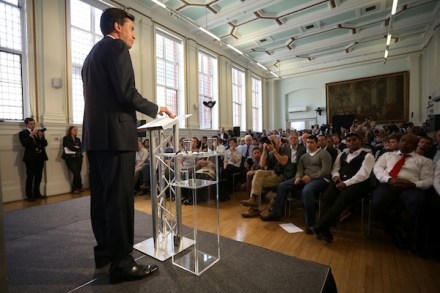
Let me start by saying how pleased I am to be here at the St Bride’s Foundation. Only a few hundred yards from where the Labour Party was founded over a century ago. And especially to be here with so many community organisers and Labour Party members from right across the country. I am here today to talk about how we can build a different kind of politics. A politics which is truly rooted in every community of the country. And reaches out to people across every walk of life. That is what I mean by One Nation. A country where everyone plays their part. And a politics where they

God forbid that unions try to influence the Labour Party

I think it was the arrival into the debate of those Blairite ghosts Mandelson and Reid which helped me make my mind up. Somehow, Ed Miliband has been coerced into taking on the Unite union on the grounds that they are doing shady business on the matter of selecting candidates. Mandelson and Reid are both demanding Miliband stand firm (an interesting thought) and stick it to Len McCluskey: Unite is trying to influence Labour’s agenda, they howl. Well god forbid that unions have any input into the Labour Party’s policies. I don’t know what Len and the boys have been up to, but the real disgrace about candidate selection is