Ed miliband

A rare success for Downing Street spin machine

Downing Street and the press are rarely a productive coupling, though it seems the PM’s spin team have, for once, inadvertently spawned something positive. Introducing his new book about journalistic cliché to the world at a star-studded occasion’ in ‘London’s glamorous West End’ this week, Bloomberg hack Rob Hutton told how No.10 had triggered him to write Romps, Tots and Boffins: ‘This book wouldn’t have happened at all, but for No 10’s inability to find a plane with room for journalists whenever the PM goes to controversial places. In the good old days, a trip to the Middle East would have meant a big plane, with the prime minister at the

PMQs: Cameron lands the blows with cheesy jokes

David Cameron managed to win Prime Minister’s Questions today by shoehorning in a series of smart one-liners about Ed Miliband’s leadership. It says a lot about how the Prime Minister has managed to recover quite impressively from his defeat over Syria that he has been able to continue his ‘weak’ attack line. On that Thursday night in the Commons when the government lost its vote, it seemed that Cameron was dangerously weakened. Today he threw out jokes about Miliband having ‘folded faster than a Bournemouth deck chair’, that the Labour leader ‘went to Bournemouth and he completely bottled it’ and that ‘he told us it was going to be Raging

Ed Miliband avoids a showy showdown with the unions

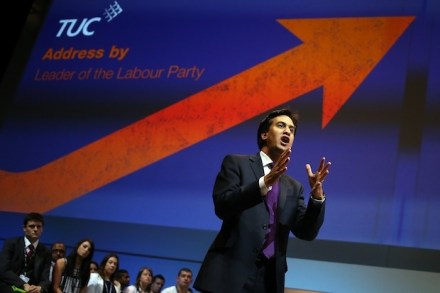
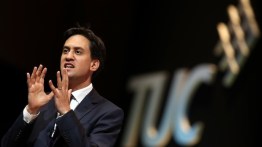
When Ed Miliband peaks, he really knows how to do it. His speech at last autumn’s Labour conference was magnificent. Given the pressure on him to convince the unions to back his reforms to their links to the Labour party, you’d expect he’d have picked today’s address to the Trades Union Congress conference to deliver another blinder. Sadly today was not a peak in the range of Miliband speeches. Sure, he produced a vaguely funny joke about a chap called ‘Red Ed’ who was in fact the Conservative Prime Minister Edward Stanley. Miliband told the conference that Stanley was ‘the man who first legislated to allow trade unions in this

Ed Miliband vs the Trade Unions (and why Tories should hope the Unions win)

There is something distasteful about the latest Tory assault on the Trade Union movement. I hold neither candle nor torch for Len McCluskey and am, generally speaking, opposed to the kinds of policies much-favoured by Union bosses (sorry “Barons”). But the Tory attack on organised labour still jars. It may well be that the unions do a poor job of representing the interests of their members. It may also be that they have an outsized influence on the Labour party. These seem matters for union members and the Labour party to decide for themselves. It’s not really anyone else’s business. And, to be frank, the distinction between attacking Union bosses

Ed Miliband: Cameron wants to write trade union members off

Ed Miliband thought he’d delivered the speech of his life at last year’s Labour conference. But though it knocked the socks off everyone in the conference hall, it wasn’t enough: the Labour leader is having to deliver to one but two speeches to save himself this autumn. Today he will try to sell his union reforms to the Trades Union Congress conference in Bournemouth, and in a fortnight he will give another important party conference speech. The Labour leader wants to frame his reforms as having a purpose that all parties should want: bringing politicians back into contact with ordinary people. He will try to contrast what he plans to

The malign influence of trade union extends beyond the takeover of Labour

Money passes hands. Allegations are made. A would-be MP is suspended, only to be pardoned once evidence is mysteriously withdrawn. Such is the murky world of Labour’s relationship with the trade unions. Since the revelations of vote rigging in the Falkirk candidate selection the Westminster bubble has become obsessed by a number of questions. How much funding does Labour get from trade unions? (too much), what exactly did they get in return? (Ed Miliband) and will Red Ed will be able to stand up to paymasters? (he won’t). As Ed Miliband travels to Bournemouth the unseemly brawl of student politics are being writ large in one of the UK’s largest

Cameron wants to stop talking about ‘the crisis of our time’ as quickly as he can

David Cameron’s statement to the Commons on the G20 wasn’t as lyrical as his response to Russia’s ‘small island jibe’. But it was a reminder of the needle that now exists between Cameron and Miliband. In previous times, these statements—which are far less tense affairs than PMQs—have seen a bit of badinage between the two front benches. But that has now gone. The statement was dominated by Syria, which Cameron called the ‘refugee crisis of our time’. When Cameron talks about his defeat in the Commons on Syria, he speaks very quickly, with no pauses between the words. It’s as if he wants to get talking about it over as

Ed Miliband’s zero hours gesture to the trade unions

Ed Miliband and Harriet Harman are keen to encourage unity at the TUC conference this week, while giving the impression they are determined to forge ahead with reforming the union link to the Labour party. Harman’s speech to the TUC dinner will include a call for unity and an attempt to explain the need for the reforms. She will say: ‘Ours is a deep-rooted and historic link but it is a relationship which has never been set in stone and is always changing. But, the thing that has endured is that our unity is the bulwark against reaction and the only hope for progress. ‘I am proud of the link

Miliband has to win the fight that he’s started

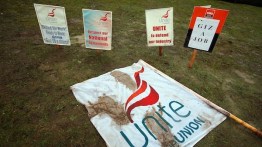
When Ed Miliband was booed at the TUC in 2011, there was quiet delight among many of his closest aides. They thought that this jeering would help put some distance between Miliband and the unions and show that he wasn’t their puppet despite the role they had played in his election. But this year, the booing that Miliband is expected to receive will matter far more. Miliband is now engaged in a defining struggle with the union machine over his party reforms. As I say in the Mail on Sunday today, if he doesn’t get them through, then he’ll be a busted flush as a leader. Unite being cleared by

Liam Byrne’s vulture strategy

David Aaronovitch’s furious Times column this morning described Ed Miliband as a vulture, swooping down on problems caused by this government rather than leading. If he wanted another example of how this leadership style has affected the rest of the Labour party, he could have done worse than to attend the Commons urgent question on universal credit this morning. There, Liam Byrne attacked Iain Duncan Smith’s handling of the project, saying: ‘What I want to say to the Secretary of State, however, is this: he has let this House form a picture of universal credit, which the nation’s auditor’s say is wrong. The most charitable explanation is that he has

PMQs: David Cameron’s hatred towards Ed Miliband is palpable

MPs piled into the Chamber expecting a blood and thunder affair. But instead it was rather subdued. Ed Miliband chose to ask six questions about the Syrian situation concentrating on the humanitarian and diplomatic situation and Cameron had to respond in measured tones. Though, one could sense that Cameron would have loved to have gone for Miliband. listen to ‘Miliband questions Cameron on Syria at PMQs’ on Audioboo The most needle came in their finale exchange when Miliband declared that last week’s vote had not been about Britain withdrawing from the world but ‘preventing a rush to war’. Cameron witheringly replied that his regret was that Miliband had chosen ‘to

GMB funding blow for Labour shows need for a clear plan from Miliband

Has Labour got a plan? If it does, the GMB doesn’t like it, announcing this morning that it will cut its affiliation funds from £1.2 million to £150,000, effective from january 2014. The cut is to reflect the number of the union’s members who it estimates would choose to affiliate to the Labour party under the new reforms announced by Ed Miliband. In a statement this morning, the union said: ‘GMB CEC expressed considerable regret about the apparent lack of understanding the proposal mooted by Ed Miliband will have on the collective nature of trade union engagement with the Labour Party. ‘A further source of considerable regret to the CEC

Could there be a second UK vote on Syria?

After the special relationship was found still breathing this afternoon, is there a chance UK involvement in Syria action might have life in it yet? If Congress does not debate and vote on action until 9 September, there is time for the UN weapons inspectors to report and the UN Security Council to vote. This assumes Congress does approve action (and Obama said he was confident he would get the support, hopefully based on better intelligence than that which led Cameron to be equally confident at the start of this week). But if all of those conditions are met, would the Labour party support action? If they would – and

On Syria, parliament has voted to have no policy at all.

A muddle and a cock-up. For all the talk of parliament reasserting itself, last night’s vote on Syria showed a parliament that voted, twice, to oppose actions it actually supports. David Cameron has been humiliated but this was hardly a banner day for Ed Miliband either. The House of Commons has, for now, cut off its nose to spite its face. Perhaps surgery can repair the damage. Perhaps it can’t. Because the longer and more deeply one contemplates yesterday’s events the more evident it seems that there were no winners. The government motion was defeated. So was Labour’s amendment. Since these motions were, in essence and in most practical respects,

‘Cameron looked like he was about to vomit’ – View from 22 Syria special podcast

Following David Cameron’s historic defeat on Syria in the House of Commons yesterday, the Spectator’s Fraser Nelson and Isabel Hardman discuss why both the government’s and Labour’s motions were defeated, the implications for the Prime Minister and Ed Miliband’s political standing and what this means for Britain’s place in the world. You can subscribe to the View from 22 through iTunes and have it delivered to your computer every week, or you can use the embedded player below: The View from 22 — Syria special. Length: 12:17 listen to ‘The View from 22 — Syria debate special’ on Audioboo

Cameron’s retreat on Syria vote: why it happened and what it means

To be fair to David Cameron, he’s not the only leader who’s performed a volte-face in the past 24 hours. If you’d listened to Ed Miliband yesterday afternoon, you might have been forgiven for thinking that he was quite likely to support the government’s motion on Syria, so long as it was and ‘legal’ and had specific and limited aims. listen to ‘Ed Miliband: Labour would consider supporting limited action in Syria’ on Audioboo

Audio: politicians mull intervening in Syria

Their holidays interrupted, MPs are trying to decide what they think about Syria as they return to Westminster for tomorrow’s House of Commons debate on military action. For those trying to make up their minds, and work out what everyone else thinks, Coffee House has compiled a helpful briefing of audio clips from across the political spectrum. Here’s David Cameron sounding like an eleven-year-old boy with a box of toy soldiers: listen to ‘Cameron: Use of chemical weapons ‘cannot stand’’ on Audioboo   Here’s the Labour front-bench being characteristically vague: listen to ‘Ed Miliband: Labour would consider supporting limited action in Syria’ on Audioboo listen to ‘Douglas Alexander: ‘Labour has never

Audio: Cameron, Clegg and Miliband on Syria and what their statements tell us

David Cameron, Nick Clegg and Ed Miliband this afternoon gave statements on Britain’s response to the use of chemical weapons in Syria. There were important similarities between the statements which are worth examining. Here is what we learned: 1. The action must be legal. Miliband told the cameras after the meeting that ‘when I saw the Prime Minister this afternoon I said to him that we the Labour party would consider supporting international action, but only on the basis that it was legal’. Meanwhile Clegg and Cameron both insisted that the measures being considered were legal. Clegg said: ‘Any steps we will take will have to be legal. This Government,