Economy

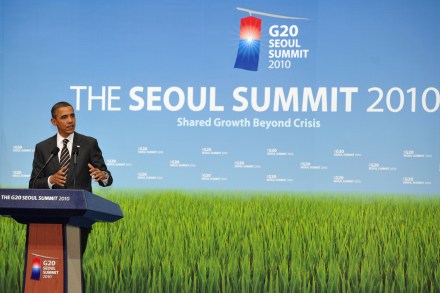
Obama stands firm on Korea

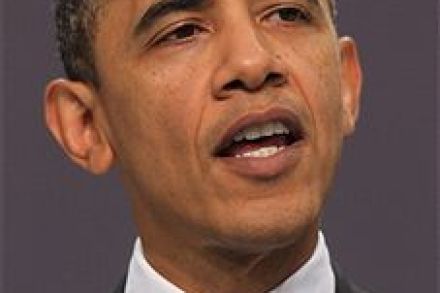
There is no diplomacy with maniacs. North Korea has been the grip of one or another lunatic for 60 years; with the succession still unsettled, Pyongyang is now a salon for the insane. The escalation of posturing, violence and the nuclear programme is a brazenly mad strategy to bribe other countries in exchange for good behaviour; it’s piratical. The world’s geopolitics may be changing, but the US President remains supreme among leaders. Yesterday, Iain Martin argued that Barack Obama had to make a strong and unequivocal statement about the situation, at least to encourage China to reprimand its errant ally. The President did so. In a long interview with the
The end of the Wall Street world

Over the last decade, Wall Street has become an important foreign policy actor in its own right, almost as important as the lobbyists on K-Street and the White House on Pensylvania Avenue. The ebb and flow of capital has been a decisive international force in determining the fate of nations – most recently illustrated in the cases of Greece and Ireland. As an aide to President Clinton once said: in a second life he would like to come back as the bond market. But Wall Street has influenced foreign policy in a deeper way too: by changing the way that successive US administrations see the world. Not by focusing on

The mad hermit strikes

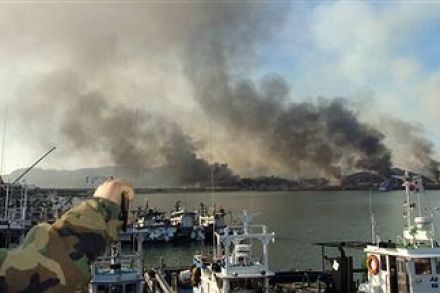
North Korea has again put itself at the centre of international relations. As the US pushed for a start to six-party talks, Pyongyang lifted the veil on a hitherto secret uranium-enrichment facility and launched an artillery barrage on a South Korean island,  injuring four soldiers, and damaging several buildings. The South Korean military scrambled fighter jets and returned fire and the situations remains tense. Conflict with nuclear-armed North Korea has intensified in recent years. North Korea launched nuclear and missile tests last year and sank a South Korean warship in March this year, killing 46 sailors. But the first ground-to-ground assault across the DMZ represents a new escalation in the

Another coalition compromise, this time on immigration

Agreement has been reached on the troublesome immigration cap. The BBC reports that skilled non-EU migration will be limited to 43,000. This is just a 13 percent reduction from this year’s cap and there are numerous exemptions to be made; notably, inter-company transfers will not be included when workers earn more than £40,000 per annum. This is a considerable moment for the coalition because the cap was thought unworkable. The Conservatives have their cap, a pep pill for the embattled Home Secretary.  But this is also a victory for Vince, who is being feted by businessmen across the airwaves this morning. Cable and May have also been praised by Migration

Cowen will seek a dissolution next year

There has been much consternation and intrigue swirling around both Dublin and Westminster this afternoon about the near-collapse of the governing coalition in Ireland. The Greens, who support Brian Cowen’s Fianna Fáil-led government, pulled out; seeking a dissolution in the hope that it might save their skins from the fate that is likely (though not certain) to befall Fianna Fáil. If the government had collapsed, then IMF would have postponed the bailout. At least now Cowen can formulate a monetary plan, hopefully under the oversight of Ireland’s international creditors, to free the country from its current extremis.   

Ireland’s crisis is the fault of Fianna Fáil, not just the euro

In all likelihood, George Osborne will rise this afternoon to groans if not jeers. Britain looks set to lend Ireland £7bn as part of multilateral and bilateral bailouts. Many, particularly the Eurosceptic right, question our involvement, given our straitened financial circumstances and the apparent fact that Britain is sustaining the eurozone’s monetary and debt union, and will have to borrow to do so.     George Osborne has been adamant throughout: Ireland is too important to Britain’s recovery to risk collapse – British and Irish banks are closely linked, debts and borrowing are often co-dependent, trade is very profitable. That the bailout should strengthen the euro is a natural consequence of Ireland

The kiss of death | 19 November 2010

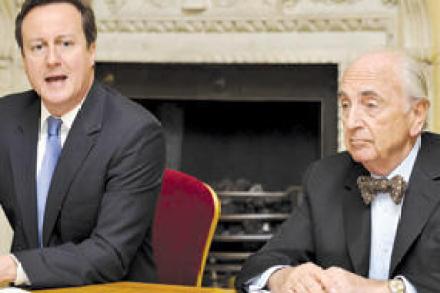
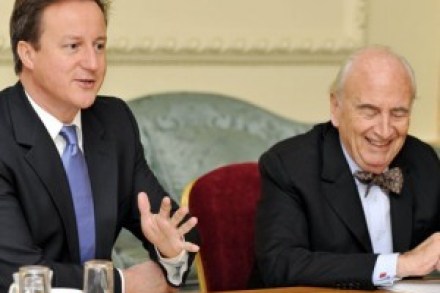
Oh dear. On Wednesday night, we at The Spectator saw David Cameron handing Lord Young his Spectator/Threadneedle Parliamentarian of the Year in the category of Peer of the Year. “Over the decades,” said yours truly, “Prime Ministers have come to value his advice. As Thatcher put it: ‘other people bring me problems, David brings me solutions.’” Not any more – David has brought him a problem, followed by a resignation. Less than 48 hours after picking-up our award, his political career appears to be at an end.   It is true that there are some people who have had a “good recession”. That is: faced no danger of losing their

You’ve never had it so good

As Michael Gove said at the launch of the Conservative Party manifesto: “Britain in 2010 is a great place to live in many ways” (4:12 in on this video). Lord Young, The Spectator’s Peer of the Year, agrees: for many of us, we’ve never had it so good. He told the Telegraph: ‘For the vast majority of people in the country today, they have never had it so good ever since this recession – this so-called recession – started…Most people with a mortgage who were paying a lot of money each month, suddenly started paying very little each month. That could make three, four, five, six hundred pounds a month

Britain may not be able to avoid bailing out the Irish

This morning, it sounds as though Ireland has finally buckled to demands that they accept a bailout from the EU. Their central bank governor, Patrick Honohan, has said that he expects a “very substantal loan” from Europe – although the details, and debtees, are yet to be clarified. In the UK, of course, backbench MPs and others have been quick to condemn any move which would force British taxpayers to cough up cash under the EU’s various bail-out arrangements. Only problem is: the UK may not have a choice. The part of the eurozone bail-out package which Britain could be underwriting to the tune of £6-7 billion – the so-called

The British taxpayer should not be bailing out Ireland

Everyone is talking about the royal wedding today.  It will be a great occasion but the public finances are tight and people are already asking about the cost.  There is a bigger issue for British taxpayers, though.  Our politicians have arranged for them to get hitched to the bride from hell: the ongoing fiscal disaster in the eurozone.   Under current plans it is reported that we could be liable for up to £7 billion in any Irish bailout.  At the TaxPayers’ Alliance, we have just this morning started a petition against British taxpayers’ money being put at risk for a euro-bailout of Ireland; you can sign it here.  

Sovereignty, and the loss of it

The superb Slugger O’Toole blog highlights what is certainly the most resonant quote if the day: “When you borrow, you lose a little bit of your sovereignty, no matter who you borrow from.” Those words were uttered by the Irish finance minister Brian Lenihan this morning, and they capture his country’s grisly predicament perfectly. The Irish government has been fighting the European attempt to bail them out because they believe, quite understandably, that it would mean a final handover of control to Brussels and Berlin. But their loose economic policy – built on debt, and structured around a stubborn currency – has already seen them lose control to the point

Cameron: it's all about the economy

A minor landmark for David Cameron tonight, as he delivers his first Mansion House speech as Prime Minister. Like occupants of No.10 before him, he will use the occasion to talk about foreign affairs – although the result may be rather more like the Chancellor’s annual speech at the same venue. Judging by the extracts that have been released so far, Cameron’s overall emphasis will be on the economy, and on Britain’s fiscal standing. As he will say, “we need to sort out the economy if we are to carry weight in the world.” Cameron develops this point by claiming that, “whenever I meet foreign leaders, they do not see

General Well-Being is back

Spectators might smile wryly at the news that the government is to devise a method for tracking the well-being of the nation. This idea of General Well-Being (GWB) was common currency in the early days of the Cameron project, when the Tory leader was going all out to “detoxify the brand”. But it soon hit a downturn-sized snag. Any talk of happiness might have sounded a little complacent and New Age-y in the face of job losses and bank bailouts. And so the Tories backed away from GWB, and it was relegated to little more than branding for the coffee stalls at Tory conference. It was quite a surprise to

Ireland's nightmare becomes Europe's problem

“We certainly haven’t looked to Europe.” That was the message spilling from the mouths of Irish Cabinet ministers last night – but, as Alex suggested in a superb post on the matter this morning, their utterances may come to naught. After all, Europe has certainly looked to Ireland – and it doesn’t like what it sees. Already, Brussels’ moneymen are urging a bailout on the country, and Ireland’s moneymen are thought to be in “technical discussions” about how that might work. The upshot is that a financial intervention from Europe is now considerably more likely than not. And with that come European demands over how Ireland should manage its public

IDS shows how arguments are won

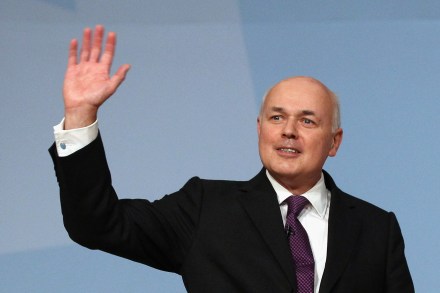
For years, I have complained that the Conservatives have timidly stayed within Labour’s intellectual parameters, arguing that they need “permission” to make certain arguments and need to stay within the limits of what the public find acceptable. Such intellectual timidity confined them to opposition: they can never win, playing by Labour rules. Iain Duncan Smith is breaking free of this. It may be rash to predict it now, but I believe he is on the brink of a breakthrough in the way that welfare is regarded in Britain. This victory in a battle of ideas could be the greatest single blow against poverty in a generation. The extent of this

The new Cold War?

In his recent cover story for The Spectator, the Financial Times’ Gideon Rachman talked about how, in the United States, China was beginning to take on the appearance of a new Cold War-style foe. Many Americans accuse China of stealing US jobs, of keeping the its currency undervalued, of exporting deflation by selling its products abroad at unfair prices, and of failing to meet its commitments to the World Trade Organisation. Two months ago, a poll from WSJ/CNBC showed that the majority of Tea Party activists oppose free trade – seeing China as the sole beneficiary of a free trade policy. But it is not only the Tea Party that

Whatever happened to Labour's economic message?

For some weeks now, Labour have struggled to project a clear voice on the economy. You can see what they’ve been trying to do: pitch themselves as an alternative to immediate, deeper cuts, whilst also accepting the requirement to deal with the deficit. But, as I’ve said before, this all too often comes across as nervous equivocation; a kind of “on the one hand, on the other hand” stuttering that won’t persuade many observers either way. You sense that Team Miliband have tried to correct this in recent weeks, with a few punchier performances, but, even then, mistakes and deceptions have greased into their offering. Anyway, I mention this because

Going beyond the IDS reforms

Iain Duncan Smith deserves credit for fully understanding the nature and scale of the welfare problem. But that’s the easy bit. Finding a solution with the right balance of carrot and stick and making it somehow affordable in these austere times is the tougher part of the equation. And it’s not at all clear that the IDS proposals have either enough carrot or enough stick.   He has certainly gone some way to tackling the lunacy of huge withdrawal rates – if by entering the workforce your new post-tax pay packet is less than the benefits you stand to lose, then don’t be surprised when an entrepreneurial work ethic fails

50p tax: the coalition's most expensive policy

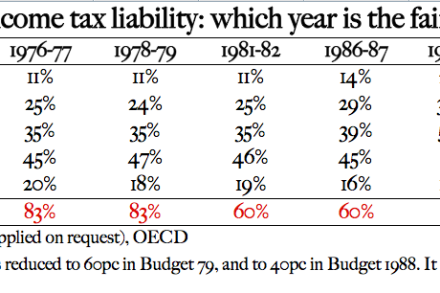
In my cover story for this week’s magazine, I say that the damage of the 50p tax, various bank levies and general banker-bashing is far greater than Osborne realises. Here are the top points I seek to make:   1. We may hate to admit it but the British tax base, and our chances of reducing the deficit, are heavily reliant on a handful of very rich people. The highest-paid 1 percent will generate 23 percent of income tax collected in the UK in the year before the 50p tax (see the table below). And spot the correlation between the top tax rate, and the burden shouldered by the richest

Johnson's deceptions and out-of-date figures

Oh, how Labour enjoy misleading the public about their record on the public finances. Ed Miliband did it a couple of weeks ago, with some very loose rhetoric about how the previous government had “paid down the debt”. And now Alan Johnson’s at it, with a fiery speech at the RSA which reheated many of the themes in his recent New Statesman article. The passage that struck me was this: “In 2007/08 as the crisis hit, we have the second lowest debt level in the G7 reduced by 14 percent in the 10 years we’d been in office… …The year before the crisis hit we were borrowing 2.4 percent of