Economy

Miliband’s Oldham dilemma

Joy. It will be a campaigning Christmas, now that the Oldham by-election is likely to be held on 13th January. The Labour party is much exercised. The permanently outraged Chris Bryant says it is a ‘disgrace’ that politics will sully the ‘major Christian festival of the year’ – the lapsed cleric seems to have forgotten the election’s proximity to Easter. More importantly, fewer students will be in Oldham on 13th January to serve ‘judgement’ on the government, as Hilary Benn put it in the Commons this morning before adding that the government is ‘running scared’. By-elections are determined by local issues, as one would expect. But Benn’s statement perhaps reveals how
Keeping the financial sector in Britain

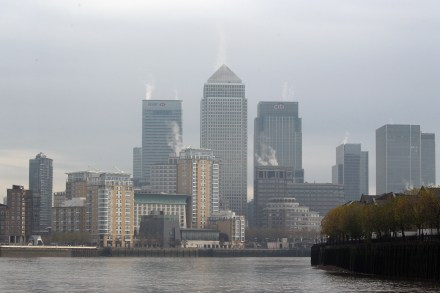
The financial services industry in the UK is at a crucial juncture. Our new research report “Not with a Bang but a Whimper” – published tomorrow –  highlights the decline in the UK’s competitiveness as a domicile for this sector, and the increasing likelihood that both companies and workers will take the leap and choose to base themselves elsewhere. Many will see this as a good thing. The economy is still recovering from the financial crisis, the eventual cost to the public purse of the bank bailouts remains unknown, and the yearly round of hated bank bonuses are impending. On the other hand, losing such a significant contributor to GDP,

Why we must remember the lessons of the Anglo-Scottish Enlightenment

The Adam Smith Institute kindly asked me to speak at their Christmas reception last night, and yesterday I was mulling what to say. When at The Scotsman ten years ago, I would sometimes visit the great man’s grave in Edinburgh, and be surprised to see only Chinese tourists paying tribute. It was a pretty good sign of how political power would play out. Edinburgh is, with Prague and Stockholm, among the most beautiful cities in Europe; itself a monument to the Enlightenment. And how tragic that students – even Scottish ones – are taught about the E word only in the context of the French Enlightenment. The likes of Rousseau,

Portrait of the week | 4 December 2010

Home The Office for Budget Responsibility said it thought economic growth for 2010 would be 1.8 per cent, not 1.2 per cent as it had previously predicted. It expected 330,000 public sector workers to lose their jobs over the next four years, not the 490,000 it forecast in June; 1.1 million jobs would be created in the private sector. ‘The bulk of this revision results from the action we have taken to cut welfare bills rather than cut public services,’ George Osborne, the Chancellor of the Exchequer, told the Commons. A lower 10 per cent rate of corporation tax would be levied from April 2013 on the profits of hi-tech

How the OBR measures up

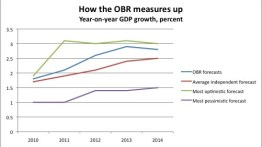
There are only so many Labour interviews a blog can take, so I’ll skip over Yvette Cooper in the Guardian (sample: “I did think about standing, and Ed said he thought I should stand and if I wanted to stand he would not stand”). Instead, another catch-up on how the Office for Budget Responsibility’s growth forecasts are shaping up against those made by other institutions. Since I last did this, two new documents have been processed into the public domain: the OBR’s latest economic and fiscal outlook, of course, as well as the the Treasury’s round-up of long-term independent forecasts. So here’s how the panorama of forecasts looks now:

Brown struggles on beyond the crash

Today’s Guardian calls it his first interview since leaving office, although I think the Independent beat them to that one back in July. But, in any case, Gordon Brown’s chat with Larry Elliot is another staging post on his slow path back to public life. Here’s my quick summary: 1) Sniping from the moral high ground. A bit late now, but Brown is making a desperate scramble for the moral high ground. Not for him, he says, scurrilous memoirs that sift through the “arguments” of the past. No, he’s got far more important things on his mind than muck-raking and innuendo, like the future of financial regulation across the world.

Any Other Business | 4 December 2010

What Ireland lacks now are statesmen who can make the case that recovery is possible The screen at Manchester airport tells me I’m about to board an Aer Lingus flight to Dublin, but there’s a Lufthansa plane at the gate. ‘Blimey,’ I mutter, ‘this bailout’s moving fast.’ I’m looking at the wrong gate, however, and it’s an Aer Lingus stewardess who becomes the first of many people during my 36-hour visit to wish me ‘the best of luck’. Luck looms large in the Irish psyche and it’s what they long for right now — an oil find would help, I hear one passenger remark — plus a bit less attention

Putting a stop to taxpayer funded environmentalism

It’s that time of year again, time for the world to pay attention to climate change policy for a few weeks.  Most of the year, schemes like the EU Emissions Trading System and the Renewables Obligation just wallow in dysfunction and quietly cost us a fortune, adding to our electricity bills in particular.  Manufacturers pay attention, and higher energy costs threaten to drive industrial jobs abroad, and the poor and elderly feel the effects, even if they don’t know why their bills are rising.  But the only people who really have the staff and the organisational clout to pursue this issue all year round are the environmental campaigns.   Many

The Guardian's Wiki-spin

In today’s Wikileaks revelations, it is Mervyn King’s turn to be pushed through the mill. Did he act politically when pushing for a deficit reduction plan? Was he critical of David Cameron and George Osborne or just pointing out the obvious: that the Tory leaders had not held power before and – shock horror – were keen to get elected? The Guardian’s reading of the cables suggests that the government’s Batman and Robin (to keep with US diplomatic style) were unprepared for the task ahead. But re-read the key passages and it is clear that Cameron and Osborne were no different from any other opposition leaders – reliant on a

Nothing Miliband says can rain on Mr Confident’s parade

Back from Zurich, where he’s been helping FIFA determine the winner of the world’s greatest bribery festival, Cameron was in hearty form at PMQs today. He faced Ed Miliband who looks increasingly like the life and soul of the funeral. His party is riding high in the polls – but only when he’s away. As soon as he pops his head back around the door a groan of misery goes up and his rating collapses. Earlier this week the OBR gave an upbeat assessment of the economy so Ed sent his bad-news beavers to sift through it for signs of toxicity. They couldn’t find much. Jobless totals are to rise.

Palin versus Romney

The GOP is ambling towards the start of the 2012 nominations race. Two probable candidates are busy pitching their media tents. Sarah Palin is on a coast to coast tour, flogging her latest book; she has also been cheering on her daughter on Dancing with the Stars and she recently gutted a halibut on her Alaskan reality TV show. It’s all action and personality from the Mamma Grissly. By contrast, the cerebral Mitt Romney has agreed to appear on…Jay Leno’s Tonight Show. Leno makes Parky look almost vital. As one Democrat strategist observed: “On the hipness scale, this is far from Bristol Palin on ‘Dancing with the Stars.’ It’s more

Tax cuts: a Swedish recession remedy

I travelled in from frozen Stockholm this morning. My colleague Mary Wakefield set out from County Durham. No prizes for guessing whose journey took more time due to snow. When my £38 norewgian.com flight arrived at Gatwick, the captain said: “Sorry, we’re going to be delayed. They can’t seem to find people to open the gate, they say they are short staffed.” The Swedes on the flight burst out laughing: welcome to Britain. Mary’s £107 train was two hours late arriving to the station, and spent a further two hours stuck in the snow. That the Swedes do better at us in the snow is no great surprise, but it’s

Osborne airs the Tories' election message

George Osborne’s autumn statement previewed what I suspect will be the coalition, or at least the Conservatives, re-election message. ‘This government has taken Britain out of the financial danger zone and set our economy on the path to recovery.’   Today’s OBR forecast was a boon for the Chancellor. It suggests that there won’t be a double-dip recession, as his critics suggested there would be. The improved economic numbers allowed him to come to the House and declare that the deficit reduction ‘plan is working’, and that already the coalition has saved the country £19 billion in debt interest. Alan Johnson was his usual self in response. He attacked the

Osborne saves his glad tidings for another day

Courtesy of Paul Waugh and the Standard, the OBR projects there to be a £6bn budget surplus by 2015-16. There was no fanfare to herald this in George Osborne’s statement, which was a litany of dirge-like thanksgiving for catastrophe averted. The Treasury is now describing the figure as being ‘within the margin of error’, which is fluent Sir Humphrey-speak. The Standard’s discovery is another example of the government deliberately hiding good economic news – in what Fraser terms Osborne’s Paul Daniels Act. Now why, I wonder, would a self-confessed tactical obsessive, who just happens to be the Chancellor of the Exchequer, be doing that?      

Setting the scene for Osborne’s speech

George Osborne will make a brief statement to the house this afternoon, responding to the Office for Budget Responsibility’s revised growth forecasts. Reuters reports: ‘As expected, the Office for Budget Responsibility raised its 2010 growth forecast to 1.8 percent from its 1.2 percent June forecast to factor in a surprisingly strong performance in the middle of the year.’ The upgrade fuels Osborne’s positive narrative: the coalition pulled Britain from the abyss and international confidence in Britain’s economy is growing. These forecasts vindicate the government’s ‘cut with care’ strategy. Concrete savings are now being made and they enable the Chancellor to announce that public sector net borrowing will fall. Reuters again:

Some early statistical vindication for IDS

The Observer has news that will warm the government’s hearts. Ernst and Young have conducted a report that suggests 100,000 public sector jobs will be saved thanks to the savings made by welfare reform. The report’s other finding, a crucial one, is that the Treasury will be raking in £11bn by 2014-15. So then, a statistical vindication for IDS’ reforms, the economic side of them at least. It also gives the government some defensive hardware ahead of tomorrow’s Chancellor’s autumn statement. Not that it really needs it. On the back of Britain’s strong economic performance in the third quarter, the Office for Budget Responsibility is expected to raise its 2010

The Big Squeeze

The media pack is often blind to an impending political car-crash.  For instance, very few in Westminster, or the media, noticed the scrapping of the 10p tax band until the screech of twisting steel turned heads. The same is happening now in relation to living standards. The media and political establishment are yet to wake up to the fact that working families in Britain are about to become poorer (though hat-tip to Allister Heath for being quick off the mark on this front). The gathering wisdom is that, with the recession now behind us, household budgets will start to recover.  We have just published a new report – Squeezed Britain 

Why Spain matters to Britain

So far Ireland and Greece have been bailed out with relative ease. If Portugal required external assistance, Europe could run to that too. But bailing out Spain would be another matter entirely. As The New York Times points out today, the Spanish economy is twice as big as the Irish, Greek and Portuguese ones combined. Spain’s situation is not yet critical. But as the NYT piece sets out very clearly, there are some extremely worrying signs. The gap between Spanish and German gilt yields is now at the biggest point it has been since the introduction of the euro. Spanish banks are also heavily exposed to Portuguese debt. Compounding these

Britain should have a Freedom Minister

Has liberal democracy lifted people out of poverty? To a casual observer, the answer is unequivocally yes. One part of the world – the industrialised democratic northern half – is both richer, and healthier than the (historically undemocratic) South or East. Coincidence?   The West’s success may be a function of north Europe’s temperate climate, cultural mores shaped on the windswept British isles and European plains, the competition spurred by centuries of warfare, the invention of modern banking, the head-start provided by inventors, colonial conquests and possibly even the ideas and ecclesiastical hierarchy of the Judeo-Christian faith. But many other regions had similar in-puts. Perhaps the West was just blessed

The corpse of Black Wednesday has been exhumed, and the demon exorcised 

Cameron clearly doesn’t rate Ed Miliband. That may be a mistake in the long run but it worked fine today. The opposition leader returned to PMQs after a fortnight’s paternity leave and Cameron welcomed him with some warm ceremonial waffle about the new baby. Then came a joke. ‘I know what it’s like,’ said Cameron, ‘the noise; the mess; the chaos; trying to get the children to shut up,’ [Beat], ‘I’m sure he’s glad to have had two weeks away from it.’ This densely worded, carefully crafted, neatly timed quip had obviously been rehearsed at the Tory gag-conference this morning. The fact that Cameron had time to polish it suggests