Durham university

I’ve found the perfect pregnancy diet

The world is full of people fierce in the belief that they know the right diet to make your children glow with superior health. Few are shy about saying so. Fortunately, I’m here to help. I happen to know exactly what should go into your mouth, and into theirs, and, although you haven’t asked, I’m happy to tell you. My confidence comes from the psychology department at Durham University, which has just published the results of a long-running experiment on getting children to eat their greens. Our broadsheets have summarised their findings with due reverence: ‘getting children to eat their vegetables starts in the womb’ (to quote the Guardian). ‘The secret to giving toddlers a taste for greens may start in pregnancy,’ agreed the Telegraph.


Durham’s maths problem

More exciting news arrives from Britain’s dimmest university, Durham, which is embarking on a programme to ‘decolonise’ mathematics. About time. For too long the subject has been dominated by racist stuff like adding things up or multiplying etc. Hopefully soon there will be room for students, when faced with a question such as ‘what is four plus four?’ to eschew the didacticism of white supremacy by answering ‘eight’ and suggest instead a number which they think feels intuitively right, such as 7,231. (Or indeed any number: it is not for me, as a privileged white straight male, to suggest to people who have been the victims of structural racism an alternative answer to the question ‘what is four plus four?

Why is Durham trying to ‘decolonise’ maths?

Is maths racist? That’s the question apparently troubling the department of mathematical sciences at Durham University at the moment. As the Telegraph reports, the department has put out a new guide on ‘decolonisation’, urging maths academics to ensure their teaching is ‘more inclusive’ and not dominated by a Eurocentric view on the world. Of course, exploring the overlooked contribution of non-western thinkers to mathematics would be no bad thing. But this guide goes a fair bit further down the ‘decolonisation’ rabbit hole. It urges academics to introduce more non-white thinkers into their classes, thus presenting their race as more important than their merit or impact.

Letters: To achieve net zero, we need to go nuclear

Nuclear future Sir: It is refreshing to see Martin Vander Weyer note that, properly and fully costed, nuclear power is cheaper than power from wind and solar sources (Any other business, 26 March). That is because, as he says, ‘wind and solar require excess capacity and battery storage to compensate for periods of low output’. It cannot be predicted when those periods of low output will occur, and the proportion of our electricity provided by wind at any one time can be anywhere between 2 per cent and 40 per cent. Martin supports the aim to meet 25 per cent of UK energy needs using nuclear by the net-zero deadline of 2050. However, he has not yet asked the crucial question of where the non-nuclear portion of our energy might come from in 2050.

Letters: We’re all still paying for the financial crash

Don’t blame the banks? Sir: Kate Andrews struggles to disentangle the causes of the developing cost-of-living crisis (‘Cold truth’, 19 March), with the fallout from Brexit, Covid and Putin’s invasion of Ukraine all vying for responsibility. She forgets the financial crash of 2008, when a few irresponsible banks and building societies dragged this country into a financial abyss. The jury is still out on the effect that the Bank of England’s remedy of quantitative easing has since had on inflation and wealth inequality. We are all still paying the price for this disaster, as will be the next couple of generations.

My meeting with the Durham University mob

My abiding memory of this fairly appalling year is of the face of the young student at Durham University who shouted ‘Disgusting!’ at me as I left the main college building. This followed a very short speech I’d given to about 250 students but which, I suspect, he hadn’t heard because he’d probably walked out before it began. That, incidentally, is one of the reasons this story in which I find myself took a comparatively long while to break. The speech was on a Friday evening — but it wasn’t until Monday, at the earliest, that the lefties got themselves into a real lather.

Durham students’ Rod Liddle protest in pictures

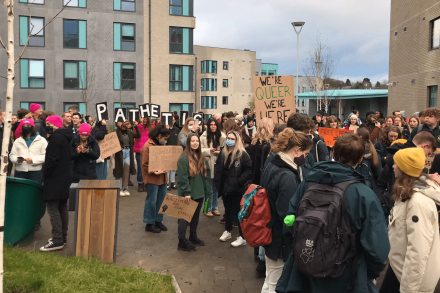
After eighteen months of Covid, there were some who feared the age-old tradition of the campus leftie had died out. Fortunately the furore about Rod Liddle has revived the inglorious habits of angry undergraduates at Durham University, with dozens of students assembling today to protest the travesty of a columnist's after-dinner speech. Mr S has covered the ups and downs of this sorry tale these past five days, with today's Durham demo being the culmination of efforts to undermine Principal Timothy Luckhurst of South College for inviting Rod to speak at high table. Among the highlights include Jonah Graham, Durham SU's Welfare and Liberation Officer, asserting to the assembled throng that 'this is not an issue about free speech...

Durham University to probe Rod Liddle speech

The masters of Durham University have reacted with Olympian swiftness to the hysteria which greeted Rod Liddle’s dinner speech at South College on Friday night. Students professed themselves to be ‘literally shaking’ at The Spectator columnist’s comments on sex and gender issues — poor darlings. The adults in and around campus, meanwhile, were equally eager to vent their sense of horror. The local Labour society insisted that 'Our university doesn’t owe hate a platform’ and the Students’ Union demanding the resignation of the College Principal Tim Luckhurst.

How I was de-platformed by Durham University

Imagine you are regularly invited to visit universities to speak with students (unpaid) on your specialist subject, but in order to be allowed to enter the campus, you are required to fill out a form to confirm that you are neither a bigot nor likely to cause offence or distress to the students. Unfortunately, I do not have to imagine such a scenario. Last year, I received an email from the president of the Durham University Union, reciting my CV back at me, schmoozing me up in the hope I would agree to take the three hour train journey from London to take part in a debate about prostitution laws. The date was fixed as 31 January 2020. I put it in my diary. Then came silence.