Donald trump

Britain’s winning hand

From our UK edition

On the morning after the European Union referendum, Britain looked like a country in crisis. The Prime Minister had resigned, Scotland’s first minister was talking about a second independence referendum and the FTSE was in free fall. In several EU capitals, there was an assumption that, when the Brexit talks began, Britain would be the new Greece: a country that could ill afford to reject any deal offered by the EU, no matter how humiliating. In the days following the vote, Mark Rutte, the Dutch prime minister, declared that Britain had just ‘collapsed — politically, economically, monetarily and constitutionally’. Five months on, Britain is in a stronger position than Rutte and co. would have believed possible.

The pick-up artists who seduced a country

From our UK edition

Many years ago, when I was a mere slip of a features journalist, I spent a weekend learning how to be a pick-up artist. Amazing. You assume it won’t work, that sort of thing, but it totally did. Towards the end of the second night, having not said an unscripted word in about half an hour, I found myself in the VIP room of a London nightclub, being gazed at in rapt adoration by a wildly attractive twentysomething blonde. Seriously, people don’t normally look at me like that. It was special. And then I ran away, terrified, because I had a girlfriend. My guide through all this was a man called Neil Strauss, author of a book called The Game.

The devil they know

From our UK edition

You will, by now, be familiar with the argument: that Donald Trump’s triumph in the American presidential election represents a kind of social and political apocalypse. That his victory came at the hands of fundamentally irrational, bigoted, disgusting extreme right-wingers beyond the pale of civilised values. It is axiomatic that there can’t be any good reason behind voting for him, so it is assumed that 60 million Americans were duped by ‘fake news’ which must now be suppressed altogether. In fact, the real ‘fake news’ was pumped out relentlessly by publications such as the New York Times, CNN, the Guardian and many other similar left-wing outlets which descended into hysterical denunciation of the voters’ choice.

Another mad day in Trumpland

From our UK edition

Yesterday was another mad day in Trumpland — or America, as it used to be called. The president-elect started the morning off by promising, somewhat mystically on Twitter, that 'Great meetings will take place today at Trump Tower concerning the formation of the people who will run our government for the next 8 years’. But the most fascinating event of his day —for us saps in the self-immolating media, at any rate —was his showdown conference with the New York Times. The meeting was nearly cancelled in the morning, after both parties failed to agree on its terms and conditions, and then put on again after a bit of confusing back and forth between the Trump team, NYT, and the Donald’s multi-personality Twitter account.

Donald Trump and the five stages of libertarian grief

From our UK edition

If you think Theresa May has made life difficult for ‘right-wing libertarians’ in the UK, spare a thought for the poor schmucks across the pond. I was in Washington DC for a few days either side of the presidential election and the overwhelming impression I got from various think tank wonks I spoke to was one of utter despair. When ‘liberty’ is branded on your currency and is supposed to be the whole reason your country exists, you expect to be thrown a bone every now and then - even the odd square meal under Reagan. But a contest between a warmongering progressive and protectionist nationalist was always going to be a choice between a rock and a hard place for libertarians.

Insulting people who think differently from you isn’t the way to engage people

From our UK edition

There were two items on BBC radio this morning which rather summed up the Corporation thinking about the State of the World. One was a brief but telling discussion on the Broadcasting House programme as to whether our political discussion now is getting to the point where we can’t actually air differences at all;  that, after Brexit and the Trump election, we are so utterly divided ideologically that common ground is impossible to find. It was an interesting conversation between Catherine Mayer, the co-founder of the Women’s Equality Party, and Iain Martin, who, while a Brexiteer, is also opposed to Trump.

Why Conrad Black was right about the genius of Trump

From our UK edition

At least two former Spectator figures understood things about the recent American contest which eluded most commentators. The first is our former proprietor, Conrad Black. Disagreeing with the anti-Trump conservative National Review, for which he writes, Conrad filed a powerful piece at the time of Trump’s nomination: ‘What the world has witnessed, but has not recognised it yet, has been a campaign of genius.’ He enumerated virtually every issue where Trump was nearer to the voters than Democrats, the media, and other Republicans. The second is Ambrose Evans-Pritchard, nowadays the Telegraph’s international business editor.

How social media won the day for the Donald

From our UK edition

There are plenty of theories about how Donald Trump pulled off his shock victory. But however he did manage to achieve one of the unlikeliest political upsets in history, one thing seems clear: social media won the day for the Donald. The starting gun was fired when Hillary Clinton called Trump’s supporters a ‘basket of deplorables’. Clinton wasn’t talking about the egg-faced trolls of Twitter when she made this remark, but it was a moniker they happily took up. It also gave this loose outfit the confidence of mainstream recognition - enabling Trump supporters to kick-start their most important election mission: starting arguments with Democrats.

The Trump revolution is doomed to fail

From our UK edition

Sunday brunch at Hugo’s, a bustling Mexican restaurant with a mariachi band and a multi-ethnic clientele: at the next table, a big Latino family with a happy baby in a high chair. This is a true picture of Houston: only a third of its citizens are white, and only 22 per cent of under-20s; the Latino population has risen from 6 to 41 per cent in two generations, its birth rate boosted by a culture of family support that tends to produce healthier babies. What’s significant about this, according to sociologists at the city’s Rice University, is that by 2050 all of the US will look like Houston today, with a majority of minorities in all age groups below 60.

The looming presence of Trump’s son-in-law follows a troubling pattern

From our UK edition

For all the top jobs being dished out by Donald Trump, there’s one figure close to the president-elect that worries me more than the others. Steve Bannon’s appointment as Chief Strategist might have fired up the Twitter mob, but it’s the elevation of Jared Kushner as Trump's unofficial chief consigliere which seems most troubling of all. After all, however you spin it, having your son-in-law apparently calling the shots means Trump is following in some worrying footsteps. While some have cheered Trump’s victory for the rude awakening it gave to soft-hearted liberals, Kushner popping up at Trump Tower for the Donald’s first meeting with a foreign leader – Japan’s PM Shinzo Abe – should be a wake-up call.

Brexit, Trump and the pious rage of the liberal clergy

From our UK edition

Here are some statistics you're unlikely to hear on Thought for the Day. Churchgoers in America backed Trump by 56 to 42 per cent – while six out of ten British Christians backed Brexit. Now, clearly these aren't identical constituencies: I didn't spot much enthusiasm for the US president-elect among Christian Leave voters. But we can spot one shared trend. Churchgoers on both sides of the Atlantic ignored the earnest but quietly hysterical entreaties of liberal church leaders to spurn Leave and Trump. (You might say: American evangelicals don't have left-leaning bishops – but American Catholics most certainly do, and they still voted for Donald Trump by 52 to 45 per cent.) What a nightmare for liberal clergy!

Thucydides on Donald Trump

From our UK edition

‘America’s journey into the great unknown’, screamed a headline greeting Donald Trump’s election as next President of the United States. Most of us call it the future, which has a long and distinguished tradition of being unknown. In the ancient world there was quite an industry in attempting to foretell the future: oracles, auguries, dream interpreters and so on.

Letters | 17 November 2016

From our UK edition

Wisdom of crowds Sir: According to Matthew Parris (‘Can we trust the people?’ 12 November), I have become part of the mob. Nevertheless, I have never really thought of myself in that way. Although it may be reasonable to criticise the antics of Farage or Trump, surely it is wrong to characterise all those who voted for their causes as a mob? My motives in voting for Brexit were simple and reasonable. Many of my generation — who lived as children through the 1940s when our parents went to war to preserve our sovereignty, our justice system and control of our borders — voted to leave the EU because they saw these three vital powers slipping away into the hands of an unelected bunch of bureaucrats.

The Spectator’s Notes | 17 November 2016

From our UK edition

On a day when much fuss was being made about ‘false news’ on the net, it was amusing to study the Times splash of Tuesday, greedily repeated by the BBC. It concerned a ‘leaked’ memo, ‘prepared for the Cabinet Office’ and ‘seen and aided by senior civil servants’. The memo, from a Deloitte employee, was in fact unsolicited. It was not a bad summary of why the government’s Brexit plans are confused, but its status was merely that of journalism without an outlet. By the use of the single word ‘leaked’, a piece of analysis was turned into ‘news’ — false news. At least two former Spectator figures understood things about the recent American contest which eluded most commentators.

High life | 17 November 2016

From our UK edition

New York   The only thing worse than a sore loser, I suppose, is a sore winner, but thank God we don’t run into too many of those. Thirty years ago, The Spectator and I lost a libel case that cost the then proprietor and yours truly a small fortune. As it turned out, after the plaintiff had gone to that sauna-like place below, everything that I had written was the truth and nothing but. (The hubby of the woman who sued me came clean after her death, but a lot of good that did the Speccie and me.) The sainted editor at the time was Charles Moore, and in view of Justice Otton having taken a great dislike to yours truly, he ordered me to remain at home when the decision was about to be pronounced.

Diary – 17 November 2016

From our UK edition

Nobody knows anything. William Goldman’s famous first law of the movie business — that no one can say before the fact what’s going to be a hit or a flop — is our new rule of political punditry. Pollsters, experts, markets tell us with scientific certainty what’s going to happen. Then the voters come along and ruin everything. Brexit. Trump. Ed Balls and Strictly Come Dancing. Who knew? As last Tuesday dawned in New York, the US election was deemed a formality. Newsrooms had lovingly compiled their historic ‘First Woman President’ editions. The final polls pointed to a clear Hillary win. And then the actual votes rolled in, uncannily like Brexit. Clinton was doing worse than expected where she needed hefty totals. Trump was doing better.

Barometer | 17 November 2016

From our UK edition

Long divisions Donald Trump reaffirmed his plan for a border wall between the US and Mexico, but said parts might end up as a fence. Who has the longest, highest barriers? India-Bangladesh India is still building a 2,545-mile three-metre-high barrier of barbed wire and concrete. Morocco-Western Sahara Separated by a 1,700-mile sand berm, typically two metres high, reinforced with land mines. US-Mexico 580 miles of fence already exist along the 1,950-mile border. Israel-Palestinian territories 440-mile barrier: part concrete wall, part barbed wire. Hungary-Serbia To thwart migration there is a 110-mile, four-metre-high fence. Catholic and Protestant Belfast 25-mile long ‘peace lines’ up to 8.5 metres high still separate some communities.

Is Donald Trump Making Journalism Great Again?

From our UK edition

Is Donald Trump about to do the impossible? No, I don’t mean become President of the United States. That’s in the bag. I’m asking if he is going to Make Journalism Great Again? He has, as we all know, humiliated the media. The media which created him, then tried and failed to destroy him. Thousands upon thousands of journalists are now feeling ashamed of themselves — even if they can’t yet admit it — for having got the story so wrong. But is their industry suffering? Is it heck! Trump’s decision to carry on attacking the New York Times on Twitter even after winning the election might upset the paper’s editors, but the money men at the Grey Lady must be rejoicing.

Moscow rules

From our UK edition

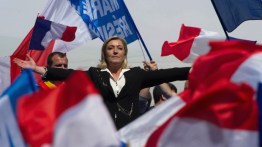
 Moscow To the Union Jack pub on Potapovsky Lane for a US election night party. The jolly Muscovite Trump supporters who organised the event had gone to the effort of providing girls with tight--fitting Trump-Pence T-shirts and Make America Great Again baseball caps. In pride of place beside the bar hung a specially commissioned triptych of oil paintings — heroic Soviet-style portraits of Russia’s new heroes: Vladimir Putin, Donald Trump and Marine Le Pen. Among the guests were a group of young men from Tsargrad TV, Russia’s popular new Orthodox nationalist channel. Sporting neatly trimmed beards and sharp suits, they were a Russian version of Republican evangelicals.