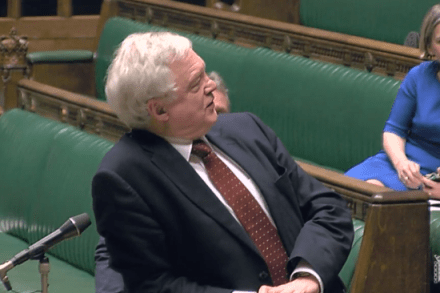
David davis

The furore surrounding the Brexit divorce bill is hotting up

The furore surrounding the Brexit divorce bill is hotting up. The weekend’s papers saw speculation that Britain would cough up £36bn as part of a settlement package for its departure from the EU. Nonsense, says Downing Street, with the Prime Minister’s spokesman saying this morning: ‘I don’t recognise the figure’. It’s not only the government hitting back; Tory eurosceptics are also turning up the volume. Yet while the government is eager to talk down the size of the bill, the criticism coming from the backbenches is less nuanced. Instead of quibbling over the amount, the likes of Jacob Rees-Mogg and John Redwood dismiss the bill out of hand. Rees-Mogg wrote on Twitter: ‘There is no logic to this figure. Legally we owe nothing’.

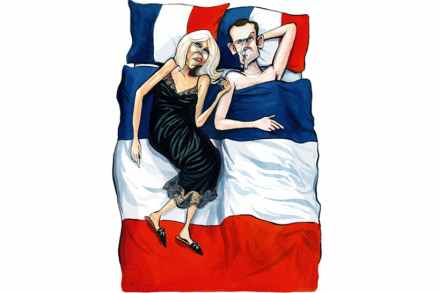
The Spectator Podcast: Macron’s vanity fair

On this week’s episode we discuss whether Macron is losing his gloss, ask if the Brexit talks are heading in the right direction, and recommend how to get the best out of the Edinburgh festival. First, it’s been just over two months since Emmanuel Macron became President of France, and already cracks are starting to show. Swept into the Elysee Palace by a sea of young voters rejecting Marine Le Pen and the National Front, those same voters are beginning to turn on the centrist former banker who they reluctantly championed. So says Gavin Mortimer in this week’s magazine, where he laments the new President’s vanity, and he joins the podcast from Paris along with the political journalist, Marie Le Conte.

Tory leadership tensions mustn’t undermine the Brexit talks

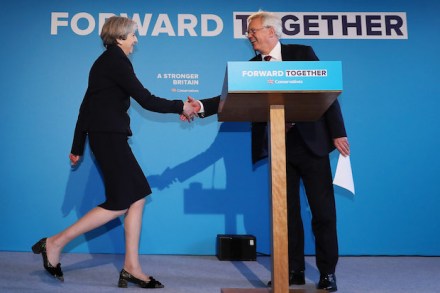
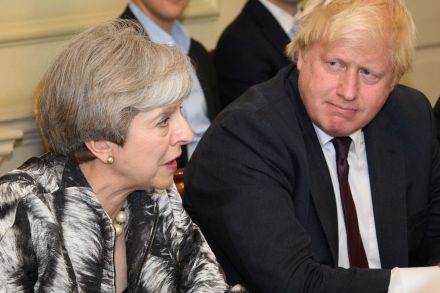
The May-Davis partnership used to be one of the strongest aspects of the government. She had brought him back from the political wilderness to be Brexit Secretary, and he was loyally working on the strategy for the negotiations. Even after the election went so wrong, Davis raced down to London to see her. But, as I say in the Sun today, Cabinet Minister reports that there are now tensions in this relationship. ‘The chemistry is not good now’, one tells me. Another says ‘that relationship has cooled’. The cause of the problem is Davis’ allies touting him for the leadership, and sooner rather than later. Those close to May don’t know if Davis is actively encouraging this.

Our Brexit-backing politicians are making fools of us

The great physicist Richard Feynman warned of the perpetual torment that lies in wait for people who try to understand quantum mechanics. Modern physics cannot be understood. It can only be observed. ‘I am going to tell you what nature behaves like,’ Feynman said. ‘Do not keep saying to yourself, "but how can it be like that?" because you will get down the drain, into a blind alley from which nobody has yet escaped. Nobody knows how it can be like that.’ Equally, nobody knows how the Conservative Party can be like that. It just is. Theresa May, to pick an example. Every morning I wake up and check if she is still prime minister. Every morning the answer comes back, ‘apparently so’.

Will May dare slap down any of those angling for the top job?

There are so many people angling for the Tory leadership now that it really is easier to list those who haven’t yet written an attention-seeking op ed or been spotted plotting in a shady spot in Westminster. It’s not just the ones who fancy the job for themselves, or the little nascent campaign teams that are springing up around them. It is also those who plan to run in order to guarantee themselves a top job in the Cabinet when the new leader carries out a unity-focused reshuffle.

Boris Johnson tells the EU to ‘go whistle’ on Brexit divorce bill

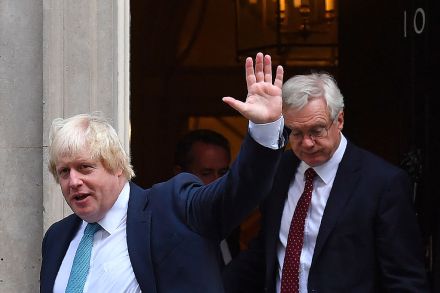
The Brexit divorce bill isn’t on the table yet but it’s already provoking plenty of debate - and quite a bit of anger. Figures bandied about have ranged from the tens of billions upwards, with some speculation the final demand could be as much as 100bn euros. Ministers have done their best to avoid being drawn on a figure which wouldn't be acceptable, with David Davis coming closest by saying Britain will not pay 100bn. Now, Boris Johnson has waded in. The Foreign Secretary told the House of Commons that: "I think that the sums that I have seen ... seem to me to be extortionate and I think go whistle is an entirely appropriate expression." What seems clear from Boris’s remarks is that there is no chance of the government agreeing to a 12-figure bill (i.e.

Why Theresa May isn’t ‘dead in the water’ just yet

It's two weeks until the summer recess and judging by today's papers, that's two weeks too late. Despite Theresa May's positive trip to the G20 summit, the Sundays are filled with tales of leadership plotting and planned Conservative rebellions. Although Philip Hammond was heralded as a caretaker PM a few weeks ago, it's now David Davis who is being talked up to take the reins from May. The Mail on Sunday reports that Davis's ally Andrew Mitchell denounced the PM as 'dead in the water' at a Tory dinner (though bear in mind his comment is two weeks old – a long, long time in politics – and the Sunday Times quotes him as telling plotting MPs to 'go and lie down in a darkened room and then take a holiday').

Opening gambit

The unexpected outcome of the general election has led some to hope that a weakened government will be forced to pursue a ‘softer’ Brexit. They are right to think that the emphasis of the negotiation will have to change, but they use the wrong adjective. The choice before David Davis and his team as they start work in Brussels is not and never has been between ‘soft’ and ‘hard’ Brexit; it is between an open Brexit and a closed Brexit. The former is one where Britain retains open trade with, and a high degree of free movement to and from, other EU countries — as well as taking fresh opportunities to liberalise trade with the world beyond.

‘Constructive’ Brexit talks get off to a shaky start for David Davis

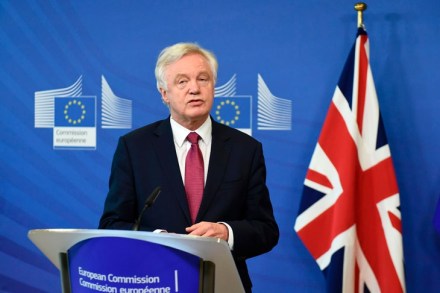
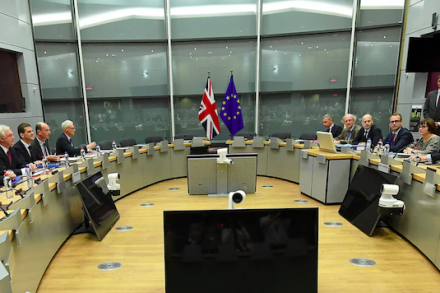
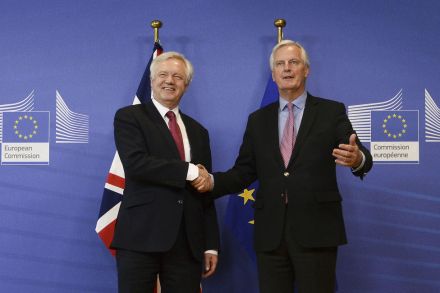
To kick the Brexit negotiations off, David Davis and Michel Barnier exchanged mountain-themed gifts, of a hiking book and walking stick. Given that the EU's chief negotiator previously warned Brexit would be a 'steep and a rocky' path, the choice seemed apt. Although the Brexit secretary said he had been encouraged by the constructive approach both sides had taken, the joint press conference hinted at the difficulties ahead. Barnier said that while it was not about 'punishment' or 'revenge', the consequences of the UK's decision to leave the EU were 'substantial' and ought not to be underestimated. The EU appear to have claimed the first victory of the talks.

It’s time to prepare voters for some tough Brexit compromises

Brexit is like life. The journey matters more than the final destination. Instead of fixating on where we will, eventually, end up, pay more attention to the things that happen along the way. As Brexit talks start, there are abundant signs of a possible compromise on Britain’s exit, or at least, on the timing of that exit. Yes, the Article 50 period will, absent an agreement to the contrary, expire in March 2019 and with it Britain’s formal membership of the EU. But what follows might not look or feel like the clean break that some voters have imagined.

Brexit negotiations will not be delayed, says David Davis

Although Philip Hammond has cancelled his Mansion House speech tonight as a result of the Grenfell Tower fire, government business will continue as normal. With the Queen's Speech scheduled for Wednesday, it's been confirmed that formal EU negotiations will commence on Monday: 'David Davis, Secretary of State for Exiting the European Union, and Michel Barnier, the European Commission's Chief Negotiator, agreed today to launch Article 50 negotiations on Monday, 19 June.' Now negotiations were always expected to begin next week. But following the surprise election result of a hung Parliament, there had been concern it could be delayed. After all, it is slightly strange to begin negotiations before a Queen's Speech.

Tory leader runners and riders: Who could replace Theresa May?

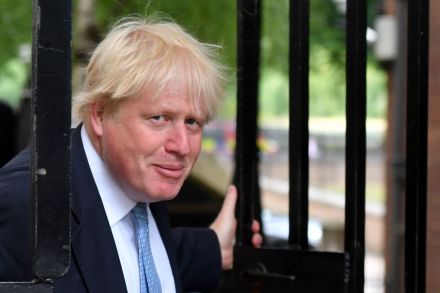
Theresa May has granted herself a brief reprieve by saying ‘sorry’ to Conservative MPs. But while the Prime Minister’s apology won her some breathing space, in the long term little has changed: the PM’s Downing Street days are numbered. Who could be next in line to take over as the new Tory leader? Boris Johnson Boris remains the bookies’ favourite despite being badly bruised by last year’s bungled bid for the top job. The Foreign Secretary has thrown his weight behind May for now. It’s difficult though to ignore George Osborne’s assessment that Boris is in a ‘permanent leadership campaign’.

Jean-Claude Juncker could learn a thing or two from David Davis

Even David Davis’s loudest critics would concede one thing about the Brexit secretary: he is nothing if not breezily confident. His performance on the media rounds this morning was no exception; and his message following Theresa May’s now-famously frosty Downing Street dinner with Jean-Claude Juncker could not have been clearer: keep calm and carry on - there’s nothing to worry about. Davis dismissed talk in the papers this morning that Theresa May will be sidelined by other EU leaders when thrashing out the terms of the Brexit deal. Instead, the Brexit secretary said that the PM will be front and centre of talks.

What the papers say: The Great Repeal Bill is the ‘blueprint’ for taking back control

The Great Repeal Bill has been unveiled - and Whitehall is already alive with the sound of copying and pasting as bureaucrats scramble to carry over EU law on to the statute book. With the Brexit clock ticking, is the Government up to the task? Make no mistake, this bill is the ‘the blueprint for restoring the supremacy of Parliament,’ says the Daily Mail. For nearly 50 years, ‘the unelected judges of the European Court’ have been in control of our legal system. But no more: ‘This Bill puts legislative power back where it belongs – in the hands of British MPs and British judges’. Of course, the process of doing so will be no mean feat.

Is the Government heading for trouble with its Great Repeal Bill?

Britain’s biggest exercise in copying and pasting has begun in earnest. The Government has published its Great Repeal Bill White Paper, which it says is vital to ensuring that whether we end up with a ‘hard’ or ‘soft’ Brexit (or any other type of Brexit), it’ll be a ‘smooth’ Brexit. The scale of the task is no mean feat. The Times reported this morning a study by Reuters identifying 53,000 laws affecting those in the UK that originated in Brussels since 1990. All of these will need to be dealt with and passed over into UK law. But even that estimate could be downplaying what the Government needs to do. In its White Paper, we learn today that: ‘There is no single figure for how much EU law already forms part of UK law’.

Brexit and the rise of the superliar

For an exercise in popular sovereignty, which was meant to take decisions away from the hated 'elite', the Brexit referendum has, inevitably,  produced Britain’s greatest outbreak of political lying. Yesterday’s liars look pale and wan in comparison with the latest models. It is as if the long-awaited singularity has occurred. But rather than advances in technology creating a new species of artificial superintelligence , the advance of plebiscitary politics has created a new species of artificial superliar. The liars of the past were often furtive figures. Like the man who has staggered home at 3 a.m. and tried to explain away the beer on his breath and lipstick on his collar, you did not know whether to shout at them or laugh at them for insulting your intelligence.

Diane Abbott spurns David Davis in Strangers’ Bar

After the government's Brexit Bill passed through the Commons unamended, whips, government ministers and Brexiteers were in the mood to celebrate. Alas, not everyone was on the same page. Although Diane Abbott was well enough to vote for Article 50 today, the shadow home secretary is far from happy about the government's plans for a 'Tory Brexit'. So, it was unfortunate timing that she ran into an elated David Davis in Strangers' bar this evening. Riding high on the day's events, the Brexit secretary approached Abbott and proceeded to try and plant a celebratory kiss on her. Her response? Abbott proceeded to tell him to 'f--- off'. Mr S suspects Davis ought to buy Abbott a 'never kiss a Brexiteer' t-shirt by way of apology.

Theresa May’s racing certainty

There are few things more predictable than people talking about the unpredictability of politics. We live in an age, we are told incessantly, in which anything can happen politically — and regularly does. Yet there is one exception. Westminster is already sure about the result of the next general election: a majority for Theresa May. One long-serving Tory MP tells me the party has never been more certain of victory in his lifetime. The Tories, with their 15-point poll lead, do look far better placed today than they did, say, 18 months before either of the Thatcher landslides, in 1983 and 1987. It isn’t just the Tory tribe who are convinced they’ll win, either. Labour MPs are looking for jobs now to beat the rush that they suspect will follow the next election.

Is the government trying to avoid scrutiny of its Brexit policy?

Is the government trying to avoid scrutiny of its Brexit policy? That’s the charge that MPs on the Labour and SNP benches are levelling at ministers today as the White Paper on leaving the European Union is published. Keir Starmer told the Commons this afternoon that he and his colleagues were being hampered in their attempts to ask decent questions and properly scrutinise the government’s approach because they had been handed the document just minutes before David Davis gave his statement on the publication. The SNP’s Stephen Gethins complained that the whole situation was a ‘mess’ and that Parliament was being mistreated. These complaints were echoed from the benches behind them.

What the papers say: Brexit’s day of reckoning and why Trump’s critics are wrong

At last, says the Guardian, MPs will finally have a proper say today on Brexit. David Davis has said the debate comes down to a simple question: do we trust the people? But for the Guardian, it’s a mistake for MPs and peers not to try and ‘get in the way’ of pushing the triggering of Article 50 back beyond Theresa May’s ‘self-imposed deadline’ of the end of March. It’s clear that the outcome of last June’s referendum left Parliament reeling: ‘casually drafted regulations’ backed up the vote and ‘with no leave process mapped out, the Commons failed to muster the resolve to force its way into the process of departure’.