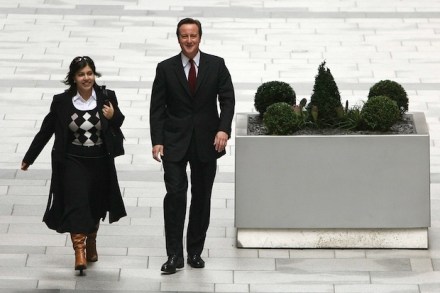
David cameron

David Cameron gets bullish on European elections: but what’s his clean-up plan?

David Cameron has now decided that rather than pretend Ukip don't exist, he's going to attack them, and do so repeatedly. This morning on BBC Breakfast, the Prime Minister remarked that 'we've seen some extraordinary statements from Ukip financial backers and candidates and I think it does go to the issue of the competence of the party: what on earth are they doing selecting people and allowing people like this to be in their party'.

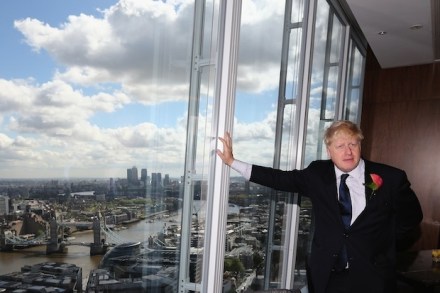
Paul Johnson’s diary: Boris would make a great PM – but he must strike now

I feel an intense antipathy for Vladimir Putin. No one on the international scene has aroused in me such dislike since Stalin died. Though not a mass killer on the Stalin scale, he has the same indifference to human life. There is a Stalinist streak of gangsterism too: his ‘loyalists’ wear masks as well as carry guns. Putin also resembles Hitler in his use of belligerent minorities to spread his power. Am I becoming paranoid about Putin? I hope not. But I am painfully aware that he would not matter if there was a strong man in Washington. As it is, President Obama is a feeble and cowardly man who makes even Jimmy Carter seem bold by comparison. He is running down America’s strategic capabilities while giving anaemic moral lectures.

What is David Cameron’s big idea?

[audioplayer src="http://traffic.libsyn.com/spectator/TheViewFrom22_8_May_2014_v4.mp3" title="James Forsyth and Isabel Hardman look forward to the general election next year" startat=766] Listen [/audioplayer]In almost a decade as Conservative leader, David Cameron has tended to avoid talking about his political philosophy. He has presented himself as a pragmatist, suspicious of anything ending in ‘-ism’ — and the very opposite of a swivel-eyed ideologue. There is something to be said for this, but it raises the great question: what is a Conservative government for? There was no clear answer at the last election and so no clear result from that election. Voters had turned away from Labour, but were not quite sure how their lives would be better under the Conservatives.

It’s not up to Cameron whether he survives a ‘Yes’ vote in Scotland

David Cameron may well have privately resolved that there is no cause for him to step down if Scotland votes for independence in a few months' time, as per James Chapman's scoop today. But the problem is that it is not in the Prime Minister's gift to make that decision. He may well say that he isn't going to resign, but that would have no effect on the number of letters that would be sent to 1922 Committee chairman Graham Brady demanding a leadership contest. It's not as though the Tory party will reel from the shock of Scotland leaving, then wait to see what the Prime Minister says and then if he says he's staying, they all get back to their day jobs.

The 2015 conundrum

One of the striking things about the next election is how what is going on at the macro level looks so different from what is happening at a micro level. On the macro front, things seem to be moving the Tories' way. The economy is growing at a good clip and that is set to continue until polling day and David Cameron has a considerable advantage on the question of who would make the best Prime Minister. But to return to the micro, it is easier to see seats where Labour might gain from the Tories rather than the other way round. Ask even the most optimistic Tories what constituencies they might win to give them a double-digit majority, and they come up short. The crucial question is whether these marginals are a lagging indicator or not.

Rising Tory, Hidden Danger: David Cameron is Doing Too Much Too Well

The British economy is growing. Not before time you might say. Be that as it may, there is a breath of summer in the air after a long winter. The quickening recovery has the Tories in jauntier spirits than for some time. The polls are closing. The Conservatives are within the margin of error and though the odds may remain it is no longer utterly fanciful to think they might remain the largest party at Westminster next year. What ho and what larks, good news is all around. Except in the north. Always the contrary north. A chill wind blows from North Britain and the message it bears should warn David Cameron he's being used by his enemies. Scottish nationalists endlessly carp that Unionists are obsessed with Alex Salmond. A vote for independence is not, per se, a vote for Mr Salmond.

PMQs: Miliband and Cameron attack on each other’s weaknesses, not the issues

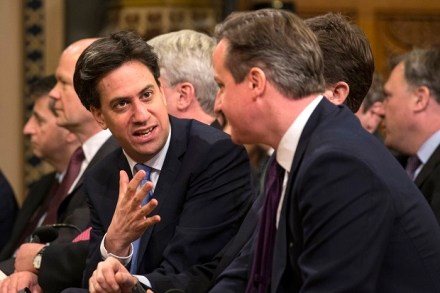
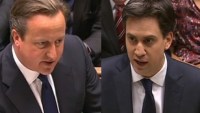
Both Ed Miliband and David Cameron turned up to PMQs today wanting to expose the flaws in their opponent's character. First, Ed Miliband taunted the Prime Minister about Labour's new private rented sector policy. Now that Labour is producing policies which seem to have purchase with voters, the Labour leader has what some might describe as the 'intellectual self-confidence' to kick off PMQs not just with a Labour policy rather than a government cock-up, but also predict that the government will eventually concede that Labour has a point.

With one year to go, Cameron has won over his internal swing voters – for now

It's a year to go until the longest election campaign finally finishes. Ed Miliband thinks he has more intellectual self-confidence than David Cameron, which since his 2013 autumn conference speech where the Labour leader finally found the courage of his convictions. But David Cameron has more confidence about his own party sticking by him for the campaign at least. The Prime Minister has mended some relationships, and others are more cordial and banging the Tory drum simply because they want their party to win next year. But it's fair to say that for the time being the PM has got the contingent of swing voters amongst his own MPs - those who are not his loyal servants but who also don't hate his guts - working on his side.

Modern England: a triumph of immigration and integration.

In a better, more sensible, world David Cameron would make a virtue of the opportunity UKIP has given him. He would appreciate that defending his party's record is actually an opportunity for a counter-attack. UKIP complain - loudly - that 4,000 people arrive in the United Kingdom from the EU each and every week. This, they suggest, is awful and Something Must Be Done to limit the number of people coming to the United Kingdom. The Conservative party appears, in its dark heart, to share this concern. It suspects the Kippers might have at least half a point. There's something nauseous about all this immigration, isn't there? No wonder the party is hemmed-in, unable to find a response to UKIP that is both sensible and persuasive. Better, then, to attack.

Ukip aren’t just David Cameron and the Tories’ problem anymore

How the Tory party will react if, as excepted, Ukip pushes the party into third place in the European elections is one of the most discussed topics in UK politics. But overlooked in all this is how Labour will react if Farage’s party beats them on May 22nd. If Ukip come top in the European Elections, as the polls indicate they have a very good chance of doing, Labour will be thrown into a panic. No opposition has ever triumphed at a general election having not won the previous European Elections. A failure in the European Elections would be a big blow to the idea that Ed Miliband is going to be the next Prime Minister. Already, influential members of the shadow Cabinet are grumbling about how the leadership hasn’t taken these elections seriously enough.

Portrait of the week | 1 May 2014

Home The British economy grew by 0.8 per cent in the first quarter of 2014, disappointing hotheads who’d expected 1 per cent. It was 3.1 per cent bigger than a year earlier, but 0.6 per cent smaller than in 2008. Pfizer, the American pharmaceutical company, said it wanted to take over AstraZeneca, with a £60 billion bid that would make it the biggest ever foreign takeover of a British-based company. The Labour party said it was leaving the Co-op Bank and taking its £1.2 million overdraft elsewhere. UK Financial Investments, which manages the Treasury’s 81 per cent stake in the Royal Bank of Scotland, blocked a plan for 200 per cent bonuses.

Ed Miliband slapped in the face by bouncy Dave

As the economy bounces back it keeps smacking Ed Miliband in the face. At PMQs today he tried to pose as the people’s champion fighting fat-cat capitalism. He started with Royal Mail, which is now worth a billion more than when it was floated. In hindsight, any privatisation can look like a Westminster mega-blunder or a Square Mile stitch-up. Miliband took the latter view. Referring to the clique of 16 ‘golden ticket’ investors, he asked why these lucky speculators had been allowed to flip their shares for an instant profit while the hard-working posties had been ordered to retain theirs for three years. Cameron spotted the trick. Posties got free shares. The City paid hard cash. The PM praised the flotation for turning a commercial dead-horse into a ripping triumph.

David Cameron is linking Ed Miliband to Labour’s past mistakes

What a very long PMQs today, presided over by a very bumptious John Bercow. The Speaker let the exchanges run into what he called 'injury time', made a rather poisonous jibe at Labour MP Fiona Mactaggart over her private schooling, and told the Prime Minister that as far as he was concerned, he had finished an answer when the PM didn't believe he had.

Labour goes after Cameron over TV debates

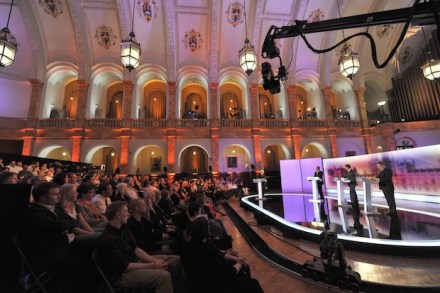
A smart move by Ed Miliband today to put pressure on David Cameron over the televised leaders' debates next year. Every time the Prime Minister is asked about these debates, he makes supportive noises while muttering about the 'right formula', but doesn't commit to anything. He has also said that he felt the debates 'dominated' the coverage of the 2010 election, which is as close as he'll come to saying that Nick Clegg's shiny new qualities at the time rather detracted from Cameron's own appeal which his strategists had been setting so much store by. But as the Prime Minister hasn't agreed to anything, Labour's trying to get ahead of the game and appear to drag Cameron into a studio.

David Cameron’s mile-high fight

How does a Prime Minister get a recalcitrant minister to agree to something? Well, if it's not going to make any difference to whether some legislation passes and the minister isn't directly responsible for the policy, then he can always let them avoid a vote, as he seems to be doing on HS2 today. But what if the minister is the one who needs to sign off on a policy change? I hear that David Cameron found himself in this situation late last year when trying to make some changes to the government's counter-extremism strategy. Baroness Warsi (not his favourite minister) was refusing to accept the changes, which the Prime Minister ambushed her over.

Christianity is not a prop for politics

First the godly, then the godless, then the godly again. The public debate about whether Britain is indeed a Christian country, which the Prime Minister kicked off with his article in the Church Times saying that Britain should be evangelical about its Christianity, took legs when fifty-odd self-important atheists took issue with his remarks in a letter in the Telegraph and now the debate has a new spin after a group of academic philosophers wrote to the same paper (lucky letters editor) to contradict the atheists. “In important ways Britain remains a Christian country, as the Prime Minister has rightly claimed”, they wrote.

Yes, Britain is a Christian country

I can’t say it was a great surprise to read a letter from a group of well-known authors, academics, comedians and politicians in the Telegraph earlier this week complaining about David Cameron’s description of Britain as a ‘Christian country’. As a general rule, any acknowledgment of Britain’s Christian heritage has members of the liberal intelligentsia reaching for their keyboards and angrily typing out words like ‘sectarian’, ‘alienation’ and ‘division’. As Harry Cole argued in a blog post for The Spectator, the evidence that Britain is a Christian country is overwhelming. We have an established church, our head of state is also the defender of the faith and 59 per cent of us define ourselves as ‘Christian’.

Portrait of the week | 24 April 2014

Home David Cameron, the Prime Minister, appeared in public with George Osborne, the Chancellor of the Exchequer — the first time they had been photographed as a couple for four years — to draw attention to infrastructure projects. Mr Cameron mentioned in an article for the Church Times that Britain is a Christian country, which made 55 celebrity atheists write to the Daily Telegraph to deny it. A new Family Court came into being, committed to resolving within 26 weeks cases about the care of children, rather than the average of 56 weeks recorded in 2011. Steve Webb, the Liberal Democrat pensions minister, said that the government could help people by telling them when they would die.

Doing God works well for Cameron

David Cameron's decision to hug-a-Christian seems to have worked pretty well, judging by the political response he's provoked. For starters, his comments about Britain being 'evangelical' about its status as a Christian country managed to enrage the sort of people who also might annoy the churchgoing conservatives he needs to win back after the row over gay marriage. Today, he - and the secularists - got a response from the Archbishop of Canterbury who wrote on his blog: 'It's all quite baffling and at the same time quite encouraging. Christian faith is much more vulnerable to comfortable indifference than to hatred and opposition. It's also a variation on the normal "Sword and Grail discovered" stuff that seems to be a feature of Easter week news.