Covid

Labour’s mask hypocrisy

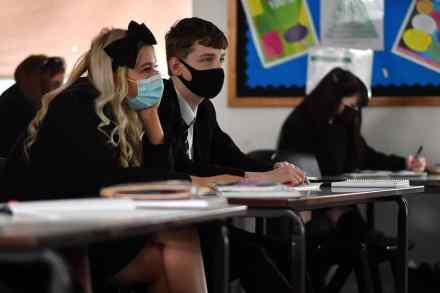
It’s day three of Labour conference and proceedings are in full swing. Whether it’s one of Andy Burnham’s 11 fringe events or yet another interminable motion in the conference hall, the rooms of Brighton have been packed to the rafters with Labour’s long-suffering members.  Clearly Covid spreads in teaching settings but has the grace to stop at the doors of conference jollies Yet walking around various venues Mr S was surprised to see just how few attendees were wearing their masks in poorly ventilated rooms, with no windows or open doors. With Covid cases still low, normally such a state of affairs would pass without comment. But Labour has made

Tory MPs are changing their minds on Universal Credit

Tory MPs will not get the chance to force the government into a U-turn on scrapping the £20-a-week Universal Credit uplift this afternoon after the Speaker didn’t select their rebel amendment. Sir Iain Duncan Smith and Damian Green had tabled the motion refusing to give a second reading to the bill on the basis that the money saved by breaking the pensions triple lock should have been diverted towards keeping the uplift. The motion would not have reinstated the uplift, but would have blocked the legislation process enabling the government to suspend the triple lock so that the state pension rises in line with inflation or 2.5 per cent, rather than

Italy’s draconian vaccine laws are terrifyingly popular

In early August, Italy banned the unvaccinated from most forms of social life, then most forms of travel and now most forms of work. The unvaccinated are pariahs. Yet unlike in France, say, where hundreds of thousands have taken to the streets to protest against compulsory vaccine passports, in Italy hardly anyone has protested against ‘Il Green Pass’ which is now the most draconian in Europe. The Italians have never been especially keen on liberty, and as a result liberty has never flourished in Italy. This, I think, explains why this removal the basic liberties – or rights, if we must – of unvaccinated Italians by Italy’s unelected premier Mario Draghi is

Don’t condemn Nicki Minaj for her vaccine blasphemy

Nicki Minaj weighed in on the coronavirus vaccine this week, and the world hasn’t been this relieved since Katy Perry peer-reviewed that swine flu research. For those even more cripplingly out of touch than I am, Minaj is a Trinidadian-American rapper best known for her filthy 2014 single ‘Anaconda.’ Real country anaconda, let me play with his rifle / Put his butt to sleep, now he calling me NyQuil, Minaj raps, and while that’s evidently considered TV-G by our woke censors, there are some things they simply can’t allow to be said. So it was that anyone who wandered onto Twitter found Minaj staring down a mob. Her problems began when

Will vaccinating teenagers really prevent disruption to schools?

After the JCVI recommended against offering vaccines to children aged 12 to 15 on health grounds, the government asked the four chief medical officers to consider the broader case, including the impact on schooling. As we know, the government has now accepted the chief medical officers’ recommendation: that all 12 to 15 year olds should be offered one dose of Pfizer on the grounds that doing so will reduce disruption to education. The government has released details of the modelling that underpins that rationale. The approach was first to estimate the number of infections with and without vaccination under different scenarios of infection spread. Next, they used this to model

America’s Covid rules are for serfs, not celebrities

Amid the ridiculous outfits at the Met Gala last night, between the faux-socialist in her absurd ‘Tax the Rich’ dress and whatever that was that Kim Kardashian was attempting, stood a row of servants, masked. The celebrities, of course, were not. If there’s one thing we have collectively learnt during the 18 months of this pandemic is that the rules don’t apply to the rich and famous. A year ago I wrote about the open hypocrisy of holding MTV’s Video Music Awards in New York while the city’s inhabitants were still largely forced into our homes:  ​​Our restaurants are only allowed to offer outdoor seating and must close at 11 p.m. You

Javid avoids Tory fightback – for now

Tory MPs were not happy when Sajid Javid unveiled the Covid winter plan in the Commons this afternoon. They’re dissatisfied with the government holding so many powers – such as vaccine passports, further lockdowns and other restrictions – in reserve as part of its Plan B, which will be activated this winter if cases breach what the NHS can cope with. The Health Secretary explained Plan B thus: ‘It is absolutely right that the government have a contingency plan, and the trigger, so to speak, for plan B, as I mentioned in my statement, would be to look carefully at the pressures on the NHS. If at any point we deemed them

Can booster shots help Britain avoid another lockdown?

For weeks now, ministers have been getting increasingly frustrated by the Joint Committee on Vaccination and Immunisation’s failure (JCVI) to back a wide-ranging programme of booster shots. Today it has finally recommended a third dose for everyone in clinical groups one to nine, which is, essentially, everyone over 50. Sajid Javid, the Health Secretary, has already accepted the recommendation and the programme will begin next week. Will this be enough to prevent the need for another lockdown? The booster programme should prevent the waning immunity problem, which was one of the reasons why Israel was hit by an unexpected fourth wave. The government is relying very heavily on boosters to avoid more restrictive

Is the inflation panic over? Probably not

So, is the post-Covid inflation panic over? That is how it looked last month, when the government’s preferred inflation index, CPIH, fell to 2.1 per cent from 2.4 per cent a month earlier. We will have the latest news on Wednesday morning, but for the moment it appears that consumer prices inflation hasn’t taken off like we feared. It is a similar story in the US, where inflation fell back from 5.6 per cent in July to 5.3 per cent in August. The fact that house prices have risen so strongly throughout the deepest recession in modern times ought to be a warning sign Yet there are good reasons to suspect that the summer

Covid pingdemic takes its toll on Britain’s economic bounce-back

The arrival of ‘freedom day’ on 19 July enabled people to return to concerts, festivals, and ditch social distancing, but these rediscovered freedoms did not revive the economy. The ONS said this morning that growth was just 0.1 per cent in July, far lower than the consensus forecast. It was particularly disappointing given the growth seen in the locked-down months of June (one per cent) and May (0.6 per cent). The Pingdemic – and concerns about the Delta variant – cancelled out any animal spirits around reopening. August’s GDP boost is going to need to be much stronger for the more bullish forecasts to pan out Nightclubs reopened and the entertainment

Why didn’t Tory MPs oppose Boris’s tax hike?

Boris Johnson has just announced his plans to increase National Insurance by 1.25 per cent for both workers and employers to fund extra spending on the NHS and social care. Johnson framed the measure as necessary to deal with the backlog that had built up during Covid. He claimed that without action hospital waiting lists would reach 13 million. He said that he didn’t break his manifesto promise lightly but that a ‘global pandemic was in no one’s manifesto’.  Of course, the problem with this argument is that the tax promise, as well as the commitment that no one would have to sell their house to pay for social care,

Why isn’t the vaccine approved for 12- to 15-year-olds?

This afternoon, the JCVI has essentially passed the buck on vaccinating 12- to 15-year-olds. It has declared that the health benefits of a vaccine for this age group are ‘marginally greater’ than the risks of Covid. But it has left the decision on whether to actually vaccinate them to the chief medical officers. It would surely have been better for the committee to have made a decision one way or the other In the past few weeks, tensions between ministers and the Joint Committee on Vaccination and Immunisation have been rising. Ministers are keen to get on with an autumn booster shots campaign for the elderly and to vaccinate more school children.

Should Britain brace itself for a major flu outbreak this winter?

Could flu be a bigger problem than Covid this winter? Professor Anthony Harnden, the deputy chair of the Joint Committee on Vaccination and Immunisation, has warned that it might be, suggesting that the low prevalence of flu over recent months could come back to ‘bite us’ as the weather worsens. There are also fears that reduced levels of flu in recent months could make it much harder to develop a successful jab. In a normal year, the route to a flu vaccine is well trodden. The annual flu vaccination programme first began in England in the 1960s, and since 2000, all over 65s have been offered the jab every year. Healthy children have also

Can schools return without disruption?

A lot of people won’t want to take much notice of Mary Bousted, joint-general secretary of the National Education Union (NEU), who warns today that schools face significant disruption by the end of September as Covid-prevention measures have to be reintroduced. It was the NEU, after all, which not only opposed the return of schools after the first lockdown, but simultaneously advised its members not to take part in online lessons either. The NEU has often given the impression of being motivated first and foremost by a desire to obstruct the government’s plans. Sir Patrick Vallance’s original verdict on the virus – that it is not possible to stop it

Afghanistan could fatally undermine Macron’s election strategy

To nobody’s great surprise, France’s Minister of Health, Olivier Véran, announced last week that the Covid Passport may have to be extended beyond 15 November – the initial expiry date of the government’s controversial measure, first introduced in July. I’ll hazard a guess that come April 2022 the French will still have to show their passport to enter cafes, shopping centres, sports clubs and cinemas. April, of course, is the date of the presidential election and Emmanuel Macron is banking on his response to Covid helping him to secure a second term. His belief is that the electorate, particularly the over-50s, will be reluctant to change presidents in the midst of a

The NHS blood tube shortage should concern us

One of the great lessons from the early stages of the pandemic was the need to shorten supply chains and make them more robust. This was especially true for medical supplies. Just-in-time supply chains have been developed over the years to increase efficiency, but had never been tested in a global crisis when demand for certain medical products is high and supply is weak. The government ended up paying huge sums for PPE which, in some cases, was not even suitable for use. The shortage raises eyebrows because a plastic tube is, after all, a plastic tube It seems the lesson has not entirely been learned. There is now a shortage of

Natural immunity is stronger than vaccination, study suggests

At times this summer, the government has been accused of fighting Covid-19 with an undeclared strategy that concentrates on vaccinating the old while allowing the young to build up herd immunity. The effort that the government has put into persuading young people to have the vaccine suggests this is more conspiracy theory than reality. Nevertheless, might it be a good strategy? The preprint of a yet-to-be-published Israeli study comparing the efficacy of the Pfizer vaccine with immunity gained through natural infection suggests that the latter may be more effective and longer-lasting. Double-jabbed, previously uninfected people are 13 times as likely to get Covid compared with the naturally immune The team,

Is Japan about to enter a ‘London-style lockdown’?

Just like the Olympics, which ended a fortnight ago, the Paralympics is set to commence amid a drumbeat of doom. Japan appears to be in the middle of a Covid renaissance, with around 5,000 new cases a day in Tokyo. The games will take place, like the Olympics, in a ‘state of emergency’ that now covers 84 per cent of the country. But how serious is the situation, and what exactly does 5,000 daily cases mean? Like much of the vaccinated world, the majority of the afflicted this time round appear to be younger people and overall deaths in Japan remain extremely low. It is at least as much a

Covid has exposed the flaws in the welfare state

Upheavals in welfare policy have historically followed major crises such as wars, civil unrest, recessions and pandemics – the Ministry of Health itself was established in 1919. The experience of the second world war led to the creation of the contemporary welfare state. If a course of action (a furlough scheme, say) is pursued in an emergency, we know it is possible. Keep the measure in place too long and it can swiftly become an accepted norm — and politically awkward to unwind. But those expecting a post-Covid reboot of the welfare system might be disappointed. Shadow work and pensions secretary Jonathan Reynolds talked a good talk on overhauling universal

Boris Johnson’s Macron-esque pettiness

How we all hollered with outrage in May when Emmanuel Macron closed France’s borders to people arriving from Britain on the dubious basis that Britons, and Britons alone, were in danger of infecting France with the Indian variant. I believed, and I still believe, that Macron and his government were in part motivated by Brexit — it was part of our ongoing punishment for daring to vote to leave the EU. It certainly wasn’t justified on scientific grounds: if Briton had more recorded Indian variant (or Delta) cases than other European countries at the time it was largely thanks to more samples of Covid being sequenced here. Some countries, France