Covid-19

Could disruption in Dover lead to empty supermarket shelves?

From our UK edition

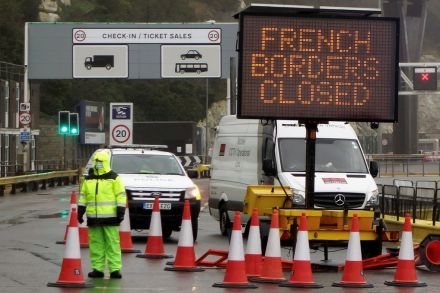
The Port of Dover has been closed, with freight as well as passengers unable to cross the Channel, due to the new strain of Covid concentrated in London and the South East. So how long before supermarket shelves are empty? A lot depends on the behaviour of British consumers.  As has been proved on a number of occasions, such as with lavatory paper at the beginning of the spring lockdown and with petrol during the fuel protests in 2000, you don’t need an actual shortage of goods to result in apparent shortages – panic-buying can lead to empty shelves within hours, if people are minded to stock up their freezers and larders to a level they would not normally do.  Yet Britain really is painfully dependent on imports of many kinds of food.
Smarmy Starmer is not making himself popular with anyone

From our UK edition

The verdict of the Twitter jury is in, articulated in a single, now viral tweet by broadcaster Matthew Stadlen:  'Keir Starmer would have been – and would be – a far better Prime Minister than Boris Johnson during this pandemic.' It is a theme that Starmer has naturally been keen to develop, leading him to make excoriating criticisms of Boris Johnson in a press conference at the weekend. The Starmer thesis is that Johnson is so anxious to be liked that he ducks out of taking tough decisions until it is too late.

Covid and Brexit are about to collide

From our UK edition

We are back in a full-scale economic crisis. In London and the south east, the richest part of the UK and engine of the economy, normal commerce has been suspended by the imposition of Tier 4. And the decision of much of the EU and a growing number of rich countries to put the whole UK into quarantine is devastating for trade. What are the immediate priorities? Probably the most important one is basic: the creation of a facility to give rapid Covid-19 tests to all lorry drivers leaving the UK so that the transport of freight can be restarted as quickly as possible. Second, to end the cancerous uncertainty for businesses about how they will be buying from and selling to EU countries in just ten days time, after the transition to full Brexit ends.

Britain faces a crisis over the coming weeks

From our UK edition

This country faces a crisis over the next few weeks. Covid cases are rising rapidly in the UK — there were more than 35,000 new cases yesterday, the largest number recorded during the pandemic and almost double the number a week ago. It seems likely that this rapid rise is, in part, a result of the new variation of the virus which does seem to be more transmissible. It is hard not to think that more of the country will be put into Tier 4 restrictions at the next review. It’ll be surprising if England gets through January without another lockdown. Concern over this new variant of the virus has led to a growing number of countries banning arrivals from the UK. France has done that, including for lorries.

Who’s to blame for the latest Covid test shambles?

From our UK edition

When schools returned in September, the sudden spike in demand for Covid-19 tests caught the test and trace programme out. Dido Harding, head of NHS test and trace, told MPs back then that demand was 'significantly outstripping the capacity we have'. It was a predictable situation – but has the government learned its lesson? Sadly, it appears not.  With Christmas only a week away, Brits have taken heed of the warnings not to give anything nasty to granny when they sit down for lunch on the big day. Unsurprisingly, many are keen to get tested as a result. University students are also returning home in their droves, adding extra demand for tests. And the recent spike in infections has also put the test and trace programme under strain.

Rishi Sunak’s definition of a ‘sustainable’ deficit

From our UK edition

Last week, Katy Balls and I interviewed Rishi Sunak for the Christmas issue of The Spectator (out today) and his comments on debt have caused some interest in today’s newspapers. As ever with such interviews, there’s only so much you can squeeze into two pages but I thought it worth elaborating on his position today. I suspect it will come to define the political debate next year: yes, 2020 was a year of almighty splurge. Sunak has borrowed more in ten months than Gordon Brown did in ten years: but there was a pandemic. The question is how you get that back to normal. For a surprising number of Tories, it’s a question of 'whether' you get it back to normal. Why not let debt rip? Let it go from today’s 100 per cent of GDP to 120 per cent or even 150 per cent?

Can any country dodge the Covid bullet?

From our UK edition

The government is yet again under fire for its handling of Covid-19, as cases rise across parts of the country. But what about the global context? Is it still possible to argue that Britain has done especially badly in handling the pandemic? Possibly, but it is becoming increasingly hard to do so, as many countries which appeared to handle the virus best the first time around are now suffering second waves much larger than what they experienced in the spring. Germany, which this week announced a hard lockdown over Christmas, is a prime example. In the spring it was held up as an example of how the rest of Europe might have handled Covid-19. New recorded cases never rose over 7,000 a day and daily deaths peaked at 333 on 8 April.

Germany is in the grip of a Covid crisis

From our UK edition

Germany’s ‘lockdown light’ strategy has failed: the country, which has been widely-praised for its response to the pandemic, recorded a daily record of 952 coronavirus-related deaths last night. After experiencing relatively low numbers of infections and fatalities compared with other European countries in the spring, Germany has plunged into a crisis. It's true that Wednesday’s number was artificially inflated by delayed reporting of data from the state of Saxony, one of the coronavirus hotspots in Germany. But even without the 153 coronavirus-related deaths recorded in that region, the grim tally marks a new peak.

Will Macron start an EU Covid chain reaction?

From our UK edition

The Elysée palace has just confirmed that French President Emmanuel Macron has tested positive for Covid-19, after developing symptoms this week. In a statement, the palace said the President had been tested ‘as soon as the first symptoms appeared’ and will now be self-isolating for the next seven days. It’s not yet clear how badly Macron has been affected by the disease, nor when he was infected. One can only wish him the best of health in the coming days.

Boris Johnson’s Christmas Covid gamble

From our UK edition

Boris Johnson is taking a gamble with his decision to stick with the easing of Covid restrictions for Christmas. The gamble is that people will suddenly start adhering to government guidance and severely restrict their contact with their families, even though the law does not force them to do so. Although, as the Prime Minister argued at this afternoon's press conference, the government's current level of involvement in people's lives is probably the strictest since Cromwell, it remains the case that it has repeatedly concluded this year that it has to force people to restrict their social contact, rather than ask them – whether that’s nicely or in the current special stern voice that ministers have decided to adopt.

Tory MPs are anxious about a post-Christmas lockdown

From our UK edition

Boris Johnson told Prime Minister's Questions today that the meeting of the four nations of the UK ended with the leaders agreeing to keep the relaxation of rules over Christmas. He said there had been 'unanimous agreement' at the meeting that 'we should proceed in principle with the existing regulations because we don't want to criminalise people's long-made plans'. But not long after the meeting broke up, the Welsh and Scottish governments announced they would be producing their own much tougher guidance. In Wales, the number of households who can mix will be cut to two rather than three, and the country will then go back into lockdown from 28 December. In Scotland, people will be asked to only meet for one day and not stay overnight.

Four-nations Christmas Covid truce hangs in balance

From our UK edition

It's become a regular refrain to hear that Brexit talks have been extended. Now the same applies to negotiations over the Christmas Covid rule relaxation. After various scientific advisers warned the UK government against going ahead with its planned five day relaxation of the rules (which would see three household permitted to gather together), representatives for the four nations discussed the policy on a call this evening. The result? No decision as of yet. As things stand, there has been no agreed change to the rules. Instead one source on the call tells the BBC:  'There was broad recognition commitment has been made to people and they will expect us to honour it – but there is a need to be stronger and clearer in guidance and messaging'.

Will the relaxation of the Christmas Covid rules be reversed?

From our UK edition

The plans of the UK and devolved governments to ease restrictions over Christmas are coming under increasing criticism. Matt Hancock faced repeated questioning last night on whether this was wise given the new strain that he thinks might be behind the more rapid spread of the virus in London and the south east. This morning, the British Medical Journal and the Health Service Journal have called in a joint editorial for the government to scrap the Christmas easing entirely and ban all household mixing this Christmas. The two editors write that ‘we believe the government is about to blunder into another major error that will cost many lives. If our political leaders fail to take swift and decisive action, they can no longer claim to be ‘protecting the NHS.

Should we worry about the new variant of Covid-19?

From our UK edition

Should we worry about the emergence of a new variant of SARS-CoV-2, the virus which causes Covid-19? News of the new variant – which, it seems, might transmit more easily than previous versions – was the big surprise of Matt Hancock’s statement to the Commons this afternoon. The other big announcement – that London and parts of Essex and Hertfordshire will be going into Tier 3 – was a foregone conclusion. As I wrote here in May, the SARS-CoV-2 virus has already mutated once into a form that might be more transmissible. This could possibly explain why Europe and North America have found it harder to contain the virus than have Asian countries. Were we fighting a slightly different disease to the one which emerged in Wuhan in January?

Hancock warns of a new Covid strain

From our UK edition

Matt Hancock has just announced that London and the surrounding area will be put into Tier 3 from one minute past midnight on Wednesday. Hancock said that government scientists had identified a new strain of Covid that they think might be behind the more rapid spread of the virus in the south east in recent weeks. Alarming as this sounds, he did emphasise that it doesn’t seem to cause more serious illness and there’s no reason to think it won’t respond to the vaccine. The news of this strain does raise further questions about the Christmas easing. The risk now is that as people head home for the holidays they will carry this new, more rapidly spreading strain of the virus around the country — and that could make the situation worse in January.

How Wales’ Covid-19 outbreak spiralled out of control

From our UK edition

Back in October, Wales implemented the 'circuit breaker' lockdown which was rejected by Boris Johnson on the grounds that these things are not long-term solutions. It’s hard to see what good it did Wales now: after a short-term dip, its Covid rates are now at least twice as high as anywhere else in the UK and seem to be spiralling out of control. The situation is particularly concerning because Wales has been swift to impose strict measures in a bid to contain the situation. No one could venture that a lack of caution is to blame for what is unfolding in Wales. The country imposed its ‘firebreak lockdown’ for just over two weeks on 23 October; it was another week before a similar lockdown was announced by Boris Johnson for England.

What my father-in-law’s death taught me about Covid

From our UK edition

It’s been a beast of a year, hasn’t it? This morning my father-in-law died of Covid in Pristina, and it’s only when it comes right home to you that you’re reminded how real and immediate the threat from that spiteful little virus is. The reason I’m writing about this personal loss is that I worry that the whole Covid situation has been politicised, even while the vaccine is finally coming into play.

Will fewer days fix the UK’s self-isolation problem?

From our UK edition

From Monday, the guidance for self-isolation is changing. Previously if you were told by officials (or the NHS app) you had been in close contact with someone who tested positive for Covid-19, you were expected to self-isolate for 14 days. Starting next week, this will be reduced to 10 days, and will also apply to those returning from 'high risk' travel areas that are not on the UK's 'green list'. The update was issued as a joint statement from the UK chief medical officers, who said: 'after reviewing the evidence, we are now confident that we can reduce the number of days that contacts self-isolate from 14 days to 10.' This brings the quarantine period for close contacts in line with those who test positive for Covid-19.

The damning verdict on NHS Test and Trace

From our UK edition

SAGE has already poured cold water on the NHS Test and Trace system in England, suggesting in September that it was making only a ‘marginal’ difference to Covid infection rates. Now the National Audit Office (NAO) has had its say, publishing its interim report into whether it has been value-for-money. It is not much more flattering.  It depicts a hugely-expensive system which leaves many of its staff sitting around with little to do and which is failing to make contact with nearly as many people as it needs to in order to work as SAGE says it needs to. The budget for Test and Trace over the whole of 2020/21, it says, is £22 billion – quite a lot more than the £12 billion that is commonly quoted as the cost of the scheme.