China

Nobody believes China

The World Health Organization now says the virus ‘most likely came from animals.' But everybody knows that the WHO is heavily influenced by China, and China is not a reliable source. Everybody, that is, except large and important sections of the US media. Before the WHO’s latest report, Feng Zijian, the deputy director of China’s Center for Disease Control and Prevention, claimed the virus spread after a bat infected a human — or the virus initially went from bat to another animal or mammal species, which then jumped to humans or that shipments of frozen food from Europe or even the United States spread the virus throughout the province of Wuhan. It’s always the West’s fault, the way Beijing tells it.
china

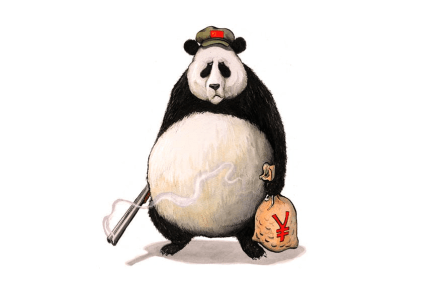
Why the West should stop investing in China

From our UK edition

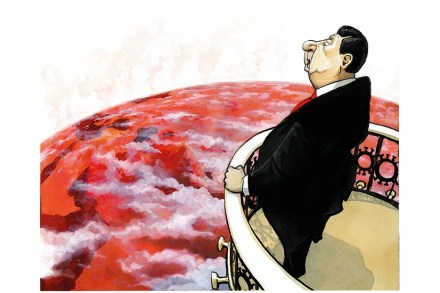
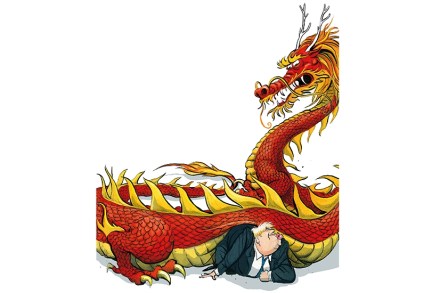
The Prime Minister has called for an international coalition of free countries to oppose the growing influence of China’s authoritarian dictatorship. But it needs to be a lot bolder. The wheels of international diplomacy turn slowly and the government should make full and immediate use of the powers it already has. Three decisive steps are already possible. Companies from Western liberal democracies are bolstering an authoritarian dictatorship First, we should stop entities under the control or influence of the Chinese Communist Party (CCP) from buying up our companies, especially infrastructure firms. A Chinese company, for example, controls about 25 per cent of North Sea oil and other companies own gas, water and electricity suppliers in the UK.

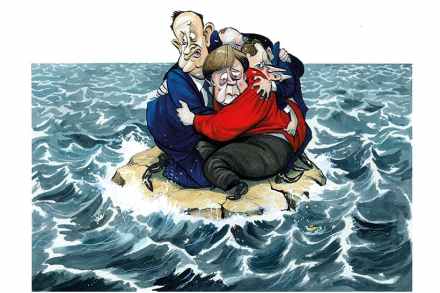
The EU’s decline is self-inflicted

From our UK edition

In 1991, at the height of the first Gulf War, the EU demonstrated to the world its divisions and helplessness, as Belgium infamously blocked the export of munitions to the UK, then at war in the Gulf. They quickly came to regret it. The Belgian Foreign Minister subsequently remarked tellingly: ‘Europe is an economic giant, a political dwarf and a military worm’. It seems these days that little has changed, save that even the EU’s claim to be an ‘economic giant’ is eroding with the loss of the world’s fifth largest economy, a dwindling share of world trade and a catatonic growth rate, even before the pandemic. Worse still, much of its relative economic decline is self-inflicted.

Why does China think it can bully backbench MPs like me?

From our UK edition

Does the Chinese Communist Party understand how our parliamentary democracy works? The evidence from the last 24 hours suggests not. Along with some of my Conservative colleagues in the House of Commons – Sir Iain Duncan Smith, Tim Loughton, Tom Tugendhat and Neil O’Brien – as well as two peers, a QC and an academic, I have been banned from entering China, had any assets in China frozen (not that I have any there) and have had Chinese citizens and institutions prohibited from doing business with me. All because I have voiced well-evidenced concerns about the persecution of the Uyghur Muslim minority by the Chinese government.

MPs facing Chinese sanctions deserve our solidarity

From our UK edition

The sanctions that China is imposing on various politicians, academics and think tanks in the democratic world are designed to intimidate. Their aim is to make people, and particularly firms, think twice about criticising China over its human rights record and in particular its treatment of the Uighurs. Last night, China slapped sanctions on a bunch of British parliamentarians, and some academics, in retaliation for Britain putting sanctions on four Chinese officials working on the Xinjiang internment policy. It is imperative that this country stands behind these individuals and groups. We cannot allow a situation where China can determine the contours of debate in this country.

Joe Biden’s dire opening chapter on the world stage

Thoughtful observers of life often comment on the richness of the English language, its huge polyglot vocabulary, its precision, it sinewy expressiveness. It is doubtless politically incorrect to say so, but English has also shown itself to be a conspicuous ally of political liberty. I have commented on this in the past, noting that 'there seems to be some deep connection between the English language and that most uncommon virtue, common sense'. Speakers of English can be plenty extravagant, it may go without saying, but there is something about English — exactly why, I do not know — that acts to tether thought to the empirical world.

world stage

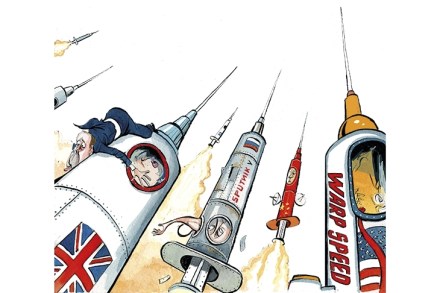
Has Britain fallen victim to the Asian vaccine war?

From our UK edition

The success story of Britain's vaccine rollout has hit its first major obstacle: five million doses of the AstraZeneca vaccine will be held up for a month. But how many of us knew it was India, not manufacturing plants in the UK or Europe, that was supplying a considerable amount of our vaccine needs? And does the delay show that Britain is now caught in the middle of an emerging vaccine war in Asia? The delayed jabs are being manufactured in the Indian city of Pune (pronounced Poona).

What happens when Facebook pays for news?

From our UK edition

The recently departed head of MI6, Sir Alex Younger, wants to balance China’s ideological antagonism to the West with the need for coexistence. Commenting on the government’s new ‘integrated review’, he says we must fight back with technological innovation and stronger alliances but avoid a second Cold War. He advocates ‘One Planet: Two Systems’ — a globalised echo of the Anglo-Chinese Hong Kong Agreement by which Hong Kong was handed back to China in 1997 under the principle of ‘One Country: Two Systems’. Sir Alex’s is an interesting analogy, but the important thing to note about ‘One Country: Two Systems’ is that China adhered to it only for 20 years and is now trashing it. Could the same problem take over the world?

Is Britain heading for war over Taiwan?

From our UK edition

It is billed as a once-in-a-generation review of Britain’s foreign policy and defence strategies. ‘Global Britain in a Competitive Age’, Boris Johnson’s ‘new chapter’ for Britain, identifies two main adversaries: Russia — an ‘acute threat’ — and China — a ‘systemic competitor’. And while it nods at a geopolitical ‘tilt’ towards the Indo-Pacific, the more hawkish Tory MPs are disappointed, thinking Beijing should have also counted as a threat. They should perhaps be careful what they wish for. The Prime Minister is sending more than harsh words in China’s direction.

How Brexit has boosted Global Britain

From our UK edition

The government’s integrated review of foreign and security policy, published yesterday, has landed surprisingly well considering that much of the Whitehall blob has been so dismissive of Boris Johnson’s concept of Global Britain. A few longstanding critics have been snippy about the new document. But no one can disagree that the review offers a genuine strategy. In recent years, one of the most persistent ideas about the UK’s future on the world stage has been that we cannot make a go of things post-Brexit. Such ideas, so the counter-argument goes, are based on the deluded nostalgia of a ‘buccaneering’ nation, foolishly going it alone on trade and much else besides.

Boris needn’t outflank Biden on China

From our UK edition

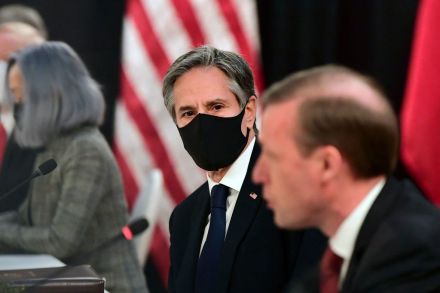
‘We must prepare together for a long-term strategic competition with China… We cannot and must not return to the reflexive opposition and rigid blocs of the Cold War. Competition must not lock out cooperation on issues that affect us all.’ These words were not spoken by Boris Johnson as he presented the integrated review to the House of Commons this week. Rather, they were said by President Joe Biden, in his speech to the Munich security conference a month ago. In setting out his vision for a future relationship with China, the Prime Minister and this week’s integrated review may well have been taken from Biden’s script. So why has the IR caused so much controversy?

uighurs

How China targets Uighur expats in the US

It has been more than two years since Ziba Murat has heard the voice of her ailing mother, Gulshan Abbas, a retired physician who was abruptly ‘disappeared’ in September 2018 in Xinjiang province, China. While exact facts and figures are hard to come by, it is widely reported that at least three million Uighurs in China have been forced into concentration camps, which Beijing calls ‘reeducation’ facilities for stamping out ‘Islamic extremism’. The scale of the ongoing atrocities is bone-chilling: from forced sterilizations and sexual violence to beatings and indoctrination. The Chinese government’s assault extends to Uighurs abroad.

MPs question Johnson’s plan for Global Britain

From our UK edition

Boris Johnson still has a journalist's ear for snappy phrases — levelling up, an oven-ready Brexit, Global Britain. The PM attempted to flesh out one of those headlines on Tuesday with his integrated review — so called because it ties together foreign and defence policy alongside trade and international aid.  The 100-page document — designed to set the course for 'Global Britain' over the next ten years — identifies Russia and China as the UK’s two biggest international challenges. The former is described as an 'active threat', a dangerous rogue state, while the East Asian country is seen instead as a 'systemic challenge'.

Boris’s China plan is a missed opportunity

From our UK edition

From Brexit to China, ‘cakeism’ – the idea that it is possible to govern without making hard choices – appears to be the defining philosophy of Boris Johnson's government. A hawk to the hawks and a dove to the doves; the Prime Minister wants to be all things to all men. The result is that the government have so far failed to make the hard decisions needed when it comes to China. But as with lockdown in March 2020, dither and delay is only going to increase the difficulty and trouble ahead down the road. The publication of the integrated review today makes this painfully clear.

Boris Johnson’s blueprint for ‘Global Britain’

From our UK edition

Boris Johnson will today unveil the government's integrated review which promises to set out the blueprint for 'Global Britain'. The 100-page document – titled 'Global Britain in a Competitive Age' – has been heralded as the most radical reassessment of Britain's place in the world since the Cold War. The Prime Minister is due to unveil the plans in the Commons to MPs this afternoon – but in the meantime the document has been leaked to several papers.  With Sino-scepticism building in the Tory party, the review appears to go a step further than many backbenchers would like So, what's next for Global Britain? The aspect which is already leading to the most animated debate in the Tory party relates to China.

The curious censorship of Chloé Zhao’s Nomadland

From our UK edition

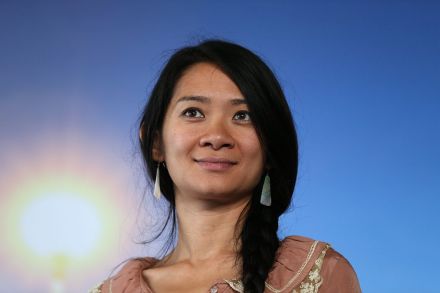
Fortunes shift quickly in Chinese cyberspace. On March 1, Chloé Zhao, the Beijing-born film director, was the ‘pride of China’, according to the Chinese Communist Party’s The Global Times. Zhao had just won the best director Golden Globe for her film Nomadland, becoming the first Asian woman in history to win the award, and only the second woman full stop. As news of her victory emerged, Chinese social media was awash with congratulatory messages for the 38-year old director.

My fight to stop the Chinese censors sanitising Dante

From our UK edition

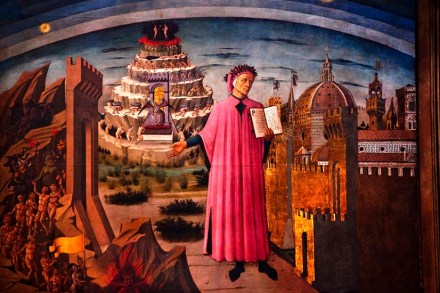
My book on Dante Alighieri was due to come out in Chinese translation later this year, but first I had to consent to sizeable cuts. Even by the standards of other authoritarian states the Beijing censors struck me as overzealous. It seems odd that the medieval Italian poet could cause such unease among modern-day totalitarians. A sanitised Chinese communist version of my book did not sit well with the 700th anniversary of Dante’s death in 1321, and in the end I withheld permission. The cuts were the work of Beijing’s blandly named Institute for World Religions. The institute undertakes ‘book cleansing’ operations on behalf of the state. No book can be published legally in China today without being vetted.

A tiger mum’s recipe for academic success

From our UK edition

You might have seen ‘Asian dad’ memes on the internet, poking fun at the famously high expectations of fathers from my part of the world. ‘You Asian, not B-sian,’ he says in one version. Or: ‘After homework, you can play… the piano.’ My personal favourite is a picture of a crying Chinese girl saying: ‘I only got 99 per cent in test. What do I tell my parents?’ Her father’s reply: ‘What parents?’ Much of Asian parenting is laser-targeted at getting into a top-tier university: Peking or Tsinghua would do in China; Ivy League or Oxbridge abroad.

The West has lost its moral high ground

From our UK edition

International travellers running the gauntlet of English airports must already test negative for Covid before the flight, and on return to the UK get tested again before boarding, fill out a locator form, quarantine for ten days and test negative twice more. But that’s not enough oppression for Boris Johnson’s government. As of this week, outbound intrepids have also to fill out ‘declaration forms’ explaining why their trip is essential. Not doing so is a criminal offence. This new hoop to jump is obnoxious on a host of levels. The declaration form came in on the very day the first few lockdown restrictions were eased, with hospitalisations and deaths dramatically down and more than a third of the adult population vaccinated.

Covid kids’ book pulped after China complains

From our UK edition

World Book Day was last Thursday and now a leading German publisher has belatedly marked the occasion by pulping copies of a children’s picture book. Its crime? Saying something that is almost certainly true: that Covid-19 originated in China. 'A Corona Rainbow for Anna and Moritz' was published to help kids understand the impact that Covid-19 is having on their lives. Based on scientific advice from a medical institute in Hamburg, it featured the fictitious protagonists’ father saying: 'The virus comes from China and has spread out from there across the whole world.' Offensive? Hardly. But it seems not everyone agreed. The Chinese consulate lodged ‘stern representations’ with Carlsen publishing house.