China

Jung Chang: what the West gets wrong about China

No writer has done more than Jung Chang to bring the horrors of Maoist China to the attention of western readers. In her monumental memoir Wild Swans (1991), she recounted the Chinese Communist Revolution, the Great Famine and the Cultural Revolution through the stories of her grandmother, her mother and herself. Its influence was enormous: Wild Swans sold more than 15 million copies, making it one of the best-selling nonfiction books of all time. In Mao: The Unknown Story (2005), co-written with her husband, the historian Jon Halliday, she blew apart decades of Chinese Communist party propaganda to reevaluate Mao as one of history’s greatest monsters, as bad, if not worse, than Hitler or Stalin.

The battle to stop US universities aiding Chinese repression

It goes by an innocuous name – “Integrated Joint Operations Platform” (IJOP) – but it’s one of the most sinister components of China’s surveillance state, managing what has been described as a genocide against the Uighurs. The IJOP combines multiple systems of repression – location, messages, contacts, social media and other data from phones, together with information from checkpoints, cameras and biometric records. It then flags “suspicious” individuals for detention and forced labor. Now leading US universities have been accused of extensive collaboration with Chinese laboratories which develop technology that may be deployed or adapted for use in this system.

It feels as if Michael McFaul’s audience has long since left

Since the end of the Cold War, politicians and commentators have been searching for a new paradigm through which to understand international relations. Notwithstanding Francis Fukuyama’s oft-misunderstood The End of History, we have tried various patterns to classify the world order, of which George W. Bush’s “Axis of Evil,” first used in 2002, was among the more enduring. In Autocrats vs. Democrats: China, Russia, America, and the New Global Disorder, Michael McFaul acknowledges the widespread if nebulous consensus that the challenge presented by Russia and China is a kind of second Cold War – historian Niall Ferguson has labeled America’s relations with China “Cold War II.

Michael McFaul

Fact-checking the Venezuela war hawks 

As the US Navy remains primed for action in the Southern Caribbean, Venezuelan dictator Nicolás Maduro prepares for what could be an American attempt to remove him. And as President Trump alternates between calling Maduro on the phone and authorizing air strikes, a bevy of misinformation is being peddled by public figures with an agenda. There are so many claims and counter-claims on the air waves right now that it’s difficult to separate fact from fiction. A sizable chunk of this disinformation is of course being sold by Maduro himself, a man who has learned from his predecessor and mentor, the late Hugo Chávez, that it’s easier to blame the United States for all of your problems than own up to your own catastrophic policy errors.

Trump team warned over London’s Chinese super-embassy

So much for simple Chinese takeout. In his never-ending search for economic growth, British Prime Minister Sir Keir Starmer has finally alighted on the obvious answer: cozying up to the liberal-minded democrats of Tiananmen Square. The Prime Minister is expected to fly to Beijing in the new year, once the long-awaited Chinese super-embassy in the London neighborhood of Tower Hamlets secures planning approval next month. No wonder 2025 is the year of the snake, eh?  But there now seems to be a wrench in the works, ahead of the mooted approval on December 10. For a group of American politicians are up in arms about the possible threat to global financial security.

china embassy

China has quietly taken over America’s food supply

For all the talk about artificial intelligence and quantum supremacy, the fate of civilizations still depends on breakfast. ChatGPT can’t grow corn. Empires rise on stomachs as much as on silicon. And America’s food system – long dismissed as safe and self-sufficient – has quietly become a front line in the US-China rivalry. We act as if lunch is inevitable, but Beijing knows that food is power. A new report from the America First Policy Institute should wake us up. Washington long treated agriculture as a post-political space where globalization could do no harm, and was therefore happy to let much of the nation ship its growth to China. As Ambassador Kip Tom and Royce Hood argue, China has thus taken over critical pieces of the US agricultural system and food supply.

china america food supply

Gavin Newsom flies to UN climate summit

“We’re in Brazil,” California Gavin Newsom said. “One of our great trading partners. One of the world’s great democracies. I mean, hell, you need rare Earth minerals, this is the country we should be engaging with. Instead, middle finger with 50 percent tariffs. That’s shameful.” That’s certainly a point to argue, but the question is why, exactly, was Newsom in Brazil, telling the gathered at a UN climate summit that the Trump administration had “disrespected” them? “I’m here in the absence of leadership of Donald Trump," he told a Sky News reporter. “He’s abdicated responsibility on a critical issue. I’m here to show up on behalf of my country. I’m here to showcase California’s leadership, dominance in the low-carbon greenco space.

Newsom
prince

Will the Andrew formerly known as prince appear before Congress?

Amidst all the ceremony and gravity of Britain’s Remembrance Day service on Sunday, one salient fact could not be ignored. The King has long talked of his desire for a “stripped-down monarchy,” and now he has his wish. The only male figures from the Firm who were out on show alongside him were the Prince of Wales and Prince Edward, who together had the effect of making the royals look a rather paltry selection compared to the grander gatherings of the past. We all know about Harry, but although some would like to see him, too, stripped of his royal title, Montecito’s second most famous resident continues to be able to refer to himself as a prince.

China is holding the West to ransom over rare earths

China’s naked weaponization of rare earths brings to mind Mao Zedong’s "four pests" campaign, the old tyrant’s fanatical effort to exterminate all flies, mosquitoes, rats and sparrows, which turned into a spectacular piece of self-harm. Sparrows were always an odd choice of enemy, but Mao and his communist advisors reckoned each one ate four pounds of grain a year and a million dead sparrows would free up food for 60,000 people. The campaign, launched in 1958, saw the extermination of a billion sparrows, driving them to the brink of extinction. But the sparrows also ate insects, notably locusts, whose population exploded, and the ravenous locusts wreaked far more damage to crops than the sparrows ever did, hastening China’s descent into the deadliest famine in human history.

ian williams china rare earths

How to survive a Chinese banquet

When heading to China on a business trip, I was somewhat bemused to be warned about the banquets I would be attending. Do not sit next to the host, I was told. I was to find out why. Learning the rituals of banquets is an essential part of doing business in China. I was treated to at least one every day on a ten-day trip around the country – and sometimes two or three. There is no such thing as a casual business lunch. Any meal will turn into a semiformal event held in a private room and hosted by the most senior person in the organization. The meal starts slowly, with a few rather unappealing cold dishes laid out on a lazy Susan that sits on a round table, though initially no one sits down.

chinese banquet

Trump plays battleships

The US Navy retired its last battleship 19 years ago, the grand warship’s devastating firepower deemed surplus to requirements in the new war on terror. But the era of Great Power conflict has now returned with storm clouds gathering between the US and China. And with them the old warhorse bristling with guns, the battleship, is facing a call back to action. President Trump has said the battleship will come back as the centerpiece of his new Golden Fleet – a cadre of warships designed to equip our navy to face the challenges of the future, not the past.In a speech to the nation’s top military brass, Trump said:“I think we should maybe start thinking about battleships, by the way.

Trump battleships

A rare earths deal is China’s gift to Trump

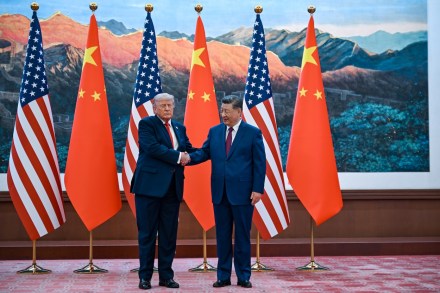
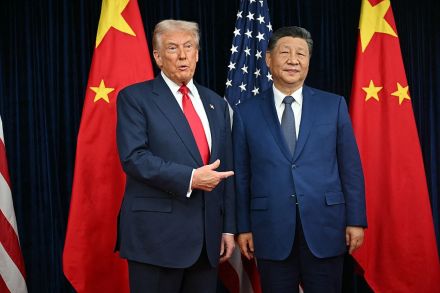
Donald Trump went nuclear. Before his meeting with Chinese leader Xi Jinping at an air base in South Korea, he ordered the Pentagon to test atomic weapons on an “equal basis” with China and Russia. Was Xi impressed? Probably not. While Russia expressed indignation, China did not permit itself to be distracted by Trump’s nuclear shenanigans. Instead, Beijing aimed to obtain economic concessions from a prideful Trump, which it did. From the outset, Xi sought to bring Trump down a peg, declaring that “both sides should consider the bigger picture and focus on the long-term benefits of cooperation, rather than falling into a vicious cycle of mutual retaliation.” Trump seems to have absorbed the lesson.

Trump’s Asian vacation

President Trump is meeting with Chinese Prime Minister Xi Jinping tonight, or tomorrow, or whenever it is in Asia. Regardless of the time, the meeting will have enormous implications for the future of the US economy and for geopolitical stability. Don’t worry, Trump told his dinner companions in South Korea last night. The three-to-four-hour meeting “will lead to something that’s going to be very, very satisfactory to China and to us. I think it’s going to be a very good meeting. I look forward to it tomorrow morning when we meet.” The China summit will cap what’s been an absolutely delightful Asian invasion for Trump and his retinue. Trump told reporters last week that he felt incredibly lucky.

Donald Trump

Welcome to the Chinese century

Competition between the US and China will shape the 21st century, but have the Chinese already leap-frogged the Americans? It looks as if they might have done. Since China opened itself up to trade and market economics under Deng Xiaoping almost 50 years ago, it has been furiously chasing the US in terms of economic and technological development – and it’s been catching up, fast. We can prove just how fast by measuring its innovation and output per capita. The US has about a quarter of China’s population, so if both countries were at a similar level of economic and technological development, one would expect China to produce roughly four times the number of scientific breakthroughs as America, four times the number of physicists and AI engineers and so on.

China

The UN’s ‘climate crisis’ tax

In between votes to legitimize the world’s worst regimes and condemn the world’s only Jewish state, the United Nations has found the time to introduce itself as a global governmental structure with the power to levy taxes on every inhabitant of Earth.   No, really.  The UN’s International Maritime Organization (IMO) is of the opinion that it can impose duties on the carbon emissions of ships to the tune of between $100 and $380 per metric ton. All of the revenue generated would be paid out to the UN’s “Net Zero Fund,” which would be used to “reward low-emission ships,” or pick winners and losers.

UN

You want a peace of me?

President Trump prevented World War Three yesterday, or so he claimed multiple times. “No one wants World War Three,” he said. Fact check: true. Trump and many of the world’s finest leaders gathered behind a large, tacky but also touching sign that read “Peace 2025.” Italy’s Giorgia Meloni also attended the summit. Trump called her “beautiful,” saying that in the US calling a woman beautiful could mean the “end of your political career.” Fact check: true. “I’ll take my chances,” Trump said. Cockburn enjoyed the day’s festivities, which featured enough comic moments to fill a season of The Office.

peace

The celebrity guide to selective outrage

In the West, outrage has become performance art. It’s not about real causes, but about carefully branded ones that play well in pastel Instagram carousels. Climate change? Of course. A vague plea for “justice”? Naturally. A curated “Free Palestine” hashtag? Absolutely. But when it comes to standing with their peers in the Middle East – singers, actors, writers who are literally jailed or executed for their art – the voices vanish. This isn’t about Israel. The point is larger: why do so many Western artists reserve their outrage for one convenient villain while ignoring regimes that jail, torture and kill their peers? Syria’s Christians and Druze are being ethnically cleansed. Yemen is enduring a famine.

Billie Eilish

How powerful is the China-Russia alliance?

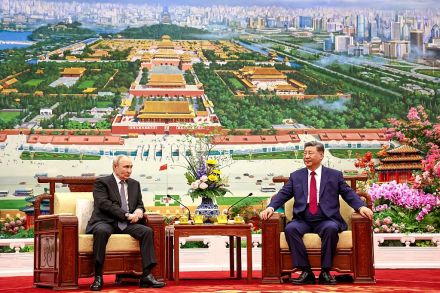
This summer’s big security summit in Tianjin, followed by the military parade in Beijing on September 3, has been widely interpreted as a sign of a new global realignment. At a time of growing friction within the US alliances in East Asia and Europe, President Xi Jinping of China, President Vladimir Putin of Russia and about 20 leaders mostly from Central Asia have not just reaffirmed their nations’ close ties. They sought to strengthen the emerging multipolar system, which they see as a rejection of the US-dominated global order. This idea is hardly new.

China
space

Russia, China and the US are preparing for battle in orbit

Russia is playing a dangerous game in space. Despite its history it’s a declining space power, having abandoned many of its long-term projects due to lack of money and technology. It effectively crippled much of its space activity when it attacked Ukraine, which was the source of many of its high-tech components. This year has seen its lowest launch rate since 1961 – the year Yuri Gagarin became the first person to go into space. Yet significantly, three of Russia’s eight orbital launches this year (the US has launched more than 100) could be potential anti-satellite weapons. On May 23, Russia launched the Cosmos 2588 satellite from the Plesetsk launch site situated 500 miles north of Moscow. The Cosmos designation is a general term used to obscure the satellites’ purpose.

Why Trump must build a nuclear reactor on the Moon

Sean Duffy, the secretary of transportation whom President Trump appointed last month as temporary leader of NASA, has issued a directive to fast-track efforts to put a nuclear reactor on the moon. “To properly advance this critical technology to be able to support a future lunar economy, high power energy generation on Mars, and to strengthen our national security in space,” he says.A small nuclear reactor on the moon is a good idea, but the directive is about more than that: it is about renewing America’s leadership in space exploration that, with its magnificent achievements receding into the past, looks vulnerable. Bill Nelson, NASA’s last leader, didn't mince his words when it came to the new rivals, China. “It is a fact: we’re in a space race.

The Moon