Catholic

The many versions of ‘Come Saturday Morning’

From our US edition

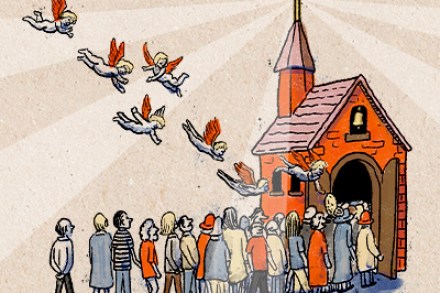
Wedding season has begun. First out of the gate this year was my young first cousin once removed, who entered marital bliss in a lovely Catholic ceremony in the small western New York city of Lockport, hometown of the logorrheic novelist Joyce Carol Oates and the supermodel cum hemorrhoid-cream spokeswoman Kim Alexis. As I sat nursing a non-alcoholic beer (I should’ve stuck with water) at the reception I awaited the father-daughter dance, and not only for its poignancy. I have paid attention to these ever since reading a newspaper article several years back that said Eric Clapton’s “Wonderful Tonight” was then the second-most-popular song for this wedding-reception custom. Hmm.

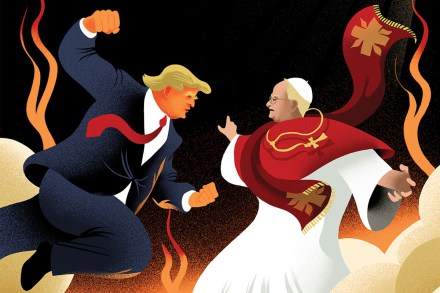
What’s really behind Trump’s clash with the Pope?

From our US edition

Donald Trump’s latest clash with the Catholic Church stunned even the most hardened veterans of culture-war X. According to the President of the United States, the Chicago-born Pope Leo XIV, the conspicuously holy spiritual leader of 1.3 billion people, is “WEAK on crime and terrible on foreign policy.” He also claimed that, “If I wasn’t in the White House, Leo wouldn’t be in the Vatican.” For commentators accustomed to the fog of modern diplomatic platitudes, such trash talk was the equivalent of a Holy Roman Emperor hurling insults at a medieval pontiff.

trump pope damian thompson

How transformative has 2025 been for Christianity?

21 min listen

Anglican author The Rev'd Fergus Butler-Gallie, Catholic priest Fr Alexander Lucie-Smith and Evangelical commentator Fleur Meston join Damian Thompson to reflect on 2025. They discuss Pope Leo XIV's leadership so far, the choice of Dame Sarah Mullally as Archbishop of Canterbury and why Christianity has been coopted by the far right. Plus, was the 'quiet revival' of Church-going the start of a trend – or just a blip? Produced by Patrick Gibbons.

Robert Munsch’s license to die

From our US edition

Once upon a time, there was a hugely successful children’s author named Robert Munsch. His books (more than 70!) sold in many, many copies; he became famous, and people gave him top awards like the Juno and the Order of Canada. They even named schools after him. More gloriously yet, he became the most stolen author in the Toronto Public Library. He was in high demand as a storyteller, and children from everywhere used to write him letters. And he would write back, often with personalized stories (which they loved) featuring them and their classmates. Like all of us, he had his sorrows. He and his wife lost two children, which led him to write one of his best-known works, Love You Forever. Eventually they became adoptive parents of three.

Robert Munsch

Recovering the Sacred: listen to our unique Spectator event celebrating the rediscovery of tradition by young Christians

75 min listen

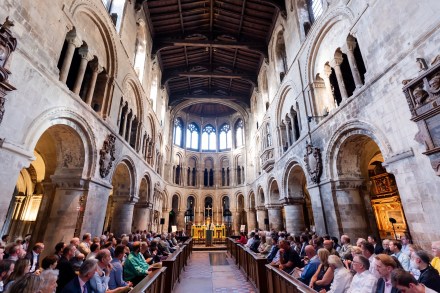
Last week The Spectator held a live event entitled ‘Recovering the Sacred’ in the glorious surroundings of St Bartholomew the Great, the oldest parish church in the City of London. The speakers included two London parish priests – one Anglican, one Catholic – who have contributed much to the growing interest among young people in traditional liturgy and Christian theology, a development that the hierarchy of their respective churches certainly didn’t foresee. They were the Rev Marcus Walker, Rector of St Bart’s, whose Prayer Book Evensongs and Eucharists attract large numbers of young professionals to his ancient church; and Fr Julian Large, the Provost of the Brompton Oratory, where an increasingly youthful congregation flocks to Latin Masses.

Why are young Christians returning to tradition?

41 min listen

Today’s Holy Smoke is a curtain-raiser for ‘Recovering the Sacred’, a Spectator event at St Bartholow-the-Great in the City of London in which a panel of experts will explore the rediscovery of traditional worship and theology by young Anglicans and Catholics. The event will be held on Tuesday 8th July; for more details, and to book tickets, go to: spectator.co.uk/church In today’s episode Damian Thompson talks to Anglican James Vitali and Catholic Georgia Clarke, two Generation Z professionals bursting with enthusiasm for their faith. It’s an exhilarating discussion; don’t miss it.  Produced by Patrick Gibbons.

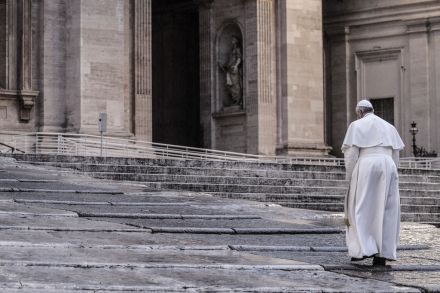
How Pope Francis kept the faith

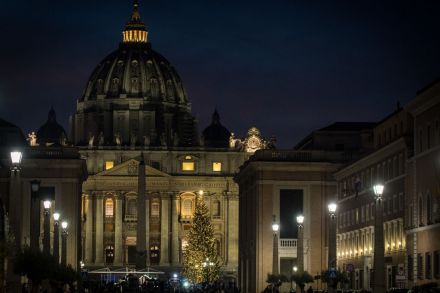
As timing goes, a pope simply can’t do better than to die just after Easter Sunday. The moral of the thing hardly needs saying. Francis died in Christ and will share His Resurrection. In fact, that’s exactly what several bishops have been observing today. But Francis also had his Good Friday. He was desperately ill in the Gemelli hospital in February, being very close to death in particular on 28 February. But he pulled through with all the drugs and therapies possible, and went triumphantly on. For that’s what he did. That popemobile trip round St Peter’s Square yesterday, the meeting with J.D.

World leaders pay tribute to Pope Francis

Pope Francis has died aged 88. At 7.35 a.m., the Vatican announced that Pope Francis had ‘returned to the house of the Father’ at his residence in the Vatican’s Casa Santa Marta. Cardinal Farrell, who announced the death, added that Francis ‘taught us to live the values of the Gospel with fidelity, courage and universal love, especially in favour of the poorest and most marginalised’. Tributes are already pouring in from political and religious leaders around the world. These are the messages that have been sent so far: J.D. Vance, the US Vice-president Vance, the last statesman to meet Francis, having been granted a brief audience with the pontiff yesterday morning, wrote: I just learned of the passing of Pope Francis.

Pope Francis and the Vatican reckoning

Modern popes, for better or for worse, tend to be defined in soundbites. John Paul II’s clarion call of ‘Be not afraid’ became emblematic of his invitation to young Catholics to embrace their faith and his rallying of the West against the spectre of international Communism. Benedict XVI’s great theological career, and his term as a pope in the model of priest and professor, remains summed up in his simple declaration that Deus caritas est. For Francis, who has died at the age of 88, the world will likely remember, in the immediate weeks after his death anyway, his often quoted, though often misrepresented, motto of ‘who am I to judge?

Conclave – what really happens when a pope dies?

54 min listen

The film Conclave has picked up a host of awards across all the major ceremonies so far, including at the Screen Actors Guild, the Golden Globes, and winning Best Picture at the BAFTAs. Adapted from the novel by Robert Harris, it also has eight nominations at the upcoming 2025 Academy Awards. Full of intrigue, the film has viewers wondering how true to life the process depicted on the big screen is. And, with Pope Francis hospitalised, amidst the award season, this has only heightened interest in Papal conclaves and the election process.  Dr Kurt Martens, Professor of Canon Law at the Catholic University of America, joins Damian Thompson to unpack the process. What really happens when a pope dies? Produced by Patrick Gibbons.

Rome is ready for its close-up

From our US edition

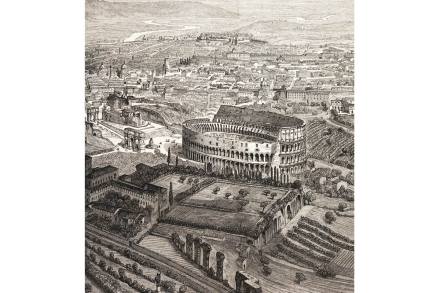
Rome Like a Parioli matron shedding her curlers, pins and hairnet in anticipation of a major family celebration, Rome’s monuments are emerging from shrouds of cladding and scaffolding ready for their close-up. The angels and river gods of the Ponte Sant’ Angelo and the Piazza Navona shine as blinding white as the day they emerged from Bernini’s workshop. The ancient granite basins of the Piazza Farnese fountains shimmer with an ethereal bluish light. The big occasion is the Papal Jubilee year of 2025, expected to draw a whopping 32 million visitors. That’s more than ten times Rome’s population, and half as many visitors again as in a normal year. If you’re planning a visit, do it soon before the city is entirely swallowed by crowds.

Rome
Lodge

David Lodge, the master of Anglo-American campus humor

From our US edition

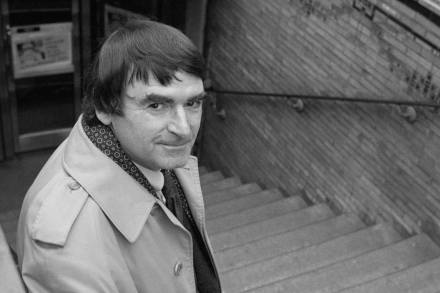
"Literature is mostly about having sex and not about having children.” So said the British novelist, occasional screenwriter and literary critic David Lodge, who died at the beginning of 2025 at the age of eighty-nine. Lodge, who had suffered from encroaching deafness for several decades, had not, in truth, been a major literary figure for a considerable period before his death. This retreat into obscurity had not been helped by a trio of memoirs, beginning with 2015’s Quite a Good Time To Be Born, which perplexed critics — including this one — with their dour, downbeat and decidedly un-humorous tone. Few would have known, from reading them, that their author had once been regarded as one of the late twentieth century’s most accomplished comic novelists.

How abuse scandals shattered the Church of England but were hidden by the Vatican

13 min listen

In this end-of-year episode of Holy Smoke, Damian Thompson discusses the abuse scandals that have forced the current Archbishop of Canterbury, Justin Welby, to resign his post, his predecessor Lord Carey to resign his ministry as a priest, and now threaten the survival of the Archbishop of York, Stephen Cotterill.  These developments are an unprecedented disaster for the Church of England – but how many Roman Catholics realise that Pope Francis would also be facing demands for his resignation if the details of various horrifying scandals were not being allegedly concealed by the Vatican and its media allies?

A prayer in Ukraine

From our US edition

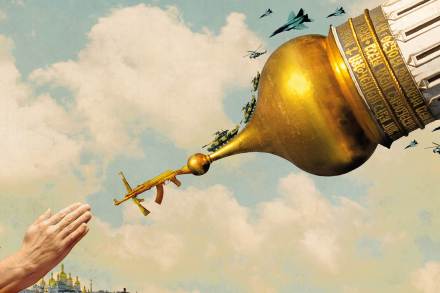
By the summer of 2024, Kyivans could joke that there was no way the Russian army could take their city now — they’d never get through the downtown traffic. The simple normality of urban congestion, crawling through grand boulevards in the shadows of buildings that, with fresh coats of paint, would suggest a Wes Anderson vision of Mitteleuropa, could lull a visitor into thinking he could be in any capital on the old Orient Express route. So, too, would the world-class Fenix restaurant, run by a celebrity chef and festooned with Chihuly-inspired decor. It was between the salmon tartare eclair and the rabbit ravioli that I heard for the first time, face-to-face, what it’s like to be persecuted for worshipping God in the wrong way.

ukraine

Trump’s very catholic cabinet

From our US edition

Donald Trump’s second term administration is taking shape, and thus far it’s turned out to be impressively Catholic in its approach — representing Trump’s dominance of the Republican coalition and his capacity to ignore the worst instincts of some of his more vocal supporters on the New Right who see governance through a naive lens. One of the questions heading into this term was who Trump would disappoint by being insufficiently one thing or the other — by being too radical in some areas or too modest in others. But at this point, there are very few people disappointed in the names he’s chosen, outside of a handful of very online voices who had fantasies of their favorite pundits and follows on X getting a shot at cabinet positions.

cabinet

Could the Catholic vote decide the election?

27 min listen

Trump won the Catholic vote in 2016 and Biden won it in 2020. Polling suggests that Trump is on course to win it back this year. With issues such as immigration and abortion high on the agenda for voters, where will the Catholic vote land?  Ryan Girdursky, the Catholic founder of the 1776 Project PAC and the National Populist substack joins Freddy Gray to discuss. Produced by Patrick Gibbons.

An incisive memoir of life in the cloisters

From our US edition

Bishop Fulton J. Sheen, the immaculately Brylcreemed megastar of the golden age of Catholic television and radio evangelism in the United States, famously hated hearing the confessions of nuns. Doing so, Sheen is reported to have said, was “like being stoned to death with popcorn.” Despite this, Sheen — at one point broadcasting to over 30 million Americans — found himself hearing a lot of nuns’ confessions in his later career. He was reduced to this, alongside what was rather euphemistically referred to as his “international cassette tape ministry,” having fallen foul of the archbishop of New York, the doughty Cardinal Spellman.

Cloistered

The media’s ignorant attempt to cover Christians

From our US edition

When you work in the media as a practicing Catholic, there are few things more hilarious than watching fellow journalists repeatedly fail miserably to get even basic components of your faith correct. I will never forget seeing NBC News’s Chuck Todd tweet this about Good Friday in 2018:  I’m a bit hokey when it comes to “Good Friday.” I don’t mean disrespect to the religious aspect of the day, but I love the idea of reminding folks that any day can become “good,” all it takes is a little selflessness on our own part. Works EVERY time. Oof. Surely holding the elevator door for someone in your high-rise apartment building comes nowhere near Christ’s sacrificial death on the cross for all of humanity and its sins.

‘Maybe I have the healing I need’: speaking to Father Paul Wierichs

From our US edition

It used to be you had to get in close to hear Father Paul Wierichs speak. For two years the former FBI chaplain couldn’t talk above a whisper. Now he is a little louder, but very hoarse; though he still struggles to swallow you can at least hear his voice. Bell’s Palsy keeps him from moving the left side of his face, and he has a difficult time seeing out of that eye. His scalp is bandaged where the doctors removed a growth. There’s cancer in his prostate, too. He’s still held onto a good amount of hair for his age and his troubles — but he expects to lose it to surgeries by the end of the month. “I wore my collar on 9/11,” Father Paul recalled on a frozen January morning in Queens. “I had to throw them out, because they were covered in dust.

Wierichs

Alaska prisons drop policy banning Catholic Mass

From our US edition

The Alaska Department of Corrections reversed its policy banning alcoholic wine from religious ceremonies in prison facilities on Friday, following a report from The Spectator. The interim policy, which was issued on June 6 and signed by Commissioner Jennifer Winkelman, stated that "no altar wine or other alcoholic beverages will be used by anyone who is involved with any activity. The use of a non-alcoholic substitute (juice) for altar wine may be considered." The policy effectively banned Catholic masses, which require alcoholic wine in order to be considered valid, from the prison system. Catholic prisoners would thus be unable to fulfill their holy obligation to attend Mass each Sunday.

alaska mass