Brexit

Parliament’s new tribe | 5 August 2017

Politics is such a fickle game that it’s perfectly acceptable to believe six impossible things before breakfast without ever having to apologise for being so wrong. Remember, for instance, when everyone was predicting that the dead cert increased majority for Theresa May would lead to the creation of a new party? Perhaps, like everyone else who has since gone on to predict another series of impossible things with equal confidence, it’s easier for us to forget those old certainties. No one talks about a new party any more. The facts have changed, so we’ve changed our minds too. There aren’t the same conditions for that proposed new party about which

Ireland’s Taoiseach talks tough on Brexit

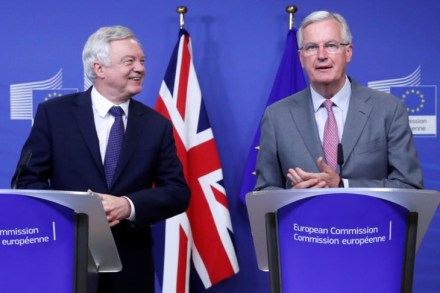
There are three areas on which the EU insists that the Brexit negotiations must make progress on, before proper trade talks can start: the so-called divorce bill, the rights of EU citizens in the UK and the Irish border. Today, the Irish PM said that no progress had been made on this issue, that the Brexiteers had had 14 months to devise a plan and hadn’t come up with anything adequate. Implicit in the Taoiseach’s speech is a threat to block the start of trade talks this autumn. If Dublin doesn’t think any progress had been made on the border question, the European Commission is highly unlikely to recommend to

What the papers say: Mark Carney, Brexit & Corbyn’s silence over Venezuela

Mark Carney is often accused of being downbeat about Brexit. But the Bank of England’s quarterly inflation report is ‘more sanguine than one might expect’, says the FT. The paper points out that despite a cut in the country’s growth forecast, the Bank ‘expects stronger net trade and business investment to drive a recovery in 2019’. Yet Carney remained ‘candid’ about the damage Brexit is already doing to Britain’s economy. Businesses are investing less, reports the FT, and ‘this has uncomfortable implications’. With the Bank warning that ‘the level of investment in the UK economy (will be) be 20 percentage points lower in 2020 than it forecast before the referendum’,

Portrait of the week | 3 August 2017

Home Philip Hammond, the Chancellor of the Exchequer, appeared to wrest control of plans for Brexit from cabinet rivals, while Theresa May, the Prime Minister, was in Italy and Boris Johnson, the Foreign Secretary, was in Australia. Mr Hammond foresaw a ‘transitional deal’ ending by June 2022, when the next general election is due. He said it would be ‘some time before we are able to introduce full migration controls between the UK and the European Union’. Liam Fox, the International Trade Secretary, insisted that the cabinet had not agreed to a three-year transition. Mr Johnson said he was unaware that Amber Rudd, the Home Secretary, had announced a year-long inquiry

Mark Carney’s gospel: give us an interest rate rise, Lord – but not yet

Is there anything more predictable than a Mark Carney press conference? The poor sod in Groundhog Day got to enjoy more variety and suspense. Explaining why, yet again, the Bank of England had decided not to raise interest rates, Governor Carney told us that rates could rise ‘faster than markets expect’. That wouldn’t be all that hard, given that markets have pretty well given up on Carney ever shifting rates. Maybe they believed him the first time, in June 2014, when he said that a rate rise could come ‘sooner than markets expect’. Maybe they were still inclined to take a little bit of notice in July 2015 when he

Losing our religion

Sir James MacMillan’s European Requiem, performed at the Proms on Sunday, isn’t about Brexit. The composer had to make this clear in a Radio 3 interview just before the broadcast, because the BBC was just itching to cast the work — a melancholy score, despite its thunderous drumbeats — as a lament for us leaving the EU. That would have been neat, given that the second half of the concert consisted of Beethoven’s Ninth, whose ‘Ode to Joy’ has been clumsily appropriated by Brussels. Incidentally, some Remainers in the audience chattered through the symphony’s first three movements, impatient for their Big Tune. I don’t know if there were any ancient

I’m a ‘Brexit extremist’ and proud of it

We used to think it was noble when people made sacrifices for their beliefs, when they were happy to endure hardship in the service of a political goal or moral cause. Now we call it ‘extremism’. Now anyone who is so devoted to an ideal that he’s willing to see his own daily comforts diminished to make that ideal a reality is likely to be branded a nutter. I mean, what kind of loon puts his beliefs ahead of his bank balance? Consider the mouths-agape response to new YouGov research published yesterday, showing that many Leave voters are willing to pay a high price for Brexit. Judging from the lingo

The Brexit betrayal bandwagon is growing

It may not be this week. It may not be Boris Johnson. But eventually a minister will break with this tottering government and establish himself (or herself, for it could be Andrea Leadsom) as the leader of the diehard right. Brexit is crying out for its Ludendorff; the scoundrel who can blame his failures on everyone but himself. The smart move for today’s right wing politicians who find their careers blocked is to break with the Tory leadership – whatever or whoever that may consist of – and resort to old  slogans. The referendum delivered a mandate to leave, Johnson, or whoever takes up the challenge of building a new

How the economics of cow-milking can help explain Brexit | 1 August 2017

Writing about judicial appointments, I incautiously compared a silly interview question asking a judge to cite an example of when he had acted with integrity, to asking a farmer, ‘How many times a day do you milk your cows?’ Jamie Blackett, a farmer, writes to say that, in the 21st century, it is a question to which the answer reveals much. He explains. Farmer One milks his 50 cows only once a day. He follows the Norwegian system and makes a marketable green virtue of leaving the calf on the cow. He lives near rich people and sells them his artisan cheese and yoghurt. He voted Remain. Farmer Two milks

What does the charity sector want from Brexit? A clean break and tax freedom

When it comes to Brexit, for many organisations it seems to be all doom and gloom. Yes, plenty of individual Brexiteers are still glad that they voted to leave the European Union. But the uncertainty that still looms over the UK’s future in so many areas – trade, farming, immigration and more, means that in many sectors, Brexit is seen as a negative. There’s some good news for Leavers today, though. The Charity Finance Group (CFG), which provides support for finance professionals working in the charity sector, has published a new report entitled ‘A Brexit that works for everyone’, analysing what would be the best option for Britain’s charity sector. The

Exports are booming thanks to the competitive pound

Remember George Osborne in his hi-viz jacket as he toured the nation’s metal-bashers and gromit-manufacturers in furtherance of his elusive ‘rebalancing of the economy’ away from services and consumers and towards manufacturing and exports? What a shame he is not still in office to witness his ‘march of the makers’ finally becoming a reality. This month’s Purchasing Managers’ Index (PMI) for manufacturing has come in at a healthy 55.1, comfortably exceeding expectations. Any figure above 50 suggests expansion. The index was boosted especially by a sharp rise in new export orders, which rose at their second fastest level in the 17 year history of the index. As I wrote here

What the papers say: Philip Hammond must ‘belt up’

Philip Hammond, of all people, ought to ‘relish’ Brexit and the opportunity it will hand to Chancellors to set their own tax rates. But in ‘yet another blunder’, says the Sun, the current occupant of No.11 has told the French that Britain won’t lower taxes. ‘Has he gone made?’ the paper asks. Back in January, Hammond said that lower taxes and limited regulation could be an important way of luring businesses to Britain after Brexit. ‘As a Conservative, that is exactly what he should be saying’. Now, though, says the Sun, ‘he has contradicted himself’. Whatever level the Chancellor plans to set tax rates, ‘why make any promises and surrender a potent bargaining

Philip Hammond creates a one-man Cabinet split over Brexit

Leaving Philip Hammond in charge of the government was always going to be a risk because of his habit of putting his foot in it. There was the debacle of his first budget, then his saying in Cabinet that driving a train was so easy that even a woman could do it, and his comments that public sector workers are “overpaid”. Now, with the Prime Minister walking in the Alps, Hammond is in charge and has goofed again – this time in an interview with Le Monde. “I often hear it said that the UK is considering participating in unfair competition in regulation and tax. That is neither our plan nor our vision

How the economics of cow-milking can help explain Brexit

Writing about judicial appointments, I incautiously compared a silly interview question asking a judge to cite an example of when he had acted with integrity, to asking a farmer, ‘How many times a day do you milk your cows?’ Jamie Blackett, a farmer, writes to say that, in the 21st century, it is a question to which the answer reveals much. He explains. Farmer One milks his 50 cows only once a day. He follows the Norwegian system and makes a marketable green virtue of leaving the calf on the cow. He lives near rich people and sells them his artisan cheese and yoghurt. He voted Remain. Farmer Two milks

I may disagree with him, but George Osborne’s first duty is to his readers

I may disagree with George Osborne on the odd issue. Like Britain’s relationship with the EU, our trading future and the exercise of democratic sovereignty. And as a Conservative minister, I certainly sometimes wince at the criticism his paper directs at the government of which I’m proud to be a part. Indeed, wince is putting it mildly. But no one can deny that, in journalistic terms, he’s proving a brilliant editor of the Evening Standard. He’s made the paper talked about in a way it hasn’t been since Paul Dacre edited it in the 1990s. He’s produced some great front pages. And he’s put the paper at the heart of critical

An Irish Sea border would damage British-Irish relations

Dublin and London had been fairly tight since December 1993 and the Downing Street Declaration—until yesterday morning. The Times led with ‘Irish want sea border with UK after Brexit’. The DUP’s Sir Jeffrey Donaldson rushed breathlessly on to the Today programme to say there was ‘no way’ his party would accept it. The notion isn’t new.  The idea is that the customs and immigration checks move away from the land border, and are done on ports or planes reaching either island. It pours cold seawater on Downing Street’s preferred idea that a ‘frictionless border’ can just rely on nifty cameras. ‘We do not want to pretend … we can solve the problems of the

Politicians are still not sure what Brexit means or whether they can make a success of it

It was only a year ago that ‘Brexit means Brexit, and we’re going to make a success of it’ seemed like a reasonably fresh phrase which could actually mean something. Now, we don’t hear so much about making a success of the thing as we do about getting through it in one piece, hopefully with Theresa May’s Cabinet agreeing on a few things along the way too. The Cabinet is slowly starting to realise that a little pragmatism on both sides wouldn’t hurt as the government burrows into the detailed negotiations with the European Union. A bit of agreement on transitional periods, if not immigration, is handy, but this is

The Labour left and Tory right agree on Brexit. Why don’t they merge?

Britain has not had a functioning opposition on the most vital question of the day ever since the Labour left and Tory right found they were in agreement on our future relations with the EU. Although both sides are too embarrassed to admit it, we are ruled by a Corbyn-Johnson pact. It will deliver a hard Brexit, whatever the costs to the country. When Nigel Farage hailed Jeremy Corbyn as ‘almost a proper chap’ you learned that whatever trouble this hopelessly ill-equipped government faces it will never face trouble from the Labour leadership. The left has ceased to exist as an organised force in British politics, at least as far as

Letters | 27 July 2017

Bugs bite back Sir: Matthew Parris is quite right to say that we Leavers would prefer independence in reduced circumstances to affluent federalism (‘Dear Leavebugs, it’s time to admit your mistake’, 22 July). But he is wrong to suggest that our preference is a guilty secret, or that it should be. Many of us despaired at the narrowness of both referendum campaigns, which made no attempt at addressing our ‘spiritual’ concerns about EU membership, or indeed the equally spiritual hopes of the Remainers. Spiritual, moral and cultural questions are at the root of all politics and economics, and any debate which leaves them out is empty. What should have been

Portrait of the week | 27 July 2017

Home Theresa May, the Prime Minister, invited the media to take a photograph of her beginning a holiday with her husband Philip at Lake Garda before pressing on to Switzerland for some walking. David Davis, the Brexit Secretary, resisted demands by Guy Verhofstadt, the European Parliament Brexit negotiator, that the European Court of Justice should retain jurisdiction over EU migrants in Britain. BMW said a fully electric Mini is to be built at Cowley in Oxford, with motors made in Germany and shipped over for assembly. The government announced plans to ban new diesel and petrol cars and vans from 2040. The number of people over 90 with a driving