Books

Dave Eggers cancels Amazon

From our UK edition

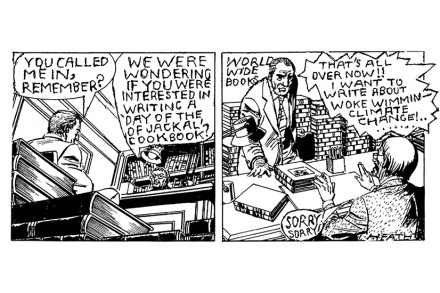
Selling books through Amazon is now part and parcel of a working author’s life. It would be a brave writer who decided to refuse to allow their work to be sold through earth’s biggest retailer. But that is exactly what Dave Eggers has done with his new book, The Every, which he has decreed can only be purchased from independent bookstores. Sorry, Jeff Bezos; this one’s not for you. It is hard to dismiss his decision to eschew Amazon as simply a quixotic act of rebellion by a washed-up has been Eggers has form in this regard.
A letter to George Steiner

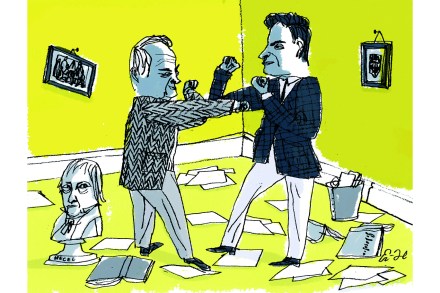
Dear George, I met you first in 1965. You had just given a lecture at the Royal Society of Literature’s premises. You were outspoken in declaring the merits of reticence. Ardent for cool, you insisted that, when writing about sex, the explicit, licensed by the verdict in the Lady Chatterley trial, was the enemy of art. Never mind Sir Robert Walpole’s ‘Let us talk bawdy, then all may join in’: obscenity was one thing, literature another. The naming of parts, in your view, belonged only in the kind of book which Jean-Jacques Rousseau held to be read with one hand.

steiner

Kate Clanchy and the new censorship in publishing

From our UK edition

‘There’s more than one way to burn a book’, wrote Ray Bradbury, in a coda to the 1979 edition of his anti-censorship classic, Fahrenheit 451. The case of Kate Clanchy, the Orwell Prize-winning author, currently rewriting her book after a particularly strange fit of identitarian pique, shows us just how true that is. The story of Clanchy’s sudden fall from grace in the publishing world is utterly mad, even by today’s standards. She is an author, poet and teacher. In 2019, she published Some Kids I Taught and What They Taught Me, a memoir reflecting on her time teaching in an Oxford comprehensive, to critical acclaim.

Why I gave up writing fiction

From our UK edition

When, three years ago, I announced my retirement from writing fiction, the only thing that surprised me was the surprise it generated. I had long come to the somewhat un-arty view that writing was a job like any other (well, almost) and that nudging 80 was a good time to step back and consider a senescence involving only serious decisions like which claret to choose. No need to rabbit on and on. Apart from the lengthening shadows, there was a very practical reason. The stuff I used to write involved the unlovely side of life with some unlovely places and people. The search for authenticity required travel to find and observe them. I never felt I could trust online research to get it right. I had to go and see for myself.

Read Ray Bradbury before he’s canceled

I was 14 or 15 when I first read Ray Bradbury, which is not a bad age to enjoy the man fully. It was the short story ‘Boys! Raise Giant Mushrooms in Your Cellar’, in which a lad called Tom does just that and it doesn’t end terribly well. Superficially, it is a silly story, but what hooked me from the outset was the vague yet pervasive sense of unease running throughout this minor small-town saga, disturbing the comfortable ennui of family life. Nothing spelled out — just a deepening disquiet, the common thread in all of Bradbury’s finest little vignettes. Back then, in the 1950s, the Cold War and the possibility of nuclear annihilation were hovering in the background, just beyond the edge of our eyesight, which perhaps explains the author’s state of mind.

bradbury

In search of Nirad Chaudhuri

The false sense of complacency in Washington DC, now restored as the imperial capital of the world, is only matched by a tone of utter bafflement. History has apparently renewed its march toward a progressive utopia, and the American cabinet seems as epidermally diverse as it is ideologically totalitarian. But there remains a sense of unease. The imperium suffered a systemic shock in 2016, one that needed and still lacks explanation. The shock was not limited to America. The Guardian struggles to comprehend that British Indians tended to support Brexit, and that members of their community such as Rishi Sunak and Priti Patel have risen to influence in the Conservative party and high office in the government.

chaudhuri

The best theatre podcasts

From our UK edition

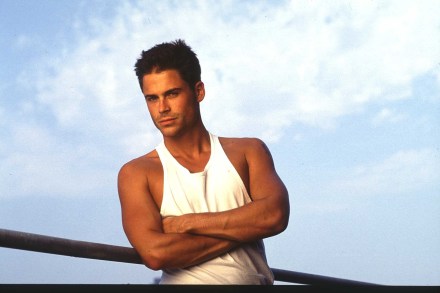
All the world’s on stage again so where to go to for insight into what to see and why? Podcasts, of course. Lowe’s ‘luck’ is that he happens to be friends, neighbours, or have starred, with everyone he interviews Let’s start with Literally! With Rob Lowe. An hour-long conversation between the most swoonable actor in the world who we’ve all forgotten, and everyone he knows and likes, from Alec Baldwin and Oprah Winfrey to St Elmo’s Fire co-star Demi Moore. It’s a wonderful and eye-opening listen. Lowe combines the enthusiasm and curiosity of the best interviewers with a knowledge and experience that makes conversation flow until the cup spilleth over.

The rise of the ‘sensitivity reader’

From our UK edition

You probably won’t have heard about sensitivity readers, but across the pond they are already an essential part of fiction. Sensitivity readers are freelance copy editors who publishers pay to cancel-proof their new books. They read books that feature identities or experiences that are outside of the lived experience of the author. They then critique the writing through the prism of what they claim to be their own authoritative life experience to guide the author toward more authentic representation. For example, the white author Jodi Picoult used a sensitivity reader for her novel about a black nurse who cares for the children of white supremacists.

Thoughtful and impeccable: Ken Burns’s Hemingway reviewed

From our UK edition

Ken Burns made his name in 1990 with The Civil War, the justly celebrated 11-and-a-half-hour documentary series that gave America’s proudly niche PBS channel the biggest ratings in its history. Since then, he’s tackled several other big American subjects like jazz, Prohibition and Vietnam; and all without ever changing his style. In contrast to, say, Adam Curtis (another ambitious film-maker whose methods have remained unchanged for 30 years), Burns’s documentaries take an almost defiantly considered approach, forgoing anything resembling self-regarding flashiness in favour of such old-school techniques as knowledgeable talking heads, careful chronology and straightforwardly appropriate visuals.

Nina Hamnett’s art was every bit as riveting as her life

From our UK edition

Nina Hamnett is in vogue again. She is the subject of a new pocket biography, no. 7 in Eiderdown Books’s Modern Women Artists series, and her first ever retrospective is now open at Charleston Farmhouse’s gallery space. I confess I didn’t know much about her before this resurrection, but she is now one of my favourite 20th-century artists. In this bucolic gallery space, where cows can be heard bellowing, her portraits are at last hanging together, like a cocktail party finally regrouped. The colours are subtle, beautiful without being decorative; as the co-curator Alicia Foster explains, Hamnett’s use of colour is ‘meaningful, incisive’.

Is caste the American class system?

John Dollard (1900-80), trained in sociology at the University of Chicago and in psychoanalysis at the Berlin Institute, brought the sensibility of a novelist to a five-month study in Indianola, Mississippi, which he wrote up as Caste and Class in a Southern Town (1937). Dollard went south, but what he found applied in the other direction: The ‘caste line is drawn in the North as effectively, if not as formally, as in the South,’ which meant ‘We are still deliberately or unwittingly profiting by, defending, concealing or ignoring the caste system.’ Caste, Dollard argued, had far-reaching implications: ‘Our social system has come under world inspection and is literally being looked at by several billion people or their competent agents.

caste

What Meghan Markle can learn from Enid Blyton

From our UK edition

The year is 2070 and English Heritage are unveiling their latest Blue Plaque: 'The Duchess of Sussex, children’s author, lived here 2017 – 2018'. The accompanying online guide praises Meghan for her work promoting inclusion and diversity. I have no idea whether Meghan will one day be rewarded with an iconic plaque for her services to literature. But she’s certainly heading in the right direction.

Let’s just go ahead and ban books

We should save ourselves some time and ban all books. They’re too much trouble. For example, Elin Hilderbrand, author of Golden Girl, hates Anne Frank. We know this because a teenager in the novel quips that hiding in a friend’s attic for the summer would make her 'like Anne Frank’. Didn’t Hilderbrand get the memo? Teenagers are not allowed to make jokes (or mistakes). One presumed reader wrote to the book’s publisher, 'As a Jewish woman, one who lost 18 members of her family in the Holocaust I'm disgusted in you as a publisher that you allowed that line to be published. It's inexcusable.’ Good for her! Hilderbrand was clearly insulting Anne Frank’s legacy, making excuses for the Holocaust and pledging her allegiance to Hitler.

unread library

Remembering David Storey, giant of postwar English culture

From our UK edition

There is a famous story about David Storey. It is set in 1976 at the Royal Court where, for ten years, his plays had first been seen before heading away to the West End and Broadway. That same week he had won the Booker Prize with his novel Saville. With unrivalled success across fiction, theatre and cinema, Storey was a giant of postwar English culture. He was also, compared with most writers, an actual giant. This Sporting Life, his novel made into a groundbreaking film, grew out of his experience of playing rugby league for Leeds. Unlike Saville, his new play Mother’s Day was greeted by a raspberry fanfare after Alun Armstrong dried during a speech containing 27 uses of the f-word.

What does your wedding reading say about you?

From our UK edition

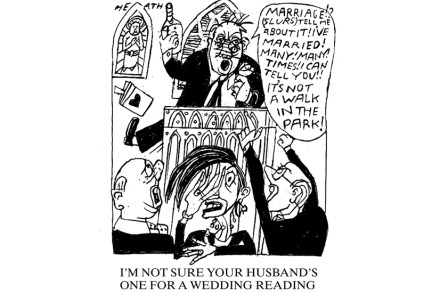
Arts journalism, like crime, doesn’t pay. So I’ve been thinking of getting a side hustle. ‘You know about books and stuff,’ say friends who are getting married. ‘What should we have for our readings?’ If I can advise friends, why not strangers? By the laws of wedding economics — pick a number and add some noughts — I could make a marital mint. We’d start with a couple’s questionnaire. No good my offering Rainer Maria Rilke if they’re more of a Purple Ronnie pair. Then a consultation over Zoom, before proposing something old, something new, something sonnet, something haiku. It is, tentatively, wedding season again. Boris and Carrie kicked us off last weekend. I wonder what they went for?

How TikTok can turn a book into a bestseller

From our UK edition

I have an American friend who loves reading, but is clueless about technology. The last time I visited him he was still using Internet Explorer, which even Microsoft has given up on. My friend was puzzled when he walked into his local bookshop and was met by a table of books with the sign ‘#BookTok made me read it’. Soon afterwards I received a bewildered WhatsApp message: ‘What is BookTok?!’ Until recently, I didn’t know. Before the pandemic, I was a working stand-up comic. I’ve never been on television and you probably haven’t heard of me, but I was happy. I worked six nights a week, made enough to pay the bills and was recognised occasionally by someone in Tesco. And then came lockdown.

The problem with decolonising Shakespeare

From our UK edition

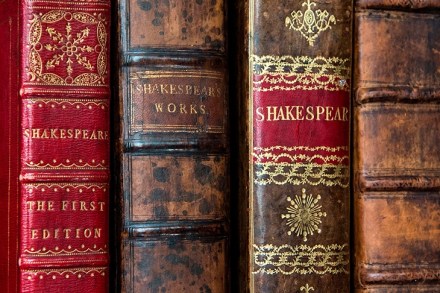
Scarcely a day passes without a major British institution announcing it is ‘decolonising’ itself. Most recently it was the turn of Shakespeare’s Globe, which announced a series of ‘anti-racist Shakespeare webinars’ as part of its ‘commitment to decolonising the plays of Shakespeare’. That brought me up short. At the time of Shakespeare’s birth, England didn’t have any colonies, although other European states did. True, The Tempest can be read as a metaphor for colonialism, with Prospero taking Sycorax’s island from her and enslaving Caliban, but Prospero is Milanese, not British. And it’s not exactly an argument in favour of colonial rule. Prospero wants nothing more than to return to Milan to reclaim his dukedom.

Help yourself to self-help

Self-help has been a popular American pastime at least since Dr Diocletian Lewis toured the countryside in the 19th century. Dr Dio preached to huge, rapt crowds about the salutary effects of gymnastics, chastity, sobriety and loose clothing. He eventually cofounded the temperance movement. Having deprived Americans of their preferred entertainment, Dr Dio went on to invent the beanbag. A century later, The 7 Habits of Highly Effective People by Stephen Covey sold tens of millions of copies and inspired spinoffs for families, companies and teens, as I learned when my mother gave me a copy during a particularly ineffective period of my adolescence. Covey, a Mormon, was the spiritual heir to the clean-living crusaders of the temperance movement.

self-help

The soul of Flannery O’Connor

Since the racial riots last summer, Flannery O’Connor has been scrutinized by literary critics and activists for reasons wholly unrelated to her literary artistry and her formidable oeuvre, whose size, though not large, is remarkable for a writer who died at the age of 39 after having been diagnosed in her mid-20s with lupus. The abruptly renewed interest in Miss O’Connor could be said almost to amount to an O’Connor revival were it not focused on a single question: ‘Was Flannery O’Connor a racist, or was she not?’ Attempts to answer it have involved an evaluation of her character based on her novels, stories and voluminous correspondence, and led in one instance to the critical conclusion that she was ‘not a saint’.

O'Connor

Books you shouldn’t read in public

Headed to the hospital recently for a rather unpleasant surgical procedure, I figured I’d bring a book to pass the down time. I was about to grab Ron Hansen’s Mariette in Ecstasy, the novel I’d been reading about a nearly 20th-century Catholic postulant who may or may not have seen a vision of Christ and suffered stigmata on her hands and feet. But the thought of nurses and order-lies glancing at the title, thinking ‘pervert’ and perhaps surmising that my demise really wouldn’t be all that great a loss for human-kind dissuaded me. Instead I brought along the Buffalo News sports section. I told a Kentucky woman about this titular discretion.

books