Book review

Tawdry lustre

From our UK edition

‘Nine hours,’ boasted my friend the curator about his trip to the Prado. Nine! Two hours is my upper limit in a gallery. After that I’m gasping for the tea room and gift shop. Knowing my lack of stamina, my own trip to the Prado was focused: just Velázquez and Goya. Then lunch. And a bit of Rubens, because that large room of lovely bottoms is so ‘Hello, sailor!’ it would be rude not to look. It helps to have a mind’s gallery of Diego Velázquez portraits while reading Amy Sackville’s novel Painter to the King. Not essential, but definitely enriching. If you haven’t a Madrid mini-break booked, have a nose around the Prado collection online.

Something in the air

’68 will do as shorthand. Most of ’68, as it were, didn’t happen in 1968. It was, at most, the centrepoint of a long accumulation of radical protest. It began with duffle-coated marches against nuclear war, a well-mannered and respectful movement whose spirit persisted to the end of the decade. (In October 1968, a rally against the Vietnam war finished with demonstrators linking arms with policemen and singing ‘Auld Lang Syne’). It continued into the 1970s with real political violence — the Baader-Meinhof gang and many other groups. It is not very much like 1848 as a year of political upheaval, more the symbolic statement of a large-scale change of mind. That change of mind is probably still happening.

Preachers, princes and psychopaths

From our UK edition

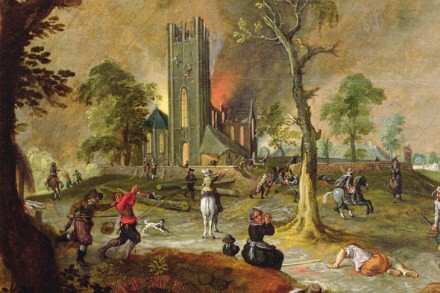
On 23 May 1618, Bohemian Protestants pushed two Catholic governors and their secretary through the windows of Prague Castle, in protest at the anti-Protestantism of Bohemia’s King Ferdinand, soon to be elected Emperor Ferdinand II. The defenestration was only injurious to dignity, and had farcical aspects, a rebel shouting: ‘We shall see if your Mary can help you!’, only to exclaim, ‘By God, his Mary has helped!’ when the men landed in a midden. This sparked what C. V. Wedgwood termed ‘the outstanding example in European history of meaningless conflict’ — the bloodiest campaign ever waged on German soil.

Look back in anguish

From our UK edition

Look Back in Anger, John Osborne’s 1956 play, was a fertile cultural seedbed: out of it sprouted the Angry Young Men and kitchen-sink drama. What was less clear at the time was the extent to which it was autobiographical, based on Osborne’s failed first marriage to the actress Pamela Lane. In the play, Jimmy, the working-class anti-hero, harangues his wife, the cool, emotionally distant and upper-middle-class Alison, attacking her parents and her background. When Lane saw the play she immediately recognised this portrayal. When asked, many years later, about her reaction, she said: ‘I felt as though I had been raped.’ The play was a theatrical version of revenge porn.

Fire and brimstone

From our UK edition

Industrial factories huddle at the very edge of our world view. Most of us have never visited one, but we know what to expect. The ugly buildings. The dull work of the shop floor. The worker reduced to a mere fleshy extension of a machine, his existence condensed into a series of jerks, twists and spasms. A life at best eroded by monotony — an eternal inhabitant of Dickens’s Coketown, ‘to whom every day was the same as yesterday and tomorrow, and every year the counterpart to the last and the next’ — or at worst snatched up and tossed onto the sacrificial flames of Fritz Lang’s modern ‘Moloch’ of the 1927 epic, Metropolis. They are places either too boring or too bleak to be of interest.

Love’s myriad forms

From our UK edition

Carmen Maria Machado’s debut collection Her Body & Other Parties (Serpent’s Tail, £12.99) takes a confident straddle across speculative fiction, erotica, fable and horror. In these electric stories, the author explores the challenges and promises of women’s bodies with forceful verve. In ‘Real Women Have Bodies’, a mysterious illness makes women gradually fade away; many of them ask a seamstress to stitch their disappearing bodies into the fabric of dresses. In ‘The Husband Stitch’, a woman gives herself completely to her husband and son, insisting only that they never touch the ribbon she always wears around her neck. When this tiny privacy is not permitted, we see just how much unravels.

The strangest Icelandic saga

From our UK edition

Everyone in Iceland has heard of Gudmunder and Geirfinnur. They were two (unrelated) men who disappeared in 1974, albeit ten months and several miles apart. Gudmunder Einarsson was a teenage labourer who loved to arm-wrestle; Geirfinnur Einarsson a construction worker and family man. Other than shared national hysteria in a country where people rarely go missing, there was nothing to link these mysteries — until, one by one, a ragtag group of petty criminals started to confess to their murders. The investigation was the biggest in Iceland’s history. It spanned decades, and saw ten people arrested in relation to the crimes, some of whom spent several years in prison. But as the fever for justice gradually gave way to journalistic scrutiny, the entire narrative began to unravel.

The hell-raiser from Baghdad

You know you’re in good hands when the dedication reads: ‘To the writers, drinkers and freethinkers of the Arab and Islamic worlds, long may they live.’ Abu Nuwas was all three, and a complete hoot. Why he is so little known in Britain should be a mystery. But outward-looking as we are as a nation, we remain peculiarly parochial in our literary tastes outside the Western canon. Born in the late 750s in Ahvaz, Abu Nuwas came to Baghdad during the reign of the Abbasid caliph Harun al Rashid in what was Islam’s golden age. In and out of favour as much as he was in and out of prison, he led a free-spirited, wine-drenched, sex-filled life, recorded in electrifying verse.

Not all bunk

This book reminded me of Kurt Andersen’s Fantasyland — but where Andersen thinks only Americans have lost their minds, David Andress thinks everyone has. I can’t say I disagree, being a subscriber to the Hourly Outrage, also known as Twitter. Andress refers to Brexit, Donald Trump’s election and Marine Le Pen’s rise in French politics as things that should have been ‘punchlines’, comparing those who voted for them to dementia sufferers. And that’s just in the first couple of pages. So I’m guessing that as a Leave voter, I’m not the intended audience — nor do I, as someone with a PhD in history, fit into Andress’s analysis of uninformed and delusional Brexit voters.

Into the heart of Bow

From our UK edition

Cockney feet mark the beat of history, sang Noël Coward, as if he had ever been east of Holborn. Yet the sugary wartime sentiment finds a moving and resonant echo in Melanie McGrath’s new work of social excavation. The past casts an unusually deep shadow over Bow. And, cleverly, she has found a fresh means of exploring these striated layers of heritage: through the enduring local appetite for minced beef pie, mashed potatoes, and side orders of stewed eels. G. Kelly’s Pie and Mash is the 100-year- old restaurant in question, on the Roman Road in Bow (there are branches elsewhere). Pie and mash served with ‘liquor’ (parsley sauce) and eels might be described as the forerunner of fried chicken: comfort food devised at a time when comfort was badly needed.

Children and slaves first

In the reign of Constantine, whose conversion to Christianity in AD 310 set the entire Roman world on a course to becoming Christian, a Palestinian scholar named Eusebius pondered the reasons for the triumph of his faith. Naturally, he saw behind it the guiding hand of God; but he did not rest content with that as an explanation. The purposes of heaven were to be traced in the patterns of earthly history. ‘It was not merely as a consequence of human agency that the greater part of the world’s peoples came to be joined under the sole rule of Rome — nor that this should have coincided with the lifetime of Jesus.’ A global faith, Eusebius argued, had been rendered possible by a globalised age.

A sea of troubles

From our UK edition

Donal Ryan is one of the most notable Irish writers to emerge this decade. So far he has produced five volumes of fiction set in post-millennial Ireland. What sets him apart is a striking facility for narrative voice as well as a startling diversity of protagonists. His first novel, The Spinning Heart — about a town’s slump when the Celtic Tiger died — had no fewer than 21 narrators, mostly speaking in effervescent vernacular. His latest work revisits tragedy and loss with just four narrative perspectives. With the first, however, he puts aside Irish provincial life to tackle global tragedy. Farouk is a Syrian doctor who is working in a local hospital after his family drowned during a desperate sea crossing to Europe.

The priest’s tale

From our UK edition

Samantha Harvey is much rated by critics and those readers who have discovered her books, but deserving of a far wider audience than she has hitherto gained — so much so that just before Gaby Wood’s appointment as literary director of the Booker Prize Foundation, the critic wrote a lengthy exploration of Harvey’s prodigious qualities, describing her as ‘this generation’s Virginia Woolf’. The reasons for her relative neglect are not complex: her work is deeply serious, her novels rarely mining the same seam; she has featured on numerous long- and shortlists but failed to scoop any major awards; and we don’t see her on the telly or at the head of newspaper columns.

Bird of ill omen

With bird books the more personal the better. Joe Shute was once a crime correspondent and is today a Telegraph senior staff feature writer. It is his investigative journalism, a series of meetings with people who deal with ravens first-hand, which provides novelty. Historical, mythological and other diversions add ballast. In the prologue he writes: ‘I was born in 1984, making me the flag-bearer of a strange generation.’ Raised comfortably and lovingly in London, his future seemed serene. Then ‘came the financial crash of 2007; and with it the collapse of all the misplaced entitlement of my youth... Rather than better, it was going to get far worse’. At this juncture, he found solace in birds in the Yorkshire countryside.

Corpses, clues and Kiwis

From our UK edition

Publishing loves a brand. Few authors of fiction create characters who reach this semi-divine status, but when they do, even death cannot part them from their fortunate publishers. Sherlock Holmes, Hercule Poirot, Bertie Wooster and James Bond are among those who have survived their creators’ deaths, thanks to the assistance of living authors. Now Roderick Alleyn, the ineffably posh Scotland Yard detective created by Dame Ngaio Marsh, returns for a posthumous outing with the help of Stella Duffy, herself a distinguished crime writer. It’s an inspired pairing — Duffy, like Marsh, is a New Zealander with a professional interest in the theatre.

The road to Damascus

Saint Paul is unique among those who have changed the course of history — responsible not just for one but two critical historical developments 15 centuries apart. First, he persuaded the early followers of Jesus of Nazareth that gentiles as well as Jews could belong to their nascent church. This enabled its spread throughout the Roman empire, until Christianity become the state religion under the Emperor Constantine, and remained the official creed of all European nations until the French revolution. Second, there was his teaching on justification by faith alone —a ticking time bomb detonated by Martin Luther in the 16th century.

The cosmic made comic

We all know that physics and maths can be pretty weird, but these three books tackle their mind-bending subjects in markedly contrasting ways. Clifford V. Johnson’s The Dialogues is a graphic novel, seeking to visualise cosmic ideas in comic-book style. Darling and Banerjee’s Weird Maths is a miscellany of fun oddities, ranging from chess-playing computers to prime-counting insects. Philip Ball’s Beyond Weird argues that we’ve got quantum mechanics all wrong: it’s not so weird actually, but quite sensible. All three books do a fine job for their respective audiences. Just make sure you know which target group you’re in.

Pandora’s Box

On 25 April 2005, Jawed Karim sent an email to his friends announcing the launch of a new video site — intended for dating — called youtube.com. Within 18 months, the site was being used to view 100 million videos a day. Last year it had more than a billion users, watching five billion videos every day, with creators uploading 300 hours of video to YouTube every minute. Given this almost incomprehensible scale, it’s fitting that the word Videocracy — the title of YouTube Head of Trends Kevin Allocca’s history of the site — evokes the idea of an authoritarian dystopia. Like any approved account from such a regime, its analysis never strays far from the realms of the vapid or tepid.