Book review

Marriage Material, by Sathnam Sanghera – review

From our UK edition

Sathnam Sanghera, in his family memoir The Boy with the Topknot, heaped much largely affectionate contempt and ridicule on his home town (now a city) Wolverhampton, with its shabby factories and shimmering new gurdwaras — ‘Wolverhampton, the arse of the Black Country, in itself the bumcrack of the West Midlands, in itself the backside of Britain’. In Marriage Material he returns to the same rich and little explored multicultural terrain, in a novel that ingeniously ‘shoplifts’ (his word) characters and elements of plot from Arnold Bennett’s The Old Wives’ Tale.

To ‘Flufftail’ from ‘Pinkpaws’: The Animals is only good for celebrity-spotting

From our UK edition

There is a fine old tradition of distinguished literary men addressing their loved ones by animal-world pet names. Evelyn Waugh saluted Laura Herbert, the woman who became his second wife, as ‘Whiskers’. Philip Larkin’s letters to his long-term girlfriend Monica Jones are full of Beatrix Potter-style references to the scrumptious carrots that his ‘darling bun’ will have unloaded on her plate at their next meeting should wicked Mr McGregor not get there first. Wanting to soften the blow of his sacking by the BBC Third Programme in the early 1950s, John Lehmann went off on holiday with an intimate known to posterity as ‘the faun’.

The Mitford Girls’ Guide to Life, by Lyndsy Spence – review

From our UK edition

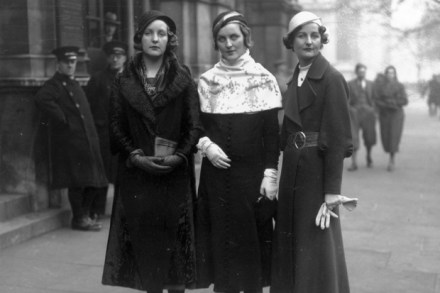
For some reason you don’t expect people to be fans of the Mitford sisters, as others are fans of Doctor Who or Justin Bieber. But just in case this subset of humanity does exist, we have The Mitford Girls’ Guide to Life (The History Press, £12.99). Lyndsy Spence’s elegant little hardback is a compendium of all things Mitford, from family nicknames (‘Sir Ogre’ for Sir Oswald Mosley) and fashion tips (tweed skirts only on weekdays) to Pamela’s household hints (‘choose an aga to match one’s eyes’) and Diana’s guide to prison life (take a fur coat to use as a blanket, use congealed hot chocolate as face cream).

Mr Loverman, by Bernardine Evaristo – review

From our UK edition

In 1998, the Jamaican singer Bounty Killer released a single, ‘Can’t Believe Mi Eyes’, which expressed incredulity that men should wear tight trousers, because tight trousers are an effeminate display of gayness. Fear and loathing of homosexuals has a long history in the West Indies. Jamaica’s anti-sodomy laws, deriving from the English Act of 1861, carry a ten-year jail sentence for ‘the abominable crime’. Similar laws exist elsewhere in the Anglophone Caribbean, yet Jamaica is outwardly the most homophobic of the West Indian islands. A white man seen on his own in Jamaica is often assumed to be in search of gay sex. Batty bwoys (‘bum boys’) are in danger of being stoned, cutlassed or shot.

Signifying Rappers, by David Foster Wallace – review

From our UK edition

Since his suicide, David Foster Wallace has made the transition from major writer to major industry. Hence this UK issue of a slender work of music history got up for a small US press in 1990 by a young Wallace and his college friend Mark Costello. The premise: it’s the early days of rap, and two overeducated white kids who like it produce a sampler considering What It’s All About. That it’s dated doesn’t matter much. That it’s juvenilia does. Its cleverness is that of a writer in possession of an immense talent but not yet remotely in control of it: a learner driver doing doughnuts in a powerful car. Almost every sentence is arch or overwrought.

Uncle Bill, by Russell Miller – review

From our UK edition

Given the outcome of recent military campaigns in Iraq and Afghanistan, it is pertinent to look for one particular quality in our senior commander: honesty. In other words, after blaming vainglorious politicians for precipitating us into war without adequate preparation or resources, it is reasonable to ask, how capable are our generals of admitting their own mistakes? Their persistence in two failed strategies — the application of Northern Ireland peace-keeping tactics to Basra and the dispersal of troops among forward posts in Helmand — does not suggest any culture of mea culpa, and ruthless self-examination has not been a distinguishing feature of the annual lectures delivered by the Chiefs of the Defence Staff to the Royal United Services Institute in the past decade.

Multiples, edited by Adam Thirlwell – review

From our UK edition

There is a hoary Cold War joke about a newly invented translating machine. On a test run, the CIA scientists feed in ‘The spirit is willing, but the flesh is weak’, press the button to translate it into Russian, and then re-translate it into English. It emerges as ‘The vodka is passable, but the meat is putrid.’ Our modern translating machine is Google Translate. It takes more than one transmutation to scramble the Biblical quotation: however, if you shift it through Russian, Azerbaijani, Chinese, Hungarian, Tamil and Haitian Creole into French, you can get ‘J’aime la chair, elle était faible.’ Since the original is usually quoted by dieters reaching for a fourth cream bun, this, paradoxically, might in practice be accurate enough.

The Tragedy of Liberation, by Frank Dikötter – review

From our UK edition

The historian of China Frank Dikötter has taken a sledgehammer to demolish perhaps the last remaining shibboleth of modern Chinese history. This is the notion, propagated in countless books and documentaries, that Mao’s regime started off well, deservedly coming to power on a wave of popular support and successfully tackling the evils left behind by the corrupt and incompetent Nationalists. Then, at the end of the 1950s, it all started to go wrong. There were terrible natural disasters, followed by famine; and, seemingly unaccountably, the brotherhood of brave revolutionaries fell out, creating the bloodbath of the Cultural Revolution. This is the version still served up to A-level students in Britain.

Narcoland, by Anabel Hernandez – review

From our UK edition

It is by now surely beyond doubt that those governments committed to fighting the war on drugs — and on paper that’s all of them — face a total rout. To understand the scale of the defeat, all you need to know is that Barack Obama and David Cameron have both been unable to deny that they were once users. The US spends more than a billion dollars a year on international narcotics control and as a result, as a US official in Colombia once told me, has forced up the price of a gram of cocaine in New York by just a few dollars. That must have put drugs beyond the reach of a few potential consumers. But it seems a very modest achievement for a government programme that has enjoyed such sustained, cross-party support for decades.

The Windsor Faction, by D.J. Taylor – review

From our UK edition

In both his novels and non-fiction, D. J. Taylor has long been fascinated by the period between the wars. Now in The Windsor Faction, he brings us a counterfactual version. What would have happened in 1939 if Mrs Simpson had conveniently died three years earlier, leaving Edward VIII free to stay on the throne?  Would he have prevented war with Germany — perhaps even by treacherous means? Taylor explores these questions from a variety of perspectives. In big London houses, groups such as the Nordic League and the White Knights of St Athelstan meet to campaign against Britain’s involvement in a ‘Jewish war’, convinced that they have the king’s unspoken support.

The Prince of medicine, by Susan P. Mattern – review

From our UK edition

In the first draft of the screenplay for the film Gladiator, the character to be played by Russell Crowe (‘father to a murdered son, husband to a murdered wife’, etc) was named not Maximus, but Narcissus. Which might have made for a slightly different movie. One can imagine the emperor Marcus Aurelius (Richard Harris) telling the beefy hero, ‘I’m entrusting the empire to you, Narcissus, because you’re loved by the soldiers, more gifted than my son Commodus, and also because you take better care of your skin than any general I’ve ever known.’ The reason for the original choice of praenomen was that the character was loosely based on a real-life athlete named Narcissus, believed to have killed Commodus in 192 AD.

Why does Max Hastings have such a hatred for the British military?

From our UK edition

One of the great problems for any historian writing of 1914 and the slide into conflict is that everyone knows the causes of the first world war and those of us who don’t still imagine that we do. It is clear that no historian can simply ignore the causes and get straight down to the fighting, but with the best will in the world it is hard not to feel like some poor Easyjet passenger, stranded on a Gatwick runway and sadly watching the precious take-off slot slipping further into the distance while the cabin crew go though the familiar old pre-flight safety instructions that they know perfectly well nobody is listening to.

Olivier, by Philip Ziegler – review

From our UK edition

Philip Ziegler is best known for his biographies, often official, of politicians, royalty  and soldiers. They include Harold Wilson, Edward VIII and Louis Mountbatten, whose correspondence he also edited. What has driven him to write about an actor — and one whose life has been fully covered in so many biographies, the most recent being Terry Coleman’s in 2005? I take it he knows little of theatre on the inside and has had to base his book on the notoriously unreliable gossip of actors, not the least of whom was Olivier himself, a supreme fantasist. I am not even sure that Ziegler is a theatre buff.

Almost English, by Charlotte Mendelson – review

From our UK edition

Novels about growing up have two great themes: loss of innocence and the forging of identity. With this sparky, sharp-eyed and  often painfully funny novel, her fourth,  Charlotte Mendelson (winner of the Somerset Maugham and John Llewellyn Rhys prizes and now on the Man Booker longlist) explores both through the story of a girl and a family openly based on her own experience. Marina Farkas is a small, round, dark-haired half-Hungarian girl of 16 (as the author was in 1988 when the novel is set).

Danubia, by Simon Winder – review

From our UK edition

Why do we know so little about the Habsburg empire, given that it is the prime formative influence on modern Europe? Its pomp gave us the art, music, literature and pageantry of our high culture; its relationship with the Ottoman East and burgeoning European protestantism drew our religious and our political maps; its collapse fomented the nationalisms that shaped the 20th century across Europe. A popular abbreviation on the internet is ‘tl; dr’. It stands for ‘too long; didn’t read.’ There’s space for another one that would come in especially helpful for the Habsburg empire: ‘tc; du’ — ‘too complicated; didn’t understand’.

The Downfall of Money, by Frederick Taylor – review

From our UK edition

In Germany in 1923 money was losing its value so fast that the state printing works could not keep up. The work had to be contracted out to 130 different printing firms, all churning out marks with the lifespan of mayflies. Only ten years earlier, the mark had been as good as gold. Then Germany had set out to fight a short war and send the bill to the losers. This had worked well the last time round: after the 1870 war, France had handed over 5 million gold francs, not to mention two provinces. But the 1914 war turned out to be longer and far more expensive, and Germany had to pay its own way — which meant borrowing — and the Reichsbank, as a wartime precaution, had taken the mark off the gold standard. In the end there were losers all round. Frederick Taylor tells the story.

E.O. Wilson has a new explanation for consciousness, art & religion. Is it credible?

From our UK edition

His publishers describe this ‘ground-breaking book on evolution’ by ‘the most celebrated living heir to Darwin’ as ‘the summa work of Edward O. Wilson’s legendary career’. As emeritus professor of biology at Harvard, Wilson, now 84, is revered across the world as the doyen of Darwinists. And in announcing that he will offer a new answer to those three cosmic questions scrawled in the corner of a Gauguin painting — ‘Where have we come from? Who are we? Where are we going?’ — he leads us to expect some profound new insight into how a billion years of evolution have made us a species unique on earth.

Salinger, by David Shields – review

From our UK edition

This biography has somewhat more news value than most literary biographies. Its subject worked hard to ensure that. After 1965, J.D. Salinger, having published one novel, a volume of short stories and two pairs of novellas, withdrew permanently from public life. His last publication, a long story entitled ‘Hapworth 16, 1924’, was never printed in hard covers. Subsequently, he went to some effort to control what was known, and could be written, about him. He retired to Cornish, New Hampshire, living comfortably on the immense, ongoing sales of his single novel, The Catcher in the Rye. From there, information occasionally leaked out. A fan might extract a couple of rebarbative sentences from his idol.