Book review

Queen Victoria, by Matthew Dennison – review

From our UK edition

When Prince Albert died in 1861, aged 42, Queen Victoria, after briefly losing the use of her legs, ordered that every room and corridor in Windsor Castle should be draped in black crepe. As a result, the country’s entire stock of black crepe was exhausted in a single week. One of the key factors of Victoria’s reign for Michael Dennison is that it was — not always consciously — a ‘performance monarchy’, in which the Queen sat in carefully fashioned stage-sets at Windsor, Balmoral or Osborne being discreetly ogled by the populace. This public posturing helped gloss over Victoria’s ‘dizzying’ contradictions, and the purpose of this short biography is to bring them back out of the shadows.

Donna Tartt can do the thrills but not the trauma

From our UK edition

Donna Tartt is an expert practitioner of what David Hare has called ‘the higher hokum’. She publishes a long novel every decade or so. Her first book, The Secret History (1992), was about some highly affected college students who took to studying ancient Greek in a cult and murdering one another in Dionysiac revels. It was a genuinely popular success — chic, macabre and supremely well-constructed. Her second, The Little Friend (2002), pursued a small girl through her attempts to pin the murder of her brother on the wrong culprit. It confirmed Tartt’s gift for an intricate plot, escalating into some furiously exciting action. The handling of suspense in both these novels was first-rate.

Mastering the Art of Soviet Cooking, by Anya von Bremzen – review

From our UK edition

The early 1990s in Russia were hungry years. At the time, I was a student, too idle to barter and hustle for food, and the collapse of the planned economy had left the shops empty. Instead, we staved off hunger- pangs with cigarettes, and if edible matter came our way, we fell upon it like locusts. More often than not, it took the form of the Soviet staple, Salat Olivier — Russian salad, plastered so thickly with mayonnaise that the ingredients were unidentifiable. (I notice that even the act of typing these words makes my mouth water; a complicated rush of nostalgia, anxiety and greed.) Like most aspects of late Soviet Russia, the Salat Olivier had a dual identity.

Clumsy and heavy, Goliath never stood a chance

From our UK edition

When we think of David and Goliath, we think of a young man, not very big, who has a fight with a terrifying opponent, and wins. We think of David as puny and Goliath as towering and strong — not to mention heavily armed. We see David’s victory as something that happened against all odds. The story of David and Goliath is, as Malcolm Gladwell puts it, ‘a metaphor for improbable victory’. Well, that’s how we think about it, anyway. But the thing is, apparently, we’ve got it all wrong. Gladwell, one of the most influential non-fiction writers in the world, often asks his reader to take a closer look at things. In The Tipping Point, his subject was epidemics.

A Strong Song Tows Us, by Richard Burton – review

From our UK edition

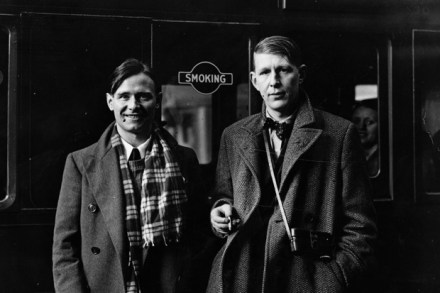
How minor is minor? ‘Rings a bell’ was more or less the response of two English literature graduates, now successful fifty-somethings, when asked what the name Basil Bunting meant to them. It is, after all, a good name, a memorable name. I asked a younger friend, about to start his Eng. Lit. degree at Keble: ‘Nothing.’ I asked a former literary publicist: ‘No, nothing.’ I quizzed a chap from the FCO: ‘Nothing, I’m afraid. Sorry.’ Perhaps not deep research, but I’d be surprised if Basil Bunting’s work was familiar to anyone not a poet or scholar of English modernism. Is this as it should be? Does he deserve a 600-page biography (any more than any other minor poet)? As a matter of fact he does. Tehran, 1951, the Ritz.

Darling Monster, edited by John Julius Norwich – review

From our UK edition

It must have been awful for Diana and Duff Cooper to be separated from their only child during the war, but we can be grateful for it because it’s a joy to read the correspondence it gave rise to. The letters in this book span the years 1939 to 1952 and take in the Blitz, Diana’s short spell as a farmer in Sussex, a trip to the Far East, when Duff was collecting intelligence on the likelihood of a Japanese invasion, the couple’s three years in the Paris embassy, and several more in their house at Chantilly, as well as a great number of journeys around Europe and North Africa. The most charming thing about the war letters is how grown-up they are. John Julius Norwich was sent to safety in America and hardly saw his parents for two years.

What caused the first world war?

From our UK edition

The centenary of August 1914 is still almost a year away, but the tsunami of first-world-war books has already begun. The government tells us that 1914 must be commemorated, not celebrated, and ministers worry about British triumphalism upsetting the Germans. But the debate about Germany’s responsibility for the outbreak of war in 1914 won’t go away. Historians are divided into those who blame Germany — John Rohl, Max Hastings — and those who point the finger at someone else, such as Serbia (Christopher Clarke) or Russia (Sean McMeekin) or even Britain (Niall Ferguson). The blame game is of course conceptually flawed. The international system in 1914 was seriously dysfunctional. The alternative to searching for scapegoats is to examine the system.

Making It Happen, by Iain Martin – review

From our UK edition

Fred Goodwin’s descent from golden boy of British banking to ‘pariah of the decade’ would be the stuff of tragedy if the former Royal Bank of Scotland chief were not such a rebarbative personality. A bully to his subordinates, obsessed with the wrong kind of detail, driven by an egoistic urge to trample his enemies, he sounds a lot like another once-prominent Scot who has recently disappeared from public view. Indeed the pair used to enjoy regular ‘cosy chats’ before it all went horribly wrong. As someone told Iain Martin: ‘Gordon and Fred are actually quite similar. Both are quite introverted individuals and that expresses itself in sometimes extremely awkward dealings with others.

Licensed to feel: The new James Bond fusses over furnishings and sprinkles talc

From our UK edition

First, an appalling admission: I have never read any of Ian Fleming’s Bond books. Nor have I read any of anybody else’s, the number of which seems to grow with each passing year. For a civilised man of a certain age this is a shameful oversight, given that I have seen all but three of the 23 films in the cinema, many of them at the Odeon, Leicester Square within days of their opening; that I can’t put on a dinner jacket without wondering whether Sean Connery would look better in it; and that I still own a copy, on 7” vinyl, of ‘Nobody Does It Better’ by Carly Simon, the theme tune to The Spy Who Loved Me. (And the soundtrack it came from, just in case the single went missing.

Stephen King isn’t as scary as he used to be, but ‘Doctor Sleep’ is still a cracker

From our UK edition

Though alcohol withdrawal is potentially fatal, booze has none of the media-confected glitz of heroin (imagine Will Self boasting of a Baileys Bristol Cream addiction). The 17th-century word for the sickness that follows excessive drinking — ‘crapula’ — effectively hints at the alcoholic’s sleazy kind of stupor. In his earlier years, Stephen King would drink himself daily into a wall-eyed hangover. His scariest novels — Carrie, The Stand, The Shining — were written in the 1970s when sobriety was a no-no for him. Jack Torrance, the author who goes off his rocker in The Shining, suffers the most horripilating of alcohol-tainted visions while holed up in the Overlook Hotel in the Colorado Rockies.

Anorexia, addiction, child-swapping — the Lake Poets would have alarmed social services

From our UK edition

The last time the general reader was inveigled into the domestic intensities of the Wordsworth circle was by Frances Wilson in The Ballad of Dorothy Wordsworth. She engaged delicately with Dorothy’s inordinate love for her younger brother William, and seemed to think her passionate attachment was romantic and sentimental rather than sexual — though there are 50 shades of grey between the one and the other, and honestly, it doesn’t matter. Katie Waldegrave, in her riveting family saga The Poets’ Daughters, is not much concerned with that anyway. Her focus is on what happened to Wordsworth’s daughter Dora, the second of his five children, and Coleridge’s youngest, Sara. There were 20 months between them and they were much together as children.

Guido Fawkes to Damian McBride: Who’s spinning now?

From our UK edition

When Gordon Brown eventually became aware that his Downing Street was about to be engulfed in the Smeargate scandal, he called Damian McBride to try to get to the bottom of the story. The latter recounts the conversation verbatim in Power Trip, his tell-all book dedicated ‘to Gordon, the greatest man I ever met’. Brown says: ‘OK, Damian, I need your word that you will tell me the truth. If the years we’ve worked together mean anything, I need your absolute word.’ ‘Yep, of course,’ McBride replies solemnly, ‘I give you my word, I promise I’ll tell the truth.’ ‘Right,’ says Brown, ‘firstly, is there anyone else in No. 10 or in the government or in the Labour party who is involved in these emails or this website?

Meeting the Enemy, by Richard Van Emden; 1914, by Allan Mallinson – review

From our UK edition

The Great War was an obscene and futile conflict laying waste a generation and toppling emperors. Yet here are two books that situate the horrors of trench warfare within a much larger perspective. One argues that the war had a forgotten ‘human face’. The other that it might all have had a very different outcome. Henry James described  the 1914 plunge of civilisation into blood and darkness as ‘too tragic for any words’ — and about tragedy there is always some air of inevitability, of sailing Titanic-like towards a foredoomed catastrophe. This air of unstoppable fatality has solidified over the intervening century.

An Officer and a Gentleman, by Robert Harris – review

From our UK edition

The Dreyfus Affair, the furore caused by a miscarriage of justice in France in 1894, is a source of perennial interest. It raises questions of national identity, political morality and personal integrity that are still relevant today with immigration, Euroscepticism and dodgy dossiers. It is also, as Emile Zola recognised, a gripping story: ‘What a poignant drama, and what superb characters.’ Like Zola, Robert Harris has recognised the Affair’s dramatic potential and re-tells it here as the taut, first-person, present-tense narrative of the heroic Colonel Georges Picquart.

Walking in Ruins, by Geoff Nicholson – review

From our UK edition

Geoff Nicholson is the Maharajah of Melancholy. The quality was there in his novels, it was there in his non-fiction book The Lost Art of Walking, and it’s there in the latter’s successor, Walking in Ruins (Harbour Books, £12.50). He savours the comfort to be gained from accepting decay as an inevitable part of life. Ruins are his muse. So he spends the book doing exactly what its title suggests. Locations include an abandoned Los Angeles zoo, now inhabited by two homeless men, a Sheffield housing estate whose road layout survives even though its houses don’t, and a desert town that’s been, er, deserted. Nicholson keeps finding shoes there, though never a matching pair. If you share his mindset, you’ll love the philosophical ruminations that result.

The Sunflowers Are Mine, by Martin Bailey – review

From our UK edition

‘How could a man who has loved light and flowers so much and has rendered them so well, how could he have managed to be so unhappy?’ This was Claude Monet’s comment on seeing Van Gogh’s ‘Three Sunflowers’ (1888). There he put his finger on one of the enigmas of the Dutch painter’s tragic life. The journalist and scholar Martin Bailey has written an admirable new book which tells the story of Van Gogh’s life and posthumous rise to fame through the pictures of sunflowers, Helianthus annuus, which the painter produced at intervals through his brief career.

England’s 100 best Views, by Simon Jenkins – review

From our UK edition

I couldn’t decide on starting England’s 100 Best Views whether it was a batty idea for a book or a perfectly sensible one. Why write about something that begs to be seen? Would this not be better as a collection of photographs, with helpful accompanying maps and perhaps a checklist that, once filled in, entitled you to a badge from Big Chief I-Spy? On the other hand, as Jenkins (he’s Sir Simon, of course, but book reviews know no distinctions of rank) explains in his introduction, a view is more than just a picture: it is something mobile — a collocation of geography and geology, the built environment and the weather, the movements of birds and mammals, and the mood of the person taking it in.

Do women want what they say they want?

From our UK edition

What do women want? You might have thought the Wife of Bath had got this one sorted, but Daniel Bergner has brought science to bear on the perennial question. And the answer from this book is that what women want is not just sex but sex outside the confines of monogamy. You know the received wisdom about women needing relationship security and emotional commitment before they feel right about having intercourse? It’s all hokum, apparently. What women want when it comes to sex is, it seems, at odds not just with societal expectations but with what they — we — say they want. Actually, do you mind if I talk about women as ‘they’ in what follows? You’ll see why.