Book review

Style and substance

In Ravelstein, Saul Bellow’s thinly disguised account of the final years of the University of Chicago professor Allan Bloom, the narrator Chick and his close friend Abe Ravelstein go on a shopping spree in Paris sometime in the 1990s. For all their highfalutin philosophical talk about Athens versus Jerusalem and the like, Bellow makes it clear that there is a Dionysian as well as Apollonian cast to the bond between Chick and Abe. After departing the Hôtel de Crillon, their first stop is Lanvin. There, Abe is smitten by a beautiful flannel jacket retailing for $4,500. He buys it.

de mans

Aleksandr Solzhenitsyn’s masterpiece is finally appearing

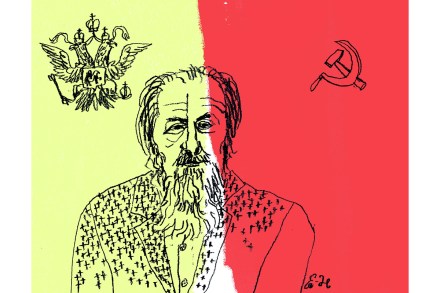
In the mid-1970s, exiled from the Soviet Union for exposing its vast crimes against humanity, and having won the Nobel Prize in Literature for that endeavor, Aleksandr Solzhenitsyn turned his back on the lionization that awaited him in New York and other cultural capitals of the West and instead settled with his family in the woods of Vermont. Avoiding visitors for the better part of the next two decades, he churned out half a dozen or so books, averaging roughly 750 pages each, that together tell the story of the Russian Revolution and its antecedents. This act of sheer energy, self-discipline and renunciation of the conventional worldly pleasures bestowed by the literary elite was in the spirit of Russia’s own eastern monasticism.

Solzhenitsyn

All Greek to us

We are traveling through a shower of Greek anniversaries, triumphant and calamitous. Last year marked the 25th centenary of the Battle of Salamis in 480 BC, when 300 Greek warships defeated a Persian armada four times larger and ended the Persian empire’s expansion into Europe. This year marks the bicentenary of the beginning of the Greek War of Independence from the Ottoman empire in 1821, which resulted in the first European nation-state to be founded on the Enlightenment values of the American Constitution. Next year will mark the centenary of Greece’s defeat in Asia Minor in 1922, which ended the modern Greek state’s aspirations to absorb all the lands where Greeks lived and had lived since antiquity, an event still referred to as ‘the catastrophe’.

greek
art women

Why should art have ever been considered a male preserve?

I’m a lady, I kept thinking, reading these two books. More: I’m a lady art historian. Oughtn’t I to like books by other lady art historians about lady artists and ladies in art? Why don’t I? Why so out of sync with the sisterhood? Start with the positive. Jennifer Higgie’s The Mirror and the Palette follows an interesting, original line: ‘If she had access to a mirror, a palette, an easel and paint, a woman could endlessly reflect on her face and, by extension, her place in the world.’ Higgie, editor-at-large at frieze magazine and the host of the (excellent) art history podcast Bow Down, considers the lives and ambitions of a series of women artists in the light of the self-portraits they painted.

An orange or an egg? Determining the shape of the world

Thirty-two years ago, the young Nicholas Crane, who would go on to become one of England’s most esteemed television geographers, set out to woo a young woman by spiriting her off to the unfailingly romantic landscape of Chimborazo and Cotopaxi. The couple spent their high-altitude idyll walking the hills in hobnail boots, making river passage in dugout canoes and boarding a Quito-bound steam train through the Andes, run by the estimable Empresa de Ferrocariles Ecuatorianos. Their journey had its moments: at one stage both parties were to be found at 13,000 feet, crusted with ice and huddled overnight from the gales inside a pair of plastic trash bags; they then got themselves lost for a while among a wilderness of huge and very active volcanoes.

crane

How Hitler’s great gamble nearly paid off

Do we need another wrist-breaking book about Adolf Hitler, the Third Reich and World War Two? What is there left to say? To gain attention, any new study has to have a thesis: some fresh angle that previous writers have overlooked or played down. For Frank McDonough it is the insane impossibility that Germany could ever have won the struggle it launched against the combined powers of the US, USSR and the British Empire that was the Führer’s fatal flaw. McDonough is an academic specializing in Nazi Germany, and he writes clearly and readably, with just enough detail, on the huge canvas that he covers.

hitler

The odd couple: John Keats and F. Scott Fitzgerald

On a shard of paper, some time in the bleak 1930s, F. Scott Fitzgerald incorporated a favorite line from one of his favorite poets, John Keats, in a short verse of his own: 'Don’t you worry I surrender Days are long and life’s a bender Still I know that Tender is the Night.' Keats was a Romantic, perhaps the Romantic, with his lyric gift and tragically brief life. Fitzgerald loved the Romantic poets, and romance in the lower case, but was at the heart’s core a modernist, far more egoist than romantic, and quite hardboiled. The little quatrain above is rather like T.S. Eliot’s ‘jug jug’ in The Waste Land — homage of a sort, but also showing ironic distance, and no intention of writing like Keats.

Fitzgerald

A fatal clash of civilizations

Many books claim to describe junctures that changed the world, but few examine ones as consequential as Conquistadores. Hailed by the Romantics as courageous explorers, the Spanish conquerors are increasingly seen as violent and rapacious exploiters. That, says Fernando Cervantes, oversimplifies the complexities of the early modern period. Cervantes, a Mexican historian, places the conquest of the Americas in Spain’s political context. In 1492, at great cost to the royal purse, Spain recovered Andalucía from the Moors. So when a charismatic Genoese navigator proposed to sail southwest in search of a new trade route to Asia, Ferdinand and Isabella approved. Columbus’s voyage was the first step to transforming a young nation into the greatest imperial power on Earth.

Conquistadores

The Browning version

‘Ah, did you once see Shelley plain?’ asks the speaker in Robert Browning’s poem ‘Memorabilia’. Yet few of Browning’s contemporaries are as hard to see plain as his own wife: the poet who was known to her family as ‘Ba’, signed herself ‘EBB’ and published a number of popular works under her married name, Elizabeth Barrett Browning. During her lifetime she was one of the most admired poets of the age: a framed portrait of her hung in the bedroom of Emily Dickinson, and when Wordsworth died in 1850 there was serious talk of her becoming the first female poet laureate. Since her death in 1861, however, her reputation has sunk like a bad soufflé.

browning

Will Tripp keeps it short

Have you met Will Tripp? He’s the pugnacious dwarf lawyer who starred in Harry Stein’s Will Tripp: Pissed Off Attorney at Law. That was probably the funniest book of 2014, certainly the most amusing novel I read that year. Will, whose credo is ‘Shut up, and get on with it’, was busy paying his way through law school by means of his athletic prowess, sort of. He specialized in being tossed back and forth by the inebriated patrons of a local bar until some do-gooding crusader took time away from battling against secondhand smoke and carbon emissions to intervene to Save the Dwarfs and got the sport of dwarf tossing declared illegal. Will had to find new employment, inspecting sewers.

will tripp

Men of letters

In the spring of 1945 three men pooled their resources to buy Long Crichel House, a former rectory built during the reign of Queen Anne in a secluded Dorset village. Desmond Shawe-Taylor and Edward Sackville-West were highly influential music critics, while Eardley Knollys, a former gallery owner, was now assistant secretary to the National Trust and a painter. The idea was for the three friends to live communally but each have his own part of the house where he could work undisturbed and enjoy some privacy. The house was in fact large enough to accommodate not only a live-in butler and cook-housekeeper but, from 1949, a fourth partner, Raymond Mortimer, the leading literary and art critic of the day.

crichel

Nature is healing

Ignoring the padlocked gate, my six-year-old son Nicholas and I climbed through a break in the metal fence and pushed into the mesh of undergrowth. This was the site of Ducker, the open-air swimming pool that once belonged to Harrow School in London. Here the young Winston Churchill romped (naked, since trunks were for prefects), as, in his own day, did my dad. When I arrived at Harrow in the 1980s, the pool — far bigger than Tooting Bec Lido, which is now the UK’s largest — had just been abandoned. It was covered with graffiti, the haunt of skateboarders. Returning in 2021, I looked for changes wrought by three decades of neglect. Google Maps showed a J-shaped artificial lake, 98ft by 492ft.

nature

Parse the curse

We all know that there are some things we shouldn’t say. Words that are mean-spirited and injurious, potty-mouthed expressions when we stub our toes, hateful things that can drip off the tongue like acid. But no words are better equipped to capture the changing landscape of a culture than those that aren’t supposed to be uttered. At a moment where everyone from high school principles to New York Times journalists are struggling with the latest iteration of language rules, John McWhorter, an associate professor of linguistics at Columbia University is out with a thoughtful, deeply researched, and downright funny book about swears. Nine Nasty Words: English in the Gutter — Then, Now, and Forever wrestles with two thorny, topical questions: what can’t we say?

john mcwhorter words

Stacey Abrams’s new novel is a love letter to lawyers

A politician publishing a novel is a bit like the lead singer of a rock band declaring that not only are they going to release a solo album but it is going to express their newfound interest in electronica. Expectations are low — or high depending on your appetite for other people’s failure. Still, for all the mean things you could say about Stacey Abrams’s new legal thriller While Justice Sleeps, you could say some kind things as well, the foremost being that it is not cynical. This is not some kind of botched cash-in. (For that, look forward to my editors asking me to review Hillary Clinton’s forthcoming novel State of Terror.) Abrams loves to write.

stacey abrams

Is Sohrab Ahmari a Satanic ogre?

Sohrab Ahmari is an ogre sent by Satan to annihilate American freedom. At least, that’s the reputation he has with liberals of the more excitable sort. His new book ought to soothe their twitchy nerves. The Unbroken Thread is an easy going, ecumenical, rather cosmopolitan tour of 12 moral questions and select thinkers who responded to each of them. ‘My primary purpose,’ writes our implausible theocrat, is ‘not to offer definitive answers, drawn from any one particular tradition, but to explore the possibility that our contemporary philosophy might be wrong in crucial respects.’ Ahmari has been much vilified for his criticism of Drag Queen Story Hour, an event in which crossdressers introduce themselves to children in public libraries.

ahmari

Read all over

In the 1880s a new group of women was entering newsrooms. Not content to write society sketches or cover the fashionable hats of the season, they went for bold reporting — often going undercover or participating in other dramatic ‘stunts’. The antic that launched Nellie Bly’s career in 1887 was getting admitted as a patient on Blackwell’s Island in New York, then an insane asylum for women. She had told the editor of the New York World she would do anything fora job on the paper, and this was what she was assigned. She went to a boarding house under an assumed name, pretended to be unhinged and was duly committed. Rescued after 10 days by a representative from the World, her exposé of the indignities suffered by patients in the asylum was a sensation.

sensational

Radetzky marches on

‘The Radetzky March’ was composed by Johann Strauss the Elder as a tribute to Field Marshal Joseph Radetzky von Radetz. An aristocrat of Czech origin, he was one of the fiercely conservative soldiers who gave the Habsburg Empire its bad name. First performed in 1848, the year of revolt in Europe, the ‘March’ was an immediate success. Austrian bands men were playing it at the battle of Königgraetz in 1866, fought against the Prussian Kaiser. For the first time, the Prussians had machine guns, and their rapid fire bloodied the white uniforms of the Austrians. Prussian victory condemned Austria to be the lesser of the two German-speaking nations, and on the losing side in the two world wars.

habsburg

Spells and bindings

In 1791, Isaac D’Israeli, father of future prime minister Benjamin, published his most famous work, the Curiosities of Literature, a collection of freewheeling mini-essays on whatever literary topics happened to tickle their author’s fancy: ‘Titles of Books’, ‘Noblemen Turned Critics’, ‘On the Custom of Saluting after Sneezing’, ‘Cicero’s Puns’. One of its joys is its capaciousness — completely unsystematic, yet seeming somehow to touch a little on everything. The book is long, but the essays are rarely more than a couple of pages, sometimes less.

library

Things go flying

There are fashions in the paranormal as in everything else. Since the famous Enfield hauntings of the late 1970s, poltergeists seem to have gone quiet, or at least unreported; but before then they were everywhere. In 1938, poltergeists kicked off in Thornton Heath, Surrey, and a Jewish Hungarian journalist and psychic investigator, Nandor Fodor, was alerted to strange happenings in the home of a 34-year-old housewife there. The list of happenings is familiar in all poltergeist stories. Furniture moves, light fittings shatter, crockery, money, knick-knacks, even small pictures are thrown through the air, sometimes seemingly aimed directly at individuals.

alma fielding

A Scottish Paradise

As every Italian schoolchild knows, The Divine Comedy opens in a supernatural dark wood just before sunrise on Good Friday, 1300. Dante Alighieri, a figure in his own work, has lost his way in middle age and is alone and frightened in the darkness. The ghost of the Roman poet Virgil is about to show him Hell: ‘Midway in the journey of our life I found myself in a dark wood, for the right path was lost.’ Begun in the early 14th century, Dante’s poem is, for many, the greatest single work of western literature. With its dramatic chiaroscuro of hellish fuming mists and paradisal stellar regions, the poem is ‘awful’ in the archaic sense of the word (still valid in the Italian terribile), meaning to inspire awe.

dante paradise