Book review - fiction

Sex and the city

Coco Mellors’s lively, involving debut novel begins on New Year’s Eve in New York, with Cleo and Frank meeting in a descending elevator. It’s a sure sign that their future relationship will not end well. Cleo is British, young, golden and an artist; Frank is American and old (well, he’s in his late thirties), and he has taken the devil’s dollar by working in advertising. Cleopatra and Frankenstein deals primarily with the indistinct boundaries between commerce and art, set against a backdrop of neurotic New Yorkers, glitter, drugs and booze. As Frank walks Cleo home through streets full of hedonists, swapping one liners and teasing each other, they fall in love (or at least, into a clinch on the stairs of her dingy apartment).


Mellors

All things lead to 9/11

In the immediate aftermath of 9/11 many writers spoke of feeling immobilised. The scale of the attacks and the world’s shared experience of the media event seemed to demand a response; but simultaneously writers such as Ian McEwan, Martin Amis and Jay McInerney described a sense that the tools at their disposal were inadequate — that the reality of what had taken place exceeded fictional representation. These three all recovered from their shock reasonably quickly, contributing to the flood of 9/11 fiction that poured into bookshops during the 2000s. In recent years this torrent of novels and stories has slowed, but as Christopher Priest’s eerily powerful An American Story demonstrates, it most certainly has not stopped.

american story
paris echo sebastian faulks

Hoping to find happiness

It is a truth universally acknowledged that a serious novel must be in want of a theme. Paris Echo soon makes it clear that it has several. It’s about the shifting nature of history and the mysterious footprints of the past in the present. It’s also concerned with the myriad and biased interpretations that we place on past events. Another preoccupation is the ambiguities of spoken and written French. Modern Paris, the novel’s main setting, allows Sebastian Faulks to explore his themes through two main viewpoints. There’s Tariq, a precociously self-aware 18-year-old Moroccan from a middle-class family in Tangier, who comes to Paris in search of himself, his mother’s French family and an obliging woman who will help him lose his virginity.

Too much American angst: the latest short stories

In ‘A Prize for Every Player’ — one of 12 stories in Days of Awe, a new collection by A.M. Homes (Granta, £14.99) — Tom Sanford, shopping with his family in Mammoth Mart, soliliquises (loudly and nostalgically) about the America he remembers, and finds himself with an audience of shoppers who nominate him as the People’s Candidate for President. Absurd? Not quite so absurd perhaps as in pre-Trump days. Days of Awe (the title comes from Rosh Hashanah, the ten days of repentance in the Jewish calendar) is Homes’s third collection and her first book since winning the Women’s Prize for Fiction in 2013.

american short stories

The plight of the returnee

If the 20th century popularised the figure of the émigré, the 21st has introduced that of the returnee, who, aided by a combination of Skype, social media and cheap air travel, doesn’t so much exchange countries as exist between them. ‘I was an émigré. I had left. Now I’d returned,’ announces Andrei Kaplan, somewhat incredulously, in Keith Gessen’s vigorously funny second novel. An inverted Pnin, Andrei is a Russian-American academic, making a living by moderating online discussion groups for a professor who, in due course, compares Pushkin, Gogol and Dostoevsky to Kanye West. Failing to find a tenured job, Andrei moves to Moscow, where he was born, to care for his ailing grandmother. The city is unrecognisable.

Shades of Rear Window: People in the Room, by Norah Lange, reviewed

A girl at a window, hidden behind curtains, watches three women in a dimly lit drawing room in the house across the road as they sit silently smoking, hands and faces pale against their dark clothes. She invents identities for the trio: they are criminals or abandoned spinsters. Sinister or pathetic. Curiosity grows into obsession: she imagines them as painted saintly icons, golden against a dark wall, ‘flies crawling across their faces… the first threads of a spider’s web spun from their eyes’. People in the Room is set in the early 20th century in the affluent Buenos Aires neighbourhood of Belgrano, where the author lived as a child.

Born again: My Year of Rest and Relaxation, by Ottessa Moshfegh, reviewed

The new novel by the author of the 2016 Booker shortlisted Eileen is at once a jumble of influences — Oblomov by way of Tama Janowitz and Elizabeth Wurtzl, Bartleby with a touch of Bright Lights, Big City, a lunatic psychiatrist who melds Ayn Rand and William Burroughs — and unnervingly original. It takes guts, after all, to spin a yarn out of a rich Upper East Side orphan who decides to put herself to sleep for a year in an attempt at rebirth. Beyond the evident — the death of her parents, an obnoxious man in her life — precisely why our narrator wishes to shed her skin remains unclear to us; but her tenacity in pursuing oblivion is unshakeable.

A Shout in the Ruins is a panorama of the Civil War and beyond

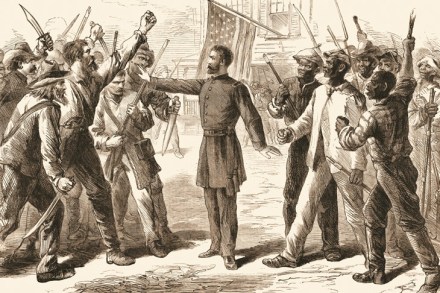
We’re in Virginia, in the 1850s. A girl called Emily is tormenting her dog, Champion, and her father’s teenage slave, Rawls. Seeing this, Emily’s father, Bob, beats her with his belt and kicks the dog. Of Rawls, Bob says: ‘Now leave him be so he can get about my business!’ A girl, a dog, a slave, and a slave-owner.The owner addresses the girl with words and violence, and abuses the dog. He helps the slave get down from the fencepost he’s standing on. But he does not talk to the slave. He talks about the slave. Thinking this over, Rawls looks at Emily,‘sprawled out and wailing in the grass’, and envies her. Her pain is temporary; his is permanent.

The marvellous humanity of Meg Wolitzer

It’s because it’s the land of the loner that the United States is so loved or loathed. Yet to me the most beguiling novels that have zipped across the Atlantic in the past half-century or so are mostly about groups, specifically groups on campus, usually a rather classy campus at that. Mary McCarthy’s Group were at Vassar; Donna Tartt’s The Secret History is set in an elite liberal arts college in Vermont. Even The Catcher in the Rye, though legendary as a portrait of moody adolescence, is also a brilliant picture of life at the sort of college Salinger himself went to. But no novelist I can think of has majored on the group portrait with quite such verve, wit and sympathy as Meg Wolitzer.

Boxing not so clever

For Horace Hopper, the half-breed protagonist of Willy Vlautin’s bleak new novel, essential truths come slowly, and usually too late to do him any good. Abandoned by his Native American mother and Irish American father, he has exiled himself from the only people who love him, an elderly couple on a sheep ranch in deepest Nevada. His one idea for becoming ‘somebody’ is to transform himself into a world-champion lightweight boxer with a wholly fabricated Mexican identity. ‘Mexican boxers are the toughest... true warriors who never quit,’ he believes. Only well into the novel does it dawn on him that his self-inflicted loneliness is ‘a sort of disease’, not a manly test of character that will redeem his young life.