Biden

Russia becomes a lost cause

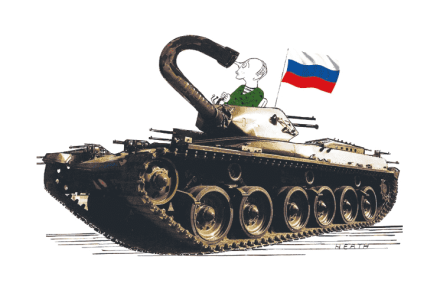
After an embarrassing two-month start to its war in Ukraine marked by pictures of abandoned armored personnel carriers, destroyed tanks and stalled armored columns outside Ukraine’s major cities, the Russian army is re-tooling and re-arming itself for a more manageable fight in the east. I use the word “manageable” not because the battle in the Donbas will be easy for Russian forces, but because the objective of expanding Russian control over the entirety of Donetsk and Luhansk is more realistic than overthrowing the Ukrainian government and occupying the entire country. Capturing, let alone holding, Kyiv, Kharkiv and Chernihiv would have entailed a massive number of personnel and a long-term commitment Russia doesn't have the resources to sustain.
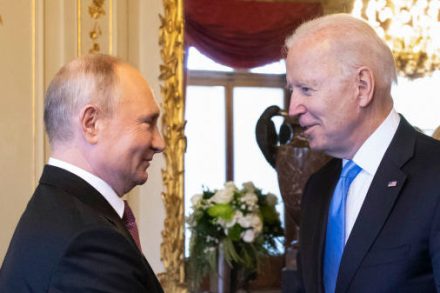
U.S. President Joe Biden and Russian President Vladimir Putin (Getty Images)

In search of a Biden doctrine

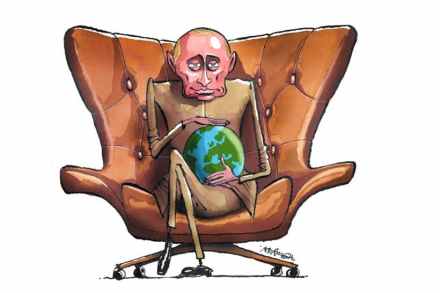
Considering how likely we all are to be blown to pieces by it within the next five years, the atomic bomb has not roused so much discussion as might have been expected,” wrote George Orwell in 1945. The public conversation soon caught up with the lethal realities of the nuclear age. The possibility of annihilation loomed over politics, domestic and foreign, for much of the second half of the twentieth century. Then, with the fall of the Berlin Wall, it faded into the background. Thanks to Vladimir Putin, the threat has returned to the fore. The isolated and unpredictable strongman in the Kremlin is not shy when it comes to reminding the world of Russia’s nuclear arsenal.

biden

Could Biden gaffe us into world war three?

From our UK edition

‘I want your point of view, Joe,’ Barack Obama once told his vice-president Joe Biden. ‘I just want it in ten-minute increments, not 60-minute increments.’ Obama understood Biden’s biggest flaw – his mouth runs away with him. He’s a verbal firebomb always threatening to go off. Last night, oops Biden did it again. As he rounded off his fiery speech in Poland against Vladimir Putin and autocracy, he concluded: ‘For God’s sake, this man cannot remain in power.’ The onset of senility had reduced the dangerousness of Biden’s loquacity The White House, in what is now a familiar routine, issued a quick clarification. The President was not demanding ‘regime change’ in Moscow.

Was Biden’s chemical weapons threat a gaffe?

From our UK edition

Did Joe Biden mean to threaten Russia with a chemical weapons attack? That seemed to be what he implied at yesterday’s Nato summit when he said Russia using chemical weapons in Ukraine ‘would trigger a response in kind’ from the US. To respond ‘in kind’ means to respond in the same way – i.e. by firing chemical weapons back at Russia. Given that the US committed to destroying its remaining stockpiles of those munitions when it signed the Chemical Weapons Convention in 1993, it would seem very unlikely that this is what Biden meant. Or indeed, that he would have any chemical weapons to unleash in the first place. There is something to be said for ambiguity.

Why is Biden copying Obama’s mistakes with Iran?

From our UK edition

There was a picture taken on Tuesday that says more than just a thousand words. The photograph was snapped in Sharm el-Sheikh and shows Abu Dhabi Crown Prince Mohamed bin Zayed Al Nahyan and Israeli Prime Minister Naftali Bennett seated either side of Egyptian president Abdel Fattah el-Sisi. According to the Egyptian president’s office, they met to discuss ‘the repercussions of global developments, especially with regard to energy, market stability, and food security’ but ‘they also exchanged visions and views on the latest developments of several international and regional issues’. That’s a very wordy way of saying ‘Iran’.

Why was the Hunter Biden laptop story covered up?

From our UK edition

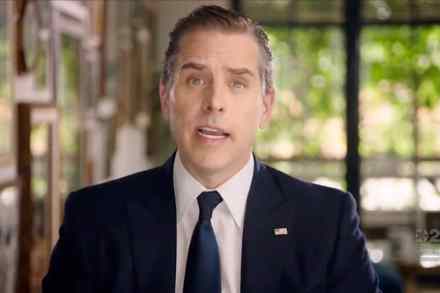
It’s now a familiar pattern – a sensational news story is dismissed by serious journalists as bogus right-wing agitprop. You’d have to be a swivel-eyed conspiracy theorist to believe that. You don’t want to be one of those. Then, a year or so later, the same important media organs, the same authorities who made you feel crazy for thinking that the story might be credible, turn around and tell you that, yep, it was true all along. It was just politically awkward to say so at the time. We saw it in the Covid years with the Wuhan lab-leak theory. We saw it to some extent with Jeffrey Epstein. And now we see it with the Hunter Biden laptop story.

Biden must decide the environment’s price tag

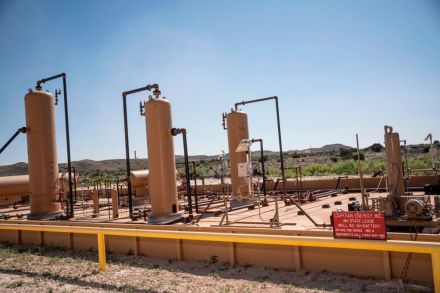
Boris Johnson is considering doing something that should be a duty for every leader. In the wake of sanctions poised to disrupt the 8 percent of domestic oil and 18 percent of diesel the UK imports from Russia, Johnson is reportedly toying with the idea of putting his country first and on the road to self-sufficiency by lifting the UK’s moratorium on fracking. The British government banned hydraulic fracturing, or “fracking,” in 2019. Fracking is a method of extracting oil and natural gas by drilling deep underground and fracturing shale rock with a fluid mixture (99 percent water and sand) that allows fossil fuels to flow out, be captured, processed and used to myriad ends (including gasoline).

Kamala invades Poland

From our UK edition

You can tell that the Biden administration is getting serious. They have unleashed their ultimate weapon, cackle diplomacy. The warhead is nicknamed Harris, and it is now in Poland cackling away, endeavouring to assemble the high-level Pierogis before Russia flattens Kiev or Putin decides to go nuclear – and by 'go nuclear', alas, I mean 'go nuclear'. Some observers say that sending Kamala Harris on this mission will give her a chance to 'burnish' her foreign policy credentials. Cynical folks – and I would include myself in that group – think it is just another emission of fog by America’s first certifiably senile administration.

Why would the Saudis bail out Biden?

From our UK edition

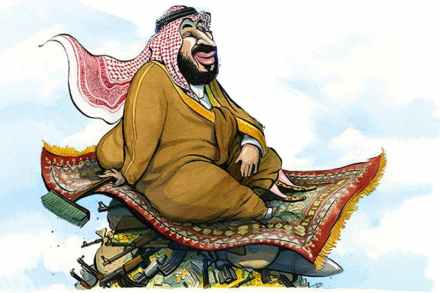
Is Saudi Arabia shunning Washington? Mohammed bin Salman has reportedly been refusing to phone Joe Biden, who wants the kingdom to turn on its oil taps as the West desperately seeks alternatives to the Russian energy market.  Riyadh – the world’s largest oil exporter – has so far failed to accommodate Washington’s pleas. Ahead of the Russian invasion in mid-February, the US asked the Opec+ cartel – of which Saudi Arabia is the most important member – to produce more oil to slow the already rising prices. Opec+ stood firm, and said they would increase production by 400,000 barrels a day in April, a rise agreed before the threat of a Russian invasion of Ukraine.

Why the silence over Biden’s links with Ukraine?

From our UK edition

‘He has been wrong on nearly every major foreign policy and national security issue over the past four decades.’ So once said Robert Gates, the former US defence secretary, of the now president Joe Biden. We don’t yet know if Biden is wrong about the current Ukraine crisis. We may be about to find out. His speech on Tuesday was at least competent, if not entirely coherent. ‘Who in the Lord’s name does Putin think gives him the right to declare new so-called ‘countries’ on territory that belongs to his neighbours?’ asked the president, in one of his now all-too-familiarly infirm attempts to sound firm.

Putin must look at the West and laugh

From our UK edition

Whatever the West’s response to Russia’s attack on Ukraine’s sovereignty, the crisis demonstrates the limitations of western politics and policy across the board. If Vladimir Putin understands any demographic better than the Russian people, it is the governing class of the West: that Harvard-Oxbridge-Sciences Po axis of toweringly smug and practically interchangeable global-liberals who weep for international norms they weren’t prepared to defend. Their ideas and their sanctions are tired because they are civilisationally tired. Putin knows this, but none of the rival ideologies aiming to replace liberalism have anything better to offer.

Biden spent billions messing up rapid test distribution

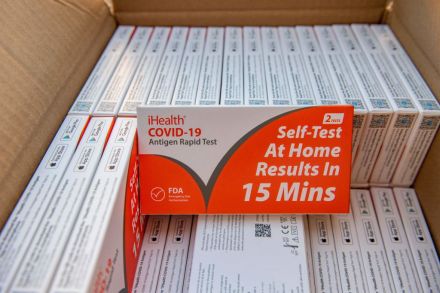
What happens when a government thinks it can distribute a consumer product more efficiently than normal retail channels? Boondoggle and failure come to mind. Two months ago, President Biden announced plans to buy 500 million at-home Covid test kits and mail them to anyone who wanted one. The Department of Defense put in orders for $1.275 billion of tests from iHealth, $340 million from Roche and $306 million from Abbott. How many tests those eye-popping figures bought from each company has never been disclosed, but Abbott, the largest test manufacturer, has a reported production capacity of 50 to 70 million tests. It is safe to assume that the quantities involved commanded an enormous portion of total manufacturing capacity.

at-home testing

Can the India-US relationship last?

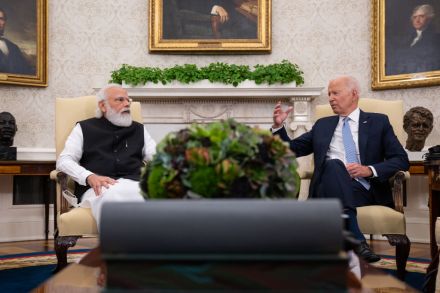
India and the United States have rediscovered each other after the cordial hostility of the Cold War. Those years of isolation have made India’s political and financial elites susceptible to flattery. America’s courtship of India, lubricated by the economics of globalization and the post-9/11 zeal to spread democracy, is now being consummated in the American search for a democratic counterweight to China. But India is a chaotic democracy in a volatile neighborhood. Can it hitch itself to America without forfeiting its autonomy? Foreign strategic experts exhort India, which is non-interventionist to its marrow, to act like a global power.

india

How western journalists became Putin propagandists

From our UK edition

Why does Vladimir Putin need Russia Today and Sputnik News when the western media are doing such a great job on his behalf? Throughout his two decades in power, Putin has yearned for international respect. Failing that, he’ll settle for fear. And what more satisfying outcome could there be for a serial sabre-rattler like Putin to have his bluff finally taken seriously? For weeks, British papers and TV have been filled with images of scary Russian tanks, warships and artillery blasting away — mostly provided, if you check the photo credits, by Russia’s Ministry of Defence. Since November, the US and British governments have been issuing increasingly strident warnings that Putin is preparing an imminent and massive attack on Ukraine.

The Ukraine crisis has united the West

From our UK edition

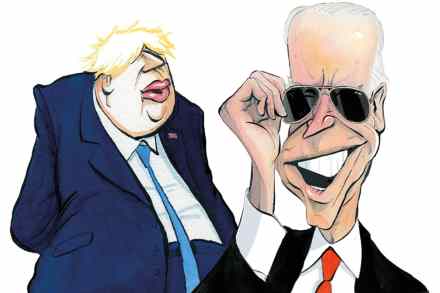
There has been a subtle change of tone from Joe Biden and Boris Johnson about the likelihood of a Russian invasion of Ukraine. It has gone from 'highly likely' to 'there may be a diplomatic solution' — or from 'almost all hope lost' to 'chink of hope'. So from where does that hope emanate? Largely, I am told, from noises out of Ukraine that its government is moving towards a public statement that although it retains the right to join the Nato western defence alliance, it will commit to not consider applying for at least ten years. The US president and UK prime minister are keen to encourage, through diplomatic channels, such a statement from Ukraine’s President Volodymyr Zelensky.

What really happens if Russia invades Ukraine?

From our UK edition

Russia will pay an enormous price if it invades Ukraine, whether it goes for the whole country or only the eastern region around Donbas. Vladimir Putin has already assembled well over 100,000 troops near Ukraine’s borders, moved in tanks, heavy artillery and aircraft, and brought in the medics and blood supplies needed to deal with casualties. Western governments have evacuated all but essential diplomatic personnel and told their citizens to get out now. Still, no one knows what Putin has decided, or even if he has decided. Visits to Moscow by senior western politicians have yielded little information and no diplomatic solution. The message seems to be that Putin remains uninterested in a compromise.

Biden’s food policies have nothing to do with hunger

No one starves in America. The public schools feed poor children breakfast, lunch and occasionally dinner. Church food banks, private charities and municipal programs are everywhere. Eating soundly is not always exciting, crunchy, convenient or microwave-ready, but getting adequate calories is not the nation’s problem. Buying clean, washed lettuce, firm potatoes or a sweet pineapple during a February snowstorm is a small industrial miracle. In 1900 Americans spent about 40 percent of their income on food, and today about 10 percent. The standard claim that 20 million adults live in households that do not get enough to eat rings false. Americans are the people of plenty and commodities surpluses. They have low-cost, safe, tasty food galore.

Are Kamala Harris’s days as Veep numbered?

From our UK edition

President Joe Biden promised last week to nominate the first black woman to the Supreme Court. ‘Long overdue,’ he says. When it comes to elevating African-American females to high office, Biden has form. He chose Kamala Harris, remember, to be the first woman US Vice President of colour. But what if Biden elected to choose the same woman — namely, Vice President Kamala Harris — for the Supreme Court? Wouldn’t that be so unimaginative and tokenistic, as to be quite racist? Even a leader as error-prone as Biden wouldn’t do that, would he?

The sleepwalkers

It is customary for presidencies to lose vitality and purpose in their last months. It is unprecedented for a presidency to lose its way in its first year, and when it still holds a majority in both houses of Congress. The Biden presidency has donned Jimmy Carter’s cardigan of shame in only nine months. If, that is, it ever was the Biden presidency. It was sold from the get-go as the ‘Biden-Harris presidency’. Double-barreled names are an inveterate mark of snobbery, and in this case the snobbery is that of the higher tokenism. Even the Democrats’ own members didn’t want Harris on the card in 2020. Harris’s symbolic merits as a woman of color seem to have been outweighed by her blatant falsity and opportunism.

biden
liberalism

Welcome to the age of entropy

Americans and other westerners have long been accustomed to thinking that history has a clear direction. Sometimes the direction is contested, as it was during the Cold War. The future could have been capitalist or communist, or perhaps a blend of both systems — ‘convergence’ was a trendy notion for a time — but one way or another the alternatives were clear. After the Cold War, there were no alternatives. Capitalism, democracy and liberalism were here to stay, and soon they would be everywhere else too. All the Islamic world needed if it was to join us at the end of history was a nudge: regime change would speedily bring about social and economic change.