Bbc

The end of the road for Newsnight?

Oddly enough, re the latest Newsnight/BBC debacle, Esther Rantzen got it right. She was talking on Newsnight. She made the point that her old programme That’s Life regularly did investigative stuff, but that there was always a lawyer involved, all the way along, right from the off. Absolutely. I did the same thing at the Today programme – when both Andrew Gilligan and Angus Stickler were on my books and we did an investigative piece at least once a week. No question: the reporter would be told what he needed to get to stand the story up at the commissioning point. There would usually be a lawyer in then. Then we’d regroup half way through the piece and review what else was needed for the piece to stand up to scrutiny.

US election 2012: the broadcast election

One product of the modern communications age is that we can all follow what US outlets and Twitter are saying while watching the BBC coverage’s of the US elections. This creates a whole host of challenges for the Beeb. Back in the day, few would have noticed that there was a gap between the US networks calling the key state of Ohio for Obama and the BBC catching up. But this time, it stuck out like a poor thumb. The other great challenge for any international broadcaster is the sheer quality of the coverage on US television. One can chuckle at NBC and their political editor having a ‘Command Centre’. But their understanding of the key swing counties in each state is unrivalled.

The politics of poppies

The politics of poppy-wearing shift slightly each year. The unofficial rule used to be that poppy-wearing began at the start of November. In recent years this has crept forward further and further into October, largely, I think, because of politicians and the BBC. The BBC lives in terror of someone appearing on one of its programmes without a poppy and thus sparking a round of ‘BBC presenter in poppy snub’ stories in the papers. If you appear on the BBC during this period you will find people on hand to pin a poppy on anyone not already sporting one. To my mind this slightly misses the charitable, not to mention voluntary, purpose of the exercise. But politicians have also fuelled this poppy mission-creep. Each year they begin to wear their poppies earlier.

Chasing Jimmy Savile’s chums

And still it goes on and on. Apparently Jimmy Savile was banned from Children In Need because it was thought he was a bit creepy. Did he try to touch up Pudsey, or something? I think we are getting ourselves into a self-righteous frenzy here. Savile was unspeakably ghastly. He was unspeakably ghastly before these latest allegations and he’s – probably, almost certainly – even worse now. But are we really going to exact revenge on pop stars who may have fondled a fourteen year old girl forty years ago? Were there any of those glam rock stars – Gilbert O’Sullivan excepted – who didn’t fondle fourteen year old girls? How many of the girls, at the time, were discomfited by this?

The View from 22 — BBC in crisis, a Major problem for the Conservatives and Lost in Europe

What is going to happen next with the BBC Jimmy Salvile saga? In this week’s magazine cover, Rod Liddle blames institutional problems within the organisation and predicts there will be plenty of buck-passing to come. Fraser Nelson says in this week’s View from 22 podcast that although he sympathises with the decision the BBC took, he believes there are more scalps to come: ‘As an editor myself, I know that if you are to come up with a story that makes an explosive allegation it has got to be absolutely nuclear-proof nowadays and if it’s not, if there is a slightest bit of chink in your armour, it could sink the whole publication or programme. ‘…I think we are going to end up with a great long list of resignations — a domino chain.

The Beeb’s self-inflicted wound

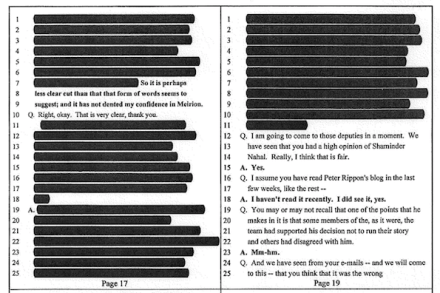
And so the Savile stuff rumbles on with George Entwistle’s singularly unimpressive performance before the House of Commons Culture, Media and Sport Committee. It still seems to me that the bosses are being evasive over the issue of pressure applied, or otherwise, to the Newsnight editor Peter Rippon. Someone is hiding something, I think. But this whole catastrophe need not have occurred. There is no great crime in a senior manager quizzing a programme editor about a controversial investigation. There is no crime at all in a programme editor deciding not to run a story because he has doubts about it.

George Entwistle’s quietly savage attack on Newsnight editor Peter Rippon

George Entwistle seemed rather mild-mannered at his first appearance before the Culture, Media and Sport select committee this morning. But after listening to him for two hours, MPs were starting to suggest that the BBC director general was making a quietly savage attack on one of his juniors. It will be astonishing if, after Entwistle's evidence, Newsnight editor Peter Rippon is not called before the committee. Entwistle told the committee that he had asked Rippon to 'step aside because of my disappointment at the inaccuracies in the blog… he hasn't stepped aside to prepare or the Pollard review, he's stepped aside because of it'.

Five questions for George Entwistle about Jimmy Savile

George Entwistle is appearing before a select committee for the first time this morning. It won't be a gentle start for the new BBC Director General, though. He is giving evidence to the Culture, Media and Sport committee from 10.30 on the Jimmy Savile scandal, and will face a slew of awkward questions from MPs. Here are five of the most pressing: 1. Why did he hold such a brief conversation about the implications of the Newsnight investigation for the rest of the BBC's output? Entwistle held a conversation with Helen Boaden last December in which she warned that the report would impact on the BBC's tribute to Savile. He will be grilled on the content of that conversation: particularly whether he asked for more details on the allegations themselves.

The BBC regains its honour

I hope that the entire editorial staffs of the Times, Sunday Times, Sun, Mail, Mail on Sunday, Telegraph and Sunday Telegraph (oh and the Express newspapers if they are still around) along with Alastair Campbell, the Parliamentary Conservative Party and Rupert Murdoch are going to be gracious enough to praise the BBC today. How many other institutions would allow junior staff to carry out a forensic examination of an internal scandal and broadcast it to the world? How many others would allow employees to expose a manager who made a self-serving decision? If you think you could do what Panorama did last night in any other media organisation, ask yourself, where were the journalists in the press warning their employers of the dangers of phone hacking?

The BBC can’t fix it like this

The BBC management cannot have it both ways. They cannot simultaneously insist that the decision to drop the Newsnight investigation into Jimmy Savile was made by the editor of the programme, Peter Rippon, and Peter Rippon alone without pressure from above – and then announce that Peter Rippon’s blog which explained why he had made that decision was inaccurate and misleading. This is the first point upon which the DG, George Entwistle, should be questioned when he comes before the Commons Culture, Media and Sport committee. The second is his puzzling lack of interest when told Newsnight would be investigating Savile – at a time when his Christmas schedules were chock full of Savile tribute programmes.

Preposterously, the BBC has taken my advice

I may sue for plagiarism. In my failed bid to become Director General of the BBC I suggested that the corporation should henceforth cover no news stories, nor commission any drama or comedy and instead simply occupy itself by debating, in public, its manifest incompetencies. I thought that this would be an entertaining and cheap way of filling up air time. Annoyingly, for me, this is exactly what the BBC is now doing. Friday’s edition of Newsnight debated at great length the culpability of the editor of Newsnight in scrapping a documentary about Jimmy Savile.

Iraq and the BBC revisited

Just finished reading a book by Kevin Marsh, the editor of the Today programme at the time of the whole Gilligan-Campbell-Kelly business which saw the director general of the BBC kicked out of the corporation. It hasn’t aroused very much interest, largely because it contains no new information which would either exonerate the programme or the government. And because stylistically it is not an untrammelled pleasure. I think Stephen Robinson, in the Sunday Times, got it about right: “It takes a particular type of journalistic incompetence to cede the moral high ground on the Iraq war to Alastair Campbell and Tony Blair, but this book…….

Citizen Khan says absolutely nothing new

I took the opportunity yesterday to catch up with the BBC’s new comedy ‘Citizen Khan’. Focusing on a Muslim family based in my hometown of Birmingham, it lampoons the trials and tribulations of the self-appointed, self-important, and self-obsessed Mr Khan. Anyone with even a cursory knowledge of British Muslim communities will recognise the basic truths on which the programme’s characters are premised. Alia, daughter of the eponymous hero, seems to have provoked the most controversy. Alia is a shrewd young girl, doting before her parents but defiant behind their backs. There are complaints she portrays a disrespectful daughter, affronting not just her myopic parents but also a stylised vision of ‘British Islam’.

Jeremy Vine’s survival guide

I first knew Jeremy Vine as a very young, charming, earnest and totally driven political correspondent for the BBC in the 1980s. So when I started reading It's All News to Me, I was dreading a rather worthy read. I was delightfully disappointed. This is a wonderful bitchfest of not quite malicious gossip and the power struggles at the BBC. In politics it is dog eat dog. At the beeb it is the other way round. Any aspiring broadcaster should use this book as a survival manual. There are some wonderful quotes. From former political editor Robin Oakley: ‘The people at the top of the BBC don't have very much power, so when they act, it tends to be very violent.’ The legendary John Sergeant has some crackers.

The Hamlet of the trenches: Parade’s End reviewed

Ford Madox Ford’s Parade’s End is being republished as well as adapted for the screen by the BBC.  I first discovered the tetralogy when, in an attempt to improve my chances, I asked my future mother-in-law for a list of must-read novels.  Parade’s End and The Good Soldier featured near the top of the list. The Good Soldier is Ford’s most remembered work and at one time he considered it his first and last novel.  In his memoirs, Return to Yesterday, he recalls that on the 28th of June 1914, ‘there was to be no more writing for me—not even any dabbling in literary affairs.’  But then there was the war and he found himself in the Welsh Regiment, at forty-one years of age, living through what he termed ‘Armageddon.

The skewed priorities of the BBC’s abortion investigation story

Did anyone else notice anything weird about the BBC’s coverage of the story last week about the 14 NHS trusts that a government health watchdog found to be breaking the law in providing abortions? Those 14 clinics used pre-signed abortion referral forms to authorise abortions, which flouts the bit in the Abortion Act that requires two doctors to allow them. But for the BBC, as, inevitably, for The Guardian, the real scandal about the investigation was that it took place at all, at a cost of £1 million and with the result that the watchdog, the Care Quality Commission, the CQC, had to delay or cancel pre-planned investigations in order to carry out this one. And how do we know that? Why, as a result of a BBC Freedom of Information Request.

My advice to the BBC’s new DG

The job of George Entwistle, the new Director General of the BBC, will be to manage a gentle decline, rather than hurtling with great enthusiasm towards a state of inexistence. A very ticklish balance needs to be maintained on the issue of the BBC’s moral cross subsidisation – that is, the extent to which the corporation justifies its &"special” existence by doing intelligent and worthy programming which nobody else does and which pulls in few viewers, and the extent to which it justifies its mass appeal by broadcasting cretinous pap which every other broadcaster can do and which drags in lots of viewers. Good luck with that one.

Transcript: IDS on Today

Iain Duncan Smith appeared on the Today programme this morning. In a heated interview with Evan Davis, the work and pensions secretary was interrogated about David Cameron’s radical welfare proposals. Conversation ranged from cutting rental payments for under-25s to protecting non-means tested pensioner benefits. The bulk of the exchange was devoted to discussing Cameron’s intentions, as he seeks to make welfare reform a central part of the 2015 election. Here is a transcript of those passages: Evan Davis: Okay, I’m going to quote a couple of things that you wrote in your green paper. ‘Successive governments have made well-intentioned but piecemeal reforms to the system.

A final word on the BBC’s Jubilee

A very lively and enjoyable Any Questions last night from the beautiful town of Aldborough in North Yorkshire. The question which seemed to bring out perhaps the most passion from an already very passionate audience concerned the BBC’s coverage of the Jubilee celebrations. I didn’t envy Jonathan Dimbleby having to chair that one. No least because the question included a reference to his own reported criticism of the BBC’s coverage. I mentioned that I had simply turned over to Sky and others on the panel went on to attack the BBC’s management. But there are two points which I didn’t get a chance to air last night which I thought I might note here: one ‘for’ the BBC and one ‘against’.

Tune in tonight

I thought Spectator readers may like to know that I will be one of the panellists on BBC Radio 4's 'Any Questions' tonight at 20.00. The programme is coming from Aldborough, North Yorkshire and my fellow panellists are Alan Johnson (Labour), David Davis (Conservative) and Salma Yaqoob (Respect).