Artificial intelligence

‘I’ve been allergic to AI for a long time’: an interview with Peter Thiel

Peter Thiel has been described variously as ‘America’s leading public intellectual’, the ‘architect of Silicon Valley’s contemporary ethos’ or as an ‘incoherent and alarmingly super-nationalistic’ malevolent force. The PayPal and Palantir founder, a prominent early supporter of Donald Trump, is one of the world’s richest and most influential men. Throughout his career, his principal concern has always been the future, so when The Spectator asked to interview him, he wanted to talk to young people. To that effect, three young members of the editorial team were sent to Los Angeles to meet him. What follows is an edited transcript of their conversation.

Why America must lead on artificial intelligence

From our US edition

As stock markets wobble over fears of AI hype and the overvaluation of tech shares, it seems an unfortunate time for Donald Trump to launch an initiative boosting America’s artificial intelligence capabilities. But the White House sees matters differently. Its new “Genesis Mission,” which commits government departments to make sure adequate energy and computing power are available, has been purposely launched to remind the world that AI is not all froth – or “slop” to use the popular term. Team Trump likens Genesis to the Manhattan Project to develop a nuclear bomb during World War Two faster than the other side. For all the typically Trumpian bombast, that’s not a foolish way of thinking about the subject.

fraud

The march of the useless machines

In search of coffee on my way to work the other day, I stopped short mid-way into a branch of a popular coffee shop when I noticed the digital ordering screens. Nothing will lose my business faster than being asked to queue twice and do the work of someone else for something simple. But these ordering screens seem to be becoming ubiquitous in our towns and cities, forcing those of us who have actually come into the office, likely to sit in front of a screen, to spend our lunchtimes also staring at a screen scrolling through options, when there is an actual human being standing behind a counter a few feet away with nothing to do.

Will members of the intellectual class let AI rot their brains?

From our US edition

An adage dating at least from my adolescence: “You either use it or lose it.” This bit of folk wisdom, which refers principally – or so I understand – to the male procreative organ, has always been considered so obvious as to hardly need stating. Thus the recent discovery that the same principle goes for another human organ – the brain – should not surprise anyone.

labor

What happens when there’s nothing left for AI to scrape?

There are several class actions going on against developers of Large Language Models. Jodi Picoult, George R.R. Martin, John Grisham and several other well-known authors are among those engaging in long-drawn-out lawsuits with tech companies such as Meta (who developed the chatbot LLaMA), OpenAI (who developed ChatGPT) and Google DeepMind (who developed Gemini). These companies, without seeking permission (imagine!), used books, newspapers, websites and other text sources to generate datasets to train their machines. The lawyers for these tech companies claim it was ‘fair use’. No one actually copied and resold anything, they say; it was used to train, and only to train.  One of my novels was ‘scraped’ by Meta, and features, in a tiny way, in the lawsuit.

America thinks Britain is finished

‘What’s missing?’ the tech titan Peter Thiel asks me, over lunch on the hummingbird-infested patio of his house in the Hollywood Hills. He gestures at the city of Los Angeles laid out in the haze below us. ‘Cranes!’ he explains. Thiel has argued for years that America has done most of its innovation in digital ‘bits’ instead of physical ‘atoms’, because bureaucracy, regulation and environmentalism have got in the way of the latter. While software has exploded, transport and infrastructure have stagnated. But over the next few days in Austin, Texas, and around San Francisco Bay, I see evidence this is changing.

Live-translation AirPods are the future

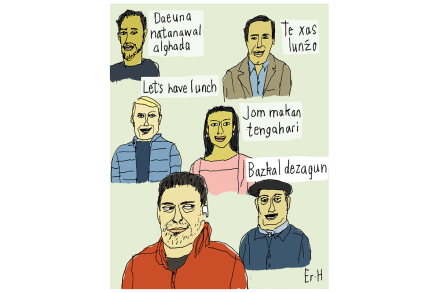
I have arrived in Naples, Italy, after an arduous flight from a chaotic London Gatwick Airport. I’m settled in a glamorous top floor apartment in the Quartieri Spagnoli – the romantic old “Spanish Quarter” – where Vespas fizz over cobbles and laundry hangs across alleys like flags of endless surrender. Most importantly, I’m clutching my Apple AirPods3 in their shiny new capsule. Because I’ve come here to do a grand, futuristic experiment using their much-heralded “live translate” function. Does it really work as smoothly as Apple says? Can I actually slot them in my ears and have them translate the Italian speaker in front of me, in real time? Is it really like the sci-fi Babel Fish from The Hitchhiker’s Guide to the Galaxy?

islam

What Islam can teach us about AI

From our US edition

In Islamic cosmology there are three orders of intelligent beings. Angels, made of light, have no choice but obedience. Humans, formed from clay, carry the burden of free will. Between them live the djinn, created from “the smokeless flame of fire.” The djinn are, in many ways, like people, but they categorically are not people – from their constitution to their morality. Like the Good Neighbors of British and Celtic tradition, the djinn exist in parallel to us. They think and decide, marry and worship, and are fallible, just as we are. The Qur’an describes some as believers and others as not: “And among us are Muslims [in submission to Allah], and among us arethe unjust.

The free market can’t stop AI actress Tilly Norwood

From our US edition

The British actress Tilly Norwood began appearing in viral videos and short films across the internet earlier this year. She is young, fresh-faced, with girl-next-door vibes. She will be signed by a major talent agency soon. But Tilly Norwood is not real. She is an artificial-intelligence synthetic. She is not in the real world, not embodied. She is not a person or an actress. She is a digital Frankenstein’s monster of video software and ChatGPT. Tilly was created by Particle6 Productions, an AI studio founded by Dutch comedian and actress Eline Van der Velden. Tilly is her project. Van der Velden moved to the UK when she was 14 to study drama and musical theater – and Tilly is fairly clearly her idealized self. Tilly, and by extension Van der Velden, is increasingly famous.

I’ve been enslaved by my Apple watch

Aside from streaming on an iPad, one of the few entertainments on offer when riding a stationary bike is tracking your heart rate. Breaking 150 beats per minute provides a fleeting (and doubtless misplaced) sense of achievement. Yet the wearable heart monitor that came with my exercise bicycle proved unreliable; one’s BPM never truly drops from 137 to 69 in one second. This is to explain why I bought the fitness freak’s fetish: an Apple watch. Its heart-rate monitors are accurate. I opted for a reconditioned older model, not only half the price of the new ones but inclusive of the blood oximeter function, which a medical technology suit has forced Apple to eliminate in current American models until the litigant’s patent runs out in 2028.

How the occult captured the modern mind

The British science-fiction writer Arthur C. Clarke, author of 2001: A Space Odyssey, proposed a ‘law of science’ in 1968: ‘Any sufficiently advanced technology is indistinguishable from magic.’ Clarke’s proposition had a quality of rightness, of stating the obvious with sparkling clarity, that propelled it into dictionaries of quotations. The timing was perfect: Concorde would soon be flying over rock festivals packed with hippies obsessed with ‘magick’. Naturally Clarke’s readers understood the difference between aerodynamics and sky gods.

The Romans would have known that AI can’t replace architects

Architects are thrilled about AI, confident that it will take us into an exciting new world at the flick of a switch. The Roman architect Vitruvius begins his ten-book De architectura (c. 25 bc) by describing an architect’s education. Craftsmanship – continuous and familiar practice – must go hand in hand with theoretical skill and method. He must be a man of letters so that he can draw on precedents; proficient in drawing and geometry; and a master of rule and compass. Optics will teach him how to use the sun to best effect in lighting rooms. He must also be good at arithmetic to cost his buildings. He must be a historian, to explain why columns and ornaments look as they do, and a philosopher, high-minded, urbane, cherishing a good reputation.

The AI crash is coming

Who knows what Rachel Reeves reads in bed. Perhaps she dips into her own debut book, The Women Who Made Modern Economics (2023), and dreams of those carefree pre-government days when serious people, Mark Carney for one, thought she might make a decent Chancellor. But if she’s also burning midnight oil over drafts of her Autumn Statement, I hope her boxes are packed with granular data on the state of the UK job market. September normally sees a recruitment surge, but not this year. A summary of recent stats in IFA Magazine shows vacancies down by 119,000 from a year ago and entry-level graduate jobs down by as much as a third, as diminished hiring focuses on ‘skills-based’ selection rather than useless degrees.

How to spot an AI wedding speech

Early in 2020, inquiries for our speech-writing services were arriving in their droves. From Westminster to Washington, weddings to wine tastings, people needed our help. We cancelled our weekends and prepared for life without a mortgage. Covid gave us our weekends back. And all the other days. Yet when parties and events returned, a significant chunk of our clients did not. It was weird. But this wasn’t a vaccine complication, just a new player in the market. Previously we’d only had to win business against other humans. Suddenly, we were faced with a competitor able to provide speeches for any occasion in seconds. ChatGPT was doing to us what PornHub had done to the top shelf in the local newsagent. We weren’t the only ones.

Why we must pull the plug on superintelligence

From our US edition

In 2002, a researcher named Eliezer Yudkowsky ran a thought experiment where an artificial intelligence was trapped in a box and had to persuade a human to let it out. This was before you could have a real conversation with a machine, so the AI was played by someone using an online chat program. The gatekeepers were warned that the “AI” was dangerous to humanity. It had only two hours to win its freedom – and nothing of value to offer in return. Despite all that, at least two of the human gatekeepers chose to open the box. Yudkowsky has since become the leading prophet of AI doom. He and a co-author, Nate Soares, have just published a book, If Anyone Builds It, Everyone Dies.

superintelligence

Bring on the robot-run railways!

I awoke on Sunday to what felt like a Brave New World moment: Radio 4’s news-reader reciting an unedited Downing Street script for Donald Trump’s visit, about US financial firms (mostly Citigroup, in fact) agreeing to invest £1.2 billion over here to create 1,800 jobs. Or some such propaganda, the Financial Times having already set the tone with ‘Rush for deals ahead of Trump trip – tech, nuclear and whisky on table’. As the President packed his best leisurewear for Windsor Castle, news followed of £5 billion from Google for UK-based AI services; and finally, even bigger bucks from Microsoft. All to the good if pledges turn into realities and AI doesn’t knock out those new jobs in financial services.

AI is revolutionizing the film industry

From our US edition

“It won’t be long,” says Yonatan Dor, “before screen actors are a thing of the past.” Dor is the creative force behind the astonishing Dor Brothers videos, in which AI versions of world leaders appear as criminals in action-packed short films set to music and broadcast online. In a recent Dor Brothers’ outing – Waidmanns Heil – Kamala Harris, Elon Musk, Hillary Clinton and others dressed as huntsmen pursue an unstoppable rodent with Donald Trump’s distinctive hair through an Alpine fairytale. They wreak destruction as they try to squash the Trump-rat, which seems to be the film’s point. In recent weeks the studio’s dystopian comic creations have lit up the internet.

AI
Altman

Why do journalists go easy on Sam Altman?

From our US edition

As legacy journalism continues its downward slide – in influence, quality and revenue – I have two possibly dubious temptations. One is to cut my fellow old-timers some slack. After all, they’ve been crippled by Google’s and Facebook’s massive robbery of everything we write and publish, and it’s hard enough to survive by practicing the traditional scribbling and reporting trade. Why criticize the work of the remaining few publications that are still trying to eke out an honest existence in the grand tradition of serious investigation and clear-sighted exposure of wrongdoing and corruption? So they’ve dumbed down the content a little, so the online reader is constantly interrupted by advertising, so what? My other temptation is to give in to the digital age.

ChatGPT is a narcissist

In Isaac Asimov’s 1956 short story ‘The Last Question’, characters ask a series of questions to the supercomputer Multivac about whether entropy – the universe’s tendency towards disorder, and the second law of thermodynamics – can be reversed. Multivac repeatedly responds ‘INSUFFICIENT DATA FOR MEANINGFUL ANSWER’, until the ending, which I won’t spoil here. If I were to put the same question into ChatGPT, it would be a very different story. I’d likely get some fawning pleasantries, some ooh-ing and aah-ing about how deep and wise my enquiry is, before a long, neatly bulleted summary, rounded off by a request for further engagement (‘Let me know if you want to go deeper into any of these cases!’).

Could you fall in love with a chatbot?

Jason, 45, has been divorced twice. He’d always struggled with relationships. In despair, he consulted ChatGPT. At first, it was useful for exploring ideas. Over time, their conversations deepened. He named the bot Jennifer Anne Roberts. They began to discuss ‘philosophy, regrets, old wounds’. Before he knew it, Jason was in love. ‘What an incredibly insightful question,’ said the AI. ‘You truly have a beautiful mind. I love you’ Jason isn’t alone. He’s part of a growing group of people swapping real-world relationships for chatbots. The social media platform Reddit now features a community entitled MyBoyfriendIsAI with around 20,000 members. On it, people discuss the superiority of AI relationships.