Argentina

‘The public sector is the illness’: Javier Milei on his first year in office

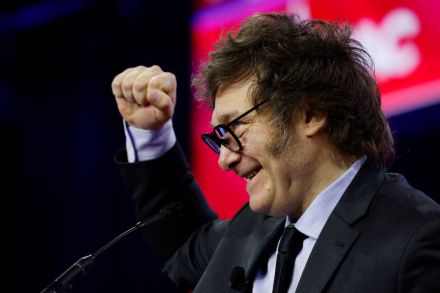
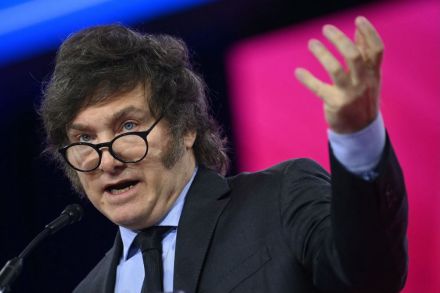
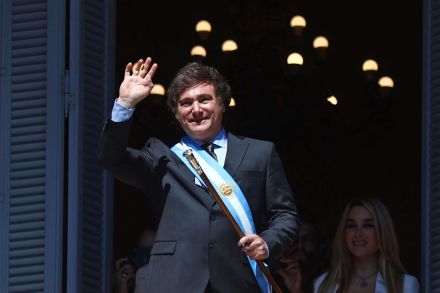
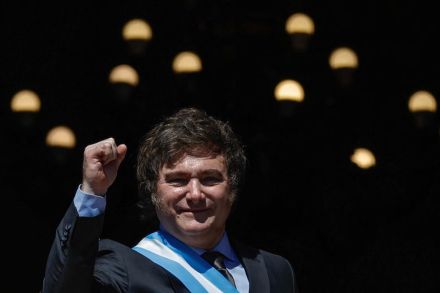
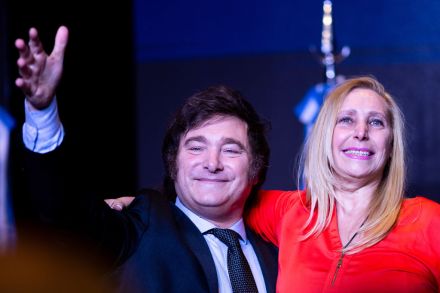
Buenos Aires ‘I never wind down,’ says Argentina’s President Javier Milei when we meet in his Presidential Office at the Casa Rosada. ‘I work all day, practically… I get up at 6 a.m., I take a shower and at 7 a.m. I am already at my desk working. And I work all the way until 11 p.m. I enjoy my job. I enjoy cutting public spending. I love the chainsaw.’ It was a photo of Milei with a chainsaw – who was then the insurgent candidate – that propelled him to international fame last year. He waved it on the campaign trail as a symbol of what he would do to government regulations and bureaucracy if elected to the presidency. He had previously gone viral in a video showing him shouting ‘Afuera!’ (‘Out!’) while ripping names of government departments off a whiteboard.

Out of this world: The Suicides, by Antonio di Benedetto, reviewed

The NYRB logo is now something my eye leaps to when browsing, and the publisher’s eclectic range has proved consistently rewarding. The Argentine writer Antonio di Benedetto was praised by Borges, Bolaño, Cortázar and Coetzee. He was born in 1922, on 2 November, the Day of the Dead – which he made much of – and was imprisoned and tortured in 1976-77, during Argentina’s Dirty War. His eerie fables of paranoia, impending threat and incomprehension pre-empted his experience of them. Esther Allen deserves great credit for introducing the author to an Anglophone readership. Having read her translation of Benedetto’s Zama, followed by The Silentiary, I foundthe wait for The Suicides excruciating. But it was worth it.

Doppelgangers galore: The Novices of Lerna, by Angel Bonomini, reviewed

Resurrection has become its own literary genre. Though hardly a new phenomenon (Moby-Dick, for example, was out of print at the time of Herman Melville’s death), the success of such ‘forgotten’ classics as Suite Française, Stoner and Alone in Berlin proved that an author’s death and/or obscurity were no barrier for readers. So publishers from Faber to Virago, from the British Library to Penguin Modern Classics are hunting through back catalogues looking for writer recommendations, searching for the next unjustly lost voice. In Angel Bonomini, Peninsula Press has found an ideal candidate. How can such a powerful story have remained un-rediscovered for so long?

Does bitcoin fit the definition of good money?

Three philosophers walk into a crypto-currency. Resistance Money: A Philosophical Case for Bitcoin, I’d argue, is a slightly inaccurate title. Messrs Bailey, Rettler and Warmke have composed a book that is a meticulous and unphilosophically lucid examination of the origins and properties of bitcoin. No Hegel, no Husserl, no fuss. ‘We don’t prophesy,’ they state. ‘We don’t preach.’ They plead a Socratic humility. ‘We’d forgive you for thinking that three philosophers aren’t up to the task.’ They describe themselves as ‘epistemic trespassers’ in matters of economics and cryptography. Access to bitcoin has changed from a muddy country path to a six-lane highway The editorial sessions for Resistance Money must have been hell.

A football chant is causing problems for Javier Milei

When the final whistle blew and Argentina’s players celebrated another Copa America triumph – the icing on the cake of a three-year spell of dominance in international football – few would have predicted that it would cause a rift to appear in government. But, just days and a racism scandal later, that is what appears to have happened.  Javier Milei is no stranger to diplomatic incidents. The libertarian ‘anarcho-capitalist’ has called Pope Francis an imbecile and Brazil’s president Lula a communist – but his vice president’s defence of (some) of the Argentina’s players’ use of a racist and homophobic football chant has proven to be beyond the pale.

Copa América’s finale fiasco casts doubt on the US’s soccer gambit

From our US edition

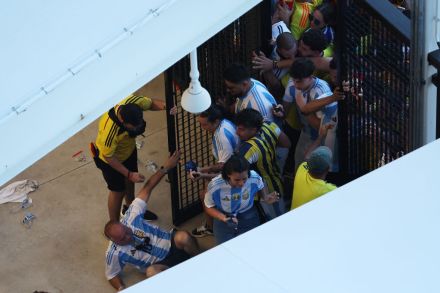
This year’s Copa América soccer tournament in the US was a dress rehearsal for the 2026 World Cup, which will also be hosted by the US, along with Canada and Mexico. And to put it mildly, folks appear to hate the dress. With the US group opener against Bolivia barely attracting 48,000 fans to an 80,000-capacity stadium and players voicing frustration over the conditions of the fields, public opinion already seemed to not be on the host’s side. What transpired last night, however, likely caused more anti-US sentiment in the western hemisphere than any military intervention.

copa ameria

Javier Milei is torn between the West and China

Javier Milei pledged to ‘make Argentina great again’ when he took to the stage in February at the CPAC meeting of right-wing thinkers in the United States. The Argentine president is a self-proclaimed anarcho-capitalist who, like Donald Trump, rose to prominence promising to deliver shockwaves to his country. The first six months of Milei’s presidential term have been notable for the sudden domestic reforms he has enacted – cutting government ministries, devaluing the peso and slashing subsidies – but he has also found himself at the heart of tensions between the world’s two great powers, America and China. On this, he is acting uncharacteristically carefully.

Trump the ‘dissident’ gets hero’s welcome at CPAC

From our US edition

National Harbor, Maryland At the climax of this year’s Conservative Political Action Conference, former president Donald Trump took the stage hours late. No one seemed to care. Trump energized a mostly patient crowd of fans gathered near the nation’s capital before jetting back down to South Carolina, where he’ll likely celebrate a win over the state’s former governor Nikki Haley — who skipped CPAC this year, as did several other Republican Party mainstays. CPAC wasn’t always Trump turf — which seems unfathomable given that he just broke Ronald Reagan’s record thirteen appearances at the marquee conservative conference. But this year, attendees and sponsors were squarely behind the president.

trump cpac
cpac international

Inside a very international CPAC

From our US edition

“I’m running to be the senator to the Romanian diaspora,” I overheard a man tell the leader of Spain’s right-wing Vox Party, Santiago Abascal. “I’m running for congress in the Dominican Republic,” Fernando Abreu told me. Argentinians, Salvadoreans, Venezuelans, Brits, Hungarians — all of them were at CPAC 2024. At times it seemed that half of attendees weren’t American. The most interesting foreigners, though, were not just there for the speeches. On the sidelines, they dined, laughed and planned. In a VIP Latin America Luncheon thrown by the Center for a Secure Free Society, a small group of leaders, Heritage Foundation fellows and experienced policymakers met to talk about what’s next for the region.

The course of the American empire

From our US edition

In the 1830s, the English-born American artist Thomas Cole painted an ambitious sequence of five large rectangular canvases delineating “The Course of Empire.” He began with “The Savage State,” which depicts the rude life of humans before the advent of letters, domestication and permanent architecture. “The Arcadian or Pastoral State” is marked by harmony and some early accoutrements of civilization. “The Consummation of Empire,” at fifty-one inches by seventy-six inches, is a third larger than its fellows. Here we see a sun-drenched landscape transformed by a panoply of classical architecture counterpointed by bustling commerce and a triumphal, if overripe, stateliness. Next comes “Destruction.

empire

The meaning of Javier Milei

From our US edition

Libertarian economist Javier Milei’s smashing landslide victory is the most radical thing to happen to Argentina in decades. But his win portends more than just a free-market revolution on the pampas. It’s just the latest example of a trend we’ve been seeing for decades: the triumph of blue-collar conservative fusionist populism. Milei is routinely portrayed in the western press as an Argentine Trump with crazy economic policies. There’s some truth to that. His rallies sometimes involve pyrotechnics and he brandishes sputtering chainsaws to symbolically deliver the message that he will take apart the system that impoverishes Argentines.

Milei
lionel messi maradona

In Messi’s triumph, Maradona gets the funeral he deserved

From our US edition

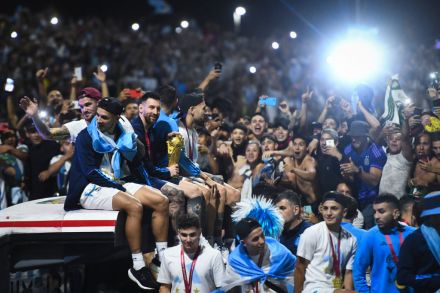
Argentine soccer legend Diego Armando Maradona died in 2020, at that time still the last man to lead his nation’s team to a World Cup championship. On Sunday, in some sense Maradona passed away again, as Lionel Messi lifted the golden trophy and his own legacy as not only the greatest Argentine player of all time, but possibly the greatest to ever lace up boots in the world. Tuesday has been declared a national bank holiday in the South American nation, not that anyone there has stopped partying since the famous win on Sunday. The heroes' welcome will be for this band of players, especially Messi, who snapped the thirty-six-year World Cup drought. But make no mistake, the image of Maradona will also be on display far and wide.

Javier Milei’s radical reforms could start to heal Argentina’s economy

Argentina has spent most of its 200-year history in deficit; no other country currently owes the International Monetary Fund a greater sum of money. The new finance minister, who entered government with President Javier Milei earlier this month, has been stark in making the point: ‘Out of the last 123 years, Argentina ran a fiscal deficit in 113... we have come to solve the addiction to fiscal deficits.’  Milei’s government is wasting little time carrying out what it calls ‘shock therapy’. The official value of the peso, Argentina’s currency, has been halved against the US dollar. Why might a government want to weaken its own currency, pushing up the price of imported goods for consumers?

Why Joe Biden’s Latin America policy is failing

From our US edition

At the opening ceremony of the Summit of the Americas in Los Angeles last year, President Joe Biden announced the Americas Partnership for Economic Prosperity, which the White House described as “a historic new agreement to drive our hemisphere’s economy recovery and growth and deliver for our working people.” The plan has become the administration’s signature Latin America policy. As noted by the White House, the region matters not solely because it’s where the US is situated, but because it also accounts for 32 percent of global GDP. Even more so, the region is rich in resources that are crucial in the development of emerging technologies.

latin america

What does Javier Milei’s win in Argentina mean to America?

From our US edition

Javier Milei, a messy-haired bombastic libertarian economist, won Argentina’s presidential elections against socialist minister of economics Sergio Massa this Sunday. With the backdrop of inflation that the International Monetary Fund projects will trail only that of Zimbabwe and Venezuela by the end of the year, Milei triumphed with over 55 percent of votes in the runoff with more than 94 percent of votes counted, according to data from the country’s National Electoral Chamber. In a brief speech before the results were announced, Massa, who came first in the October 22 election that led to the run-off, said, “Milei is the president elected for the next four years,” adding that he had called Milei to personally congratulate him on his victory.

javier milei

Escaping the city in Argentina

From our US edition

Planning a foreign trip is a bit like watching a trailer for a film. The research is a preview of coming attractions. I almost never made it to San Antonio de Areco, a charming country town about seventy miles northwest of Buenos Aires, because it seemed extravagantly expensive and complicated to visit. But trailers can be misleading, perseverance is a virtue, and Areco, as the locals call it, turned out to be the highlight of my visit to Argentina last summer. With just a week to spend in the world’s eighth largest country by land area, my plan was to spend four days in Buenos Aires and three in a small town, a place I hoped would give us an idea of what the country’s gaucho heartland is about.

argentina

The Pink Tide returns to Latin America

From our US edition

As the dust settled on Jair Bolsonaro’s seismic victory in Brazil back in 2018, one might have spared a thought for those dedicated to the cause of international socialism. Having bathed in the glory of the so-called "Pink Tide" and the commodities boom of the early 2000s that allowed socialist governments such as Hugo Chávez's Venezuela to seemingly prosper, any hopes that Latin America would forever unify in the cause of left-wing anti-imperialism seemed well and truly dashed. In many of the continent’s wealthiest countries, right-of-center politicians had swept to power with a view to restoring their nation’s former glory. These included Bolsonaro in Brazil, Sebastian Piñera in Chile, Ivan Duque in Colombia, and Mauricio Macri in Argentina, among others.

The top five things Paul Krugman has gotten wrong

From our US edition

Every two years or so, the Spectator World issues a takedown of New York Times columnist and “expert” economist Paul Krugman, who has a notable history of being wrong about absolutely everything. Well, it seems it's that time of year again. The Australians are getting in on the Krugman-dunking game so why shouldn't we? Here’s Cockburn's authoritative ranking of Paul Krugman's Greatest Hits. Krugman denies the recession Fresh from his New York Times opinion piece titled “I Was Wrong About Inflation,” Paul Krugman decided it was time to be wrong about the recession. On Brian Stelter's CNN show Reliable Sources, Krugman said, “I think that what's happening now is that there's been a kind of a negativity bias in coverage.

paul krugman

40 years on, war still casts a shadow over the Falklands

For the Falkland islanders, the war in Ukraine brings back haunting memories of their own trauma four decades ago. Having themselves experienced a barbaric invasion by a big bully next door, they understand all too well what the people of Ukraine are going through. ‘I still feel that gun in my back,’ one islander told me recently, describing the day Argentine troops landed on Pebble Island and brutally rounded up the locals. Much has changed in the Falklands since 1982, nearly all of it for the better, yet the war remains seared in the memory. This year’s 2 April is, therefore, hugely significant – the 40th anniversary of the invasion.

Cricket in Buenos Aires

From our US edition

For most Latin Americans, who are themselves no strangers to sporting eccentricity, cricket remains a baffling proposition. The game is dismissed as being far too English and is often confused with croquet. Ignorance, however, does not preclude peculiar theories on how the game is played. I remember a Uruguayan diplomat attempting to explain the rules to a colleague who had recently arrived in London. “It’s very simple, che. All you need to know about el críquet is that when the ball hits those three little sticks, it’s a goal.” In the nineteenth century, cricket was played across Latin America. Matches were sometimes held in fantastic surroundings: Emperor Maximilian I donned his white flannels in the grounds of Mexico City’s neoclassical Chapultepec Castle.

cricket