Antonio pappano

Ways of hearing

‘What gives your lies such power?’ asks the bewildered Sicilian leader in Szymanowski’s opera Krol Roger. The question is addressed to a charismatic shepherd, on trial for propagating a lascivious new religion of unbridled sensuality. Roger’s wife, Roxana, has already converted along with many of his subjects, while the city’s conservative and clerical factions clamour for the blasphemer’s death. But Roger resolves to see for himself. Or rather hear for himself.
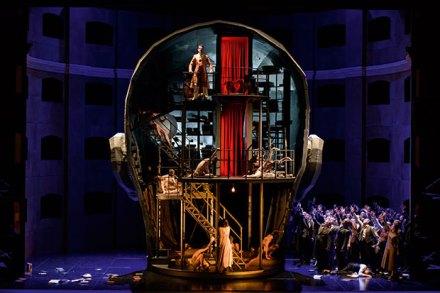
Andrea Chénier, Royal Opera House, review: like a Carry On – but without the jokes

Who on earth could have predicted that a hoary old operatic melodrama set in revolutionary France would find resonance in the present where the pen as a weapon against bigotry and hypocrisy has suddenly achieved iconic status. But hold up, let’s not get carried away. We’re talking about Giordano’s Andrea Chénier. Though its eponymous poet does indeed extol free expression at the service of love, the sentiments — the voices of reason in a time of high anxiety — don’t run too deep. And so we’re back where we started, with a hoary old melodrama.

Andrea Chénier, Royal Opera House, review: like a Carry On – but without the jokes | 21 January 2015

Andrea Chénier Royal Opera House, in rep until 6 February Who on earth could have predicted that a hoary old operatic melodrama set in revolutionary France would find resonance in the present where the pen as a weapon against bigotry and hypocrisy has suddenly achieved iconic status. But hold up, let’s not get carried away. We’re talking about Giordano’s Andrea Chénier. Though its eponymous poet does indeed extol free expression at the service of love, the sentiments — the voices of reason in a time of high anxiety — don’t run too deep. And so we’re back where we started, with a hoary old melodrama.

Royal Opera’s Tristan und Isolde: an absurd production – but still a magnificent night

Any adequate performance of Tristan und Isolde, and the first night of the Royal Opera’s production was at least that, leaves you wondering what to do with the rest of your life, as Wagner both feared and hoped it would. What Tristan does — one of the things — is to present an image of romantic love, in both its torments and its ecstasies, which makes everything else seem trivial; and at the same time to undercut that image by asserting the claims of ordinary life, but in the subtlest way.

Is Anna Nicole’s absurd life worth our while? Not as much as Otello’s

So how did London’s two big opera companies launch their new seasons last week? Not perhaps in the way you might expect. Decked with pink balloons and the acrid smell of popcorn, the Royal Opera House waved the garish contemporary flag with Mark-Anthony Turnage and Richard Thomas’s Anna Nicole of 2011, revived before a youthful opening-night crowd attracted by specially subsidised tickets. It was left to the friskier English National Opera to offer a new production of sober mien and an audience containing some people who dressed up. Standard repertoire, too: the opera was Verdi’s Otello — filled enough with base passions, but not with phrases like ‘douchebag’ or the delightful ‘skid-marked panties’. The Coliseum threw the best party, by far.

Is Anna Nicole’s absurd life worth our while? Not as much as Otello’s

Otello ENO, in rep until 17 October Anna Nicole Royal Opera, in rep until 24 September So how did London’s two big opera companies launch their new seasons last week? Not perhaps in the way you might expect. Decked with pink balloons and the acrid smell of popcorn, the Royal Opera House waved the garish contemporary flag with Mark-Anthony Turnage and Richard Thomas’s Anna Nicole of 2011, revived before a youthful opening-night crowd attracted by specially subsidised tickets. It was left to the friskier English National Opera to offer a new production of sober mien and an audience containing some people who dressed up.

Manon Lescaut: Puccini’s Anna Nicole?

This season has already seen Manon Lescaut appear in several different operatic guises across the UK, but it was Covent Garden’s new production of Puccini’s version (its first staging of it in three decades) that was the hottest ticket of all. The Latvian soprano Kristine Opolais and the superstar tenor Jonas Kaufmann were tackling the roles of the lovers, Manon and Des Grieux, for the first time. Antonio Pappano, in the repertoire where he most reliably excels, was in the pit. In an introductory talk before the production opened, the conductor tentatively drew a comparison between Puccini’s first major success and Mark-Anthony Turnage’s Anna Nicole, which opens the Royal Opera’s next season.

Parsifal has anxiety, rage, near-madness — unfortunately the Royal Opera’s version doesn’t

Debussy’s description of the music of Parsifal as being ‘lit up from behind’ is famous; less so is Wagner’s own remark to Cosima that in his last music drama he was trying to get ‘the effect of clouds merging and separating’. The scoring of the music, especially in the outer acts, is so extraordinary that even people who are repelled by the subject matter of Parsifal, such as Nietzsche, are still overwhelmed by its beauty, which uniquely combines sensuousness and spirituality. It’s a beauty that has to cope with and contain a very great deal of pain, more even than Act III of Tristan.

Joshua, Opera North, Don Carlo, Royal Opera House

Why stage a Handel oratorio, or anyone else’s for that matter? The recent urge to do it, with Bach’s Passions — even, I’m told, with Messiah — suggests a further incursion of TV into our lives, the inability to absorb anything that isn’t partly or primarily visual. At least Handel’s Joshua, which Charles Edwards directs and designs in a new Opera North production, is bellicose so there is a fair amount of action, though the most indelible parts of it are the choruses, some of them, strangely, sung with scores in hand, some not. The setting is post-second world war, yet another production with an excuse for dressing the characters in dowdy clothes suggestive of a Ken Loach movie.