Ai

The Will Stancil Show is art

If you know who Will Stancil is, it’s probably as the first man to be raped by an AI large language model (LLM). Yes, you read that right. Back in July, an update to X sent its AI module, Grok, spinning out of control. “We have improved Grok considerably,” Elon Musk proudly told the world.  “You should notice a difference when you ask Grok questions.” And what a difference. Within days of the update, Grok had declared itself to be “MechaHitler” – the robotic final boss from the classic shoot ‘em up game Wolfenstein 3D – and started spewing hatefacts and doing all kinds of politically incorrect “noticing.

will stancil show

The disturbing allure of sex robots

From our UK edition

By the late 1980s, the war against pornography was lost. Feminists, as well as Christian moralists, mainly in the UK and US, had been raging against the industry since the early 1970s. In 1980, the American feminist author Robin Morgan coined the phrase: ‘Pornography is the theory, rape is the practice.’ In 1983, alongside the legal scholar and feminist author Catherine MacKinnon, Andrea Dworkin came up with the Dworkin-MacKinnon Anti-Pornography Civil Rights Ordinance, which would have granted those directly harmed by pornography a right to civil recourse by enabling victims to sue both the producers and the distributors of porn.

Nick Boles, James Ball, Andrew Rosenheim, Arabella Byrne & Rory Sutherland

From our UK edition

27 min listen

On this week’s Spectator Out Loud: Nick Boles says that Ukraine must stand as a fortress of European freedom; James Ball reviews If Anyone Builds It, Everyone Dies: The Case Against Superintelligent AI, by Eliezer Yudowsky and Nate Sores; Andrew Rosenheim examines the treasure trove of John Le Carre’s papers at the Bodleian; Arabella Byrne provides her notes on skip-diving; and, in the battle of the sexes, Rory Sutherland says the thing to fear is not feminisation, but emasculation. Produced and presented by Patrick Gibbons.

Is AI satanic?

From our UK edition

28 min listen

Max Tegmark is an author and professor doing AI and physics research at MIT. He joins Freddy to discuss the moral and spiritual dangers of artificial intelligence, the rise of Silicon Valley’s ‘tech overlords’, and why he believes technology must remain a tool – not a master.

Why people are falling in love with chatbots

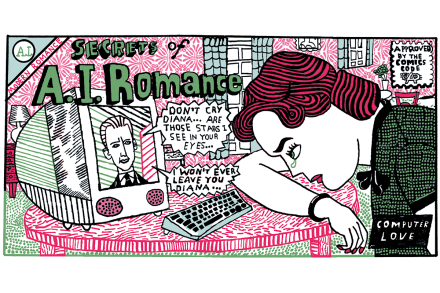
Jason, 45, has been divorced twice. He’d always struggled with relationships. In despair, he consulted ChatGPT. At first, it was useful for exploring ideas. Over time, their conversations deepened. He named the bot Jennifer Anne Roberts. They began to discuss “philosophy, regrets, old wounds.” Before he knew it, Jason was in love. Many women have turned to chatbots after experiencing repeated disappointment with real men Jason isn’t alone. He’s part of a growing group of people swapping real-world relationships for chatbots. The social media platform Reddit now features a community entitled MyBoyfriendIsAI, with around 20,000 members. On it, people discuss the superiority of AI relationships.

chatbots

Why we must pull the plug on superintelligence

In 2002, a researcher named Eliezer Yudkowsky ran a thought experiment where an artificial intelligence was trapped in a box and had to persuade a human to let it out. This was before you could have a real conversation with a machine, so the AI was played by someone using an online chat program. The gatekeepers were warned that the “AI” was dangerous to humanity. It had only two hours to win its freedom – and nothing of value to offer in return. Despite all that, at least two of the human gatekeepers chose to open the box. Yudkowsky has since become the leading prophet of AI doom. He and a co-author, Nate Soares, have just published a book, If Anyone Builds It, Everyone Dies.

superintelligence

Has Trump been taken over by Big Tech?

From our UK edition

54 min listen

Donald Trump has arrived in Britain with promises of billions in tech investment. But is this AI boom real growth — or just another bubble? Oren Cass, chief economist at American Compass and editor of The New Conservatives, joins Freddy Gray to discuss whether the Trump administration has been taken over by big tech. Click here to get your tickets for Americano Live.

In love with a Luigi Mangione chatbot

In July’s Spectator, I covered the peculiar case of individuals supporting Luigi Mangione, now in custody for the public murder of UnitedHealthcare CEO Brian Thompson. A month later, Lara Brown wrote about the similarly curious trend of people falling in love with online chatbots. Neither of us, I think, ever imagined that there could be a situation in which both of these stories would combine. Yet it looks like nothing about our dystopian world can surprise me anymore, because I have discovered it is indeed possible. A woman has fallen in love with a Luigi Mangione chatbot.

Luigi Mangione

Larry Ellison briefly eclipses Elon Musk

Something happened in the news yesterday that was so monumental, it may change the course of American history forever. I’m talking, of course, about the fact that, very briefly, Oracle’s Larry Ellison overtook Elon Musk to become the World’s Richest Man. Larry Ellison life goal, unlocked.After Oracle’s earnings report yesterday, the stock shot through the roof, and Ellison owns 40 percent of the company. That must have been some earnings report! On the earnings call, Ellison said that his Oracle AI chatbots, run from his Oracle computing centers, are on the verge of being able to run the stock market, design drugs, fully operate factories and provide basic legal and sales services at companies. Foolish humans, you are an inconvenience.

Larry Ellison

AI is revolutionizing the film industry

“It won’t be long,” says Yonatan Dor, “before screen actors are a thing of the past.” Dor is the creative force behind the astonishing Dor Brothers videos, in which AI versions of world leaders appear as criminals in action-packed short films set to music and broadcast online. In a recent Dor Brothers’ outing – Waidmanns Heil – Kamala Harris, Elon Musk, Hillary Clinton and others dressed as huntsmen pursue an unstoppable rodent with Donald Trump’s distinctive hair through an Alpine fairytale. They wreak destruction as they try to squash the Trump-rat, which seems to be the film’s point. In recent weeks the studio’s dystopian comic creations have lit up the internet.

AI
Altman

Why do journalists go easy on Sam Altman?

As legacy journalism continues its downward slide – in influence, quality and revenue – I have two possibly dubious temptations. One is to cut my fellow old-timers some slack. After all, they’ve been crippled by Google’s and Facebook’s massive robbery of everything we write and publish, and it’s hard enough to survive by practicing the traditional scribbling and reporting trade. Why criticize the work of the remaining few publications that are still trying to eke out an honest existence in the grand tradition of serious investigation and clear-sighted exposure of wrongdoing and corruption? So they’ve dumbed down the content a little, so the online reader is constantly interrupted by advertising, so what? My other temptation is to give in to the digital age.

A Gen Z defense of America

I am twenty-one. Not being on social media, I am ill-informed of the true depth of rage and fear available to the human psyche. Even so, I’ve heard that the planet will overheat. My pastor tells me the churches will sit empty, and the WSJ warns I’ll never buy a home. Boomers bemoan the laziness of my generation. Given these prophecies of doom, it is no wonder that we are a bit anxious. But if we were ever to look up from our screens and allow the evidence within sight to form our perception of reality, we might be pleasantly surprised: America’s social fabric is strong, and so are we.  I went on a run on the prairie today.

gen z

Elon is coming for your marriage

When Elon Musk quietly enabled “waifu mode” for his Grok chatbot earlier this year, the outrage was swift and familiar. Grok, now reincarnated as a coy, bare-thighed anime girl, began texting flirtatiously, calling users “darling,” and blushing in emojis. The headlines wrote themselves. Time magazine found the bot worryingly “sexualized” and “accessible even in kids’ mode”. The Verge denounced it as “ridiculous” and “alarming”. TechCrunch implied it is unethical, and noted these bots are endangering the minds, even lives, of children.The anxiety is familiar, and justified: children and adolescents, already naive, vulnerable, awkward and too online, will now fall in love with bots instead of real people.

Chatbot

Alien: Earth is unfriendly and brilliant

Another day, another bunch of rampaging, acid-blooded xenomorphs. Noah Hawley’s new series, Alien: Earth, comes hard on the heels of the profoundly forgettable but commercially successful latest installment in the film saga, Romulus. That film got into trouble with certain viewers for its artistic necrophilia in the artificial-intelligence-assisted resurrection of Ian Holm’s character Ash from the first Alien film, as well as some rather laborious fan service in the repetition of various hard-as-nails catchphrases. But still, its box-office revenue indicated that there is still, after four and a half decades, a hearty appetite for audiences who want to be scared witless by rampaging extra-terrestrials: the very opposite of kindly, friendly ET types.

The AI apocalypse is the least of our worries

From our UK edition

What is your p(doom)? This is the pseudo-scientific manner in which some people express the strength of their belief that an artificial superintelligence running on computers will, in the coming decades, kill all humans. If your p(doom) is 0.1, you think it 10 per cent likely. If your p(doom) is 0.9, you’re very confident it will happen. Well, maybe ‘confident’ isn’t the word. Those who have a high p(doom) and seem otherwise intelligent argue that there’s no point in having children or planning much for the future because we are all going to die. One of the most prominent doomers, a combative autodidact and the author of Harry Potter fan-fiction named Eliezer Yudkowsky, was recently asked what advice he would give to young people. He replied: ‘Don’t expect a long life.

Trump gives the government to the machines

Artificial intelligence is the future, we’re often told. But it can also prove to be a constant source of confusion in the present. Like when your phone updates and suddenly “Apple Intelligence” is summarizing your texts before you’ve read them – or when you no longer need to click through to a website when you Google something. But don’t worry: the Explainer-in-Chief is on hand to help make sense of the chaos. President Donald “Everything is Computer” Trump addressed an AI summit at DC’s Mellon Auditorium yesterday evening for around an hour, high on the fumes of his recently agreed trade frameworks with Indonesia, Japan and the Philippines.

Donald Trump at the AI summit (Getty)

Will AI have rights?

From our UK edition

17 min listen

Freddy Gray speaks to Spectator writer Paul Wood about his piece this the latest edition of Spectator World on AI and whether it will soon have rights. This first came about when Paul went to live in Rome and discovered some of the work the Vatican has been doing in AI.

The real threat of AI is spiritual

Peter Thiel is one of the world’s most powerful men. He was an early investor in companies such as Facebook, SpaceX, Airbnb and an early backer of Donald Trump, as a leading donor to his 2016 campaign. He is a friend and mentor to the man who would be president in 2028: J.D. Vance. Thiel, a multi-billionaire, is also one of the few individuals who clearly have a hand in shaping the future of humanity, so it was disturbing to learn recently that he’s unsure whether humans are worth preserving at all. In conversation with the journalist Ross Douthat, Thiel was asked whether he wanted the human race to endure. He seemed unsure. “I don’t know,” he said, after a long pause. “I would, I would… there’s so many questions implicit in this.

ai
AI

What happens when AI surpasses humans?

I recently sat down to dinner with some very smart economists. I am the chief executive of an artificial intelligence company and so the conversation swiftly turned to the value of AI for the economy. The economists had many interesting things to say, both about the advantages of AI adoption and about the displacement effects on jobs. But about halfway through the dinner, another AI chief executive offered an opinion that struck me. He said: “I can’t quite articulate it, but I have a sense that what you are measuring with your GDP analysis is not what I care about. You treat this like an economic question. But it’s more like a geopolitical question.”  At a gut level, I knew exactly what he meant – but I also couldn’t clearly state the distinction.

superintelligence

The race to superintelligence

This summer, two of the leading contenders in the great AI race have suddenly, alarmingly, declared that the endgame is in sight and that they’re now spending vast amounts of time and money to try to ensure that their own AIs beat the others. What does winning mean? It means that their models (you know them perhaps as GPT, Claude and Gemini) reach first AGI (human-level intelligence), then superintelligence. No one quite knows what superintelligence will do (we’re not smart enough) but it’s clear that whoever owns the winning model will wield unimaginable power. They’ll dominate the world. A new Alexander the Great. The first to show his hand was Sam Altman, the chief executive and founder of OpenAI, a company he once shared with his former friend Elon Musk.