Features

Silicon Valley wants to control the economy

I recently walked past an old minicab stand which, during our younger student days, sallied my friends back and forth between the city’s nightlife and our more affordable suburban digs. It is gone now; only a dilapidated and cordoned-off shack remains of a once-thriving minicab empire. Like thousands of others across the western world, the business went into terminal decline the moment Uber appeared in our lives. Yet a simple check of the app today shows the price of an Uber is not substantially less than a minicab ride back then. Uber rocketed to celestial heights because it was heavily subsidized by venture capital – driving the value through the floor, bankrupting all physical competitors, before it then jacked up the price to create an instant monopoly.

LLM

The £10 pint explains the rise of Reform

I bought my first pint of bitter, in a pub in Slough, in 1972. It cost 12 pence. The Bank of England inflation calculator tells me that is the equivalent of £1.45 today. Yet a pint now sells for £10 in London. What went wrong? Many factors, of which the first was Britain’s entry into the EEC on January 1, 1973. We were eventually made to "harmonize" our alcohol duties with our partners, leading to a drop in the duty on wine and a rise in that on beer, to reflect French cultural preferences. The most recent shock has been Rachel Reeves’s attack on small businesses with employer NI rises, punitive workers’ rights, ever-higher minimum wage etc. In the 1970s, the price of a pint, like the cost of a packet of cigarettes, was a major issue of concern in each year’s Budget.

pint

Weight-loss drugs killed my appetite for life

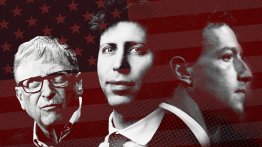
Sam Altman, the co-founder of OpenAI, which launched ChatGPT, is not overweight. Gay tech billionaires rarely are. Even so, as he explained in a recent interview, he was keen to try a GLP-1, one of those drugs that have revolutionized weight loss in the past five years. You can understand why he was curious. Ozempic and Mounjaro might appear to have nothing in common with artificial intelligence, but both phenomena have helped to create the sensation that we’re entering an era of accelerating and uncontrollable change. Alas, he screwed it up. He had someone inject him with a megadose, puked all night and then lay in bed for days "staring at a white ceiling thinking nothing," not only feeling no urge to eat but also no "desire for anything.

weight

Did Plato invent women’s lib?

One could go on endlessly about what the ancients have done for us, but one of the most interesting things is that Plato could be said to have invented women’s lib, though it seems to have taken 2,500 years to catch on. Since most ancient states were at war much of the time, putting the male population especially at risk, women had to commit to the production line as soon as possible if the state were to survive. But Socrates, in Plato’s dialogue The Republic, portrays a utopia in which women shared the same status as men. The ruling class of this state are called Guardians and Plato likens them to dogs hunting and protecting the flock, an activity in which female dogs engage just as much as male dogs (though the males are stronger).

plato

The secret shame of being ‘Reform-curious’

As a sucker for any melody which relies heavily upon fourth and eighth notes hammered out on a piano, I was always going to fall for Billy Joel’s 1978 hit single "My Life." The lyrics were, as ever with Joel, awful, mixing his cringeworthy ordinary guy New York vernacular shtick with what I dare say he thought were original and profound psychological insights. He is such a hack singer-songwriter. He makes Neil Diamond resemble Wittgenstein. But the tune made me swoon, even its two predictable cod-Beatles middle eights. What to do? Obviously, I couldn’t buy it. There were four record shops in Middlesbrough back then and I was known in all of them.

Trump Iran

Trump has Iran over a barrel

When is a ceasefire not a ceasefire? When the person declaring it is Donald Trump. Opinions differ about the wisdom of the President’s activities with respect to Iran. Some observers tell us he is playing four-dimensional chess. Some say it more like checkers with no kings. What, after all, is he up to? The commentariat proffers several conflicting narratives. The one common thread is the certainty with which these opinions are uttered. Trump is an idiot. Trump is a genius. For those who say that he has thrown in the towel – that Iran has “won” – I’d offer two observations.

Elon Musk Mars

Elon Musk is deluded about life on Mars

Elon Musk, already the richest person who ever lived, is at the center of the biggest share offering of all time. A valuation of $1.75 trillion at IPO would hand $75 billion to his company, SpaceX. Musk is being allocated two sets of shares, with performance-based conditions. They will materialize if SpaceX reaches a market capitalization of $7.5 trillion, and if a colony of a million people is established on Mars. The first of these is possible, the second is not. On the face of it, you wouldn’t bet against SpaceX. By 2024, it was launching more rockets than the rest of the world combined. Its Starlink internet service generates oodles of cash. It has more than 9,600 satellites in orbit that require constant replenishment, so the market is firm.

Let AI eat the universities

College is extraordinarily expensive and becoming less useful, and those who insist otherwise are working from a model of the labor market that stopped describing reality sometime in the 1990s. Four-year courses at private institutions often cost more than $70,000 a year, and it should come as no surprise that student debt has tipped over $1 trillion . This situation is ridiculous for a film student, but it is also ridiculous for a computer science graduate whose program could not keep pace with the industry it was preparing him for – and who learned more in four months on GitHub and dicking around on X and Repl.it than in four years of lectures. It’s sad, but how many people were attending school for “the life of the mind” to begin with?

US military

How warfare became welfare

As tensions with Iran once again push the US toward the possibility of further involvement in Middle Eastern conflicts, a novel brand of anti-interventionism has swept American politics. After two decades of costly wars in Iraq and Afghanistan, both the populist right and progressive left have grown more willing to question the assumptions underpinning American military engagement abroad. Politicians as ideologically diverse as Thomas Massie and Alexandria Ocasio-Cortez now openly criticize interventionist foreign policy, while public fatigue with the post-9/11 wars has become increasingly visible across the political spectrum. Yet even as Americans tire of foreign interventions, cuts to the defense budget are politically untouchable. Wars end, defense spending does not.

subsidy

How to save American farming

Farm bankruptcies in the US have risen by 50 percent in the past year. Soybean farmers lost an average of $100 per acre in 2025, according to the Department of Agriculture, while corn growers are set to lose $150 per acre this year. Meanwhile, the national beef herd is at its lowest level since 1950 and retail prices have jumped by 40 percent in the past 18 months. Normal businesses would diversify away from corn or soybeans and try to profit from the rising price of beef, as well as goods such as eggs and tomatoes. They would, in other words, react to the changing realities of the market. But American farms are not normal businesses. Most of my fellow farmers are stuck in a world of perverse incentives, from government subsidy and bailouts to financialized capital and farmland.

Don’t bet on a blue wave

There are several reasons to think we won’t see a blue wave in this year’s midterm elections. A basic one is that the Democratic party simply isn’t very popular. In late May, Donald Trump’s approval ratings in the RealClear polling aggregate stood around 40 percent, which sounds bad. Yet Trump is more popular than his party – approval of the Republican brand was in the vicinity of 38 percent. And the Democrats’ ratings were even worse – standing, or one might say wilting, at about 36 percent. Those figures are not to be confused with “generic ballot” polling, which asks voters which party they would prefer in the forthcoming election. Democrats have lately enjoyed a lead of some seven points over the GOP in that category.

How to reclaim your life

I stopped charging my phone beside my bed four years ago and have never regretted it. Alarm clocks seemed destined to go the way of the DVD, but I am on a solo mission to restore them to bedside tables around the world. The harsh tone of the alarm is certainly no match for what Spotify can give us, but it’s worth avoiding the 30 minutes of doomscrolling that the phone inevitably causes. Since making the switch from the waking blue-light bath, I have rediscovered those early hours of the morning, with their associated peace and silence, before children and work invade my limited headspace. Carving out that half hour before the noise begins has helped restructure my priorities in life. Every year the Pope chooses a preacher for the Roman Curia’s annual Lenten retreat at the Vatican.

Woke isn’t dead. It’s just getting started

“Woke is officially DEAD,” Donald Trump announced last summer. That has been a common refrain since the 2024 election: the anti-western, anti-white, pro-transgender ideology is over. The excesses of left-wing radicalism have been rejected. Sadly, nothing could be further from the truth. We’re all still living under the yoke of woke. Just look at Chicago. Over the Memorial Day weekend, 38 people were injured by gunfire and two were shot dead. Five police officers were hurt when a car drove into a crowd amid widespread disorder. This happened in a city where the Democratic mayor, Brandon Johnson, promised to defund the police.

The Pope’s AI intervention shames our politicians

I was born into a sternly Presbyterian culture. Politically, I’m more Orange than Donald Trump’s skin tone. But today I am on my knees giving thanks to the Pope. He has produced the most powerful political document of the year, taking on the greatest challenge of our times. His first encyclical, Magnifica Humanitas, deals with the changes which will be wrought to all our lives by artificial intelligence in the months and years ahead. AI will transform our economies and societies massively and irrevocably; it will change what it means to be human; it may even mark the end of humanity itself. If it takes the Pope to alert us to this revolution then perhaps the Reformation wasn’t such a good idea after all.

AI

Will the Supreme Court allow a ‘creed’ to kill America?

Supreme Court Justice Neil Gorsuch’s tour to tout his new children’s book about the Declaration of Independence should have been uneventful. But then Gorsuch decided to talk about what America is. On Fox News, with the New York Times and in the pages of the Wall Street Journal, Gorsuch kept staking out his view on what makes America special: America has no religion, no race, no people at all really, but instead a singular majestic idea. “We’re a creedal nation, right,” Gorsuch told the Times. “I mean, we don’t share a religion, we don’t share a race, we share an idea, OK? And that idea has to be passed down generation to generation through history, as we discussed.

Get ready for a Spencer Pratt Summer

This spring, many Angelenos have reported a strange, wild wind blowing down through the brushy canyons and over the sunbaked asphalt plains and across the urine-soaked beach parking lots of Los Angeles.  There is a whiff of something new wafting into your Tesla sun roof at red lights, and for once it isn't the choking smell of weed or the belching exhaust from junkie-filled RVs idling in alleys. It is hope. And its name is Spencer Pratt. His momentum is real and it's spectacular.

pratt

How Trump got immigration spectacularly right

Parts of the MAGA movement are unhappy with President Trump’s migration strategy. The administration has softened its policy on deportations following a public uproar over the ICE killings in January, it is said. The focus has been on removing only the most violent offenders. “The truth is the first year was not a year of mass deportation,” says Mike Howell of the Mass Deportation Coalition. “A conscious decision was made to go after the worst first, which was, we’ll call it a deviation, from the central campaign promise of mass deportations.” Such criticisms miss the point. The Trump administration has tackled the worst offenders to shore up support for its wider migration crackdown. And that crackdown has been wildly successful.

An eight-wheeled military vehicle patrols near the border wall which is being painted black after an order by US President Donald Trump, according to US Secretary of Homeland Security Kristi Noem, between Santa Teresa, New Mexico and Ciudad Juarez, Chihuahua, Mexico on August 28, 2025. 8 miles of metal barrier are under construction since July 15 in the El Paso Sector. (Photo by Herika Martinez / AFP)

The Romans would tax anything

When Nero committed suicide in AD 68, he left Rome deep in debt after military campaigns, building himself a fabulous “Golden House,” and the great fire of Rome (AD 64). His successor Vespasian, who fought his way to power in late AD 69, set to work at once. A hardworking man of humble origins and simple tastes, Vespasian was well suited to the task: “He got up early, even when it was still dark, and read the letters and the official breviaria” (“reports”; Latin brevis, “brief”). He sold off some imperial estates and nearly doubled provincial taxes, while extending Roman citizenship.

tax