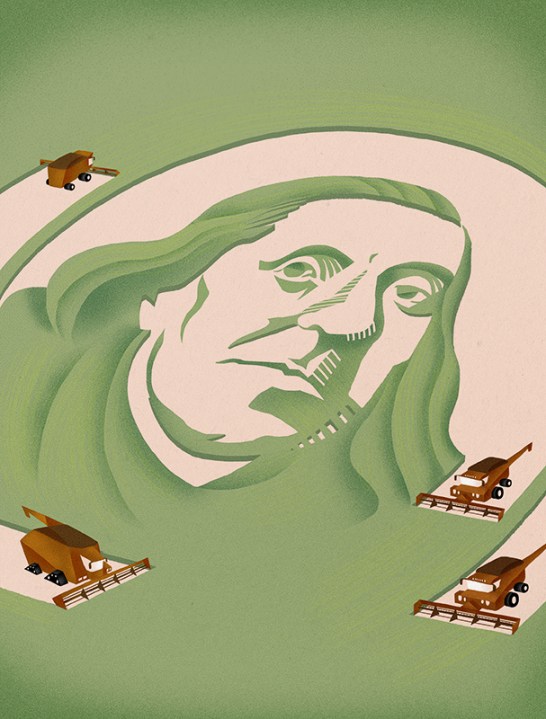
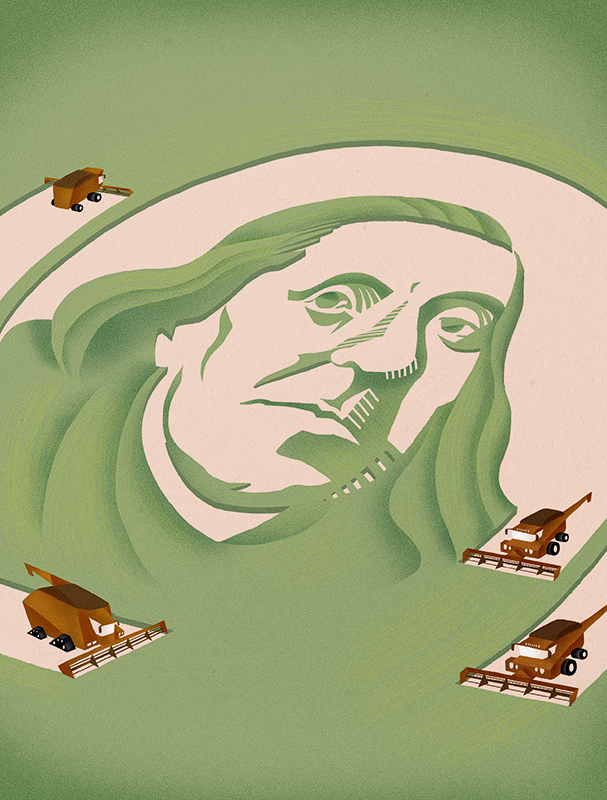
Farm bankruptcies in the US have risen by 50 percent in the past year. Soybean farmers lost an average of $100 per acre in 2025, according to the Department of Agriculture, while corn growers are set to lose $150 per acre this year. Meanwhile, the national beef herd is at its lowest level since 1950 and retail prices have jumped by 40 percent in the past 18 months.
Normal businesses would diversify away from corn or soybeans and try to profit from the rising price of beef, as well as goods such as eggs and tomatoes. They would, in other words, react to the changing realities of the market. But American farms are not normal businesses.
Most of my fellow farmers are stuck in a world of perverse incentives, from government subsidy and bailouts to financialized capital and farmland. And as the world has become more unstable, this crazy web of incentives has been shaken.
I’ve been a farmer for most of my adult life, working 550 acres that my family bought in the early 1960s in the Shenandoah Valley. What I’ve learned on the farm has made me who I am: a Christian, a libertarian, an environmentalist and a capitalist. Both the market and the land are telling us to change. But we seem intent on ignoring both.
The government is protecting farmers from the consequences of their own actions
Take the cost of borrowing. Many crop farmers finance their season’s operating costs with debt. They borrow to pay for seed, fertilizer, equipment and labor, months before they see any return. But as inflation pushes interest rates higher, the cost of a season’s capitalization eats into profitability. Even a 2 or 3 percentage point increase makes a big difference to profit margins.
At the same time, the conflict in the Middle East has led to spiraling fertilizer costs. Since February, urea has jumped from about $760 a ton to about $1,100 a ton. Some farmers who forward-contracted fertilizers say they will sell their contracts, pocket the current inflated values, and just sit out the year. It’s crazy that some farmers are currently incentivized not to farm. The market is telling us the current system isn’t working. But it gets even crazier: many farmers are turning to soybeans, something that makes no sense when you look at the drop in value.
Yet soybean planting has increased by some three million acres this year. Why? Partly because soybeans don’t require as much nitrogen to produce as corn, which means farmers don’t have to borrow as much money at inflated rates to pay for more expensive fertilizer. But the main reason is the government. If soybean prices drop far enough, the taxpayer covers the difference.
Last year, Trump authorized $12 billion in bailouts to farmers after China banned the import of American soybeans in retaliation for tariffs. There was a similar bailout the year before. These are becoming routine. So routine, in fact, that many farmers are planning for another bailout.
The government is protecting farmers from the consequences of their own actions. The result is that bad decisions continue to be made. The first policy change must surely be: stop subsidizing, stupid. Everyone in business has to look at trends in profit margins and adjust their behavior accordingly. Subsidies of any type skew the market and obscure what is actually occurring.
Farmers have become separated from both the food and economic systems, as if they’re some sort of levitating, disconnected Brahmin class that deserves holy treatment. Why should soybeans, corn, wheat, cotton, rice and sugarcane be given special status by Washington? Why is a bushel of corn more important than a bushel of apples? Why is wheat bread more important than a chicken breast or a pork chop?

Meanwhile, convoluted regulation helps the big players. They can afford to employ specialists to navigate and profit from all these carveouts. The result is that the food sector is controlled by fewer and fewer companies, which reduces competition in the marketplace. In 1906, seven companies controlled 50 percent of the American beef market. Today, just four firms control 85 percent. This consolidation reduces farmers’ bargaining power in the marketplace.
The flipside is that food regulations stymie market entry for smaller entrepreneurs. Farmers are finding it harder and harder to access the retail market due to zoning, inspections and compliance paperwork. Right now, a T-bone steak cannot be sold to anyone in the US without asking a bureaucrat’s permission. Under the 1906 Federal Meat Inspection Act, meat sold commercially must be slaughtered and processed under USDA or state inspection.
If this act were to be scrapped, thousands of farmers could access the retail market and collapse the oligarchy. Millions of Americans who would like a chicken pot pie without artificial food additives such as monosodium glutamate could buy one from a neighbor. If we want to stop farmers going out of business, we need to allow them access to retail profit margins. In 1940, a farmer received roughly 40 cents of the retail food dollar. Today, it is about 8 cents. The vast companies that remain in the market are happy to rely on economies of scale. But allowing smaller farms to sell directly to customers would bring urban money back to rural communities. It could lead to a revival in the countryside.
This is part of a much larger story, one of centralization, consolidation and concentration. Currently, 47 percent of US farmland is leased, which means the farmer managing the land does not own it. High land prices have pushed sales toward large investment entities; the land is increasingly owned by the likes of Bill Gates, Vanguard and Blackrock. And it’s only going to get worse. The average American farmer is just shy of 60 years old.
The current paradigm is best understood by looking at Donald Trump’s recent executive order designating the herbicide glyphosate a matter of national security. Nothing could be further from the truth. But it shows how utterly dependent we are on chemical agriculture.
I don’t use vaccines, chemical fertilizers or genetically modified organisms. The reason is that 500 years ago, North America produced more food than it does today. That is a fact. The land contained some 100 to 200 million bison. Roughly two million wolves each ate 20 pounds of meat per day. As many as 400 million beavers ate more plants than all the humans in North America today. Passenger pigeons were so numerous they blocked out the sun for a day as they flew overhead. Lewis and Clark recorded seeing one bear every mile as they traversed from St. Louis to the Pacific – and those were just the ones they saw.
When Europeans came to North America, they found deep soils, rich vegetation, and teeming wildlife. This abundance did not occur because someone poured chemical fertilizer on the ground and sprayed Roundup on the vegetation. But the Europeans plowed, turning the soil upside down and denuding it of vegetative protection. They planted monocrops rather than interwoven, diversified species. They left animals in fields to overgraze and further denuded the soil, rather than moving them around like the migration of native herds. Eventually, they applied chemicals to the soil that killed earthworms and destroyed organic matter. And they installed drainage and pumped from aquifers, impeding the hydrologic cycle.
They locked up livestock in massive concentrated animal feeding operations, turning the blessing of manure into a toxic curse. They eventually abandoned domestic culinary arts in favor of industrial chemical-oriented, nutrient-deficient foods with additives full of high-fructose corn syrup. Then we became the sickest nation on Earth.
Few civilizations have abused their resource base as quickly and as completely as America. Farmers need to realize they are in a biological world, not a chemical one. Western thinking portrays the natural world as fundamentally mechanical, as if a cow is like a car. Food allergies, avian influenza, E. coli and salmonella are nature’s way of telling us we’re getting things wrong.
Few civilizations have abused their resource base as quickly and completely as America
So it’s time to listen to both the market and the land. There are clear solutions to both government dependence and ecological degradation. Soil-building must be first and foremost on every farmer’s mind. When we revive our dying soil, we’ll no longer be at the whims of Middle Eastern petroleum fertilizers. Depletion is not an option. A riparian dead zone the size of Rhode Island in the Gulf of Mexico is unacceptable. Soil builds up today just as it did 1,000 years ago: from decomposing organic matter. Something formerly alive must break down by microbial activity. Death renews life in fertility.
The fastest way to build soil in modern America would be to convert half the soybean and corn acreage to perennial prairie polycultures with properly managed herbivores (think cows). Cattle fertilize the land, prune the fast-growing biomass and, at today’s prices, offer massive profit-per-acre opportunities over monocrops. But 60-year-old farmers acclimated to taxpayer bailouts stomp and fume: “I don’t want to learn about cows.” How long can our nation keep subsidizing things we don’t need?
We need to mimic the beavers with excavation equipment, building millions of ponds across America’s farmland. We need to be hydrating the landscape and controlling floods, refilling aquifers and adding thermal mass to control air temperatures. Water is the foundation of life. But we seem to have forgotten that. And rather than spending $7 billion a year fighting fires, how about we start up the chainsaws and turn that overgrown, often dead biomass into chips for large-scale composting? Roughly 75 percent of landfill waste is compostable. That our nation buries critical soil-building material is unconscionable.
Ultimately, the solutions to the farmers’ problems are simple. Not easy, but simple. These changes require a policy shift, but most of all a mental shift. If we listen to both the market and the countryside, we could re-create the North American abundance that once greeted the Europeans. The land can make us rich, if we let it.





Comments