Features

The joy of crossing people off your Christmas card list

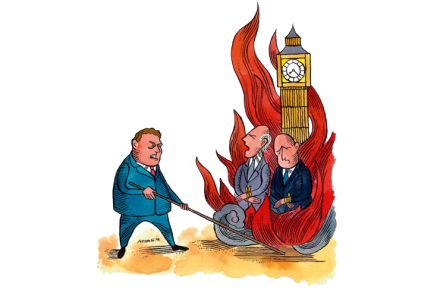
It’s that time of the year again, the time when 12 months’ worth of pent-up malevolence comes flooding out, mixing malice, schadenfreude, one-upmanship and virtual punishment beatings. Yup: it’s time to start writing our Christmas cards. Has there ever been an activity better designed to bring out the worst in people than that dedicated to the season of goodwill? We all know that Christmas is a time to celebrate bitter familial enmity, but the Christmas card tradition goes one better and gets the rest of the world in on the act. This came to me as I was efficiently consulting the list of my Christmas card recipients from last year: I landed on a couple who recently canceled on the day of a dinner party for which it had taken my husband and me three days to prepare.

How Garrison Keillor is living at 83

I’ve been having a wonderful year since I turned 83 and decided to lighten up on world affairs and let other people agonize over corruption in high places and the fate of American democracy, which concern me too. But at this age one can only take on so much. Time is running out. Time to leave the problems to the young and energetic and devote myself to writing limericks. Better to do one thing well than wave your hands and yell at a brick wall. One day an old man in ManhattanSaid at the library he sat in,“Enough politics,I’ll write limericks.So light up your pipe and put that in.” A remarkable metamorphosis:One door opens, one closes.What a reliefTo give up that griefAnd happiness is the prognosis.

Queen Camilla’s recommended reading list

As Christmas approaches and we wrack our brains to find something that suits everyone, there is no present quite like a book. Whether it’s an unputdownable novel, a heart-stopping crime series, a thought-provoking biography or a collection of beautiful poetry, a book provides an escape, the perfect antidote to the hurly-burly of everyday life and, above all, hours and hours of pleasure. Here are half a dozen of my favorites, previously recommended on my Queen’s Reading Room, which you might like to add to your Christmas present list… or (if preferred) keep for yourself! The Cazalet Chronicles by Elizabeth Jane Howard This is a series of books that I return to again and again, to reacquaint myself with the irresistibly charming Cazalet family.

Pete Hegseth is a polarizing figure who doesn’t quit

Pete Hegseth’s Saturday begins with personal training. The Secretary of War, @SecWar on your socials, is very fond of working out with the troops – something most defense secretaries have done without someone dutifully filming the experience for Instagram. Then he heads off to the Reagan National Defense Forum, the annual gathering of war hawks, policy nerds and defense contractors in Simi Valley, California. Hegseth, the veteran of the Global War on Terror, is there to fulfill his mission of denouncing the neocons. “Out with idealistic utopianism, in with hard-nosed realism,” he declares, insisting the United States will no longer be “distracted by democracy-building, interventionism, undefined wars, regime change, climate change, woke moralizing and feckless nation-building.

America’s free-speech war on the EU

If I were a bookie, I would be making odds now about when the European Union will finally unravel and die. Unless there is an imminent and drastic course correction, the blessed event cannot be far off.  I might need a Doomsday Clock akin to the one publicized by the Bulletin of the Atomic Scientists. Their clock hovers near midnight, which signifies nuclear Armageddon, the minute hand pushed closer or farther away from the blast depending on minatory world events. My clock would measure the EU’s proximity to implosion. Its recent decision to fine Elon Musk and his company X €120 million for “non-compliance with transparency obligations” has me nudging the minute hand closer to midnight. “Non-compliance with transparency obligations.” What do you reckon that means?

Peter Thiel predicts the future

Peter Thiel has been described variously as “America’s leading public intellectual,” the “architect of Silicon Valley’s contemporary ethos” or as an “incoherent and alarmingly super-nationalistic” malevolent force. The PayPal and Palantir founder, a prominent early supporter of Donald Trump, is one of the world’s richest and most influential men. Throughout his career, his principal concern has always been the future, so when The Spectator asked to interview him, he wanted to talk to young people. To that effect, three young members of the editorial team were sent to Los Angeles to meet him. What follows is an edited transcript of their conversation.

Epstein, like Russiagate, damns the elite

As President Trump’s first year back in office drew to a close, his enemies had high hopes they’d hit on a scandal that could do to his second term what the “Russian collusion” story had done to his first. Donald Trump didn’t have to be found guilty of any wrongdoing tied to Jeffrey Epstein’s sleaze. All that was necessary was to stain his reputation indelibly and distract his administration from its work. The Epstein weapon even had an advantage over the Russia allegations of yesteryear – it resonated with much of Trump’s own MAGA base. Trump campaigned in 2024 on releasing the Epstein files, and many in MAGA considered it a betrayal when he resisted doing so once back in the White House.

The pleasure in not knowing

A few years ago, the podcaster Lex Fridman published a list of books that he was hoping to read in the year ahead. It included works by George Orwell, Fyodor Dostoyevsky, Hermann Hesse and others. If he had published this in the world of print media he might have got back some encouraging noises. But because he put the list online – worse, on the platform then still known as Twitter – he received mostly mockery. “Who hasn’t read Animal Farm?” was the general tenor of the blowback, as though a man who had been a researcher at MIT was next to being a Neanderthal.

douglas knowing
Jeffrey Epstein

How the ‘deep state’ enabled Epstein to operate

How do characters like Jeffrey Epstein come about, really? One way to find out is to read his emails, 20,000 of which were released by the House Oversight Committee in November. What they show us is that people like Epstein were a product of the second half of the 20th century, their existence more or less impossible outside this era and its conditions. After World War Two it was decided that majoritarian democracy was too dangerous and had to be replaced by international law, human rights and expanded bureaucracies. Epstein took this state of affairs for granted. In a 2016 email to the New York Times journalist Landon Thomas Jr., he talks blithely about the existence of what we would now call a “deep state”: “In politics the USA meant the white house. now there is pentagon.

No, America isn’t fundamentally flawed

What has gone wrong for Americans? To listen to an increasing number of politicians and pundits on both sides, from Tucker Carlson to Alexandria Ocasio-Cortez, from Nick Fuentes to Zohran Mamdani, the answer seems to be: everything. Americans are unable to get a job; to afford the necessities of life; to get married or have children; to find religious meaning or form friendships. And all of this can be laid at the feet of corrupt institutions and a corrupt system. This conspiracy-tinged, vitriolic take on the American system is a lie. Yet it contains a grain of truth. Our institutions have been led self-servingly by a coterie who disdain American values.

Christmas in Los Angeles and London

“Never again!” I sigh every January 6, as I pack away the abundance of Christmas decorations lovingly collected over the decades. “It’s too much!” I moan to Percy. “Let’s go to a hot island next year and get away from it all…” But I never do, because I just love Christmas. Every year in early November I eagerly unpack multiple boxes tenderly packed two years earlier because we like to spend Christmas in London one year and in LA the next, as we love both cities. I have quite a lot of extended family in each, so we know that celebrating in either one will be very “happy families.” But it’s the run-ups to Christmas in each city that are quite different. In the US, everyone celebrates Thanksgiving, which comes at the end of November.

Taki’s life as a writer

It was roughly 55 years ago, at the tail end of the 1960s, that I took the monumental decision to become a writer. It wasn’t exactly an agonizing one. By then I’d been on the European tennis circuit for a decade, and was kaput. Joining the circuit at 19, I traveled nonstop seeing the world. I was never tired or hungover no matter how much I partied – and I partied relentlessly. And, needless to say, there were constant thump-thumps in the heart, as at every opportunity I pursued beautiful women. I had a great advantage in this regard. As one of the worst players on the circuit, I was usually free to chase the fairer sex by the second day of the tournament. To the losers go the spoils! Except in those days the females who followed tennis looked more like losers than the losers.

Immigration policy should discriminate

Many years ago, a friend described one of my serious literary novels as “clever.” I was offended – but I shouldn’t have been. The friend was from across the pond, where I now understand “clever” means smart. For Americans, cleverness implies a shallow, facile intelligence. Applied to people, it hints at sly, calculating deviousness or cunning. It has no positive moral qualities, as westerners understand them. Tax evasion can be “clever.” Let’s move on to “culture” – a big, fuzzy word we throw about with careless abandon, that often summons images of traditional clothing and cuisine. But parsed in its most profound sense, culture might best be defined as “what a people admire and what they deplore.

Bonnie Blue: I stand with Nigel Farage

I have sweet memories of Christmas. My dad is proper old-school and would set up the video recorder. I don’t think we’ve ever watched the footage; I don’t know if he was even filming. But we couldn’t do anything until it was filmed. We never had loads of money, but Mum always went above and beyond. There was gold wrapping paper for presents from Santa. My family say I’m impossible to buy for now I’m better off. This year, I’ve asked for Disney princess pajamas. Christmas is a time for me to give back. Last Christmas was a bit of a shock. I was due to be in Australia but was then banned for my sexual stunts. My family was glad because it meant they got me for Christmas. Not that I’m much help. Cooking isn’t my forte.

Will US businesses profit from a return to the Russian market?

Rome Will peace in Ukraine also prove to be a great deal for US business? Vladimir Putin would certainly like Donald Trump to think so. Within days of Trump’s election victory last November, the Kremlin ordered major Russian corporations to prepare detailed proposals for economic cooperation with Washington. Coordinating these efforts were Maxim Oreshkin, deputy head of Putin’s presidential administration, and Kirill Dmitriev, the US-educated Harvard, Stanford and Goldman Sachs alumnus who heads Russia’s sovereign investment fund.

Trump’s brave new world

No one ever tucked themselves up in bed to read a government document – at least not in the expectation of enjoying it. The standard format is one of hundreds of pages of impenetrable jargon yielding no more than nuggets of significant ideas. The Trump administration has admirably cut through that tendency to produce a National Security Strategy (NSS) that is worth reading: a coherent outlining of America’s strategic intentions on the world stage. Originally composed by Michael Anton, a brilliant mind who is sadly leaving the State Department, the document concisely lays out a Trumpian vision of America’s role in the 21st century.

The battle to stop US universities aiding Chinese repression

It goes by an innocuous name – “Integrated Joint Operations Platform” (IJOP) – but it’s one of the most sinister components of China’s surveillance state, managing what has been described as a genocide against the Uighurs. The IJOP combines multiple systems of repression – location, messages, contacts, social media and other data from phones, together with information from checkpoints, cameras and biometric records. It then flags “suspicious” individuals for detention and forced labor. Now leading US universities have been accused of extensive collaboration with Chinese laboratories which develop technology that may be deployed or adapted for use in this system.

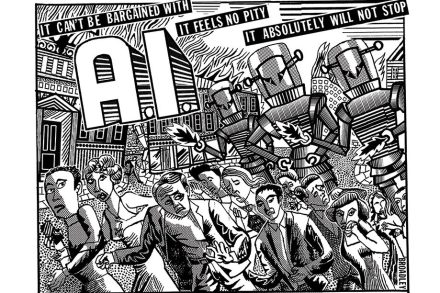
Why America must lead on artificial intelligence

As stock markets wobble over fears of AI hype and the overvaluation of tech shares, it seems an unfortunate time for Donald Trump to launch an initiative boosting America’s artificial intelligence capabilities. But the White House sees matters differently. Its new “Genesis Mission,” which commits government departments to make sure adequate energy and computing power are available, has been purposely launched to remind the world that AI is not all froth – or “slop” to use the popular term. Team Trump likens Genesis to the Manhattan Project to develop a nuclear bomb during World War Two faster than the other side. For all the typically Trumpian bombast, that’s not a foolish way of thinking about the subject.

fraud