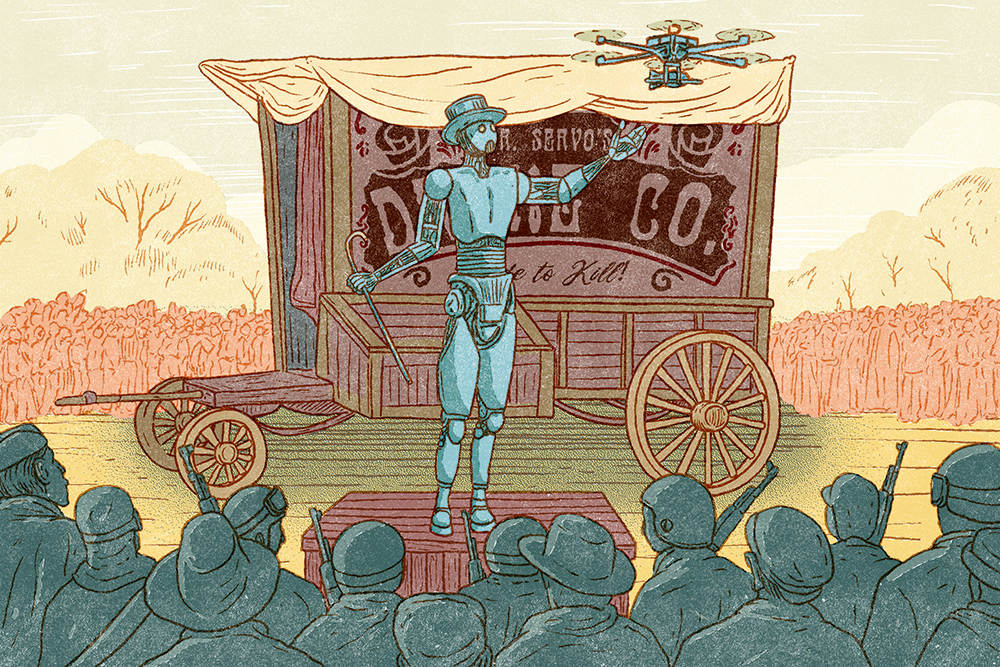



Donald Trump calls Dan Driscoll the “drone guy.” The 39-year-old Secretary of the Army – also a “total killer” with a “nice, beautiful face,” according to Trump – is on a mission to modernize the US military and firmly believes that drones are “the future of warfare.” The former Army Ranger, Yale Law School student and venture capitalist, announced last month that the Army was going to buy 1 million drones. Catch-up will be hard. Currently, the US military acquires around 50,000 a year – while Russia makes 4 million and China 8 million.
In his race against time, Driscoll’s north star is Ukraine, the country he calls the “Silicon Valley of warfare,” where cheap, often garage-made drones have effectively killed tank warfare and redefined the modern battlefield. Driscoll says he wants to mimic the Ukrainian approach to drone manufacture by handing contracts to small civilian makers rather than major defense contractors.
The Ukrainian military has created an innovation loop of R&D engineers embedded within combat units
Driscoll was recently in Kyiv to discuss cutting-edge drone technology when his brief was suddenly changed to negotiating a peace deal. A Ukrainian military source told The Spectator that meetings that had been scheduled with Driscoll in November were all canceled at the last minute.
But Ukrainian military and tech leaders at the tip of the drone-making spear cautioned that if Driscoll focuses purely on acquiring hardware in volume, he is in danger of ignoring the most important component of their success – innovation. New drones can be rendered obsolete in just weeks or even days by Russian technological advances. Only constant upgrades to their hardware and software keep them sharp.
To stay ahead of the curve Ukraine has, in part, learned from a great American invention: Amazon. The military has created an innovation loop of R&D engineers embedded within combat units who are authorized to work directly with a network of small manufacturers. It’s a bonfire of procurement red tape. They can then sell their cutting-edge tech on an Amazon-for-war website – with ratings for every product based on battlefield success – where they can also buy innovations created by other units. It is called Brave1 Market and was launched in April by the Ukrainian military.
Another key lesson might have been taken from Uber. Each unit is awarded points for everything – men and materiel – its drone operators destroy on a sliding scale: six points for killing a soldier, 20 points for damaging a tank, 40 points for destroying a tank and up to 50 points for eliminating a mobile rocket system. The drone pilots upload their videos to a website and are awarded points if their kills and hits are confirmed. These points are then used to buy more equipment from Brave1. The more successful the unit, the more it can buy. Success begets success – that’s the theory.
Driscoll’s Ukrainian counterparts say that if he really wants to replicate Ukraine’s achievements he needs to distill their technique, not just their technology.
An R&D company in the Ukrainian Third Army Corps has recently created a drone called Pavuk Dopkhina – Spider of Dophin (named after a fallen comrade, call sign “Dophin”). It penetrates up to 40 miles inside enemy territory using artificial intelligence to navigate terrain autonomously and then retransmits signals to swarms of strike drones to direct them to hit important targets. It has a high rating on the Brave1 marketplace and is selling well. Some of the income goes to the unit that invented and deployed it, further incentivizing success.
“With the Pavuk Dopkhina drone we had to transmit a signal that would not be vulnerable to interception over enemy territory,” the commander – call sign Dolyna – of the R&D company says. “There were some fails during the process, it was going back and forth to the testers, then back in the field. But now this is a drone that has its own name, it’s codified in the armed forces of Ukraine and any unit can access it and buy it directly from Brave1 Market. Whenever units have enough points, they can buy for themselves drones from Brave1 that are not issued by the government. It is a kind of motivation for the unit.”
Dolyna and his team work on or close to the front line. One element puts the drones together, one is responsible for the software, another tests the initial drone – and another, the most important, takes it into the battlefield. “They fly it, hit some enemies, and they integrate the drone itself into the unit and other units within the brigade or the corps.”
Yuliia Myrna, product manager at Brave1 Market, says that to be ready for modern warfare the US military needs to release its iron grip on central control of procurement and development and embrace decentralization to empower people like Dolyna. “In Ukraine we understand that technology changes on the battlefield every three or four months,” she explained. “And when we analyze how much time you need for centralized supply, it’s always about six months or even more than a year. But decentralized supply can take just six days. If you have a mission on your part of the front line, you could easily get directly from the manufacturers through Brave1 exactly what you need – get it in less than two weeks and complete your mission.
“Drone pilots earning e-points sounds like gamification, but in reality it’s a system to understand which units hit the enemy the most effectively and which should be given more resources. And it helps the commander or general staff implement their priorities. If you send an order down through a lot of chains of command it might not be as effective as giving a target a value. Soldiers won’t always realize the big strategy.
“We add a feedback QR card to every product. When a soldier gets this product, he or she uses it and can scan the QR code and leave their feedback or maybe a question – manufacturers see it immediately. They are testing the product on the front line and giving real-time feedback which saves money and time on the lab testing.”
Brave1 sells 3,000 products from 700 manufacturers. “We really want to share this information with the US and our partners because we think it’s crucial to modernize centralized supply and procurement. The big problem is that defense technology is a pretty closed sphere – you need to get a lot of certificates and approvals. But the Brave1 Market shows that if you open this sphere for everybody who is ready to work and who has great ideas, it gives incredible impetus for innovation and also saves money.”
The US Army is currently building its own online marketplace to help soldiers buy drones for their units. New military systems will be validated and rated and then made available on the website. Software and AI companies that have invested heavily on developing uncrewed military technologies – such as Anduril, Palantir and Shield AI – are also racing to win lucrative new defense contracts.
‘They are testing the product on the front line and giving real-time feedback which saves money on lab testing’
However, Kateryna Stepanenko, from the Institute for the Study of War, warns that the American R&D cycle is “far too slow” and systems currently being developed in the US without access to the battlefield realities of Ukraine “may be obsolete at their launch.”
Stepanenko says the US military will find it hard to fully emulate the decentralized Ukrainian system due to procurement regulations and established systems. Because the cost of development in the US is much steeper than in Ukraine, it makes sense to buy drones and other systems from Ukraine.
Oleksandr, an officer with the 1st Unmanned Systems Center (formerly 14th Unmanned Aerial Systems Regiment) that carries out deep strikes into Russia, said that the war in Ukraine gives the US access to the most relevant body of knowledge about modern drone warfare currently available anywhere in the world. “Potential US adversaries – Russia, China, North Korea – are actively studying and scaling lessons from Russian battlefield experience,” he says. “Cooperation allows the US to remain intellectually and doctrinally ahead in the kinds of conflicts it is most likely to face in the future.
“Ukraine is interesting for the US military because we are dealing daily with the threats that NATO armies are only beginning to think through. A number of platforms, that looked effective on paper, had to be adjusted to the modern drone-saturated environment to become really efficient on the battlefield. At the same time, Ukraine has developed its own long-range drone systems and operational concepts. What makes this experience unique is speed: the feedback loop between operators, engineers and the battlefield is measured in weeks, not years.”
Driscoll recently told a podcast that soon “every infantryman will carry a drone with them into battle.” But what if that drone is obsolete before the first bullet is fired? Ukraine’s burning necessity to survive has driven an innovation cycle that could help the US military avoid that nightmare scenario. And while Driscoll may not secure a peace deal for Ukraine, he could clinch a drone deal for the US. To give the US infantryman he spoke about a fighting chance, he must somehow bottle Ukrainian ingenuity as well as load up on their rigorously battlefield-tested systems.






Comments