Theatre

118 minutes too long: The Picture of Dorian Gray, at the Theatre Royal Haymarket, reviewed

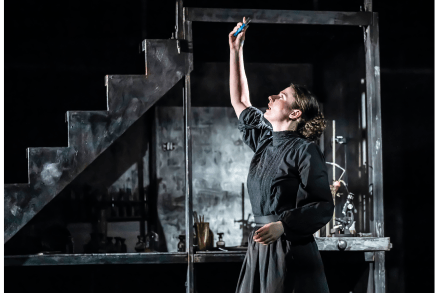
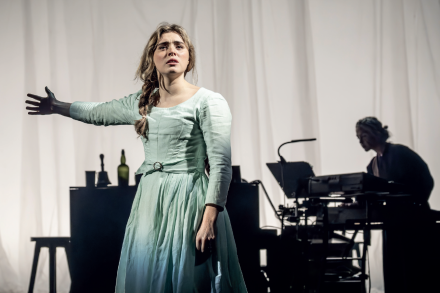
Sarah Snook, who appeared in Succession, takes centre stage in Kip Williams’s adaptation of Oscar Wilde’s only novel. The best thing about The Picture of Dorian Gray is the narrative premise: a young aristocrat commissions a portrait of himself and the image grows old while he retains his youthful good looks. It’s a ghost story, really, and Dorian ‘dies’ when the portrait is completed and then haunts his own life as an ageless and untouchable spirit. Wilde used the book as a literary showcase for his aphorisms. On ageing: ‘The tragedy of old age is not that one is old, but that one is young.

Dramatically riveting and visually superb: Dear Octopus, at the Lyttelton Theatre, reviewed

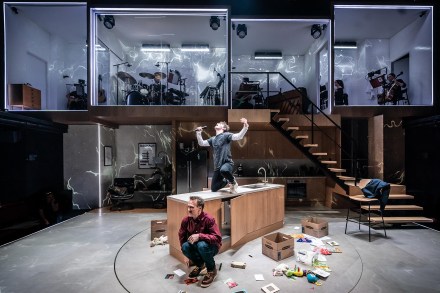
Big budget, huge stage, massive temptation. The Lyttelton is a notorious elephant-trap for designers who feel obliged to fill every inch of space with effortful proof of their brilliance. Frankie Bradshaw, designer of Dear Octopus, avoids these snares and instead creates a modest playing area, smaller than the actual stage, which is bookended by a doorway on one side and a fireplace on the other. These physical boundaries draw the actors towards the middle of the stage with a staircase overhead to complete the frame. Brilliant stuff. Perfectly simple, too. Any director planning to work at the Lyttelton should see Emily Burns’s fabulous production. So should everyone else.

It’s no Jerusalem: Jez Butterworth’s Hills of California, at Harold Pinter Theatre, reviewed

Fifteen years after penning his mega-hit Jerusalem, Jez Butterworth has knocked out a new drama. The slightly baffling title, The Hills of California, refers to a hit by Johnny Mercer (the US songwriter not the MP for Plymouth) and it suggests American themes and locations. But the show is set in a knackered old Blackpool boarding house in the 1970s, where three sisters are waiting for their elderly mum to croak. It takes an hour of chit-chat to explain what’s happening. When the sisters were little, their ambitious mother forced them to perform song-and-dance routines in the hope of launching them as kiddie superstars on the new medium of television. The eldest girl, Joan, quit the group at the age of 15 and fled to America to make it big.

An unmistakable hit: Till the Stars Come Down, at the Dorfman Theatre, reviewed

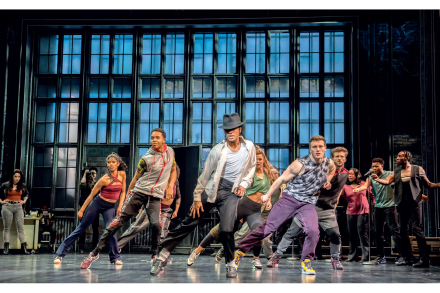
Till the Stars Come Down is a raucous, high-energy melodrama set at a wedding in Hull. The writer, Beth Steel, focuses on three female characters and virtually ignores the men in her story which is just as well because her male characters all talk and act like planks. Her women are full of courage, craziness and fun. This is a hit. West End, easily Broadway, maybe. Pack your bags, girls We meet Sylvia, the anxious bride, who fears that her family won’t accept her Polish spouse, Marek. Her sister, Hazel, is facing a romantic crisis because her husband has stopped paying her attention in bed. And sexy Maggie harbours a secret that’s bound to spill out during the drunken festivities. The three shrieking women exchange ribald gags.

Meandering, flat and witless: Plaza Suite, at the Savoy Theatre, reviewed

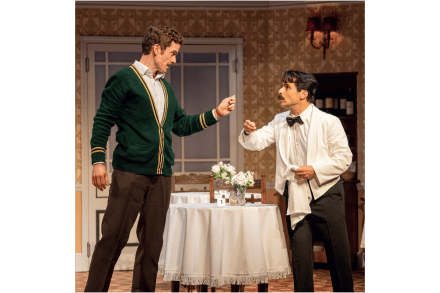
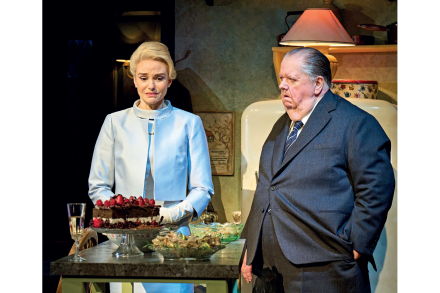
Plaza Suite is a sketch show by Neil Simon set in a luxury New York hotel in 1968. The play is rarely revived and it’s never been staged in the West End before. Simon’s idea (which Noël Coward accused him of stealing from his play Suite in Three Keys) is to place a trio of unrelated stories in the same hotel room. Simon struggles to find good endings for his set-ups and he keeps scribbling page after page of chit-chat in the hope of stumbling on a decent exit-line. He can’t do it. The dialogue sounds true to life but it’s also meandering, flat and witless – the sort of drivel you’d overhear in a vet’s waiting room.

Visually world-class, dramatically second-rate: Don’t Destroy Me, at the Arcola, reviewed

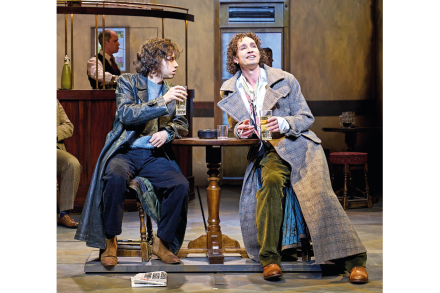
Don’t Destroy Me is the rather breathless title of Michael Hastings’s first play which he wrote when he was just 18. The material draws on his adolescent years in a south London boarding house and the action opens with an elderly husband, Leo, and his unfaithful young wife, Shani, preparing for a visit from their handsome teenage son, Sammy. Leo knows that his marriage is being undermined by Shani’s affair with a cocky spiv who lives next door but this tawdry business fades into the background as the play starts to come alive. The characters upstairs take over. The flat above is occupied by Mrs Pond, a pretentious fraud in her early forties who is desperate for romance and attention.

Duff nonsense: The Enfield Haunting, at Ambassadors Theatre, reviewed

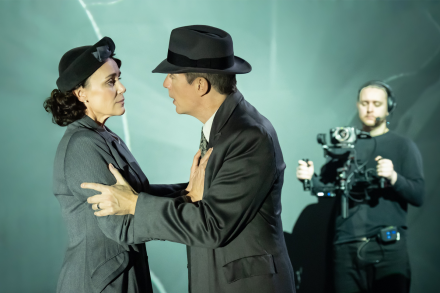
The Enfield Haunting is a good old-fashioned horror show that wants to be a documentary as well. It’s based on a hocus-pocus yarn that made the front page of the Daily Mirror in 1977 and was swiftly forgotten. The play opens in an Enfield terrace that resembles a bomb site, complete with charred plasterwork, missing walls and ripped out floorboards. Peggy, a harassed housewife played by Catherine Tate, is struggling to cope with three teenage brats and a ghost that’s got loose in her home. Two ghosts, in fact. Peggy’s daughter, Janet, has been possessed by a demonic spirit that forces her to rasp out nonsense in a hoarse, throaty gurgle, like that annoying girl from The Exorcist.

Donmar Warehouse declares war on Shakespeare

Many of today’s theatre directors seem to believe that Shakespeare’s work was a huge mistake which they have a duty to correct. According to Max Webster, the director of Macbeth at the Donmar, Shakespeare’s error was to write scripts for the stage which would work better as radio plays. His amended version is set in a fake recording studio where every seat is equipped with a set of headphones. Spectators must test the gear first to ensure that the stereo effect is working. If not, contact a member of staff, etc. David Tennant, playing the lead, transforms himself from a nice friendly Time Lord into an irascible Scottish warlord. He’s a terrific light comedian but his mischievous off-beat style doesn’t suit the role of an earnest, bloodthirsty villain.

Do we really need this unsubtle and irrelevant play about Covid?

Pandemonium is a new satire about the Covid nightmare that uses the quaint style of the Elizabethan masque. Armando Iannucci’s play opens with Paul Chahidi as Shakespeare introducing a troupe of players who all speak in rhyming couplets. A golden wig descends like a signal from on high and Shakespeare transforms himself into the ‘World King’ or ‘Orbis Rex’. This jocular play reminds spectators with a low IQ that Orbis is an anagram of Boris. The former prime minister, also labelled the ‘globular squire’, is portrayed as a heartless, arrogant schemer driven by ambition and vanity. He retells the main events of the pandemic with the help of an infernal aperture which works as a dungeon, a hospital and, finally, as a version of Hades into which the characters are sucked.

You’ll want all the characters to die: Infinite Life, at the Dorfman Theatre, reviewed

Infinite Life is about five American women, all dumpling-shaped, who sit in a hotel garden observing a hunger strike. Some of them haven’t touched food for days, some for weeks. ‘Don’t be afraid to puke,’ counsels one of the dumplings. ‘Puking is good.’ They pass their afternoons wittering inanely about nothing at all. One dumpling is an air hostess, another works in banking, a third has a job as a fast-food executive. Or so they claim. Each of the dumplings might be lying to the others but it would make no difference because nothing connects them, and they have no stake in the situation other than the desire to burn up time.

What a muddle: The House of Bernarda Alba, at the Lyttelton Theatre, reviewed

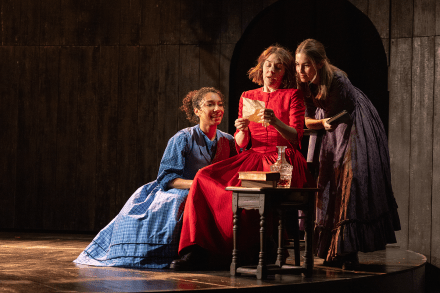
Green, green, green. Everything on stage is the same shade of eau de Nil in the NT’s version of Federico García Lorca’s classic, The House of Bernarda Alba. All the furniture and props are green. The mirrors, the walls, the crucifixes, the clocks and even the bucket and the knife-rack bear the same queasy pigment. The idea, perhaps, is to suggest a lunatic asylum or an NHS waiting room. Lorca’s steamy tale is set in a remote Spanish village in the 1930s where life is dominated by the repressive and superstitious Catholic church. The story opens with a nasty matriarch, Bernarda Alba, celebrating her husband’s death by ordering her five unmarried daughters to spend the next eight years indoors, doing embroidery. No visitors are allowed.

An amusing playlet buried in 150 minutes of rhetoric: Mates in Chelsea, at the Royal Court, reviewed

Theatres outside London like to produce shows that appeal to their local communities. Inside London, where cultural attitudes are strangely warped, theatres are happy to disregard the neighbourhoods they serve, and they show little interest in the lives of their customers. But the Royal Court Theatre and Hampstead Theatre have both chosen to stage shows that feature characters who live nearby. Mates in Chelsea, at the Royal Court, stars a bone-idle superbrat, Tuggy, whose inheritance is threatened when his snooty mother (who is brilliantly played by Fenella Woolgar) decides to flog the family castle in Northumbria. An offer is received from a Russian billionaire, Oleg, and Tuggy promptly has a meltdown. After an elaborate farce, the play ought to peter out.

Magical: The Box of Delights, at Royal Shakespeare Theatre, reviewed

In Stratford-upon-Avon, the wolves are running. And if you’re old enough to feel a little thrill of wintery excitement at those words, you’ll have questions of your own about the Royal Shakespeare Company’s The Box of Delights. Questions about talking rats and flying cars, and whether time and tide and buttered eggs still wait for no man. John Masefield’s novel thrived on radio adaptations for decades after its publication in 1935 but the beloved BBC TV version was in 1984, and four decades is a horribly long time. Piers Torday’s new dramatisation faces the double challenge of entertaining a new generation of youngsters while also pleasing the nostalgia-addled oldies who are, after all, splashing the cash.

Gloriously entertaining: Backstairs Billy, at the Duke of York’s Theatre, reviewed

Backstairs Billy is a biographical comedy about William Tallon, who worked as the Queen Mother’s chief footman for years following the death of George VI in 1952. Tallon was an enthusiastic gay cottager whom the tabloids suggestively dubbed ‘backstairs Billy’ during the 1970s when attitudes to homosexuality were growing more enlightened. The show, directed by Michael Grandage, is set in 1979 and Luke Evans plays Billy as a swaggering charismatic stud who loves his role as the unofficial head of the Queen Mum’s household. He adores his employer, ‘the last Empress of India’, and he praises her decision to remain in London during the Blitz rather than decamping to safety in the countryside or overseas.

Surprising flop from a top-class team: To Have and To Hold, at Hampstead Theatre, reviewed

To Have And To Hold boasts a starry cast and a top-class creative team. Richard Bean’s script is a meditation on ageing, directed by Richard Wilson and Terry Johnson, and it opens with a sight-gag about a wonky stairlift descending into a suburban lounge in Yorkshire. The stairlift is occupied by Flo, a tea-drinking fusspot (charmingly played by Marion Bailey), who looks after her crumbling husband, Jack. Both have endured 70 years of marital bliss and are slithering gently into the grave. Flo gets help from her middle-aged son Rob and his sister Tina, but they’re zestless, bland personalities.

Branagh can’t quite banish the spirit of Noel Edmonds: King Lear, at Wyndham’s Theatre, reviewed

Branagh vs Lear. The big fixture in theatreland ends in a win for Shakespeare’s knotty and intractable script which usually defeats any attempt to make it coherent or dramatically pleasing. This truncated version is a two-hour slug-fest set in the stone age – and it sort of works. The warriors fight with sharpened walking sticks and they stab each other using twigs whetted to a fine point. If you ignore the steel buckles and the writing paper, which were clearly invented earlier, you’ll find it just about believable. On stage, Branagh can’t quite banish the spirit of Noel Edmonds and he adds to the cheeky-chappie persona with a thick golden quiff (possibly a wig) and a mink collar that seems to have been backcombed and scented with talcum powder.

Comedy of the blackest kind: Boy Parts, at Soho Theatre, reviewed

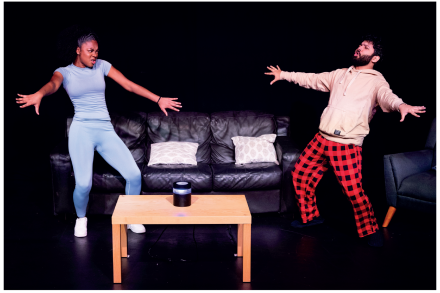
There’s something mesmerising about watching a good mimic. And Aimée Kelly, who plays fetish photographer Irina Sturges in Soho Theatre’s Boy Parts, is a very good mimic. Across the 80 minutes of this one-woman performance, she inhabits the bodies of dozens of characters, each a carbon copy of the worst kind of person: oleaginous city bankers; shrill, hysterical twenty-something women; ‘Andrew Tate-core’ men. An unnamed boy ends up as nothing more than a severed head Her sneering representations of these characters instruct us to see them (whether we want to or not) as Irina does: pathetic and deeply undesirable. It’s uncomfortable.

Real women do not behave like this: Lyonesse, at the Harold Pinter Theatre, reviewed

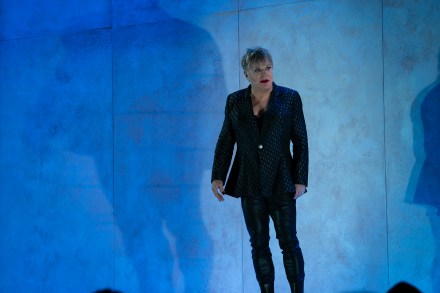
Lyonesse by Penelope Skinner takes a while to get going. The central character, Elaine, is a washed-up British actress (Kristin Scott Thomas) who lives in a crumbling mansion in Cornwall where she dreams of making a comeback as a movie star. She contacts a clueless researcher, Kate, and asks her to drive down from London to write a screenplay about her reclusive existence in the sticks. Kate meets Chris, a mixed-race lesbian poet who works as Elaine’s chauffeur, factotum, and companion. Chris also keeps the moths away from Elaine’s collection of 12 dead parrots, stuffed and caged. It’s a piece of absurdism that doesn’t know how absurd it is After nearly an hour of stage time, Elaine is ready to narrate her life story with Chris on duty as her stagehand.

If only Caryl Churchill’s plays were as thrillingly macabre as her debut

The first play by the pioneering feminist Caryl Churchill has been revived at the Jermyn Street Theatre. Owners, originally staged in 1972, feels very different from Churchill’s later work and it recalls the apprentice efforts of Brecht who started out writing middle-class comedies tinged with satirical anger. Churchill sets her play in the cut-throat London property market where prices are soaring and tenants are apt to be evicted if they can’t cover sudden rent rises. Marion is an estate agent who secretly buys a house occupied by her former lover Alec who is married to Lisa. Their third child is on the way. Marion hatches an evil plan to kick the family out and to claim Alec back as they sink into financial ruin.

Scherzinger is superb but why’s the set so dark and ugly? Sunset Boulevard, at the Savoy Theatre, reviewed

Sunset Boulevard is a re-telling of the Oedipus story set in the cut-throat world of Hollywood. Pick a side in this tortured yarn. There’s Norma, a burned-out sex-goddess, who wants to make a comeback as a teenage ballerina in a dance epic. Or there’s Joe, a penniless scribbler, who becomes Norma’s reluctant toyboy while he works on her doomed screenplay (which stands for a stillborn child). Clinging to Joe is Betty, a drippy girlfriend who represents escape and artistic integrity. The final piece in the jigsaw is Norma’s discarded husband, Max, who stands for sadistic and destructive obsession. Each day he sends Norma a new batch of counterfeit love letters from non-existent fans.