Theatre

Heart-warming but safe biographical drama: Going for Gold, at Park90, reviewed

Going for Gold is a biographical drama about a forgotten star of the 1970s. Frankie Lucas was a middleweight boxing champion, born on the Caribbean island of St Vincent, who won a gold medal at the Commonwealth Games in 1972. Although he lived in London he wasn’t picked for the England team and instead he wore the colours of his native land. He did them proud. Frankie Lucas seems to have spent 42 years sitting in a council flat, smoking weed and sulking The script, by Lisa Lintott, emphasises Lucas’s virtues and downplays his rackety personal life and his habit of smoking bales of cannabis on a regular basis.

A flop: The Curious Case of Benjamin Button, at Ambassadors Theatre, reviewed

The Curious Case of Benjamin Button carries a strap-line, ‘an unordinary musical’. Perhaps the word ‘extraordinary’ is simply too banal to capture the outstanding qualities of this unique show. The year is 1918 and a miraculous birth occurs in a remote Cornish fishing village. The newborn is not a baby but an adult pensioner, Benjamin, who emerges from the  womb wearing a three-piece suit, a pair of spectacles and a bowler hat. His shame-faced mother hastens away from the family home and takes a walk along the cliffs, which results in her death. Suicide, perhaps. And Benjamin’s angry father locks him in the attic and refuses to let him out. Benjamin escapes and visits the local pub where he enjoys a single pint of ale every Friday night for the next four years.

A riveting show crammed with the kind of risky gags rarely heard on stage these days

How To Survive Your Mother is a play based on a memoir by political dramatist Jonathan Maitland. He portrays himself in the show, and he muses on the wisdom of turning his manipulative, devious, sex-mad mother into a dramatic heroine. In the end, he’s swayed by ‘Edinburgh derangement syndrome’ as he calls it. ‘You’re diagnosed with terminal cancer and you think: “Great, there’s a show in this.”’ Maitland’s account of his rackety childhood is crammed with risky gags rarely heard on stage these days His mother, Bru, was a Jewish refugee from Haifa who posed as a Frenchwoman with Spanish roots to protect herself from the anti-Semitic bigotry. Her self-taught skills included seduction, bribery and fake suicide attempts.

Is Coogan’s Dr Strangelove as good as Sellers’s? Of course not

Stanley Kubrick’s surreal movie Dr Strangelove is a response to the fear of nuclear annihilation which obsessed every citizen in the western world from the end of the Cuban missile crisis in 1962 until the fall of the Berlin Wall in 1989. The play’s co-adaptors, Sean Foley and Armando Iannucci, are old enough to recall that fear – but they’ve omitted any sense of collective anxiety from their adaptation. It’s a just a larky tribute to the movie, like a sketch show. Daft not disturbing. It turns out Dr Strangelove is like Father Christmas – more potent as a mythical abstraction than as a reality The story starts with an insane American, General Ripper, ordering a squadron of B-52s to nuke Russia before the communists can overwhelm the United States.

Revenge tragedy for kids: The Duchess [of Malfi], at Trafalgar Theatre, reviewed

The Duchess [of Malfi] has been partially updated by Zinnie Harris in a puzzling modern-dress production. The set by Tom Piper resembles a concrete bunker in an abandoned apartment block and Ben Ormerod’s lighting throws weird shadows across the playing area, which seems to consist mostly of discarded plywood sheets. It feels like a scout-hut production on a micro-budget. The second act involves gory scenes of homicidal violence staged with amusingly inept special effects Jodie Whittaker stars as the lustful Duchess whose destiny lies in the hands of her elder brother, the Cardinal, played by the entertaining Paul Ready. Whittaker’s role is clumsily arranged within the play and she spends a lot of time off-stage. And her character lacks emotional coherence.

Almeida’s Look Back in Anger is flawless

Strange title, Juno and the Paycock. Sean O’Casey’s family drama is about a hard-pressed Dublin matriarch, Juno, whose husband Jack ‘the paycock’ Boyle refuses to support his family and spends all day drinking with his penniless cronies. The producers have labelled the show an ‘Irish masterpiece’, which raises the bar. Mark Rylance plays Jack as a stammering, dissembling, wisecracking malingerer and he’s terrific value on stage, of course, but he seems detached from the material. He performs like a star comedian stranded in a boring classic against his will and he pokes fun at the script rather than immersing himself in the story.

How is Arnold Wesker’s Roots, which resembles an Archers episode, considered a classic?

The Almeida wants to examine the ‘Angry Young Man’ phenomenon of the 1950s but the term ‘man’ seems to create difficulties so the phrase ‘Angry and Young’ is being used instead. It’s strange to encounter a theatre that’s scared of words. The opening play, Roots, by Arnold Wesker, looks at the conflict between town and country in 1950s Norfolk. Beatie, in her early twenties, returns from London and announces to her warm-hearted but unsophisticated family that her boyfriend, Comrade Ronnie, wants to meet them. He’s a pastry chef who supports a Marxist revolution and Beatie is eager to fight for everything he believes in.

Faultless visuals – shame about the play: the National’s Coriolanus reviewed

Weird play, Coriolanus. It’s like a playground fight that spills out into the street and has to be resolved by someone’s mum. The hero is a Roman general whose enemies conspire to banish him so he takes revenge by joining forces with a foreign power and laying siege to Rome. Coriolanus’s mother shows up on the battlefield and begs him to drop his vendetta and come back home. Later he dies but without delivering a big speech. The Roman soldiers have plastic swords that go ‘clack’ rather than metal ones that go ‘ching’ The key difficulty is that Coriolanus’s tragic flaw, a lack of ambition, is really a virtue. He’s far too noble for his own good and his disdain for power makes him annoying rather than admirable.

The show belongs to Jonathan Slinger and Ben Whishaw: Waiting for Godot reviewed

Waiting for Godot is a church service for suicidal unbelievers. Those who attend the rite on a regular basis find themselves wondering how boring it will be this time. A bit boring, of course, but there are laughs to be had in James Macdonald’s production. The set resembles a Gazan bombsite with a tree-stump stranded in a pit of ashen rubble. Didi is played as a goofy English toff by Ben Whishaw who supplied the voice of Paddington in the movies. The bear is back.

A massive, joyous, sensational hit: Why Am I So Single? reviewed

Why Am I So Single? opens with two actors on stage impersonating the play’s writers Toby Marlow and Lucy Moss. You may not recognise the names but you’ve probably heard of their smash-hit, Six, which re-imagined the tragic wives of Henry VIII as glamorous pop divas. This follow-up show is a spoof of vintage musicals and it’s deliberately knowing and self-referential. That’s why the authors are played by members of the cast, and they start with a few disparaging quips about Mamma Mia! and other West End fare. They even call the audience at the Garrick ‘riff-raff’, which seems a little charmless.

The rise of soapy, dead-safe drama: The Band Back Together reviewed

The Band Back Together is a newish play, written and directed by Barney Norris, which succeeds wildly on its own terms. It delivers a low-energy slice of feelgood nostalgia involving three musicians who reunite in their hometown of Salisbury. The action consists of talk and songs, more talk, more songs, some cider-drinking and a surprise ending to convince the audience that it was worth the wait. The play was commissioned by Farnham Maltings, an arts centre in Surrey, whose aim is to ‘bring artists, makers and communities together’ and it feels a bit am-dram. The script has no conflict, suspense or uncertainty. No harrowing emotions or life-changing experiences. It’s just a pipe-and-slippers get-together involving three has-beens who once shared a stage as musicians.

Dazzling: Stoppard’s The Real Thing, at the Old Vic, reviewed

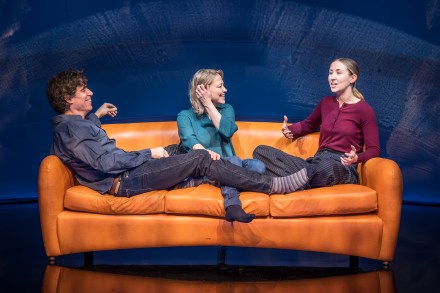
The Real Thing at the Old Vic is a puzzling beast. And well worth seeing. Director Max Webster sets the action in a vast sitting room painted electric blue with a white sofa in the centre. A lovely use of empty space. But the preview trailer on the theatre’s website shows the actors seated in a scruffy bomb site where they discuss similarities between Tom Stoppard’s 1982 play and the lyrics of Taylor Swift. Perhaps the Old Vic hopes to attract a younger audience, but this show will appeal most to Stoppard’s lifelong fans. The play marks a major shift in his development. The exuberant and frothy cleverness of his earlier work has acquired emotional weight and a tougher outer shell. There’s a lot of jealousy and anger smouldering beneath the surface.

Artistically embarrassing but a hit: Shifters, at Duke of York’s Theatre, reviewed

Shifters has transferred to the West End from the Bush Theatre. It opens at a granny’s funeral attended by the grief-stricken Dre, aged 32. Dre was raised by his ‘Nana’ as he calls her – rhyming it with ‘spanner’ – and he weeps when he realises that his mother has failed to show up. A beautiful young woman arrives unexpectedly. This is Dre’s teenage sweetheart and they exchange gossip over a glass of whisky while rummaging through Nana’s belongings. The press night crowd adored these flawless yuppies. An artistic embarrassment but a sure-fire hit The lovebirds met at school where they studied philosophy and outshone all their rivals in the class.

The cast mistake screaming for comedy: Cockfosters, at Turbine Theatre, reviewed

The Turbine Theatre is a newish venue beneath the railway arches of Grosvenor Bridge in Battersea. The comfy auditorium is furnished with 94 cinema seats and the only snag is the scent of mildew clinging to the plasterwork. Overhead, the rumbling commuter trains create the perfect soundscape for Cockfosters, a zany rom-com set on the Tube. Two travellers meet by accident on a Piccadilly line service departing from Heathrow Terminal 3. James is a nerdy public-school reject who spots a fellow traveller, Victoria, struggling to shift three monster suitcases onto the train. Obeying Tube etiquette, he makes no attempt to help her and they sit in adjoining seats without acknowledging each other. Beside them are two passengers engrossed in royal biographies.

This Edinburgh Fringe comedian is headed for stardom

Dr Phil Hammond is a hilarious and wildly successful comedian whose career is built on the ruins of the NHS. His act has spawned a host of imitators on the stand up-circuit and they share Dr Phil’s confused adoration for the NHS. All of them love the idea of universal healthcare but they dislike the messy practical details. And they’re convinced that extra cash will save the system. The evidence suggests otherwise; handing more money to the NHS is like giving a gambling addict the keys to a bullion van. The gallows humour is delightful if you’re not stuck in an NHS queue Dr Phil claims that he would gladly pay higher taxes because the NHS has to scrape by on ‘third-world funding’. This is part of the difficulty.

Reinforces the caricatures it sets out to diminish: Slave Play, at the Noël Coward Theatre, reviewed

Slave Play is a series of hoaxes. The producers announced that ‘Black Out’ performances would be reserved for ‘black-identifying’ playgoers but the ticketing system is colour-blind and these so-called ‘segregated’ shows were attended by audiences of all ethnicities. The PR gambit generated lots of free publicity, but these stunts don’t always translate into ticket sales. The second hour involves screeds of impenetrable psychobabble as the couples bicker and moan The show appears to be a drama set in the Deep South before the American civil war. It opens with a white farmer humiliating his black cleaner, who easily outsmarts him. When he forces her to eat fruit from the dirty floor she tells him how delicious it tastes.

Shapeless and facile: The Hot Wing King, at the Dorfman Theatre, reviewed

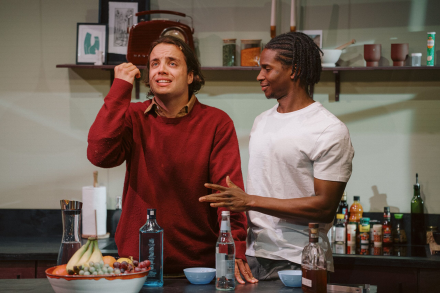
Our subsidised theatres often import shows from the US without asking whether our theatrical tastes align with America’s. The latest arrival, The Hot Wing King, is a Pulitzer Prize-winning play about unhealthy eating. The production opens in a luxury house in Memphis, occupied, rather strangely, by four gay men who dress gracelessly in cheap, flashy designer gear. They behave like overgrown babies and spend their time leaping about the place, bickering and bantering, singing songs, performing dance moves and exchanging cuddles. This cameo repeats the caricature of the foolish African crook. Why is the Globe perpetuating racial bigotry? One of the four man-babies wears a business suit and calls himself ‘a manager’ but the others appear to be unemployable. Yet they’re affluent.

Vapid and pretentious: Visit From An Unknown Woman, at Hampstead Theatre, reviewed

Visit From An Unknown Woman, adapted by Christopher Hampton from a short story by Stefan Zweig, opens like an episode of Seinfeld. A playboy writer enjoys a fling with a black-clad beauty – but when he kisses her goodbye, he can’t remember her name. It feels like a set-up for a gag, but the script is very short of jokes. A year passes and the mysterious beauty, named Marianne, returns to the playboy’s pad and delivers a series of astonishing revelations. At this point, the show turns into a memory play as Marianne starts to yammer about her childhood, her family struggles and a mass of other details which sound like an over-emotional shopping list. Not everyone found this show vapid and pretentious.

Unmissable – for professors of gender studies: Alma Mater, at the Almeida Theatre, reviewed

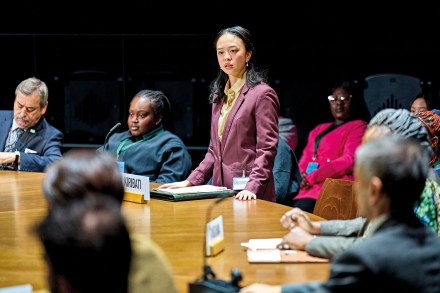
Alma Mater is a topical melodrama set on a university campus. The new principal, Jo, (amusingly played by Justine Mitchell) is a radical feminist who recalls the bitter struggles of the 1980s when she strove to put women on an equal footing with men. Her task now is to address the college’s reputation for ‘binge-drinking, partying and casual sex’. To ingratiate herself with the students she makes a speech full of swear words which greatly impresses the first years, apparently. Then a nightmare unfolds. A naive Welsh fresher, Paige, attends a fancy dress party where she’s sexually assaulted by a handsome older student. Drink was involved. Paige admits that she blacked out during the incident and the accused has no recollection of what happened.

Morally repugnant: Boys From the Blackstuff, at the Garrick Theatre, reviewed

Yosser Hughes is regarded as a national treasure. He first appeared in 1982 in Alan Bleasdale’s TV drama, Boys from the Blackstuff, which followed a crew of Liverpool workers who lay tarmac (‘black stuff’) for a living. When their contract expires the lads are left shocked and helpless even though job security is not a perk of their profession. The atmosphere of the show, adapted by James Graham, may come as a surprise to those who know Yosser by reputation only. Far from being a worker’s champion, Yosser is a crook, a hypocrite and a class-traitor. He and his friends moonlight for cash while claiming state benefits, which are, of course, levied on the wages of honest workers. And they pilfer from Liverpool docks which increases the prices paid by customers who aren’t cheats.