Theatre

A gaggle of husbands and a pair of piglets

Here’s a great idea for a play. Turn the polygamy principle upside-down and you get a female egoist presiding over a harem of warring husbands. Sharmila Chauhan’s drama, The Husbands, introduces us to a pioneering sex maniac, Aya, who founds a commune in India where women take as many spouses as they fancy. Aya herself has three blokes on the go and is about to get married again.  Curtain up and we meet her pre-existing husbands, Sem and Omar, who get along together very nicely. Both are childishly besotted with Aya. Which is also nice. Anticipating the arrival of husband number three, the hubbies quietly vacate the bedroom and start preparing a wedding feast. Lovely. For the characters, at least.

If you’re going to adapt a bestseller, don’t choose the A-Z

What’s the quickest way to create a hit musical? Base it on a bestselling book. The writers of The A-Z of Mrs P have done just that. But they’ve chosen the wrong book. You twits. You need to pick a popular novel, not the London street directory. The main character, Phyllis Pearsall, spent years trudging the pavements of the capital creating her catalogue of 23,000 streets. In this show, the character of Mrs P, a posh and self-contained bumpkin, proves dramatically inert. The writers seem to have twigged that she’s a dud, so they’ve turned their attention to her uppity Hungarian father and his sozzled Irish wife. But these two yield no rewards either. He’s a shouty nuisance and she’s a whimpering wreck.

Rape, porn and Cheesy Wotsits

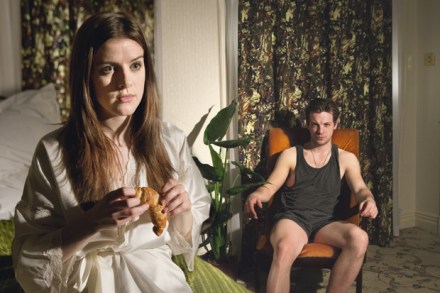
Interesting times at Soho Theatre. One of its outstanding shows of last year, Fleabag, was an offbeat Gothic love story written by and starring Phoebe Waller-Bridge. The director of Fleabag, Vicky Jones, has penned another offbeat Gothic love story. And it stars Waller-Bridge. The action plunges us into the weird, manipulative love life of beautiful Jo and her slick older lover Harry. Up goes the curtain and they’re copulating to porn while sharing a bag of Cheesy Wotsits. Harry’s old flame Kerry bursts in and announces that she’s been raped. Harry and Jo console her, rather perfunctorily, and then use her distress to start swapping cynical, sneering accusations about their own relationship. Already, the audience is gripped.

Superior Donuts – a very irritating success

Tracy Letts, of the Chicago company Steppenwolf, has written one of the best plays of the past ten years. August: Osage County is an exhilarating, multilayered family drama whose sweep and power amazed everyone who saw it on stage. His 2008 play, Superior Donuts, has a smaller, cosier canvas. We’re on the north side of Chicago in a doughnut bar run by an ageing hippie named Arthur. Yes, doughnuts. In a world seized with dietary paranoia, this long-haired old dreamer is trying to peddle wheat-based, starch-ridden, gluten-crammed, sugar-encrusted spheres of death. That’s Arthur in shorthand, stodgy and moribund. His donkeyish life is perked up by the arrival of Franco, a chatty young black dude, who needs a job and a publisher for his novel.

Brave Tommies and dim earls — Oh What a Lovely War is hoity-toity reductionism

Here it is. Fifty years late. Oh What a Lovely War was originally staged at Stratford East in 1964. It returns to its birthplace to cash in on this year’s anniversary of the Great War. Sorry, I meant commemorate. The title is so familiar that one overlooks its callow, misanthropic glibness. Does anyone think war ‘lovely’? The show’s narrator sprints through the causes of the conflict, and its chief battles, without offering any historical insight. Music-hall songs and comedy stereotypes trundle past on a conveyor belt of laughter and slaughter. The show was inspired by angry dogmatist Joan Littlewood, who wanted to sock it to R.C. Sherriff for writing a hit play, Journey’s End, that overlooked working-class infantrymen.

Putin: ‘Oi, Europe, you’re a bunch of poofs’

Sochi 2014 is the least wintry Winter Olympics ever. Yes, there’s a bit of downhill shimmying going on in the slalom. And a few figure skaters are pirouetting around the rink. Midair daredevils, with their feet lashed to planks of bendy plastic, are performing spectacular twirls and somersaults and crashes. And there are speed freaks on tea trays racing down ice-packed gulleys in tribute to the Hadron Collider. But the real action is off-piste and off-chute. It’s a political grudge match. Two implacable foes are angrily denouncing each other as shameful and perverted barbarians. The Hope Theatre’s verbatim drama, Sochi 2014, taps into this febrile mood with a documentary history of gay Russia since the collapse of the Soviet empire. At first all was rosy.

A World Elsewhere hints it’s about Bill Clinton. But it’s about Al Gore

Why, oh why, the producers ask, are the national press so reluctant to cover the London fringe? The snag is that a national paper has to justify a report about a play produced in a Deptford yoga studio, or in a Wandsworth priest hole, to readers living in Liskeard, Inverness, Great Yarmouth and Carlisle. Rather than changing the habits of the newspapers, the producers might change the way they select plays. A few years ago, a modest little venue in Hoxton mounted a satire called The Death of Margaret Thatcher. The national papers dispatched their finest critics and they were joined by political commentators from around the world. The play was rubbish, alas, but as a piece of publicity it remains unsurpassed. Theatre 503 in Battersea seeks to emulate this ploy.

Sam Mendes’s King Lear is a must-see for masochists

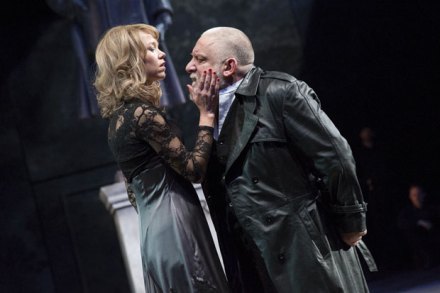
Directors appear to have two design options when approaching a Shakespeare tragedy. Woodstock or jackboot. Woodstock means papal robes, shoulder-length hair and silver Excaliburs gleaming from jewelled belts. Jackboot means pistols, berets, holsters and submachine-guns. Sam Mendes sticks the jackboot into King Lear in an attempt to find ‘a modern understanding of the story’, as he puts it. What this ‘modern understanding’ reveals is that Shakespeare’s opening scene allows the dramatic focus to move between the personal and the political with invisible fluency. Mendes destroys this asset by laying on a televised show trial. Lear’s daughters, surrounded by scowling commandos, are arraigned at miked-up tables as if accused of treason.

If you can figure out the mind-boggling plot of Ciphers — join Mensa

Here’s a heartwarming tale from the London fringe. A company named Above the Stag was merrily plying its trade at a small pub attic in Victoria. Then in March 2012 a bulldozer squashed the pub flat. In its place rose a glittering steel tower full of geeks, screens, beeps and loot. Undeterred by demolition trucks and by dollar-gobbling speculators, Above the Stag began searching for a new arena. After a difficult year cadging empty spaces from nearby theatres, the company has now found a permanent home beneath a Vauxhall archway. Good news: London’s theatreland is expanding even when freeholders are literally whipping the land from under its feet.

The Thomas Cromwell plays would be stronger if they made him weaker 

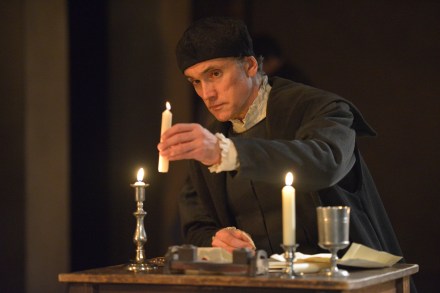
Three things you might not expect of the RSC’s adaptation of Hilary Mantel’s Tudor novels. First, Mike Poulton’s plays have some great jokes. Laugh-your-head-off funny, you might say. Second, although Tom, Dick and Mary tell me they found Mantel’s Bring Up the Bodies a more enjoyable read, Wolf Hall is the better play. Finally, the reinvention of the brutal Thomas Cromwell as someone you would have liked is, in the plays, a source of weakness as much as strength. Not that these are weak plays: six hours is a long time to spend on a theatre seat, yet I would happily see these plays back-to-back again tomorrow.

The play to watch if your country is breaking up

Of all the West End’s unloved venues the loveliest is the Arts Theatre. It specialises in creaky off-beat plays like Only Our Own by Ann Henning Jocelyn. We’re in Connemara, in the west of Ireland, in the early 1990s. A family of Anglo–Irish toffs are struggling to cope with their status as universal pariahs. Wherever they go they’re out of place. Catholic Ireland resents them. In England, their spiritual home, they feel like aliens. Titania, a narky teenager, is baffled by her parents’ religious prejudices and she merrily announces her involvement with a boozy local bumpkin. He’s Catholic, naturally. This prompts a bombshell of a speech from Titania’s grandmother, Lady Eliza, who witnessed a village insurrection in 1922 when she was just 11.

The Duck House is the best show in the West End

It’s taken me a few months to catch up with the political farce The Duck House. Then again, it’s taken The Duck House a few years to catch up with the expenses scandal that it mocks. The story is set in the half-forgotten era of 2009. Robert Houston, a glib New Labour high-flier, is planning to defect to the Conservatives on the eve of the general election. His scheme, which is a little hard to decipher, is to stand for the Tories in his safe Labour seat and to persuade his Labour supporters to join him in a mass conversion to Conservatism. Having pulled off this piece of electoral magic, he expects to land a plum job in the cabinet as soon as Cameron is returned to power.

Get tickets for Emil and the Detectives, and opera glasses — some of the child actors are tiny

It starts with a brilliant joke. We’re in the Weimar Republic in 1929. Little Emil Tischbein is listening to his mother and a moaning neighbour, Mrs Wirth, lamenting Germany’s loss of moral fibre. Mrs Wirth cites a recent gangster film whose depravity shocked her to the core. ‘We saw it three times,’ she adds.  Forewarned about thieves and hoodlums, Emil travels to Berlin carrying a precious cargo of 140 marks. A sinister stranger robs him on the train and he befriends a gang of Berlin school-kids who set off to retrieve his cash. Erich Kästner’s classic is directed with great style by Bijan Sheibani, who captures much of the book’s verve and atmosphere.

Jude Law’s Henry V is a buccaneer leading a stag-night raid across the continent — but he’d be a great Macbeth

Henry V is the final show in Michael Grandage’s first West End season. The theatre was full to bursting on press night. Jude Law, in the title role, had attracted a crowd of autograph hunters, who shivered outside the stage door. One was a tall, chubby young man in loose grey clothes wearing a bobble hat and a very kindly grin. His flies were undone. The play itself is a disjointed, rambling affair. Poorly shaped, and even a little artless, it’s crowded with fights, bloodshed and laddish humour. The scenes of brutality are offset by soaring passages of patriotic verse that have been quoted into overfamiliarity. There was much coughing and guttural distraction throughout the performance. Grandage aims for handsome, elegant informality and here he scores full marks.

How to get your child hooked on theatre (hint: don’t rule out Peppa Pig)

I remember my first trip to the theatre. I was about eight, and I got hit in the face by a finger of fudge thrown from the stage by a particularly overzealous am-dram Widow Twankey. It was an inauspicious start to what would become a lifelong passion. Despite the confectionary-based assault, I’m now a theatre writer; and, fortunately, my wife is a theatre lover, too. When we had our son, we agreed that it was important he should experience the theatre from early on, and I began mentally planning his first visit, determined for it to be more enjoyable than mine. But when would be the right time to take him? And what sort of production should we take him to?

You can’t have Mojo and your money back

In 1992 Quentin Tarentino gave us Reservoir Dogs. At a stroke he reinvented the gangster genre and turned it into a comedy of manners with a deadly undertow. This new mutation looked as if it might be easy to copy. Many tried. Among them was Jez Butterworth, whose 1995 play Mojo takes Tarantino’s zany-macabre format and moves it to Soho in the 1950s. Butterworth also leans heavily on Pinter. The play opens in the back-office of a nightclub. Two pilled-up criminals are exchanging streams of lairy London chit-chat. Their boss, Ezra, has discovered a teenage heart-throb named Silver Johnny but rival gangsters are keen to muscle in and grab a piece of the star’s income. The details are hard to follow because the jabbering thugs leap so fast from one topic to the next.

Ben Miller interview: ‘Everyone was doing alternative comedy. I thought I’d distinguish myself by just telling jokes’

Ben Miller is wolfing down a pizza. I meet the comedian in a Cambridge restaurant where he demolishes a Margherita shortly before racing off to appear on stage in The Duck House, a new farce about corrupt MPs. The show is set in 2009. Miller stars as a Labour backbencher who wants to jump ship and join the Conservatives. But first he has to convince a Tory bigwig that his expenses claims are entirely legitimate. He’s not helped by his dim-witted wife, his corrupt Russian cleaner, and his anarchist son, Seb, who has sublet the family flat in Kensington to a suicidal Goth. The writers Dan Patterson and Colin Swash wanted to stage the play just before the 2010 election. Miller believes this would have been premature.

Martin Shaw’s flaws make him perfect for Twelve Angry Men

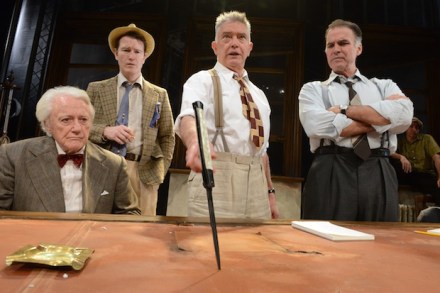
Strange actor, Martin Shaw. He’s got all the right equipment for major stardom: a handsome and complicated face, a languid sexiness, a decent physique and a magnificent throbbing voice. He sounds like a lion feeling peckish in mid-afternoon. At top volume, his growl could dislodge chimney pots. And yet he’s just a steady-eddy TV performer who does the odd stint in the West End. Why isn’t he Patrick Stewart or Anthony Hopkins? Perhaps his rhythm is too slow. Certainly, he lacks pep or sparkle, or a sense of mystery. You know what he’s going to do next because he’s just done it. And even then it wasn’t much. Warmth, innocence and fun are outside his range but these defects make him a great choice to play the central role in Twelve Angry Men.

Finally — a play about insomnia that cures insomnia

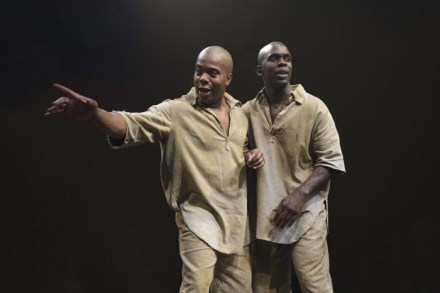
Athol Fugard is regarded as a theatrical titan but I usually need a microscope to find any trace of greatness in his work. The Island is set in a South African prison camp in the 1960s. Two banged-up lags, John and Winston, are toiling in the noonday heat. The governor torments them with a Kafka-esque prank. They’re placed at opposite ends of a sandpit and given shovels and wheelbarrows. Each must amass a dune of gravel, which his colleague is forced to deplete. This backbreaking futility is supposed to grind their spirits into nothing. It fails. Released from punishment at sundown, they retreat to their cells where they express themselves with abandon. They amuse each other with frolicsome monologues. They swap reminiscences about good old chums from home.

The sickeningly talented Johnny Flynn

‘I am walking in some mountains’. That’s the out-of-office that pops up when I email Johnny Flynn to request an interview. The folk star and West End actor is on holiday. But he’s not doing the Three Peaks Challenge. No, he’s tracing St Paul’s third missionary journey across southern Turkey, a 30th birthday present from Bea, his wife and teenage sweetheart. ‘I’m obsessed with pilgrimages,’ Flynn says. He’s also done the Way of St James, which finishes in Santiago de Compostela. ‘I love following old routes, imagining the consciousness of those who walked them.’ When he’s come down from the mountains we sit down to talk about the recent release of his third album, Country Mile.