Leanda De-Lisle

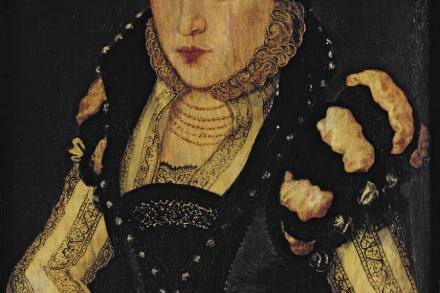
Friend of Elizabethan exiles: the colourful life of Jane Dormer

From our UK edition

Thomas Cromwell’s biographer Diarmaid MacCulloch once told me that my father’s family, the Dormers, had been servants of the great enforcer of Henry VIII’s Reformation. This may have been a tease. It is a matter of family pride that Jane Dormer’s great- uncle, the Carthusian monk Sebastian Newdigate, was executed for refusing to accept the Royal Supremacy. Jane, Duchess of Feria (1538-1612), was named after his pious sister, her grandmother. Most of Jane Newdigate’s Dormer descendants remained stubbornly Catholic over the centuries of persecution that followed, but they were never aggressive about it.
The plot thickens

From our UK edition

John Adamson’s The Noble Revolt asserts the crucial role of political ideas in the coming cataclysm of the English civil war. His focus is close: the 18 months before the final breach between Charles I and Parliament, but it is as scholarly in depth as it is cinematic in scope. Here is a dramatic retelling of a story we thought we knew well. The old Marxist interpretation of class struggle is put to rest and so is the revisionist view that the civil war was brought about by unfortunate conjunctions of personalities and events. Instead we discover how a small group of ideologically motivated noblemen came to dominate the state and attempted to reduced Charles I to a puppet king.

Elizabeth I, queen of the waiting game

From our UK edition

Women are ‘foolish, wanton flibbergibs, in every way doltified with the dregs of the devil’s dunghill’. So a cleric reminded Queen Elizabeth I. His sermon reassured her that her personal qualities made her exceptional. But Elizabeth was not merely an ‘exceptional woman’, snorts Lisa Hilton. She was also ‘an exceptional ruler’ — one who refashioned her kingdom as ‘a modern monarch, a Renaissance prince’. Elizabeth’s accession in 1558 coincided with the publication of John Knox’s notorious blast against the ‘monstrous regiment’ or ‘rule’ of women. Happily such views were ‘based more on hostility to Catholicism than to female rule per se’, we are told.

Thomas Cromwell: more Tony Soprano than Richard Dawkins

From our UK edition

The travel writer Colin Thubron once told me that to understand a country and its people he first asks, ‘What do they believe?’ This is also a good place to begin when writing about the past, not least when your subject is Thomas Cromwell, a key figure in the English Reformation.  But Tracy Borman’s Cromwell doesn’t have beliefs so much as qualities: ones that will appeal to fans of the fictional Cromwell of Hilary Mantel’s Tudor novels. Borman’s Cromwell likes women, and is nice to the poor. True he fits up Anne Boleyn on treason charges, and has the illiterate nun Elizabeth Barton executed without a trial. But then he is a ‘pragmatist’, and much of his killing, torturing and bullying is ‘self-defence’.

The Thomas Cromwell plays would be stronger if they made him weaker 

From our UK edition

Three things you might not expect of the RSC’s adaptation of Hilary Mantel’s Tudor novels. First, Mike Poulton’s plays have some great jokes. Laugh-your-head-off funny, you might say. Second, although Tom, Dick and Mary tell me they found Mantel’s Bring Up the Bodies a more enjoyable read, Wolf Hall is the better play. Finally, the reinvention of the brutal Thomas Cromwell as someone you would have liked is, in the plays, a source of weakness as much as strength. Not that these are weak plays: six hours is a long time to spend on a theatre seat, yet I would happily see these plays back-to-back again tomorrow.

Anne Boleyn’s last secret

From our UK edition

With his wife, Anne Boleyn, in the Tower, Henry VIII considered every detail of her coming death, poring over plans for the scaffold. As he did so he made a unique decision. Anne, alone among all victims of the Tudors, was to be beheaded with a sword and not the traditional axe. The question that has, until now, remained unanswered is — why? Historians have suggested that Henry chose the sword because Anne had spent time in France, where the nobility were executed this way, or because it offered a more dignified end. But Henry did not care about Anne’s feelings. Anne was told she was to be beheaded on the morning of 18 May, and then kept waiting until noon before being told she was to die the next day.

Royal bling with the Tudors at the Queen’s Gallery and the V&A

From our UK edition

As soon as the battle of Bosworth was won, Henry VII’s politically astute mother sent him appropriate clothing for his state entry into London. A king was expected to look like a king, having ‘a prerogative is his array above all others’. Sumptuary laws policed the system under the Tudors, with everyone — in theory — wearing only as much glitter and flash as their rank permitted. You really were what you wore. The Great Wardrobe Accounts of Henry VII and Henry VIII offer numerous unexpected insights into contemporary events. One sinister detail I spotted during my research on the period is a warrant issued in November 1498 for black damask to be made into doublet for the pretender Perkin Warbeck, then a prisoner in the Tower.

Bosworth, by Chris Skidmore – review

From our UK edition

Although Richard III was five foot eight, his spine was so twisted he stood a foot shorter. Imagine him hacking his way towards Henry Tudor at the battle of Bosworth; a furious human pretzel, ‘small in body and feeble of limb’, as a contemporary noted, he cut his way towards his rival ‘until his last breath’. Earlier this year, five million people watched the Channel 4 programme The King Under the Car Park which first revealed that Richard really did have slight bones, and one shoulder higher than the other, as the earliest sources had always claimed. It caught the national imagination with the details of the injuries he suffered at Bosworth bringing the violence of the battle to life.

His dark materials

From our UK edition

Like the dyslexic Faustus who sold his soul to Santa, the life of John Dee was a black comedy of errors. His vain and vulgar efforts to harness the occult for material ends often rendered him ridiculous. But there is a darker tale in Dee’s work for the Tudor state: a story of dodgy dossiers, fear-mongering and greed. During the Tudor period no clear distinction was made between science and magic. John Dee’s study at Cambridge of arithmetic, geometry and astronomy enabled him to become a navigational consultant, who worked with England’s greatest explorers. But it also helped him measure the rays of celestial virtue that emanated from the stars and influenced human affairs. Mathematics helped him predict the future — and that was a much sought-after skill.

From this week’s Spectator: The Winter King

From our UK edition

This review of Thomas Penn's biography of Henry VII, by Leanda de Lisle, is taken from the latest issue of the magazine. It is reproduced here for readers of this blog. There is something of Gordon Brown in the older Henry VII: an impression of darkness, of paranoia and barely suppressed rage, not to mention the terrifying tax grabs and tormenting of enemies. But Gordon was never quite as entertaining, or frightening, as Thomas Penn’s Winter King in this brilliant mash-up of gothic horror and political biography. David Starkey once declared Henry VII ‘boring’.

Against all odds | 1 October 2011

From our UK edition

There is something of Gordon Brown in the older Henry VII: an impression of darkness, of paranoia and barely suppressed rage, not to mention the terrifying tax grabs and tormenting of enemies. But Gordon was never quite as entertaining, or frightening, as Thomas Penn’s Winter King in this brilliant mash-up of gothic horror and political biography. David Starkey once declared Henry VII ‘boring’. But in writing his magnus opus on the supposedly more interesting Henry VIII he got so caught up in the drama of Henry VII’s court that Henry VIII is now largely being relegated to volume two of his own biography.    The first Tudor King had no legitimate English royal blood and no legal right to the throne.

A Tudor mystery unravels

From our UK edition

The fate of Lady Mary Grey, Queen Elizabeth’s prisoner and a potential heir to the throne, has never been resolved. Now Leanda de Lisle tells all At the Prime Minister’s country residence at Chequers, scribbles on the walls of the 12-foot prison room bear testimony to the dreary misery of the woman Elizabeth I had kept there. An heir to the throne, a potential English queen, now buried in obscurity. If Lady Mary Grey is recalled today, it is as a historical footnote. She was the dwarf who married a giant, the curious youngest sister of the famous Lady Jane Grey. But Mary was a more significant figure than her stature in the literature suggests.

Progress at a price

From our UK edition

I was sitting recently with a former US marine by one of the huge open windows on the top floor of the Caravelle Hotel in Saigon. Our drinks were being served on shiny black tables, and at the bar was a group of rather podgy prostitutes. There is something seedy but fun about the hotel, which reeks of new money: not unlike Saigon — as its inhabitants persist in calling Ho Chi Minh City. Saigon, and indeed Vietnam, has been transformed since the early 1990s, when the Soviet Union unravelled and the Hanoi politburo was forced to water down its rigid Marxism. The cycle rickshaws, peddled by thin men who had served in the South Vietnamese army, have gone. The streets now swarm with Hondas, and the children of the politburo mandarins shop in Versace.

A keen sense of duty

From our UK edition

William Cecil, Lord Burghley, would be delighted that in his historical afterlife he remains the old man he died as, after 40 years of power. The frail flesh and white beard projects the image of the dull bureaucrat we remember: ideal cover for an ideologue who makes Donald Rumsfeld appear warm and fuzzy, and a spin doctor whose fictions retain, after 400 years, a powerful hold on the culture of the English-speaking world. ‘Terrifying’ is an adjective Stephen Alford deploys on more than one occasion to describe Cecil, and with reason. Cecil began his political career in the household of the future Protector Somerset, surviving his master’s fall to become Secretary of State to the boy King, Edward VI.

The return of the maypole

From our UK edition

The return of the king follows a death. As the Lord Protector of the three kingdoms draws his last breath a great storm rises up, blowing down houses, trees and ships at sea. To Charles Fitzroy it is as if the elements themselves were celebrating Oliver Cromwell’s passing. But it was expected that tempests should mark the death of great rulers and in 1658 the violent winds must have appeared less a celebration than a warning of coming bloodshed. There was no more dangerous a time in a nation’s life than the passing of a ruler when the succession was in doubt. Although Cromwell was not a king in name, the idea of monarchy had survived the trial and execution of Charles I.

Diary – 9 June 2006

From our UK edition

Researching the dead can feel like being buried alive with them. After months spent with manuscripts and dusty books about the 16th century I even look like a corpse. But this week I am taking a heart-stimulating trip to Manhattan. I am giving a talk to the St Andrew’s Society of the State of New York, the oldest charitable organisation in the country. I was a bit concerned about frightening its members with my ghostly pallor, but a young friend from Men’s Health came to my aid. He arrived for a lunch date at the London Library looking gorgeously sun-kissed. He has been spray-tanned, he tells me, and inspired by his healthy appearance I have booked myself for the same treatment at a beauty salon in a local former mining village.

Diary – 13 May 2005

From our UK edition

The trouble with country life is that it is so unhealthy. Where I used to walk to the Tube I now take the car. Where I used to go out and see friends I now ruin my eyes watching television. After 20 years in Leicestershire I am almost blind and I have no muscle tone. But I have determined to go on a health and beauty drive. My first stop is the optician, where I demand tinted contact lenses — only to be told I can’t have them. They say you should suffer to be beautiful but, apparently, if you are long-sighted, stabbing at your pupils without blinking doesn’t earn you the right to be a violet-eyed lovely. Still, anything is better than glasses. For several days I practise putting in my new, colourless lenses.