Theatre

Blond ambition | 23 May 2019

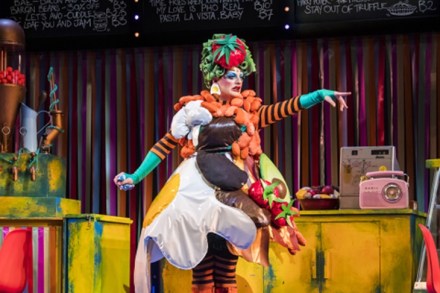
The opening of Jonathan Maitland’s new play about Boris purports to be based on real events. Just before the referendum, the Tory maverick invited some chums over to help him decide whether to opt for Leave or Remain. Mrs Johnson was present along with Michael and Sarah Gove and the Evening Standard’s owner, Evgeny Lebedev. For a bit of fun, the writer adds spectral appearances from three ex-prime ministers, Blair, Thatcher and Churchill. This is amusing at first but it slows the play down because the fantasy figures can’t affect the real-life action. There are dazzling performances here. Tim Wallers plays Evgeny as a name-dropping simpleton with naked ankles and an ultra-camp gait. Wonderful.

Labour pains | 16 May 2019

Colour-blind casting is a denial of history. The Young Vic’s all-black version of Death of a Salesman asks us to believe that an ordinary African-American chap living in Brooklyn in 1928 might have owned a Chevrolet, and that a black businessman in the 1940s would consider asking a friend for ten grand to purchase a ranch in Texas. Younger viewers may assume that US society has been racially integrated for nearly a century. Is that the right message? Willy Loman, the duffer at the play’s core, is one of American drama’s least attractive heroes. A preachy, devious, boastful, fawning, angry, narcissistic misery guts, he’s professionally incompetent and morally bankrupt.

Hilarity with heart

Small Island, based on Andrea Levy’s novel about Jamaican migrants in Britain, feels like the world’s longest book review. We meet Hortense, a priggish school teacher, and her cool, handsome boyfriend who survive on a pittance in the Caribbean. Then we skip back to Hortense’s childhood in a house dominated by a bullying preacher who forbids conversations at mealtime. Then we cross the Atlantic to Lincolnshire and meet a chirpy blonde, Queenie, whose auntie runs a sweetie shop. Does Queenie want a job selling sweeties? Yes, says Queenie to her auntie. All this takes ages, and it feels like a deadly earnest sociology lecture. Then a stiff young bank clerk enters the shop and asks Queenie if she’d like to go for a walk. And the show takes off.

One of the great whodunnits

It starts on a beautiful summer’s morning in the suburbs of America. A prosperous middle-aged dad is chatting with his neighbours in the garden of his comfortable home, but by nightfall his family has been destroyed. This is one of the most momentous convulsions in all drama. Arthur Miller’s masterful plotting, which he never again surpassed, is a match for the best. By the best I mean Oedipus. Jeremy Herrin’s production emphasises the lush fertility of America in the late 1940s. Trees in full leaf overlook the timber house that is perhaps a little too small for its millionaire owner. Joe Keller is a pioneering industrialist who served a brief jail term for supplying faulty components to the air force during the war. More than 20 pilots died.

Keeping it real | 25 April 2019

It starts at a secretarial college. The stage is occupied by a dignified elderly lady who recalls her pleasure at learning shorthand in the 1920s. She lived in Germany and she took a job at a firm headed by a man named Goldberg. He was Jewish. These unremarkable disclosures are spoken by Brunhilde Pomsel, a woman of high intellect and modest ambitions, who was born in 1911 and died two years ago, aged 106. Her life story was turned into a documentary film, which Christopher Hampton has adapted for the stage. Pomsel’s words are spoken by Dame Maggie Smith. What makes her fascinating is that she worked for Josef Goebbels and spent the entire war in the propaganda ministry in Berlin. Her acceptance of Nazism is gradual and semi-conscious.

Sweet nothings

Nigel Slater is popular because he’s an exceptionally meek cook. Not for him the sprawling restaurant empire or the transatlantic TV career to excite envy and loathing. He writes about his trade in simple vivid prose and his bestselling memoir, Toast, has become a play. Young Nigel enters as a 1960s schoolboy, with shorts and a side parting, living in a posh suburb of Wolverhampton. Dad is a kindly but remote presence, an alien in his own home. Mum is a braindead kitchen-limpet who encourages Nigel’s first culinary experiments. The family are adventurous. They try spaghetti bolognese. Dad takes charge at the dinner table and loads each plate with a heap of yellow string topped by garnish the colour of lava spewed from a volcano. Nigel pronounces the dish quite good.

Rising to the top

Caryl Churchill’s best-known play, Top Girls, owes a large debt to 1970s TV comedy. It opens with a Pythonesque dinner party in which noted female figures from myth and history get drunk while swapping gags and stories. We meet a Victorian explorer, an emperor’s concubine, a 16th-century Flemish battle-axe and a long-suffering Italian peasant girl. The scene has no internal logic or dramatic direction and, just like a Python routine, it’s besotted with its own inventiveness and it relies on erudite banter and verbal shocks to sustain our interest.

Bad blood | 4 April 2019

The Phlebotomist by Ella Road explores the future of genetics. Suppose a simple blood test were able to tell us how long we will live and what disease will kill us. If the tests were compulsory and the results publicly available, a new hierarchy based on life expectancy would emerge. Citizens facing chronic illness or early death would struggle to find jobs and spouses. The scientists who administer the tests would come under pressure to falsify the results. And alpha citizens with high-grade DNA would be murdered, and their blood harvested to create fake genetic identities. This gruesome, ingenious and all-too-believable scenario is presented through a squeaky-clean romance between two young lovebirds.

Toxic waste

Bruce Norris is a firefighter among dramatists. He runs towards danger while others sprint in the other direction. His Pulitzer-winning hit Clybourne Park studied ethnic bigotry among American yuppies and it culminated in a gruesomely funny scene in which smug liberals exchange racist jokes in public. The play was morally complex, dramatically satisfying and an absolute hoot to watch. His new show, Downstate, co-commissioned by the NT and Steppenwolf Theatre in Chicago, takes on a far crunchier topic than racism. Child sex abuse. We’re in a residential home occupied by a quartet of tagged offenders monitored by a sharp-tongued probation officer. We meet the molesters. Fred was once a music teacher who thought it was OK to seduce the boys perched on his piano stool.

Great expectations | 21 March 2019

No menace, no Venice. This new production of Pinter’s Betrayal is set on a bare stage with scant regard for the play’s physical requirements. The script specifies a handful of furnished locations: a pub, a study, a flat, a hotel bedroom, a living room. But instead we get an off-white void where three youngish actors prowl in circles, ogling each other. This is Pinter’s finest work, a tense romantic tragedy with flashes of comic fireworks, and it differs from the rest of his output by revealing its themes directly to the audience, by delivering an intelligible plot full of suspense and surprises, by focusing relentlessly on the human duel at its core, and by never relapsing into obscurities or screeds of reminiscence spoken by dotty vagabonds.

Brideshead revisited

Nicholas Hytner’s new show, Alys, Always, is based on a Harriet Lane novel that carries a strong echo of Brideshead. A well-educated journalist, Frances, becomes entangled with the wealthy Kyte family (the closeness to ‘Flyte’ is doubtless intentional), and she befriends the silly daughter, Polly, before setting her sights on the enigmatic father, Laurence, a famous scribbler who never gives interviews. This slow-moving tale is intercut with scenes from Frances’s day job at a failing newspaper where the staff keep getting the boot. But Frances, mystifyingly, retains her post. How come? Floppiness is her most conspicuous quality.

Rooting for crime

Jesus Hopped the ‘A’ Train by Stephen Adly Guirgis deserves its classic status. This wordy and highly cerebral play pulls off an extraordinary feat by leading the spectator inside the mind of a psychopath. The setting is Rikers Island, where an old lag, Lucius, befriends a younger detainee, Angel, who hopes to be acquitted of killing a pastor whom he shot in the buttocks. (The bullet-in-the-bottom detail is typical of Adly Guirgis’s macabre frivolity.) Lucius is a chain-smoking fitness freak who keeps himself in trim by jogging on the spot and performing bursts of press-ups in his cell. We first meet him as the victim of petty bullying by a sardonic prison guard and we aren’t told why he’s in custody.

This will hurt

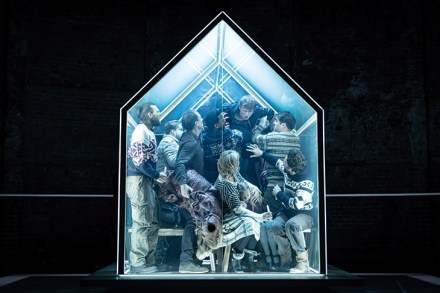
When reviewers call a work ‘important’ they mean ‘boring’ and ‘earnest’. And in those terms Shipwreck is one of the most ‘important’ shows I’ve ever seen. It’s not a play but a series of monologues and conversations spoken by a group of American liberals stuck overnight in a rural farmhouse. ‘It’s a red zone,’ they shudder when they learn that they’re in a Republican county. They pass the night carping loftily about the faults of Trump’s campaign and of his presidency between the inauguration and his dismissal of James Comey on 9 May 2017.

Blurred vision

All About Eve is Cinderella steeped in acid rather than sugar. Eve, or Cinders, is a wannabe star who uses a powerful theatre critic (the Buttons character) to help her win fame by overcoming two Ugly Sisters represented by a movie goddess, Margo Channing, and her film-director boyfriend. This fairytale was filmed in 1950 with Bette Davis as Margo and it remains a widely loved classic. Ivo van Hove’s version is torn between the 1950s and the present day. Result: a mystery. Margo is clearly being stalked by Eve but instead of referring the poor girl to a psychiatrist, she hires her as an understudy. Somewhat rash! Margo seems oddly dependent on her looks for work. She never considers directing or producing her own scripts, and she regards television as a loser’s graveyard.

Age concern | 14 February 2019

The Dumb Waiter is a one-act play from 1957 that retains an extraordinary hold over the minds of theatre-goers. It’s set in the basement of a Birmingham restaurant where two Cockney hitmen are preparing to execute an unknown victim. A dumb waiter, or shelf on pulleys, descends from above containing requests for two-course meals. Liver and onions are on the menu. Demands for cups of tea and sago pudding are sent down. The nervous thugs start to panic as they struggle to fulfil the instructions arriving from on high. It’s an absurd situation underpinned by an authentic sense of menace and violence. These are not just clownish villains but real criminals trained to kill. The play is usually done for laughs but it can be performed as a macabre thriller.

Love, sex, sponges and disability

Hampstead has become quite a hit-factory since Ed Hall took over. His foreign policy is admirably simple. He scours New York for popular shows and spirits them over to London. His latest effort, Cost of Living, has attracted the film-star talent of Adrian Lester, who plays Eddie, a loquacious white trucker from Utah. (His ethnicity is made clear in the dialogue and the relevant lines have been left unchanged.) Earnest Eddie tells us about himself in a 15-minute monologue at the top of the show. Rather a clunky device. He’s a bookish teetotaller with a strong work ethic who appreciates the landscape of Utah, enjoys listening to Erik Satie’s over-played Gymnopédies, and spends his evenings and weekends caring for his -crippled ex-wife who lost both her legs in an accident.

You’ve been scammed

The NT’s new play is an update of Pamela, a sexploitation novel by Samuel Richardson. It opens with Stephen Dillane and Cate Blanchett stranded in a concrete garage dressed as French maids. On one side, a black Audi saloon. Mid-stage, colourful blinking lights. At the edges, four other actors lurking. The main characters have no names so let’s call them Stephen and Cate. Who are they? Adulterous workmates, or a divorcing couple, or a male boss and his abused underling? The script reveals nothing about their characters, their backgrounds, their location or their intentions, and the audience’s natural reaction to this indifference is further indifference.

Best in show | 24 January 2019

The cast of Party Time includes John Simm, Celia Imrie, Ron Cook, Gary Kemp and other celebrities. They play a crew of posh thickos at a champagne party who chat away about private members’ clubs and adulterous affairs. In the background we hear of a ‘round-up’ involving the arrest and perhaps the murder of the government’s political foes. This is a short play with little spectacle, movement or psychological depth. Once the party-goers have been introduced, the script glazes over entirely. The actors form a line at the front of the stage, like glammed-up waxworks, and take turns at injecting their speeches with irony and humour in the hope of prompting laughs from their fans in the stalls. It’s more a talent competition than a play.

The end of the beginning | 17 January 2019

One masterpiece, one dud, and one interesting rediscovery. That’s Pinter Five. Victoria Station is a hilarious sketch which might have been turned into TV gold by the Pythons or the Two Ronnies. A radio controller needs a cabbie to collect a fare from Victoria Station, but the only driver available is a charming lunatic whose car is idling near a ‘dark park’. The cabbie already has a passenger on board, who may be a murder victim, and although he claims not to know Victoria Station he insists that he’s the best man for the job. This dotty piece of verbal slapstick feels a bit dated because cab firms no longer rely on radios.

Thinking outside the box | 10 January 2019

Sweat, set in the Pennsylvanian rust belt, looks at a blue-collar community threatened by a factory closure. The script uses the flashback device. Scene One informs us that two lads were found guilty of doing a Bad Thing eight years ago. What Bad Thing? The author won’t tell us because the play needs suspense but the revelation is delayed so long that our patience is tested to the limit. The flaccid writing doesn’t help. Scene Two lasts 30 minutes and introduces us to the main characters, who visit the same bar every evening to get hammered and scream at each other. The only dramatic point in this lengthy scene is the revelation that two lovers had a big row about a fish tank.