Theatre

Comedy gold: The Upstart Crow at the Gielgud Theatre reviewed

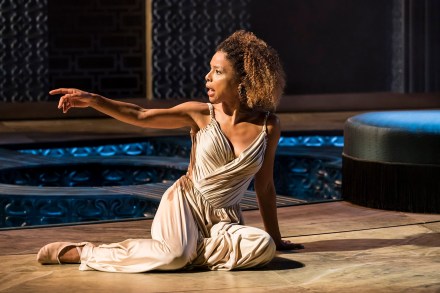
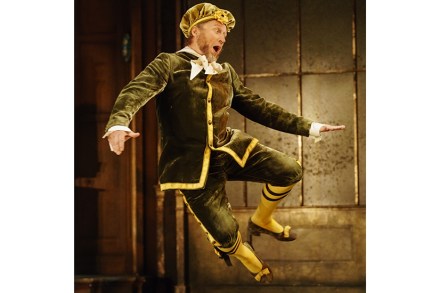
A Moorish princess shipwrecked on the English coast disguises herself as a boy to protect her virtue. Arriving in London, she’s hired by William Shakespeare as an assistant to his maidservant Kate, who instantly falls in love with the exotic cross-dressing newcomer. This absurdity, familiar to fans of Twelfth Night, is the opening move in Ben Elton’s exquisite Shakespearean remix, The Upstart Crow. It’s 1604 and the Bard is in poor creative form. ‘I have banged out a few clunkers of late,’ he admits, referring to Measure for Measure and All’s Well That Ends Well. ‘Should have been All’s Well That Ends Crap,’ suggests a lackey.

Why foreign-language series will always have the edge over American ones

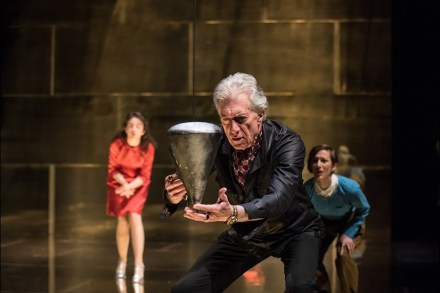
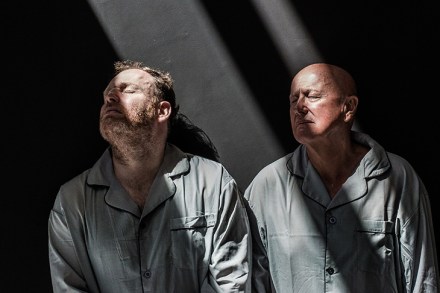
An office worker stands on the ledge of an open window about to leap. Two colleagues enter, ignoring him completely. They sit at symmetrical desks and read reports about the man’s background while he clings to the window frame, poised between life and death. This is the opening of Samuel Beckett’s Rough for Theatre II, starring Daniel Radcliffe and Alan Cumming. Stewart Laing’s beautiful design places the window centre-stage with the man standing in isolation between his two colleagues, like Christ and the thieves at Calvary. Beckett would have approved. For the first ten minutes of this bizarre play, the Old Vic audience sat in polite silence tittering only at expletives like ‘cunt’, ‘bugger’ and ‘dogshit’.

This is how theatre should work post-Brexit: Blood Wedding reviewed

Blood Wedding, by the Spanish dramatist Federico Garcia Lorca, is one of those heavyweight tragedies that risks looking a bit ridiculous when you take it out of its period setting. With rival families, murdered patriarchs and Albanian-style blood feuds — not to mention a talking moon — modern adaptations often come across as implausibly melodramatic. Hats off, then, to Barney Norris for his decision to strip back much of the excess drama for his West Country rewrite of Blood Wedding. Norris stays loyal to the play’s central arc — a frenzied bride torn between her husband-to-be and her bad-boy ex-boyfriend — but decides to dispense with much of the baggage (not to mention half of the characters). It’s a bold move, but one that pays dividends.

A brilliant, unrevivable undertaking: Tom Stoppard’s Leopoldstadt reviewed

History will record Leopoldstadt as Tom Stoppard’s Schindler’s List. His brilliant tragic-comic play opens in the Jewish quarter of Vienna in 1899. We meet a family of intellectuals and businessmen who are celebrating their very first Christmas. The eldest son, Hermann, has married a Catholic and become ‘Christianised’ in order to smooth his path through Austrian society. ‘The Jews know a bargain when they see it.’ The family are amusingly puzzled by the distinction between ‘papist’ and ‘Protestant’ and they’re also keen to honour their ancient traditions. This generates plenty of foreskin gags. (‘Are we on or off with the circumcision?

A terrific two-hander that belongs at the National: RSC’s Kunene and the King reviewed

The Gift is three plays in one. It opens in a blindingly white Victorian parlour where a posh lady, Sarah, is teaching her clumsy maid to serve tea correctly. Both characters are black. Sarah’s prosperous husband, also black, arrives home and the scene continues as the gauche skivvy (Donna Berlin, brilliant) makes more and more hilarious blunders. What is this play? Perhaps a neglected Victorian comedy revived with colour-blind casting. In fact, the script is inspired by a historical character, Sarah Forbes Bonetta, a Yoruba princess born in Nigeria in the 19th century, who was adopted by Queen Victoria and raised as an English gentlewoman.

Strong performances in a slightly wonky production: Uncle Vanya reviewed

Uncle Vanya opens with a puzzle. Is the action set in the early 20th century or right now? The furnishings might be modern purchases or inherited antiques, and the costumes are also styled ambiguously. It soon becomes clear from Conor McPherson’s script, which uses colloquialisms like ‘wanging on’, that this is a contemporary version. It’s always a risk to update Chekhov and the director Ian Rickson pulls it off. Never once did I wonder why these chattering idlers didn’t have broadband or mobile phones. But the casting is awry. Vanya is a middle-aged Hamlet, a thinker, an observer, whose dreams are smashed to pieces in the course of the action.

Sweeping, sod-you comedy – irresistible: Billionaire Boy reviewed

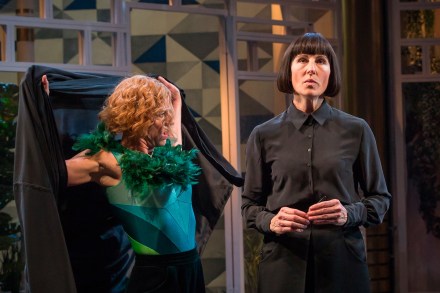
Falling In Love Again features two of the 20th century’s best-known sex athletes. Ron Elisha’s drama covers a long drunken night spent by Marlene Dietrich and Edward VIII at Fort Belvedere, near Windsor, on the eve of Edward’s abdication in December 1936. It sounds like a contrived premise for a play but Elisha, who researches his material thoroughly, says this encounter actually took place. Marlene (played by Ramona von Pusch as an enigmatic adventuress in green lipstick) claims to have fled the Savoy where Rudolf Hess is bombarding her with flowers in the hope of luring her home to make films for the Third Reich. Marlene refuses because she can’t stand Hitler.

People expecting punishment won’t be disappointed: Almeida’s Duchess of Malfi reviewed

The Duchess of Malfi is one of those classics that everyone knows by name but not many have witnessed on stage. So a production is likely to attract theatre-goers who feel they ‘ought to’ see it rather than ‘want to’. This may have affected the Almeida’s version which is opaque and almost impossible to follow. Yet audience members who are expecting punishment rather than entertainment will not be disappointed. The play by John Webster was first presented in London in 1613 (or possibly a year later), and it relies on events that occurred in Italy more than a century earlier between 1508 and 1513. So even the original London audience would have had to work hard to follow the unfamiliar plot which traces the elopement of an Italian duchess with her steward.

Redneck twaddle: Young Vic’s Fairview reviewed

Fairview by Jackie Sibblies Drury won last year’s Pulitzer Prize. It deserves additional awards for promoting racial disharmony and entrenching false, divisive and outdated stereotypes. The title is a pun. ‘Fair’ means ‘white’ and ‘view’ means ‘world outlook’ or ‘prejudice’. Really it ought to be called Honky Bias. The script declares its fascination with antique hatreds in its opening line which is a stage direction: ‘Lights up on a negro.’ No one talks like that any more. I attended the December press night where the play began as a moderately amusing TV-level comedy about a rich black family preparing for a birthday. This opening scene was followed by 30 minutes of confusing absurdity.

Full of fascinating data and excellent comedy: Messiah at Stratford Circus reviewed

I’ve joined the Black Panthers. At least I think I have. I took part in an induction ceremony at the start of Messiah at Stratford Circus. ‘Stand up,’ said the actor Shaq B. Grant to the predominantly white crowd. ‘Raise your right fist and repeat after me: “I am a revolutionary.”’ Everyone obeyed and chanted his mantra, some with more sincerity than others. Then the show began. The subject is a notorious police raid on a Panther hideout in Chicago in 1969 which resulted in the death of Fred Hampton, a 21-year-old activist nicknamed ‘the Black Messiah’. The police alleged that the Panthers opened fire first. The Panthers claimed that Hampton sustained survivable wounds during the raid and was later executed by unnamed police officers.

A flimsy tale of self-pity and thwarted ambition: Hunger at the Arcola reviewed

Oh my God. The Nazis have invaded the Arcola Theatre. Norwegian novelist Knut Hamsen won the Nobel Prize in 1920 and later became such an ardent fan of Hitler that he sent his Nobel gong to Goebbels as a token of his admiration. The Arcola admits these demerits in the programme notes. What it overlooks is the intriguing fact that some commentators credit Hamsen with inventing the stream of consciousness technique developed by James Joyce in Ulysses. His breakthrough novel, Hunger, published in 1890, recounts his experiences as a penniless scribbler seeking work in the Norwegian capital. The protagonist in Fay Lomas’s engaging production is an archetype whom any professional writer will recognise: the unpublished hack who thinks he’s a genius.

Smart, funny and beautifully imagined: RSC’s The Boy in the Dress reviewed

David Walliams is one of the biggest-selling children’s authors in the world (having shifted some 25 million copies in more than 50 languages). And he’s now become the first children’s novelist since Roald Dahl to have their book turned into a full-scale RSC musical extravaganza. As fun as these big musicals might be, they aren’t something the RSC takes lightly. Not only has the head honcho, Gregory Doran, decided to direct The Boy in the Dress himself, he’s also hired some serious talent. Robbie Williams — probably not seen in Stratford-upon-Avon since Take That were an up-and-coming boy band — has co-written the songs. Mark Ravenhill, the 1990s playwright best known for his tales of jaded shaggers, adapts the text. That’s quite the team.

Punk spirit underpinned by darkness and horror: Richard III at the Sam Wanamaker Theatre reviewed

The history plays are different. In dramas like Othello, Hamlet and Much Ado, Shakespeare laid out the plot with great clarity because the stories were new, or newish, to his audiences. But Richard III belonged to the recent past. The wonky monarch’s death predated the play’s debut by just over a century, so Richard’s era stood at the same distance from the Elizabethans as we stand from the Edwardian age. However, few modern playgoers know the dynastic complexities that drive the storyline so it’s worth mugging up in advance. This modern-dress production (co-directed by Sean Holmes and Ilinca Radulian) has been cast without regard to race, gender or age.

An astonishing treat: Dear Evan Hansen at the Noël Coward Theatre reviewed

Dear Evan Hansen, by Steven Levenson, opens as a standard American teen-angst musical. Evan is a sweaty geek with a crush on Zoe Murphy whose rebellious brother, Connor, is so disturbed that he styles his hair to suggest ‘school-shooter chic’. Evan tries to befriend Connor but gets shoved to the ground. Then, a bombshell. Connor kills himself. By an amazing but credible coincidence Connor’s parents start to believe that Evan was good pals with their deceased son. And Evan exaggerates the depth of the friendship in order to help the family, and especially the mother, cope with their grief. He even fabricates an exchange of emails in which Connor appears to speak warmly about his parents and to express hopes for the future.

Riveting and beautifully staged analysis of totalitarianism: Arcola’s #WeAreArrested reviewed

When the RSC does modern drama it usually lays on an ultra-worthy yarn with a huge cast, dozens of fancy costumes and a three-hour running time. Miraculously, its new co-production with the Arcola avoids these faults and delivers a terse, gripping 75-minute documentary drama based on the prison diary of Turkish journalist, Can Dundar. In 2015 Dundar received proof that his country’s intelligence service was attempting to supply arms to Syrian rebels. He knew that if he released the material he might face jail but he published it anyway and was threatened with life imprisonment. Peter Hamilton Dyer, well known for impersonating journalists, plays Dundar as a loveably cerebral type determined to stick to his principles.

The script’s a dud: Antipodes at the Dorfman Theatre reviewed

The Antipodes, by the acclaimed dramatist Annie Baker, is set in a Hollywood writers’ room. Seven hired scribblers are brainstorming a new animated feature under the direction of a mysterious, bearded multimillionaire, Sandy, who seems thoroughly bored with the movie-making process. The script is in its early stages and Sandy decrees that the central character must be a monster. That’s all. The writers can fill in the details. He asks them to indulge in a free-association experiment by describing their first sexual encounter or the scariest moment in their lives. Long speeches follow. Very long, some of them. Sandy loses interest in the project, not surprisingly, and starts to absent himself from the room. The writers toil on, chatting and wittering.

Why the Royal Court is theatre’s answer to Islamic State

The Royal Court is the theatre’s answer to Islamic State, a conspiracy of nihilists fascinated with death, supported by groups of self-flagellating puritans, and committed to inflicting pain on all who stray into its orbit. The latest fatwa from Sloane Square concerns the imminent demise of the Welsh language — an emergency for which there seems to be scant evidence. On Bear Ridge by Ed Thomas proclaims its amateurish origins with stage directions that belong in Pseuds Corner. ‘Spindly winter branches dance on a fading sign,’ is Thomas’s attempt to create a ghostly mood. The setting is a derelict village shop where ‘ancient bluebottles cling to death on sticky brown fly-catching strips’.

A surefire international hit: Lungs reviewed

No power on earth can stop Lungs from becoming an international hit. Duncan Macmillan’s slick two-handed comedy reunites Matt Smith and Claire Foy from The Crown. It’s short (90 mins), it has a minimalist set (‘arty’), and it makes no intellectual demands on the crowd (phew!). Best of all, it parrots all the ecological prejudices currently supported by today’s urban bourgeoisie. Matt and Claire play a broody couple who fear that having a child will destroy the planet and kill billions of their fellow earthlings. Their voluble anxieties persist for 40 minutes and become a little tiresome for those blessed with long memories.

A 90-minute slog up to a dazzling peak: ‘Master Harold’… and the boys reviewed

Athol Fugard likes to dump his characters in settings with no dramatic thrust or tension. A prison yard is a favourite. He specialises in bored, talkative characters who squirt the time away swapping memories and indulging in bursts of creative play-acting. It’s dull to watch but good fun to perform. Thesps love to step out of character and road-test a range of fictional personalities. ‘Master Harold’… and the boys is classic Fugard. We’re in an empty restaurant in South Africa in 1950. Lunch service has ended. Two waiters twiddle away the afternoon discussing sex, ballroom dancing and beating women (as if this were a standard feature of male behaviour). Enter the boss’s school-age son, Hally, whom both waiters know well.

A hoot from start to finish: The Man in the White Suit reviewed

The Man in the White Suit, famously, is a yarn about yarn. A brilliant young boffin stumbles across an everlasting polymer thread but when he tries to profit from his discovery he faces unexpected ruin. There are only three beats in the story — breakthrough, triumph, disaster — so it needs to be elaborated with some skill. Writer/director Sean Foley does a superb job of making the gaps unnoticeable. He aims for the farcical texture of a pantomime and he opens the story in a cheery northern pub where working-class men and women sit around as equals, sharing pints of ale. Rather a fanciful view of 1950s England but never mind. We move to the factory where Sidney, a clumsy Cambridge graduate, muddles his way through various madcap experiments.