The Wiki Man

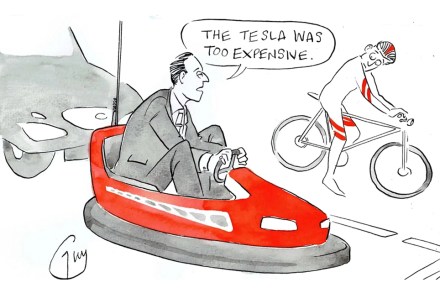
Why should everyone have an electric car?

Some excellent thinking this month from the Italian complexity theorist Luca Dellanna: Two days ago, the EU parliament approved a ban on new fossil fuel cars starting in 2035. While I like the idea of greener cars, I’m not too fond of a fast and complete transition.    Let me use the metaphor of the Summer Olympic Games – an event with attractive economics during the planning phase that predictably overruns its budget by enormous amounts (an average of 213 per cent!). The Olympic Games are the only infrastructural megaproject that always has cost overruns. Why? Partly because it has inescapable deadlines – and everything is more costly when rushed.

How to dress for air travel

Even though I fly a lot, I retain the notion that air travel should be treated as a special occasion for which one should dress accordingly. I am writing this from Gatwick, accompanied by one of those canvas bags you get for a fiver at Sainsbury’s Back in the day, if you showed up looking as though you’d made a bit of a sartorial effort, the check-in person might pick up the phone, announce to reservations that a Mr Sutherland was ‘SFU’, and would rip up your boarding pass to replace it with a nicer one. In airline argot, SFU stood for ‘Suitable for Upgrade’. Now that upgrades almost never happen, it won’t be long before people start turning up in dressing gowns. And, though I hate to say it, one of the best tips for modern airline travel is to wear naff clothes.

How to outperform ChatGPT

Much of the magic of Curb Your Enthusiasm comes from the show being plotted but not scripted. The direction of the conversation is agreed in advance, after which the cast – mostly stand-up comedians and hence naturally good at extemporising – improvise the lines on the fly. This makes the show engagingly realistic even in the rare moments when it isn’t being funny. ChatGPT is unaware of anything since 2021, and so believes that ‘Nicola Sturgeon is sure to have a long future in politics’ In such ‘high-context’ communication, there is always a side-channel alongside the words which determines their real meaning, whether through tone of voice, facial or hand gestures or shared knowledge.

What really motivates workers (and it’s not money)

I recently heard a tip from an older colleague on managing a department. ‘Everyone is primarily interested in one of three things,’ he said. ‘To motivate them, all you need do is discover which one drives them most.’ People want some leeway to apply their imagination, creativity and knowledge What are the three? They are power, money and autonomy. I wish I had heard this 20 years ago, as it explains a great deal about the stark differences between colleagues’ working motivations which had often baffled me in the past. A huge amount is written about power and money, but very little thought is devoted to autonomy. Yet it is probably the need for autonomy that drives people to become entrepreneurs much more than greed.

The dwindling case for living in London

The recent debate around ‘levelling up’ may be missing something. I would argue that there is another way to consider geographical inequality – and, by this alternative measure, a levelling has been under way for more than 20 years. I’ve spent three decades working in advertising, so it’s unsurprising that I tend to view economic life through the lens of consumption. By contrast, mainstream economists tend to view disparities through the medium of earnings or wealth. To me, measures of wealth should include not only the quantity of money you have but the breadth of worthwhile options available in choosing how to spend it. Let’s put it another way.

The case for maths to 18

Recently Chinese 11-year-olds faced the following question in a maths exam. ‘If a ship has 26 sheep and ten goats on board, how old is the ship’s captain?’ Chinese social media lit up with parents furious at their little emperors being asked a question they could not answer. The BBC did find one Weibo user who had devised a plausible solution. ‘The total weight of 26 sheep and ten goats is 7,700kg. In China, if you’re controlling a ship with over 5,000kg of cargo you need to have possessed a boat licence for five years. The minimum age for getting the licence is 23, ergo the captain is at least 28.

Why work is no longer working

It is often said that Rishi Sunak has no idea what it is like to survive on a low income but this failing is hardly confined to the über-rich: in reality, few people above median income really know what it’s like to be skint. People may think back to leaner years but, even then, if a few relatives or good friends had some cash to spare, it’s not the same. ‘But you’ll never get it right/ ’ Cause when you’re laid in bed at night/ Watching roaches climb the wall/ If you called your dad he could stop it all,’ as Jarvis Cocker has it. There are many other predicaments we cannot really recreate in the imagination. Addiction – to gambling, say – is largely incomprehensible to most non-addicts.

Why should I be compensated for a delayed train?

In early 2020 my family and I were due to fly home from visiting a friend in Oman when the plane encountered a technical problem. We returned to departures and were rebooked on to a flight the following day. British Airways then sent us to a very decent hotel, where we were given rooms and a food voucher. The next day we were taxied back to the airport, and flew to London without incident. What if money went on improving trains instead of pandering to whingers who claim for every minor inconvenience? I then learned that under EU regulations, this relatively minor inconvenience entitled us to additional compensation of £600 each. We were in business class, but had bought all four tickets with frequent-flyer points.

What the media is doing to our politics

An American academic told me that during the 2016 presidential election nobody in academia believed there was the faintest chance Donald Trump would win. Except for the primatologists, that is. It was that silverback gorilla, alpha male thing – and Trump played the role freakishly well. One election tweet showed him enthroned in his private jet eating a KFC meal, gravy and all. This said ‘I have a Boeing 757 with monogrammed headrests, but I eat the same food as you.’ That’s anthropological gold, right there. No one could imagine Hillary Clinton eating KFC – she’d be hospitalised by a trip to Nando’s. No one could imagine Hillary Clinton eating KFC – she’d be hospitalised by a trip to Nando’s It’s an old marketing ploy.

The allure of ‘delight qualities’

If you were to ask which single business concept deserves to be more widely known, I would be hard-pressed to find a better answer than the Kano model. Developed in the 1980s by Dr Noriaki Kano at the Tokyo University of Science, it is not only self-evidently true, it also provides a simple framework to explain much that is wrong with modern life. Kano is a management theorist, but his greatest contribution is in seeking to reduce the wasted effort and expense which arise when an organisation’s pursuit of seemingly logical targets becomes misaligned with other crucial qualities which deliver emotional value to customers. A Pot Noodle without the sachet is like a Bloody Mary without Worcestershire sauce — i.e.

The case for ‘premium economy’ train carriages

A few years ago I wrote here about the unexpected symbiosis between economy passengers and business travellers on commercial flights. Largely unnoticed by people in either cabin, those buying each class of air ticket are unintentionally helping out their fellow travellers at the other end of the plane. Precisely because the two classes of passenger have wildly different priorities (the people at the front are sensitive to time, productivity and comfort; the people at the back are more sensitive to price), it benefits both groups to share the same aircraft. Why? Well, put simply, leisure passengers do not much care whether a flight to Miami operates daily, weekly or even fortnightly, since they are most likely going away for one or two weeks.

The genius of bottomless brunch

I’m rather fond of the many service stations on the M4, since I am convinced they are all named after Jane Austen characters who never made it into the final drafts of the novels. But as an alternative, west of Lord Chieveley and Lady Membury and just east of Sir Leigh Delamere, you can try the Three Trees Farm Shop & Café just south of Junction 15. There is a bank of four car chargers outside, which is what drew me there. The farm shop is wonderful, with charming staff, and stocked with the kind of high-margin artisanal goods you can buy as presents for the people you are visiting or, better still, for yourself.

The hidden benefits of smart motorways

In 2015, Holborn Underground station was suffering from serious overcrowding at peak hours, with a bottleneck forming in the space leading to the escalators. So Transport for London tried an experiment. Abandoning the usual ‘stand on the right, walk on the left’ convention, they placed signs on two of the three ascending escalators instructing people on both sides to stand. Outrage followed. But the experiment worked. Escalators with passengers standing transported an average of 151 people per minute, compared with 115 for the dual-use escalator. People cannot all walk up an escalator in strict lockstep for fear of ending up on the sex offenders register You can see why people objected: it is counterintuitive to the point of seeming daft.

Why we pick the wrong holiday destinations

Having returned from a fortnight’s break, I wonder if we get holidays all wrong. In northern Europe, the custom is that you head south to spend time on the beach. But equally, there is such a thing as too damned hot, especially if, like me, you have a healthy dose of Celtic ancestry. To avoid this, you need to study what is called the ‘wet-bulb temperature’. This is a measure of temperature which accounts for the cooling effect of evaporation. At 100 per cent relative humidity, the wet-bulb temperature is equal to the dry-bulb temperature shown on weather forecasts. At lower humidity the wet-bulb temperature is lower, owing to evaporative cooling, a mechanism all humans other than Prince Andrew depend on to reduce their body temperature.

The mathematical formula that proves London is over

Some years ago, an Australian neurologist was in the habit of walking barefoot across his lawn. This being Australia, the lawn was slightly prickly, and the experience was painful but not intolerable; until one day, when one of the pricks in his heel was more pronounced than usual. He had been bitten by a snake and, again this being Australia, the snake was highly venomous. Doctors saved his leg and he made a complete recovery. But there was one lasting side-effect: he now found walking across his lawn agonising. In terms of the stimulus to his feet, nothing had changed. What had changed was how his brain processed the stimulus. What was once a mildly aversive discomfort was amplified by a learned fear into something much more painful.

What Bob Dylan can teach us about economics

The problem with attempts to make everything in life more scientific is that reality hates generalisation. You can try to formulate universal laws, but in any complex system even the smallest contextual difference or hidden asymmetry can be enough to rewrite those laws completely. Economics refers to something called ‘the market’, the laws of which supposedly govern all economic activity. In reality, anyone exposed to commerce soon realises that different markets follow wildly different rules. With airline seats, it is widely observed that ‘scarcity bias’ drives sales – hence the message ‘only three seats left at this price’. But this does not work for vegetables.

The case for theft-tanks

The Conservative party leadership contest is a milestone for diversity and inclusion. This time, we get to choose between someone who studied philosophy, politics and economics at Lincoln College, Oxford and someone who studied philosophy, politics and economics at Merton College, Oxford. I can barely contain my excitement. I find the very idea of an undergraduate degree in politics alarming. It is often seen in business that people who complete an MBA straight after university turn out to be spectacularly useless employees, and it’s possible that this unhappy pattern recurs in politics. The reason is simple: there is an order effect at work. It’s one thing to theorise on the basis of practice; quite another to practise on the basis of theory.

The hidden benefit of an electric car

Hello, and welcome to episode one of What’s in My Frunk?, the first in an occasional Spectator series of news and advice for the electronic motorist. In this edition we’ll be discussing one of the unexpected benefits of owning an electric car. The space under the bonnet vacated by the engine often provides a small but usable secondary storage area. This is the ‘frunk’, a portmanteau word combining ‘front’ and the American word ‘trunk’. Now that even Land Rover Defenders have carpeted boots, your frunk is great for transporting anything wet or dirty – wellingtons, charging cables, takeaways or body parts from your last hit.

The unhappy truth about holidays

In the 1980s, the great advertising writer John Webster described the following paradox. As he saw it, the dream of everyone in advertising was to work hard for many years, ultimately winning enough accounts and awards to retire to a French farmhouse where they could wake to the smell of fresh bread and black coffee, before driving a rusted 2CV to the local market. ‘A simpler alternative,’ Webster explained, ‘was simply to be born a French peasant, in which case you could cut out the middle bit altogether.’ Retirement plans are prone to what the behavioural economist Daniel Kahneman calls ‘affective forecasting’. We think we know what will make us happy.

Buying a brand-new car is the ultimate good deed

The Department for Transport recently ended a £1,500 subsidy towards the price of new, lower-priced electric cars one year earlier than planned. To their credit, there are better ways to promote electric-car use – for instance by encouraging the installation of public charging stations. As it is, the spread of rapid-charging stations in the UK is bizarrely uneven. Some parts of the country are well served, but there are unexpected black spots. Oddly, trendy places where people talk endlessly about sustainability – such as Oxford, Cambridge and Brighton – are hopeless for rapid charging points, while less fanciful places like Thurrock, Milton Keynes and Newport are awash with them.